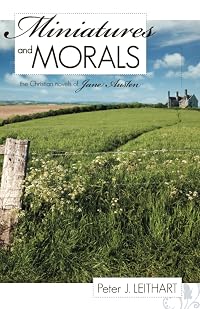
Miniatures and Morals: The Christian Novels of Jane Austen
by Peter J. Leithart
On This Page
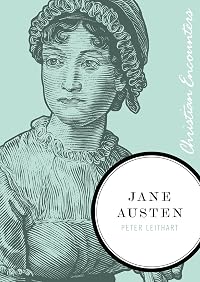
Description
Not only are Austen's novels still widely read, they continue to influence modern film and literature. In both their moral content and their focused, highly detailed, "miniaturist" execution, they reveal Austen's mastery of the art of fiction and her concern for Christian virtues exercised within communities. She entertains, edifies, and challenges men and women readers alike. From theological and literary angles, Leithart analyzes character and theme while summarizing each of Austen's major show more works - Pride & Prejudice, Northanger Abbey, Sense & Sensibility, Mansfield Park, Emma, and Persuasion. Including helpful review and thought questions for each section, this book is an excellent introduction to Austen for students and for all who desire a richer appreciation of her enduring genius. show lessTags
Recommendations



Member Reviews
Wow, I was not impressed with this author at. all.
I originally chose the book, despite it's being a little bit "textbooky" because I was intrigued to see what the author had to say on the question of Jane Austen's true personal faith. You see, I just finished reading Cassandra and Jane by Jill Pitkeathley --- a fictional story in a biographical style that imagines the character of Jane as being much harsher than she is usually made out to be by real biographers. The author insinuates that Jane's faith was not genuine but was, instead, put on for the sake of the times and her family's situation. Other writers who have tried to make her out to be the ultimate Feminist have suggested the same. I would find it very refreshing to be assured show more that my favorite can be cynical, silly, sarcastic, and an authentic believer all at the same time---much as I am, myself!
From tiny irritations like claiming Austen's was the world of "hoop skirts" (out of fashion decades earlier unless you were visiting the Royals) to really sweeping generalizations (detailed below), I was immediately turned off by the author's lack of education. Big words does not a scholar make.
Leithart makes grand and arguable generalizations and assumptions about characters and plots, as well as the character of Austen herself, that I very much disagree with. A little thing is I think he's got the characters of Darcy and Elizabeth wrong---they both struggled with pride and prejudice, but I see Lizzie being the more prideful one and Darcy being the more prejudiced. A big thing is his view on what it means to be an effeminate male in the Austen era.
He says Edward Ferrars is "more than a little effeminate" because he is "painfully silent". WHAT?? And Tilney, as well, because he knows so much about fabrics? Does this man not realize who were the primary sellers of fabrics, designers of clothing, and clothiers of the day? MEN!
He was also way off on his understanding of the characters of Sense and Sensibility, Marianne and especially Willoughby's motives. The annoyances just go on and on ad nauseam to conclude with---no conclusion! Literally, the book just stops.
Please don't waste your time. A knowledgeable Janeite will be perturbed and a new one will be misled. show less
I originally chose the book, despite it's being a little bit "textbooky" because I was intrigued to see what the author had to say on the question of Jane Austen's true personal faith. You see, I just finished reading Cassandra and Jane by Jill Pitkeathley --- a fictional story in a biographical style that imagines the character of Jane as being much harsher than she is usually made out to be by real biographers. The author insinuates that Jane's faith was not genuine but was, instead, put on for the sake of the times and her family's situation. Other writers who have tried to make her out to be the ultimate Feminist have suggested the same. I would find it very refreshing to be assured show more that my favorite can be cynical, silly, sarcastic, and an authentic believer all at the same time---much as I am, myself!
From tiny irritations like claiming Austen's was the world of "hoop skirts" (out of fashion decades earlier unless you were visiting the Royals) to really sweeping generalizations (detailed below), I was immediately turned off by the author's lack of education. Big words does not a scholar make.
Leithart makes grand and arguable generalizations and assumptions about characters and plots, as well as the character of Austen herself, that I very much disagree with. A little thing is I think he's got the characters of Darcy and Elizabeth wrong---they both struggled with pride and prejudice, but I see Lizzie being the more prideful one and Darcy being the more prejudiced. A big thing is his view on what it means to be an effeminate male in the Austen era.
He says Edward Ferrars is "more than a little effeminate" because he is "painfully silent". WHAT?? And Tilney, as well, because he knows so much about fabrics? Does this man not realize who were the primary sellers of fabrics, designers of clothing, and clothiers of the day? MEN!
He was also way off on his understanding of the characters of Sense and Sensibility, Marianne and especially Willoughby's motives. The annoyances just go on and on ad nauseam to conclude with---no conclusion! Literally, the book just stops.
Please don't waste your time. A knowledgeable Janeite will be perturbed and a new one will be misled. show less
Awesome!!
Ratings
Members
- Recently Added By
Author Information

84+ Works 6,746 Members
Peter J. Leithart (PhD, University of Cambridge) is president of Theopolis Institute in Brimingham, Alabama, and an adjunct senior fellow of theology at New Saint Andrews College. He is the author of many books, including Defending Constantine.
Classifications
Statistics
- Members
- 217
- Popularity
- 151,289
- Reviews
- 2
- Rating
- (4.45)
- Languages
- English
- Media
- Paper
- ISBNs
- 1