On This Page
Description
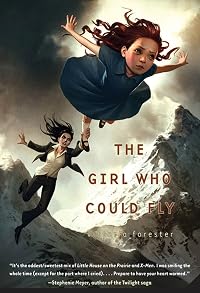
When homeschooled farm girl Piper McCloud reveals her ability to fly, she is quickly taken to a secret government facility to be trained with other exceptional children, but she soon realizes that something is very wrong and begins working with brilliant and wealthy Conrad to escape.Tags
Recommendations






Member Recommendations
Member Reviews
This review is also available on my blog, Read Till Dawn.
A few weeks ago, I saw in my Goodreads monthly releases e-mail that Victoria Forester has finally written a sequel to The Girl Who Could Fly, and that it's coming out late October. To say I'm excited about The Boy Who Knew Everything is an understatement - I've been waiting for this book since 2008. During the painful wait between now and October, I decided to review my long-time favorite The Girl Who Could Fly, thereby simultaneously spreading the word about a great MG book and having a valid excuse for re-reading an old favorite (instead of tackling my massive TBR pile, which I really need to start working on - I've never returned so many unread books to the library!).
What is it show more about The Girl Who Could Fly that has made me love it so much? For starters, there are the characters. I knew from the beginning that I couldn't help but love Piper McCloud, the homeschooled girl with a penchant for floating and a desperate desire for friendship. Back in 2008, having only been homeschooled for a few years, I could relate just a little too closely to Piper as she sat on a hidden perch and watched all of the kids her age stream off to school where they got to goof around and make friends. My situation wasn't quite as extreme as hers (my parents weren't actively separating me from my peers, and actually tried very hard to find friends for me), but that core loneliness struck a chord in me. Plus, I just plumb loved her bubbly determination to make the world a better place, even in the beginning she was a little too ditzy to actually figure things out. I also loved the kids at the school, but I can't talk about them much for fear of spoilers. Needless to say I became deeply attached to each and every one of them, and revisiting The Girl Who Could Fly is like revisiting old friends.
I also love the idea of the story. Who could resist a book about kids with special abilities, brought to a special academy for kids with abilities? It's like Camp Half Blood or the X-Men academy, but with a dark twist. A pretty disturbing twist. A twist that is actually way creepier now than I remember it being the first time around. I think maybe I just blanked out on some of it the first time. Because what some of the characters, both big and small, went through was just plain evil. And heartbreaking. And in the end, the anger and sorrow I feel about what has happened is amplified as I struggle with which it is that certain people deserve: the anger, or the sympathy. It's a deep book, much deeper than the flighty cover and the exciting synopsis make it out to be.
What I love about The Girl Who Could Fly, though, is that it's a deep book and a shallow book, all in one. It's got small-town rivalries and mean gossips and the push and pull of life in boarding school (not to mention the insanely cool talents all of the main characters have!), but then it's also got things that make you cringe and cry out and just plain cry. Every time I've read The Girl Who Could Fly, I've found new things to draw from it - this time, it got me mulling over the things that make people unique, and the fact that no one has the right to command others to change. When I was younger, the scene that struck me the most strongly was the one with the giraffe - which I won't spoil - and I came away with the idea that it takes only a little bit of kindness to light up someone's world.
So go. Read this book, and discover the wonderful world of Piper McCloud - I promise you won't be disappointed. And now you won't even have to wait five years to read the sequel! show less
A few weeks ago, I saw in my Goodreads monthly releases e-mail that Victoria Forester has finally written a sequel to The Girl Who Could Fly, and that it's coming out late October. To say I'm excited about The Boy Who Knew Everything is an understatement - I've been waiting for this book since 2008. During the painful wait between now and October, I decided to review my long-time favorite The Girl Who Could Fly, thereby simultaneously spreading the word about a great MG book and having a valid excuse for re-reading an old favorite (instead of tackling my massive TBR pile, which I really need to start working on - I've never returned so many unread books to the library!).
What is it show more about The Girl Who Could Fly that has made me love it so much? For starters, there are the characters. I knew from the beginning that I couldn't help but love Piper McCloud, the homeschooled girl with a penchant for floating and a desperate desire for friendship. Back in 2008, having only been homeschooled for a few years, I could relate just a little too closely to Piper as she sat on a hidden perch and watched all of the kids her age stream off to school where they got to goof around and make friends. My situation wasn't quite as extreme as hers (my parents weren't actively separating me from my peers, and actually tried very hard to find friends for me), but that core loneliness struck a chord in me. Plus, I just plumb loved her bubbly determination to make the world a better place, even in the beginning she was a little too ditzy to actually figure things out. I also loved the kids at the school, but I can't talk about them much for fear of spoilers. Needless to say I became deeply attached to each and every one of them, and revisiting The Girl Who Could Fly is like revisiting old friends.
I also love the idea of the story. Who could resist a book about kids with special abilities, brought to a special academy for kids with abilities? It's like Camp Half Blood or the X-Men academy, but with a dark twist. A pretty disturbing twist. A twist that is actually way creepier now than I remember it being the first time around. I think maybe I just blanked out on some of it the first time. Because what some of the characters, both big and small, went through was just plain evil. And heartbreaking. And in the end, the anger and sorrow I feel about what has happened is amplified as I struggle with which it is that certain people deserve: the anger, or the sympathy. It's a deep book, much deeper than the flighty cover and the exciting synopsis make it out to be.
What I love about The Girl Who Could Fly, though, is that it's a deep book and a shallow book, all in one. It's got small-town rivalries and mean gossips and the push and pull of life in boarding school (not to mention the insanely cool talents all of the main characters have!), but then it's also got things that make you cringe and cry out and just plain cry. Every time I've read The Girl Who Could Fly, I've found new things to draw from it - this time, it got me mulling over the things that make people unique, and the fact that no one has the right to command others to change. When I was younger, the scene that struck me the most strongly was the one with the giraffe - which I won't spoil - and I came away with the idea that it takes only a little bit of kindness to light up someone's world.
So go. Read this book, and discover the wonderful world of Piper McCloud - I promise you won't be disappointed. And now you won't even have to wait five years to read the sequel! show less
I read this book when it was first published in 2010, but when I saw the sequel out in hardcover (2015), I purchased them together. The Girl Who Could Fly is a story with strong voice, well-paced plotting and convoluted friendships. Piper McCloud can fly and she knows she likes it. Though her conservative parents and community try to convince her that flying is impossible and bad, Piper can't accept that something that makes her feel so good can be harmful. Though she tries to be a "normal" girl, her temper gets the best of her and she flies in front of everyone. Her ability goes global and she is whisked away to a top secret school for children with special gifts, under the purview of the kind-seeming Dr. Hellion. At school, Piper's show more goodness is quickly at odds with the smartest boy in the world, Conrad, who is mean and cruel to everyone. But when even Dr. Hellion, Piper's new hero, tells her not to fly, Piper begins to suspect that the school, its leaders and its purpose are not what they seem.
Piper McCloud's voice shines in her forthright and positive attitude as she is faced with both cruelty and hope, friends and enemies. Forester keeps the plot twisting in this fine middle-grade science fiction novel as Piper strives to fulfill the epigraph "to be nobody but yourself." show less
Piper McCloud's voice shines in her forthright and positive attitude as she is faced with both cruelty and hope, friends and enemies. Forester keeps the plot twisting in this fine middle-grade science fiction novel as Piper strives to fulfill the epigraph "to be nobody but yourself." show less
I'm older than the target audience for this middle grade novel, but I adore super-hero stories, so I felt compelled to pick it up. This book exceeded my expectations. It resonated with me on a lot of levels.
If Disney-Pixar ever makes a sequel to The Incredibles, I hope they base it on The Girl Who Could Fly. It would be a perfect fit. Piper McCloud loves to fly, but her parents and community want her to be normal. Other kids her age react to her flying power with hatred or shocked fear. Local and worldwide news media are obsessed with her. So when a beautiful government agent comes to take her away from the demanding media circus and her loving-but-not-understanding parents, Piper is thrilled by the prospect of meeting other people who show more have super-powers.
At first, it seems like the expensive, top-secret government facility hidden beneath the Arctic ice is a paradise for special kids. Piper meets ten other kids with unique super-powers, and makes her first friends--and an enemy whose super-power allows him to bully not only her other classmates, but the government officials who run the facility. But despite her fabulous new life, Piper begins to see hints of nightmarish torture beneath the surface of daily life at the facility. Nothing is as simple as it seems--not the easy classes, the nice teachers, the gourmet meals, the designer clothes, the atrium garden and zoo full of wonders. The students can't communicate with the world outside. Sometimes students vanish for weeks, then come back crippled and vapid. One of the students can't remember his super-power. Another seems to be going slowly insane.
As Piper discovers the true purpose of the facility, she must reevaluate her own goals and biases. Her sworn enemy might be trying to save her life instead of kill her. Her most trusted confident might be trying to destroy her. If Piper ever wants to see the sky again, she must fight for her freedom, and she can't do it alone. She must convince the other "special" kids that they have a right to use their powers even when it terrifies adults, even when it goes against everything they were taught to believe.
This was a gripping story suitable for all ages. I was happy to see a super-hero story with strong female characters; the girls had some of the best powers. All of these characters are unique and memorable. Victoria Forester plays with the reader's expectations, so the character you hate the most becomes endearing and complex by the end, and the character you trust the most turns out to be a monster. I particularly liked Conrad, the super-genius.
There's more than enough wonder, beauty, sincerity, and fun in this book to make up for its flaws. But it contains some writing problems that perhaps only a nitpicky writer or editor would pick on. For one thing, it's written in third person omniscient instead of third person limited, which adds a layer of distance between the reader and Piper. The story follows Piper as the main protagonist, but one of the most pivotal scenes was not shown in her point of view. Although Piper is a wonderfully cheerful and compassionate character, her qualities are over-emphasized at times, so that she becomes a bit of a caricature. Her regional dialect ("Yeehaw!") seems too over the top. And there is one plot inconsistency: Piper is severely punished for breaking rules that her classmates seem to get away with breaking on a regular basis. The reader never learns why she's treated this way. There is also a mysterious character named J and an unresolved plotline, so I assume there will be a sequel. I look forward to reading it.
Overall, this is a refreshing new take on the super-hero genre. It may be the most sincere portrayal of being "gifted" that I've ever read. In the X-Men universe, just about every mutant wants to wear spandex and become a soldier as soon as they gain their powers; in this novel, most of the kids aspire to use their powers for future careers. Instead of splitting into teams of good guys versus bad guys, their alliances shift, because they were all lonely in the normal world or rejected by their own families. On top of that, these super-kids must deal with the labels and expectations that normal people put on them. They have to fight a powerful enemy, but this novel goes much deeper than good versus bad.
I hope to read sequels, and more books by Victoria Forester.
http://abbygoldsmith.com/reviews/GirlCouldFly.html show less
If Disney-Pixar ever makes a sequel to The Incredibles, I hope they base it on The Girl Who Could Fly. It would be a perfect fit. Piper McCloud loves to fly, but her parents and community want her to be normal. Other kids her age react to her flying power with hatred or shocked fear. Local and worldwide news media are obsessed with her. So when a beautiful government agent comes to take her away from the demanding media circus and her loving-but-not-understanding parents, Piper is thrilled by the prospect of meeting other people who show more have super-powers.
At first, it seems like the expensive, top-secret government facility hidden beneath the Arctic ice is a paradise for special kids. Piper meets ten other kids with unique super-powers, and makes her first friends--and an enemy whose super-power allows him to bully not only her other classmates, but the government officials who run the facility. But despite her fabulous new life, Piper begins to see hints of nightmarish torture beneath the surface of daily life at the facility. Nothing is as simple as it seems--not the easy classes, the nice teachers, the gourmet meals, the designer clothes, the atrium garden and zoo full of wonders. The students can't communicate with the world outside. Sometimes students vanish for weeks, then come back crippled and vapid. One of the students can't remember his super-power. Another seems to be going slowly insane.
As Piper discovers the true purpose of the facility, she must reevaluate her own goals and biases. Her sworn enemy might be trying to save her life instead of kill her. Her most trusted confident might be trying to destroy her. If Piper ever wants to see the sky again, she must fight for her freedom, and she can't do it alone. She must convince the other "special" kids that they have a right to use their powers even when it terrifies adults, even when it goes against everything they were taught to believe.
This was a gripping story suitable for all ages. I was happy to see a super-hero story with strong female characters; the girls had some of the best powers. All of these characters are unique and memorable. Victoria Forester plays with the reader's expectations, so the character you hate the most becomes endearing and complex by the end, and the character you trust the most turns out to be a monster. I particularly liked Conrad, the super-genius.
There's more than enough wonder, beauty, sincerity, and fun in this book to make up for its flaws. But it contains some writing problems that perhaps only a nitpicky writer or editor would pick on. For one thing, it's written in third person omniscient instead of third person limited, which adds a layer of distance between the reader and Piper. The story follows Piper as the main protagonist, but one of the most pivotal scenes was not shown in her point of view. Although Piper is a wonderfully cheerful and compassionate character, her qualities are over-emphasized at times, so that she becomes a bit of a caricature. Her regional dialect ("Yeehaw!") seems too over the top. And there is one plot inconsistency: Piper is severely punished for breaking rules that her classmates seem to get away with breaking on a regular basis. The reader never learns why she's treated this way. There is also a mysterious character named J and an unresolved plotline, so I assume there will be a sequel. I look forward to reading it.
Overall, this is a refreshing new take on the super-hero genre. It may be the most sincere portrayal of being "gifted" that I've ever read. In the X-Men universe, just about every mutant wants to wear spandex and become a soldier as soon as they gain their powers; in this novel, most of the kids aspire to use their powers for future careers. Instead of splitting into teams of good guys versus bad guys, their alliances shift, because they were all lonely in the normal world or rejected by their own families. On top of that, these super-kids must deal with the labels and expectations that normal people put on them. They have to fight a powerful enemy, but this novel goes much deeper than good versus bad.
I hope to read sequels, and more books by Victoria Forester.
http://abbygoldsmith.com/reviews/GirlCouldFly.html show less
This is the story of Piper, a girl who can fly. It is also the story of both the people who would take this gift away from her and those who struggle to protect and justify her uniqueness. Who among us has not dreamt at some point in our lives of being able to glide through the air like a cloud. Would we be willing to give up this gift? The book takes a while to get up to speed, but then it takes off and soars. It seems to suffer a bit from being a trifle verbose in the opening chapters. I did like the use of dialect for developing Piper's character. Younger readers may find the story slow going at first, but it pays to stay the course. They will be rewarded with the action and the lessons learned in the later chapters.
racist, ableist, and disparaging of the rural South. The characters of color are introduced as sociopaths and stooges, although at the end, they're suddenly nice enough people with no connection to their characterization at the beginning.
The girl protagonist is tortured and loses the use of her legs, which at first no one notices and when they do, they're horrified and cannot cope with her disability. Then the youngest (white) boy who has never used his powers while at the school suddenly has the power to heal and magics her all better. As a disabled, amnesiac person, Piper is grotesque-ified and made a subject to be ignored. (Guess how infuriating I found this. As if a person has lost all worth to her friends and to her society because show more she's been victimized by a psycho!) Worst, the kids' respect for her is only reestablished once the boy protagonist restores her health and she -- ta-da -- suddenly adn conveniently recovers from traumatic amnesia.
If you take out all the offensive parts, it's a pretty good story, but THIS OFFENSIVENESS is what people would teach elementary school children and ingrain in their minds while they're young.
Beyond that, the story is incredibly derivative. It's very X-Men Academy meets Superman meets Wolverine meets Supreme Power meets Runaways. I'm a happy reader of fanfic, so I don't mind that it's derivative (true originality is so rare these days -- we'd all be stuck if that were a requirement for enjoyment of a book or movie), but it's worth being aware that other sources have done it differently and better.
The best part about this novel, though, is that it's a solidly feminist book, where girls and boys all have equal potential for talent or weakness.
ETA:
I realized a few minutes after finishing this that the book's main villain is only evil because she herself was a metahuman who took her sister flying and her sister died when they flew into a storm. So. Survivor's Guilt ==> EVILNESS (if you're meta). There's nothing else about her that would lead her to try to "rehabilitate" or kill off meta kids. Her parents were apparently nice, supportive people. The cause was just her guilt over something she couldn't control. *annoyed* show less
The girl protagonist is tortured and loses the use of her legs, which at first no one notices and when they do, they're horrified and cannot cope with her disability. Then the youngest (white) boy who has never used his powers while at the school suddenly has the power to heal and magics her all better. As a disabled, amnesiac person, Piper is grotesque-ified and made a subject to be ignored. (Guess how infuriating I found this. As if a person has lost all worth to her friends and to her society because show more she's been victimized by a psycho!) Worst, the kids' respect for her is only reestablished once the boy protagonist restores her health and she -- ta-da -- suddenly adn conveniently recovers from traumatic amnesia.
If you take out all the offensive parts, it's a pretty good story, but THIS OFFENSIVENESS is what people would teach elementary school children and ingrain in their minds while they're young.
Beyond that, the story is incredibly derivative. It's very X-Men Academy meets Superman meets Wolverine meets Supreme Power meets Runaways. I'm a happy reader of fanfic, so I don't mind that it's derivative (true originality is so rare these days -- we'd all be stuck if that were a requirement for enjoyment of a book or movie), but it's worth being aware that other sources have done it differently and better.
The best part about this novel, though, is that it's a solidly feminist book, where girls and boys all have equal potential for talent or weakness.
ETA:
I realized a few minutes after finishing this that the book's main villain is only evil because she herself was a metahuman who took her sister flying and her sister died when they flew into a storm. So. Survivor's Guilt ==> EVILNESS (if you're meta). There's nothing else about her that would lead her to try to "rehabilitate" or kill off meta kids. Her parents were apparently nice, supportive people. The cause was just her guilt over something she couldn't control. *annoyed* show less
“Piper decided to jump off the roof” is not a sentence you’d expect to read at the very beginning, but it is a great way to capture the attention of the reader and open up to the unusual life of Piper McCloud. Secretly having superpowers can be hard when you live in a very normal town with very normal people. Having superpowers can be hard when you live in an institution full of very unique people who are slowly losing their abilities. The plot is incredibly captivating and is brought to life by the distinct characters. There is never a slow moment and the emotion written into the book is strong.
The Girl Who Could Fly is a beautifully written book about an introspective girl. Except that this introspective girl also has a bit of a temper, an inability to lie convincingly, and the bad habit of sticking up for what is right even when it has the potential to ruin her. I loved reading this book. Piper's adventures at I.N.S.A.N.E. were both the normal kinds of things a young girl who has never been allowed to attend school might have (if you've never seen a bully, how do you react to a mega-bully in a mixed-age classroom?) and the kinds of things that you'd expect to happen at a school for kids with superhero abilities.
Before things go south at I.N.S.A.N.E., Piper is the poster child for doing what she's told and standing up to show more bullies, or kids who like to electrocute littler kids, just as an example. Having grown up on a farm with only her parents for company, Piper is in many ways older than her 10 years. This might be a problem for some readers, especially when Piper waxes poetic about how they should all have goals in life and take the hard road as long as it's the right one. But Piper is just so genuine that I couldn't manage to be bothered by it. Her conviction (some might call it stubbornness at times) comes through the page, and it's easy to see how the other kids can go along with her, even when they think she's a little odd.
Unlike similar books, TGWCF has some more fantasy to it. Each of the kids at I.N.S.A.N.E. has some kind of special ability, each of which is important to the story and important to their plans. Other than their abilities (and little bits of backstory), many of the other kids are pretty one-dimensional. Still, Piper manages to make friends, and those friends are fully realized characters. This book definitely has a lot of precocious kid elements to it, especially when the kids all start working together. I think it will be a good fit for fans of the Lemony Snicket books or The Kneebone Boy.
Book source: I bought it. show less
Before things go south at I.N.S.A.N.E., Piper is the poster child for doing what she's told and standing up to show more bullies, or kids who like to electrocute littler kids, just as an example. Having grown up on a farm with only her parents for company, Piper is in many ways older than her 10 years. This might be a problem for some readers, especially when Piper waxes poetic about how they should all have goals in life and take the hard road as long as it's the right one. But Piper is just so genuine that I couldn't manage to be bothered by it. Her conviction (some might call it stubbornness at times) comes through the page, and it's easy to see how the other kids can go along with her, even when they think she's a little odd.
Unlike similar books, TGWCF has some more fantasy to it. Each of the kids at I.N.S.A.N.E. has some kind of special ability, each of which is important to the story and important to their plans. Other than their abilities (and little bits of backstory), many of the other kids are pretty one-dimensional. Still, Piper manages to make friends, and those friends are fully realized characters. This book definitely has a lot of precocious kid elements to it, especially when the kids all start working together. I think it will be a good fit for fans of the Lemony Snicket books or The Kneebone Boy.
Book source: I bought it. show less
Members
- Recently Added By
Lists

Boys, girls, flying, fantasy -- children's/young adult fiction
27 works; 2 members

Magic School Kidlit
43 works; 3 members
Author Information

5 Works 1,913 Members
Some Editions
Awards and Honors
Awards
Notable Lists
Series

Common Knowledge
- Original publication date
- 2008-07
- People/Characters
- Piper McCloud; Jasper; Dr. Letitia Hellion; Conrad Harrington III; J; Joe McCloud (show all 19); Betty McCloud; Millie Mae; Professor Mumbleby; Smitty; Violet; Kimber; Bella Lovely; Ahmed Mustafa; Nalen Mustafa; Myrtle Grabtrash; Nurse Tolle; Lily Yakimoto; Daisy
- Important places
- Lowland County; Dr. Hellion's Institute
- Epigraph
- To be nobody but yourself in a world which is doing its best,
night and day, to make you everybody else
means to fight the hardest battle which any human
being can fight; and never stop fighting.
e... (show all) e cummings - First words
- Piper decided to jump off of the roof.
- Last words
- (Click to show. Warning: May contain spoilers.)A moment later she took to the night air, gliding upward to the stars.
- Blurbers
- Meyer, Stephanie
Classifications
Statistics
- Members
- 1,673
- Popularity
- 13,372
- Reviews
- 54
- Rating
- (3.86)
- Languages
- English, Hungarian, Italian, Spanish
- Media
- Paper, Audiobook, Ebook
- ISBNs
- 26
- ASINs
- 13