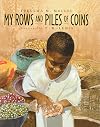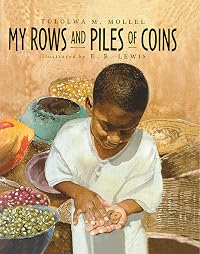
My Rows and Piles of Coins
by Tololwa M. Mollel
On This Page
Description
A Tanzanian boy saves his coins to buy a bicycle so that he can help his parents carry goods to market, but then he discovers that in spite of all he has saved, he still does not have enough money.Tags
Recommendations


Member Reviews
This story takes me back to the feeling I had as a child when I would save my change intentionally to buy something special, and I shared a similar sense of purpose and pride that Saruni felt. Although, he was much more selfless in his reason for saving- to help his mother with their daily work. The author builds up anticipation, when will he FINALLY save enough to get that bike, as he repeats the process of emptying his box, arranging the coins, and hoping for his dream bike. Saruni reminds us that sacrifice of our time and energy is so worth it and makes our reward that much sweeter. The illustrations in water color create scenes that come to life- making me feel as if these character are real, as if I know them, as if I am the one show more desiring to earn that bike to help my own mother. show less
I loved this book for a multitude of reasons. Firstly, this book gave a wonderful snapshot into the culture of Mollel’s childhood. This book transported you into this distant place, but with problems we have all experience, which brings me to my next point. This book is incredibly relatable. Almost every child has a memory of working hard to save for something they special they wanted and many also have the experience of not having enough and a parent swooping in to reward them for their hard work. Finally, the family bonds were very strong in this book. The selfless nature of our protagonist, Saruni, shows a wonderful example of the idea that families take care of each other. Saruni causes us to think how we have served our families show more and encourages us to participate more. show less
I like this is the book for a couple of reasons. First, I like the determination Saruni had for saving money to buy what he really wants: a bike. As a young child, even as adults, it is very hard to save money for just anything, especially if you are surrounded by temptation. “There were wooden toy trucks, kites, slingshots, and marbles. . . . [Saruni] want[ed] to buy everything.” Second, the genre of this book is realistic fiction. This is very significant when to readers because they can easily relate times when they really wanted to buy something but did not have enough money. In turn, it inspires readers to be determined like the Saruni, not only on saving money for the thing he likes but also determined to reach their goal. show more Third, I like the repetition in the book when Saruni counts his rows and piles of coins: “I emptied the box, arranged the coins in piles and the piles of rows. Then I counted the coins and thought about the blue and red bicycle.” This helps the young reader stay with their reading group and teachers can implement a small math lesson. Where young readers count the rows and piles of coins as it progresses. The determination, genre of the book, and repetition in My Rows and Piles of Coins enable readers to easily relate to Saruni. show less
A young Tanzanian boy named Saruni longs to buy a bicycle so he can help his mother carry goods to the marketplace. He spots his bike – a beautiful red and blue one – and begins to save his money. Each time he earns some money, he pulls out his secret money box and lines his coins up in rows. He finally believes he has enough money and is crestfallen when the bicyle man laughs at him and the amount of money he brought in order to buy a bicycle. His parents learn of his disappointment and his dad sells him his own bicycle for the amount of money Saruni has saved. Then unexpectedly, he gives Saruni back his money.
This was such a sweet book about the sacrificial love this boy had for his parents and they for him. I also liked how it show more showed that even across the world, children in other cultures have difficulty learning to ride a bike for the first time. In addition, just as my children think a quarter is enough to buy anything they want in a toy story, there are little boys in Tanzania having difficult with the concept of money too. There are more similarities across cultures than there are differences.
In a classroom, I think it would be fun to have a “Price is Right” game where they guess how much items cost and then use paper money to count and purchase the item. There are also several pages with illustrations and text that describe the Tanzanian marketplace. It would be interesting to take a field trip to an outdoor market and compare the two. If they were Saruni, what would they pick out at the marketplace for which they would save their money? show less
This was such a sweet book about the sacrificial love this boy had for his parents and they for him. I also liked how it show more showed that even across the world, children in other cultures have difficulty learning to ride a bike for the first time. In addition, just as my children think a quarter is enough to buy anything they want in a toy story, there are little boys in Tanzania having difficult with the concept of money too. There are more similarities across cultures than there are differences.
In a classroom, I think it would be fun to have a “Price is Right” game where they guess how much items cost and then use paper money to count and purchase the item. There are also several pages with illustrations and text that describe the Tanzanian marketplace. It would be interesting to take a field trip to an outdoor market and compare the two. If they were Saruni, what would they pick out at the marketplace for which they would save their money? show less
This book is absolutely amazing! It is a very good example of showing the diversity and positive aspects of African countries. Students who may come from the country of Tanzania, may appreciate the fact that their culture is being displayed in a positive light. The illustrations are very detailed and give some good insight into the African culture. The illustrations alone elaborate on some African traditions such as clothing, food and some of the hardworking traits that Africans possess. The story can easily bring different emotions out of readers. I went from feeling a sense of happiness, to disappointment, to excitement and then to prideful. I think that this book really captures the gratefulness that appears in many African show more communities. The little boy in the story was earning his money in an honest way and could only think about how he could use his money to help and give back! That is amazing! I think that this story teachers an important lesson. The lesson is that when you do good things, good things will happen! You should always do your very best to be a good person and to help others. The little boy was absolutely devastated when he found out that he didn't have enough money to buy the bike, but he was gifted a bike as a token of the couple's appreciation. This was a great read!!! show less
When reading this book, a few thoughts came into my mind. One, the shadings and textures of this book really make it seem as if I'm watching a real movie. Two, this plot is very warm and encouraging to a child who may have come upon hard times. Lastly, how much research would I have to do to find out why would a child be wearing a coat in July in Africa. This book gave me many reasons why it is a Coretta Scott King Award winner. I feel as if the author and illustrator were the same person. The only thing that kept this book from being five stars in my eyes is its lack of explanation of the climate in Africa, because I as a college student had issues keeping up with the differences in climate in New Orleans and Tanzania, so I'm pretty show more sure a young child reading this on there own will have questions. show less
This story is about a young boy that is helping his mother at the market in Africa. After a long day, his mother rewards him with a handful of coins and tells him to buy whatever he would like from the market. The boy searches for something that would be helpful for his mother and then he comes across a bicycle. He decides this would be the perfect thing to buy to help his mom carry things to and from the market. The boy begins to save his coins for the bicycle. Eventually, his mother finds out why he wants the bicycle and when his other family member gets a new motorbike, they give the bicycle to the boy. He then starts to save more coins for a cart to go with his bicycle. This story teaches kids many important lessons, such as helping show more others, like the boy was planning on helping his mother. It also teaches the value of saving and that hard work is rewarded. I like this book because while the setting may be different, the situation is relatable. I remember saving money for something I really wanted to buy and how difficult it was to keep saving, much like the little boy from Africa felt every day when he counted his coins. The story also provides insight into another culture that faces more hardship when it comes to money, transportation, etc. The sentences are age appropriate and the illustrations are eye-catching and help tell the story. show less
Members
- Recently Added By
Lists

A Child's Book Tour of East Africa ::: Ethiopia, Kenya, Sudan, Uganda
68 works; 4 members

Childhood: Books for or about children in different cultures around the wor
345 works; 18 members

Tanzania
46 works; 1 member

Early Picture Books
467 works; 9 members
Author Information

17+ Works 1,609 Members
Tololwa Mollel was born in Tanzania in 1952. He grew up in Arusha Tanzania at the times when oral tradition was still alive and well. Mollel received his undergraduate degree from the University of Dar-es-Salaam in Tanzania, and his masters degree from the University of Alberta, Edmonton. He has worked as an actor and university theatre instructor show more in Tanzania and Canada and as a writer-in-residence for the Edmonton Public Library. It was not untill Mollel went to study in Canada that he realized the depth of experience related in the stories his grandfather told him. The Orphan boy is one of his best story books, it won the Canadian Governor General's Award in 1990. Mollel has also won the Writers Guild of Alberta's R. Ross Annett Children's Prize for Big Boy in 1995. He was Shortlisted for Ontario's Silver Birch Award for The Flying Tortoise in 1994, and he won the Florida Reading Association Award for Rhinos for Lunch and Elephants for Supper! (Bowker Author Biography) show less
All Editions
Awards and Honors
Awards
Distinctions
Notable Lists
Common Knowledge
- Canonical title
- My Rows and Piles of Coins
- Original publication date
- 1999
- People/Characters
- Saruni; Yeyo; Murete
- Important places
- Tanzania
- Dedication
- In memory of my grandfather and murete, Lotasarwaki Marti
- First words
- After a good day at the market, my mother, Yeyo, gave me five whole ten-cent coins.
- Last words
- (Click to show. Warning: May contain spoilers.)Then I counted the coins and thought about the cart I would buy...
- Original language
- English
Classifications
Statistics
- Members
- 492
- Popularity
- 61,352
- Reviews
- 42
- Rating
- (4.38)
- Languages
- English
- Media
- Paper
- ISBNs
- 4
- UPCs
- 1
- ASINs
- 3