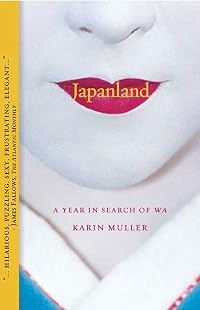
Japanland: A Year in Search of Wa
by Karin Muller
On This Page
Description
Documentary filmmaker Muller committed to living in Japan for a year in order to deepen her appreciation for Eastern ideals. What she's after--more than understanding tea-serving etiquette or the historical importance of the shogun--is wa: a transcendent state of harmony, of flow, of being in the zone. With only her Western perspective to guide her, though, she discovers in sometimes awkward, sometimes funny interactions just how maddeningly complicated it is to be Japanese. Beginning with a show more strict code of conduct enforced by her impeccably proper host mother, Muller is initiated in the centuries-old customs that direct everyday interactions and underlie the principles of the sumo, the geisha, Buddhist monks, and now the workaholic, career-track salaryman. At the same time, she observes the relatively decadent behavior of the fast-living youth generation, the so-called New Human Beings, who threaten to ignore the old ways altogether.--From publisher description. show lessTags
Recommendations





































Member Reviews
I haven't read many travel memoirs, but I find myself hoping that all of them are as engaging as this one.
Of course, it helps to have an interest in the places the author writes about. My best friend first got me interested in Japan, and there's something about its cultural differences from the West, its contradictory values, and its unique way of blending the past and the present so seamlessly that fascinates me. Karin Muller's journey into this country only deepened my knowledge and wonder.
In easy, conversational language, Muller jumps among the people and places she meets, from her up-and-down relations with her host family to various strangers, professionals, roommates, homeless, monks, and pilgrims she interacts with. Sometimes show more she is met with incredible acts of kindness and understanding, other times with coldness and even cruelty. It serves to underscore the kind of experience a foreigner can have in Japan; either welcomed or shunned, or sometimes both.
Muller's style makes it easy to get to know not only Japan, but also her as a person. I found myself admiring and sympathizing with her; she is honest about her fear, anger, and hopelessness in some situations, and yet she never grows self-pitying or gives up, although I might have many times. She tries her best to understand Japan and its culture, going to sometimes unimaginable lengths to fit in and accept its laws and values. She never judges the culture as right or wrong, instead musing over it, a fact I found very refreshing. She is honest about the good and the bad facets.
All in all, I want to read more of Karin's adventures, if she handles them all with such engaging and unwavering curiosity and aplomb. show less
Of course, it helps to have an interest in the places the author writes about. My best friend first got me interested in Japan, and there's something about its cultural differences from the West, its contradictory values, and its unique way of blending the past and the present so seamlessly that fascinates me. Karin Muller's journey into this country only deepened my knowledge and wonder.
In easy, conversational language, Muller jumps among the people and places she meets, from her up-and-down relations with her host family to various strangers, professionals, roommates, homeless, monks, and pilgrims she interacts with. Sometimes show more she is met with incredible acts of kindness and understanding, other times with coldness and even cruelty. It serves to underscore the kind of experience a foreigner can have in Japan; either welcomed or shunned, or sometimes both.
Muller's style makes it easy to get to know not only Japan, but also her as a person. I found myself admiring and sympathizing with her; she is honest about her fear, anger, and hopelessness in some situations, and yet she never grows self-pitying or gives up, although I might have many times. She tries her best to understand Japan and its culture, going to sometimes unimaginable lengths to fit in and accept its laws and values. She never judges the culture as right or wrong, instead musing over it, a fact I found very refreshing. She is honest about the good and the bad facets.
All in all, I want to read more of Karin's adventures, if she handles them all with such engaging and unwavering curiosity and aplomb. show less
Who can fathom the ways of readers? Here I was, smack-dab in the middle of a book about a person who travels to China, and I suddenly find myself drawn to a book about a person who travels to Japan. This one. Go figure.Nevertheless, a compelling read. Japan is not all it appears, it seems. In fact, that's the central theme of the book, the mask that Japan and the Japanese wear for the rest of the world. All is well, the mask says, while underneath the person dies for another day. This take on Japan has altered the appeal Japan has always had for me. Appearance as more important than essence. Hiding sadness and pain with stoic masks. Just an Eastern version of my deep South America.
I have what some might call a minor major obsession with Japan. As such, it didn't take much convincing for me to buy this book, which is an account of the author spending a year in Japan in search of harmony and balance for her life.
What this is not, I should say, is a travel guide to Japan. It contains a lot of fantastic insights into the culture, both mainstream and more esoteric, but if you plan to read this book thinking that it will make your trip to Tokyo easier, you'll be disappointed.
On the other hand, if you have an interest in what Japanese culture is like for both an insider and an outsider, then I definitely recommend this book. From her stay with a host family to her Buddhist pilgrimage, Karin Muller weaves a wonderful show more story with skill, honesty, and respect. She's not ashamed to reveal her own ignorance of some situations, nor is she ashamed to point out when other people are just plain baffling, at least by Western sensibilities.
I have read this book more than once now, and it's one of the few books that I can safely say I take more away from it each time I read it. It's an engrossing book, with plenty to amuse those who nothing about Japanese culture and those who know quite a bit.
By the end of the book, whether the author feels they've achieved a sense of inner peace and harmony is almost irrelevent. She's learned a great deal, experienced more than most people ever dream of, and she's taken away a little piece of another place to keep inside herself. In a sense, her pilgrimage toward the end of her time in Japan was only a fraction of the pilgrimage she embarked upon, and it left an impression that even the reader can feel as they share the journey from beginning to end. show less
What this is not, I should say, is a travel guide to Japan. It contains a lot of fantastic insights into the culture, both mainstream and more esoteric, but if you plan to read this book thinking that it will make your trip to Tokyo easier, you'll be disappointed.
On the other hand, if you have an interest in what Japanese culture is like for both an insider and an outsider, then I definitely recommend this book. From her stay with a host family to her Buddhist pilgrimage, Karin Muller weaves a wonderful show more story with skill, honesty, and respect. She's not ashamed to reveal her own ignorance of some situations, nor is she ashamed to point out when other people are just plain baffling, at least by Western sensibilities.
I have read this book more than once now, and it's one of the few books that I can safely say I take more away from it each time I read it. It's an engrossing book, with plenty to amuse those who nothing about Japanese culture and those who know quite a bit.
By the end of the book, whether the author feels they've achieved a sense of inner peace and harmony is almost irrelevent. She's learned a great deal, experienced more than most people ever dream of, and she's taken away a little piece of another place to keep inside herself. In a sense, her pilgrimage toward the end of her time in Japan was only a fraction of the pilgrimage she embarked upon, and it left an impression that even the reader can feel as they share the journey from beginning to end. show less
Lately my Netflix queue has been full to the brim with anime and J-Horror movies. I find myself with an insatiable curiosity about most things Japanese (if it's small, fuzzy and saccharine sweet I can usually resist). I dream of packing my bags and heading off to the island 'someday'. So when Amazon recommended this book to me, I felt it was the perfect venue for some armchair travel. And indeed, Muller does give you a sense of what being an outsider, a Gaijin, is like: at the home of her host family, at the market, asking directions on the street, in the public baths, etc.
Japanland, as described by Muller, is "an alternate reality", "the mask Japan wears in public". She spent a year documenting various Japanese citizens: monks, sumo show more wrestlers, drummers, judo practitioners, sword makers, business men, immigrants, geisha, even the homeless, with the purpose of assimilating their true culture. The marketing blurb on the front flap says the book has 'broad scope' and I do agree with that. But it also feels quite shallow, as if Muller never penetrated the 'mask' she speaks of. It's a light, easy read but ultimately I was left somewhat unsatisfied with it and will probably look for another book on the same subject. show less
Japanland, as described by Muller, is "an alternate reality", "the mask Japan wears in public". She spent a year documenting various Japanese citizens: monks, sumo show more wrestlers, drummers, judo practitioners, sword makers, business men, immigrants, geisha, even the homeless, with the purpose of assimilating their true culture. The marketing blurb on the front flap says the book has 'broad scope' and I do agree with that. But it also feels quite shallow, as if Muller never penetrated the 'mask' she speaks of. It's a light, easy read but ultimately I was left somewhat unsatisfied with it and will probably look for another book on the same subject. show less
The author spent a year in Japan, for a combination of personal seeking and documentary film (http://www.japanlandonline.com/). The book is written in anecdotal style, each chapter a snippet of culture entwined with stories of individual participants: religious ritual, sumo wrestling match, agricultural harvest, a homeless man collecting aluminum cans, a sword craftsman, a geisha. More interesting to me though were the mundane cultural frictions (e.g. months of ultimately unsuccessful efforts to be accepted by her host family, negotiating a landscape of rules spoken and assumed), and the kind gestures of ordinary people (e.g. when the highest ranking among a group of passing businessman gave incorrect directions, the lowest ranking, who show more could say nothing publicly in opposition, surreptitiously returned to set her right).
(read 1 Jan 2011) show less
(read 1 Jan 2011) show less
Strange, having read through the reviews here before beginning mine, I feel a strong impulse to defend the author. Japan is a difficult place for Americans because the language and the behavioral patterns are subtle and minimalist beyond the typical American ability to perceive (think politeness, tea, zen) AND violent or vivid (think: youth fashions, drinking, sumo). Karin Muller is admirably independent and courageous - without those characteristics she would not have made it through her year - but it is just those characteristics that also seem to block her from fitting in enough to understand the interpersonal messes she made. I really liked her for trying, though, and it is a credit to her writing that her character shines show more through.
True, this book is not a good source if you want to learn about Japan, but it is not intended as a book about Japan (notice the title - it's about her search). There's a certain argument in cultural anthropology that I picked up in a book by Maya Nadig but is probably derived from older sources, that explores what happens to a person's sense of self when living in a different society. Broadly, because who you are is built up and suspended in a web of social relations and expectations, when these are ripped away or when you land in a completely different web, your own sense of self tends to break up. It's a weird feeling, often frightening, sometimes enraging. I can see some of that happening with Karin Muller, and it's a pity she doesn't seem to have been able to become aware of and analyze her experience.
In the end, what we have here is another book about failing to fit in (oddly, compared to travel writing about other places, the books about Japan seem to admit failure more frequently; look at the first dozen titles in this list, for example). At least this one is energetic and covers a lot of cultural ground. show less
True, this book is not a good source if you want to learn about Japan, but it is not intended as a book about Japan (notice the title - it's about her search). There's a certain argument in cultural anthropology that I picked up in a book by Maya Nadig but is probably derived from older sources, that explores what happens to a person's sense of self when living in a different society. Broadly, because who you are is built up and suspended in a web of social relations and expectations, when these are ripped away or when you land in a completely different web, your own sense of self tends to break up. It's a weird feeling, often frightening, sometimes enraging. I can see some of that happening with Karin Muller, and it's a pity she doesn't seem to have been able to become aware of and analyze her experience.
In the end, what we have here is another book about failing to fit in (oddly, compared to travel writing about other places, the books about Japan seem to admit failure more frequently; look at the first dozen titles in this list, for example). At least this one is energetic and covers a lot of cultural ground. show less
My favorite kind of memoir that shares personal feelings and motivations but also teaches me new things. I loved her escape to the ceramics village with her mom and again when she went to film the mountain sect monk initiation. Many of her goals were obscure to me and I got a little tired of her list of weird cultural events. Still the insider/outsider insights were good: those who dedicate their lives personal and professional to heritage arts, brushes with gay culture, expat English teachers.
Members
- Recently Added By
Published Reviews
Does Muller succeed at "unravel[ing] the great ball of Japanese culture" (pp. 190–91)? Her rather anticlimactic conclusion is that conformity "is not a sign of weakness, but rather a great inner strength" (p. 300). In terms of providing accurate, reliable information on Japanese society and culture, Muller's book ultimately suffers from superficiality in its attempts to cover so much show more territory. . . . [K]nowledge-seekers who want to move beyond stereotypes or another entertaining read will have to look elsewhere. show less
added by sgump
Lists

Travelogues in Japan
22 works; 3 members
Author Information

3 Works 440 Members
Common Knowledge
- Important places
- Japan
- Related movies
- Japanland (2006 | IMDb)
- Dedication
- To the people of Japan
- First words
- I remember turning twenty-one in a squatter's village on a remote island in the Philippines.
- Last words
- (Click to show. Warning: May contain spoilers.)And then he giggles, calls for his cane, and shuffles off.
- Blurbers
- Lyden, Jacki
Classifications
Statistics
- Members
- 294
- Popularity
- 109,591
- Reviews
- 15
- Rating
- (3.61)
- Languages
- English
- Media
- Paper, Ebook
- ISBNs
- 3
- ASINs
- 2