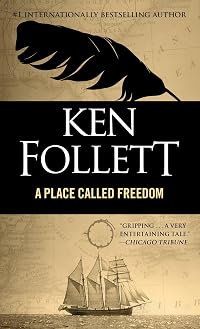
A Place Called Freedom
by Ken Follett
On This Page
Description
NEW YORK TIMES BESTSELLERScotland, 1766. Sentenced to a life of misery in the brutal coal mines, twenty-one-year-old Mack McAsh hungers for escape. His only ally: the beautiful, highborn Lizzie Hallim, who is trapped in her own kind of hell. Though separated by politics and position, these two restless young people are bound by their passionate search for a place called freedom.
From the teeming streets of London to the infernal hold of a slave ship to a sprawling Virginia plantation, show more Ken Follett’s turbulent, unforgettable novel of liberty and revolution brings together a vivid cast of heroes and villains, lovers and rebels, hypocrites and hell-raisers—all propelled by destiny toward an epic struggle that will change their lives forever. show less
Tags
Recommendations





Member Reviews
This book was recommended to me by a friend who loved it, but I didn't.
Stylistically, Follett is like a fourth-grader with lofty aspirations but no real skill or subtlety. I felt continually led by the nose and given commands on how to think and react.
Consider this passage, thrown gratuitously into Mack's cross-examination of the villain in a courtroom scene. "Gordon said: 'You should be a lawyer, Mack. Where did you learn to argue like that?'" Come on, now. If we can't decide whether Mack's argument is convincing, then we're too damn stupid to be reading books with abstract themes anyway. But Follett is too insecure to let his action and dialogue speak for itself, so he insists on inserting an onlooker to pronounce from on high that show more Mack's argument was good.
And there's the nonstop exposition on what characters think and feel, almost all of it fully disconnected from the action. Can't we have a character who does things that a person feeling an emotion would do, instead of just being told about the emotion? "Lizzie was happy. She was scared and anxious and guilty, but she could not help smiling. She was out of doors, on a horse, beside the man she loved, beginning a great adventure. In her mind she worried about what might happen, but her heart sang." It's kind of him to specify that the place where she did her worrying was "in her mind," but how she's holding so much worry, fear, and guilt in there while her heart sings is far from clear. But Follett seems unaware that emotions and inner conflict usually have physical expression; he's satisfied to describe a woman smiling on a horse, fling allegations of an inner state, and call it a day. I picture stick figures drawn in crayon. The whole book is like that.
If the Pillars of the Earth was a letdown; this is a total collapse. The fact that it deals with grand themes of freedom and justice only makes it worse, because such themes deserve better than this book's ineptitude. You'll never catch me touching another Ken Follett book. show less
Stylistically, Follett is like a fourth-grader with lofty aspirations but no real skill or subtlety. I felt continually led by the nose and given commands on how to think and react.
Consider this passage, thrown gratuitously into Mack's cross-examination of the villain in a courtroom scene. "Gordon said: 'You should be a lawyer, Mack. Where did you learn to argue like that?'" Come on, now. If we can't decide whether Mack's argument is convincing, then we're too damn stupid to be reading books with abstract themes anyway. But Follett is too insecure to let his action and dialogue speak for itself, so he insists on inserting an onlooker to pronounce from on high that show more Mack's argument was good.
And there's the nonstop exposition on what characters think and feel, almost all of it fully disconnected from the action. Can't we have a character who does things that a person feeling an emotion would do, instead of just being told about the emotion? "Lizzie was happy. She was scared and anxious and guilty, but she could not help smiling. She was out of doors, on a horse, beside the man she loved, beginning a great adventure. In her mind she worried about what might happen, but her heart sang." It's kind of him to specify that the place where she did her worrying was "in her mind," but how she's holding so much worry, fear, and guilt in there while her heart sings is far from clear. But Follett seems unaware that emotions and inner conflict usually have physical expression; he's satisfied to describe a woman smiling on a horse, fling allegations of an inner state, and call it a day. I picture stick figures drawn in crayon. The whole book is like that.
If the Pillars of the Earth was a letdown; this is a total collapse. The fact that it deals with grand themes of freedom and justice only makes it worse, because such themes deserve better than this book's ineptitude. You'll never catch me touching another Ken Follett book. show less
The history the storyline follows is intriguing - in 1767 a Scottish coal miner learns he was not born a slave and continues to question and disrupt the existing power structures around him (reflecting the lower populaces' sentiments) as he journeys to London (coal-heaver offloading ships), Virginia (indentured convict on a tobacco plantation), and finally over the Cumberland Gap to a life in service of what he chooses. But the caliber of writing makes me hesitant to read another work by Follett.
Well written story woven around the mistreatment of poorer classes in British society in late 1760's. The efforts of one man to achieve freedom with many struggles along the way.
I picked this up because of its purportedly dealing with an aspect of Scottish history that I was interested in - the perpetuation of feudal slavery in the Scottish mines. I soon discovered that the author knew and understood even less about the period and the system then I did - for example he presents a punishment that was often fatal (and intended to be so) as merely tiring and embarrassing.
This is simply a unhistorical vehicle for a trite and banal romance, in which every character is a banal cliché.
I will never waste my time on another novel by this author.
This is simply a unhistorical vehicle for a trite and banal romance, in which every character is a banal cliché.
I will never waste my time on another novel by this author.
A page turner, describes the struggle of a miner in Scotland who is forced to become indentured in America. Good evocation of his journey and some decent descriptions of settings and thehistorical context. That said, this is basically a love story---the miner and the woman who is forced to wed a ne'er do well aristocrat. With a fair amount of attention to erotic detail (pretty well done), the story is a bit too Hollywood-ended.
This was the first book I ever read by this author, and I ended up enjoying it. It was surprising to hear about white people being held as slaves (or practically slaves) in a time where it was usually the black person in that situation, so I found this book to be rather educational. I certainly am glad I wasn't a coal-miner back then, these white 'slaves' were really not much better off (and sometimes worse-off) than the blacks because they had to work in caves all day and deal with black lung and all that other stuff that comes from mining without proper safety equipment.
This coal stuff happens in Scotland, but a good part of the story also happens in America (hence the title of this book) with several good main characters and a show more convincing story. show less
This coal stuff happens in Scotland, but a good part of the story also happens in America (hence the title of this book) with several good main characters and a show more convincing story. show less
I wanted to read another Scottish tale to compare the experience against the Outlander that's back in vogue. I've been reading that series and thought of this book which is set in the same time period (1700) and I like Ken Follett's historical fiction. So I read A Place Called Freedom.
The biggest difference in the experience was the story's voice. I found Ken Follett's writing to be more formal. Though he presents a good image of the characters, time period, and unique human scenes, the prose doesn't touch the heart as deeply. In that regard, Outlander shines a higher score.
This does not mean it's not worth the time reading - it is a good book. The story did tug on my heart, especially the scenes that showed the horrid treatment of the show more people back then, the miners, and even children. As a mother of four reading the sections, where they were shipped off as 'indentured slaves' and when working in the mine, moved me. I am very thankful things have changed.
The two strong protagonists, Lizzie & Mac have stories that weave together in and out until the final conclusion. They find what they had been searching for - freedom. The storyline has a love relationship that develops over years, a great villain in the character Jay, and lots of confrontation and obstacles to overcome.
If you want not only historical fiction, but also action adventure and romance, then this book's a wise choice to read. show less
The biggest difference in the experience was the story's voice. I found Ken Follett's writing to be more formal. Though he presents a good image of the characters, time period, and unique human scenes, the prose doesn't touch the heart as deeply. In that regard, Outlander shines a higher score.
This does not mean it's not worth the time reading - it is a good book. The story did tug on my heart, especially the scenes that showed the horrid treatment of the show more people back then, the miners, and even children. As a mother of four reading the sections, where they were shipped off as 'indentured slaves' and when working in the mine, moved me. I am very thankful things have changed.
The two strong protagonists, Lizzie & Mac have stories that weave together in and out until the final conclusion. They find what they had been searching for - freedom. The storyline has a love relationship that develops over years, a great villain in the character Jay, and lots of confrontation and obstacles to overcome.
If you want not only historical fiction, but also action adventure and romance, then this book's a wise choice to read. show less
Members
- Recently Added By
Lists

Best Contemporary Literary Fiction (Around the Last 30 Years)
400 works; 124 members

20th Century Literature
1,161 works; 55 members

Historical Fiction
889 works; 91 members
Favourite Books
1,820 works; 316 members

1990s
309 works; 17 members
Author Information

184+ Works 129,606 Members
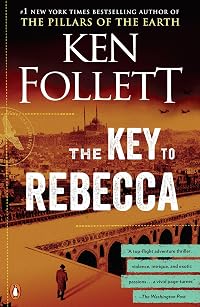
Ken Follett was born in Wales, United Kingdom on June 5, 1949. He received an Honours degree in philosophy from University College, London. He began his career as a newspaper reporter for the South Wales Echo and later with the London Evening News. He decided to switch to publishing and worked for a small London publishing house, Everest Books, show more eventually becoming Deputy Managing Director. His first bestselling novel, Eye of the Needle, was published in 1978 and won the Edgar Award. His other works include Triple, The Key to Rebecca, The Man from St. Petersburg, Lay Down with Lions, The Pillars of the Earth, The Third Twin, The Hammer of Eden, Code to Zero, Whiteout, World Without End, The Century Trilogy, and A Column of Fire. Many of his novels have been adapted into films and television miniseries. He has won numerous awards including the Corine Prize in 2003 for Jackdaws. His nonfiction works include On Wings of Eagles. (Bowker Author Biography) show less
Some Editions
Awards and Honors
Distinctions
Series
Belongs to Publisher Series
Grandes Narrativas (629)
Bastei Lübbe Taschenbuch (12815)
Work Relationships
Is contained in
Set of 16 Techno-Thrillers by Ken Follett (Whiteout, Hornet Flight, Jackdaws, Code to Zero, Hammer of Eden, Third Twin, A Place Called Freedom, A Dangerous Fortune, Night Over Water, Lie Down with Lions, Man from St. Petersburg, Key to Rebecca, Triple, Eye of the Needle, Pillars of the Earth) by Ken Follett
Is abridged in
Reader's Digest Condensed Books 1996 v01: A Place Called Freedom / The Horse Whisperer / The Apocalypse Watch by Reader's Digest
Reader's Digest Condensed Books: Come to Grief • Let Me Call You Sweetheart • A Place Called Freedom • Riptide by Reader's Digest
Het Beste Boek 180: Vaders mooiste / De paardenfluisteraar / De vlam van de vrijheid / Mijn kleine wolven by Reader's Digest
Common Knowledge
- Canonical title
- A Place Called Freedom
- Original title
- A Place Called Freedom
- Original publication date
- 1995
- People/Characters
- Malachi "Mack" McAsh; Lizzie Hallim; Jay Jamisson; Sir George Jamisson; Robert Jamisson; Cora Higgins (show all 10); Quick Peg Knapp; Caspar Gordonson; Sidney Lennox; Esther McAsh
- Important places
- Scotland, UK; London, England, UK; Virginia Colony
- Dedication
- Dedicated to the memory of John Smith
- First words
- Snow crowned the ridges of High Glen and lay on the wooded slopes in pearly patches, like jewelry on the bosom of a green silk dress.
- Last words
- (Click to show. Warning: May contain spoilers.)"Never to forget," he said with a smile. "Never."
- Original language*
- Englisch
*Some information comes from Common Knowledge in other languages. Click "Edit" for more information.
Classifications
Statistics
- Members
- 3,277
- Popularity
- 5,236
- Reviews
- 52
- Rating
- (3.60)
- Languages
- 15 — Czech, Danish, Dutch, English, Finnish, French, German, Hungarian, Icelandic, Italian, Norwegian (Bokmål), Polish, Portuguese, Spanish, Swedish
- Media
- Paper, Audiobook, Ebook
- ISBNs
- 110
- UPCs
- 1
- ASINs
- 33