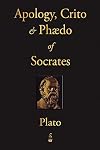
The Apology / Crito / Phaedo
by Plato
On This Page
Description
Remains a powerful document partly because it was a true - perhaps in certain parts verbatim - account of the end of one of the greatest figures in historyTags
Recommendations















Member Reviews
I admit it, I'm a philosophy geek, although I usually end up arguing with much of the books so don't read them often. Even if I disagreed with a lot, the writing is brilliant and there is a lot of food for thought.
Plato was not just a speculator in ideas, but a man of letters and community involvement. These three "dialogues" were the "popular" materials produced by Plato, widely distributed in Athens. With Socrates as the main interlocutor, they paint an attractive picture of the closing scenes of his life. The serious philosophical and scientific work done by Plato has never been recovered.
Edition: // Descr: iv, 259 p. 18.5 cm. // Series: Call No. { 888 P69 2 } From the Text of C.F. Hermann Edited with English Notes, Critical and Explanatory by Rev. James Davies. // //
APOLOGÍA DE SÓCRATES. CRITÓN, FEDÓN
Salvando toda la doctrina socrático-platónica sobre el deber, el alma y su inmortalidad, que aparece de modo especial en 'Critón' y 'Fedón', en las obras que recoge el presente volumen Platón deja de lado la vida del maestro para centrarse en un momento común: su muerte.
Los tres siguen un ritmo ascendente centrado en los últimos días de la existencia de Sócrates: juicio y condena en 'Apología', prisión en 'Critón' y fin de ésta y muerte en 'Fedón'. Y si en la primera hay una aceptación de la ley impuesta, en la segunda el lector encontrará una defensa de las restantes leyes, y en la tercera, su cumplimiento hasta el fin.
Salvando toda la doctrina socrático-platónica sobre el deber, el alma y su inmortalidad, que aparece de modo especial en 'Critón' y 'Fedón', en las obras que recoge el presente volumen Platón deja de lado la vida del maestro para centrarse en un momento común: su muerte.
Los tres siguen un ritmo ascendente centrado en los últimos días de la existencia de Sócrates: juicio y condena en 'Apología', prisión en 'Critón' y fin de ésta y muerte en 'Fedón'. Y si en la primera hay una aceptación de la ley impuesta, en la segunda el lector encontrará una defensa de las restantes leyes, y en la tercera, su cumplimiento hasta el fin.
Mar 30, 2018 (Edited)Spanish
APOLOGÍA DE SÓCRATES, CRITÓN , FEDÓN
Salvando toda la doctrina socrático-platónica sobre el deber, el alma y su inmortalidad, que aparece de modo especial en Critón y Fedón, en las obras que recoge el presente volumen Platón deja de lado la vida del maestro para centrarse en un momento común: su muerte. Los tres siguen un ritmo ascendente centrado en los últimos días de la existencia de Sócrates: juicio y condena en Apología, prisión en Critón y fin de ésta y muerte en Fedón. Y si en la primera hay una aceptación de la ley impuesta, en la segunda el lector encontrará una defensa de las restantes leyes, y en la tercera, su cumplimiento hasta el fin.
Autoría
Platón
(Atenas o Egina,2 ca. 427-347 a. C.) fue un filósofo show more griego seguidor de Sócrates y maestro de Aristóteles. En 387 fundó la Academia, institución que continuaría su marcha a lo largo de más de novecientos años y a la que Aristóteles acudiría desde Estagira a estudiar filosofía alrededor del 367, compartiendo, de este modo, unos veinte años de amistad y trabajo con su maestro. Platón participó activamente en la enseñanza de la Academia y escribió, siempre en forma de diálogo, sobre los más diversos temas, tales como filosofía política, ética, psicología, antropología filosófica, epistemología, gnoseología, metafísica, cosmogonía, cosmología, filosofía del lenguaje y filosofía de la educación; intentó también plasmar en un Estado real su original teoría política, razón por la cual viajó dos veces a Siracusa, Sicilia, con intenciones de poner en práctica allí su proyecto, pero fracasó en ambas ocasiones y logró escapar penosamente y corriendo peligro su vida debido a las persecuciones que sufrió por parte de sus opositores. Su influencia como autor y sistematizador ha sido incalculable en toda la historia de la filosofía, de la que se ha dicho con frecuencia que alcanzó identidad como disciplina gracias a sus trabajos. show less
Salvando toda la doctrina socrático-platónica sobre el deber, el alma y su inmortalidad, que aparece de modo especial en Critón y Fedón, en las obras que recoge el presente volumen Platón deja de lado la vida del maestro para centrarse en un momento común: su muerte. Los tres siguen un ritmo ascendente centrado en los últimos días de la existencia de Sócrates: juicio y condena en Apología, prisión en Critón y fin de ésta y muerte en Fedón. Y si en la primera hay una aceptación de la ley impuesta, en la segunda el lector encontrará una defensa de las restantes leyes, y en la tercera, su cumplimiento hasta el fin.
Autoría
Platón
(Atenas o Egina,2 ca. 427-347 a. C.) fue un filósofo show more griego seguidor de Sócrates y maestro de Aristóteles. En 387 fundó la Academia, institución que continuaría su marcha a lo largo de más de novecientos años y a la que Aristóteles acudiría desde Estagira a estudiar filosofía alrededor del 367, compartiendo, de este modo, unos veinte años de amistad y trabajo con su maestro. Platón participó activamente en la enseñanza de la Academia y escribió, siempre en forma de diálogo, sobre los más diversos temas, tales como filosofía política, ética, psicología, antropología filosófica, epistemología, gnoseología, metafísica, cosmogonía, cosmología, filosofía del lenguaje y filosofía de la educación; intentó también plasmar en un Estado real su original teoría política, razón por la cual viajó dos veces a Siracusa, Sicilia, con intenciones de poner en práctica allí su proyecto, pero fracasó en ambas ocasiones y logró escapar penosamente y corriendo peligro su vida debido a las persecuciones que sufrió por parte de sus opositores. Su influencia como autor y sistematizador ha sido incalculable en toda la historia de la filosofía, de la que se ha dicho con frecuencia que alcanzó identidad como disciplina gracias a sus trabajos. show less
Jan 30, 2018Spanish
Ratings
Members
- Recently Added By
Author Information

2,715+ Works 100,342 Members
Plato was born c. 427 B.C. in Athens, Greece, to an aristocratic family very much involved in political government. Pericles, famous ruler of Athens during its golden age, was Plato's stepfather. Plato was well educated and studied under Socrates, with whom he developed a close friendship. When Socrates was publically executed in 399 B.C., Plato show more finally distanced himself from a career in Athenian politics, instead becoming one of the greatest philosophers of Western civilization. Plato extended Socrates's inquiries to his students, one of the most famous being Aristotle. Plato's The Republic is an enduring work, discussing justice, the importance of education, and the qualities needed for rulers to succeed. Plato felt governors must be philosophers so they may govern wisely and effectively. Plato founded the Academy, an educational institution dedicated to pursuing philosophic truth. The Academy lasted well into the 6th century A.D., and is the model for all western universities. Its formation is along the lines Plato laid out in The Republic. Many of Plato's essays and writings survive to this day. Plato died in 347 B.C. at the age of 80. (Bowker Author Biography) show less
Some Editions
Awards and Honors
Notable Lists
Series
Belongs to Publisher Series
Work Relationships
Common Knowledge
- Canonical title
- The Apology / Crito / Phaedo
- Disambiguation notice
- Please separate and combine only LT works having substantially the same content. For example, this LT work includes three of Plato's dialogues: The Apology (a.k.a. The Defense of Socrates), Crito, and ... (show all)Phaedo. Thank you.
Note: later editions of Penguin Classics Last Days of Socrates (trans. Tredinnick) add a fourth dialogue, the Euthyphro.
Classifications
Statistics
- Members
- 401
- Popularity
- 77,217
- Reviews
- 5
- Rating
- (3.82)
- Languages
- 12 — Chinese, English, Finnish, French, Greek (Ancient), Italian, Japanese, Portuguese, Serbian, Spanish, Swedish, Turkish
- Media
- Paper, Audiobook, Ebook
- ISBNs
- 39
- ASINs
- 15