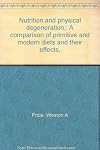
Nutrition and Physical Degeneration
by Weston A. Price
On This Page
Description
"Circling the world in the 1920s and '30s, Dr. Price and his wife found the same sinister pattern among "primitive" populations, whether isolated Irish fishermen, tribal Africans, Pacific Islanders, Eskimos, North and South American Indians or Australian Aborigines. Those groups that followed their traditional nature-based diets enjoyed good health and vigor, and those that turned to the "civilized" diet of processed, sugar-laden foods soon developed a variety of ills, including misshapen show more bones and teeth - and the situation worsened with each generation." "Dr. Price's fascinating accounts of his discoveries, and the extensive photo documentation he provides, drive home the nutritional truths that are only now gaining general understanding, and Nutrition and Physical Degeneration remains an unequaled source of basic information."--BOOK JACKET.Title Summary field provided by Blackwell North America, Inc. All Rights Reserved show lessTags
Recommendations

























Member Reviews
В края на 19 век индустриализацията на света върви с пълна сила и индустриалните храни започват да навлизат сред все повече общества. Захар, бяло брашно, консервирани храни, хидрогенизирани растителни масла - са вече съвсем евтини и стават основни хранителни продукти на много хора, които до сега са се хранили по традиционния начин - с отгледани от тях продукти.
Авторът Уестън А. Прайс е канадски зъболекар, show more който забелязва, че точно в този период бизнесът му се увеличава неимоверно - водят му деца с десетки кариеси, с маломерни челюсти и криви зъби - при условие, че родителите им, невежи селски хора, имат силни, здрави и правилни зъби.
В продължение на десетилетия, той и съпругата му обикалят света, за да изучават местните примитивни хора, които живеят и се хранят според древните си традиции и обичаи и техните сблъсъци с модерните храни (главно що се отнася до здравето на зъбите им). Двамата документират изследванията си с над 15 хил. фотографии и издават тази книга през 1939 г.
Изводите, които правят са фрапиращи - независимо дали става дума за селяни в швейцарските алпи, ескимоси, папуаси или африкански племена, туземците практически не познават кариеса и зъбните изкривявания. Зъбите им са често мръсни, изтъркани от употреба и с наслоен зъбен камък, но не са развалени. Наблюдават се кариеси между 0.09-5 на 1000 зъба.
Там обаче, дето тия местни хора вече са в контакт с цивилизацията и ядат бяло брашно, захар и производните им храни, не само зъбите им се развалят неимоверно (разбира се, за това допринася и фактът, че не ги мият), но и се наблюдават зъбни и челюстни изкривявания.
Изводът на автора от тия наблюдения, изследвания на храните и проведени клинични експерименти относно хранителното съдържание на традиционните храни са изключително интересни и полезни и някои по-късни учени наричат У.Прайс "Чарлз Дарвин на хранителната наука".
Прайс обръща голямо внимание на мазнините като основен разтворител на повечето витамини - особено кравето масло от хранени с трева крави, рибеното масло и маслото от рибен черен дроб. Описва също така и пълнозърнестото брашно, като източник на калций и фосфор (макар че племената, които се хранят с напълно животински храни - инуити в Аляска и масаи в Африка - имат всъщност най-ниски нива на кариес).
Макар в книгата да личат недостатъците на епохата (малко архаичен научен подход и език, модерните за периода расови залитания и т.н.) тя е невероятно четиво за тия от нас, които се интересуват от здравословен живот и хранене. show less
Авторът Уестън А. Прайс е канадски зъболекар, show more който забелязва, че точно в този период бизнесът му се увеличава неимоверно - водят му деца с десетки кариеси, с маломерни челюсти и криви зъби - при условие, че родителите им, невежи селски хора, имат силни, здрави и правилни зъби.
В продължение на десетилетия, той и съпругата му обикалят света, за да изучават местните примитивни хора, които живеят и се хранят според древните си традиции и обичаи и техните сблъсъци с модерните храни (главно що се отнася до здравето на зъбите им). Двамата документират изследванията си с над 15 хил. фотографии и издават тази книга през 1939 г.
Изводите, които правят са фрапиращи - независимо дали става дума за селяни в швейцарските алпи, ескимоси, папуаси или африкански племена, туземците практически не познават кариеса и зъбните изкривявания. Зъбите им са често мръсни, изтъркани от употреба и с наслоен зъбен камък, но не са развалени. Наблюдават се кариеси между 0.09-5 на 1000 зъба.
Там обаче, дето тия местни хора вече са в контакт с цивилизацията и ядат бяло брашно, захар и производните им храни, не само зъбите им се развалят неимоверно (разбира се, за това допринася и фактът, че не ги мият), но и се наблюдават зъбни и челюстни изкривявания.
Изводът на автора от тия наблюдения, изследвания на храните и проведени клинични експерименти относно хранителното съдържание на традиционните храни са изключително интересни и полезни и някои по-късни учени наричат У.Прайс "Чарлз Дарвин на хранителната наука".
Прайс обръща голямо внимание на мазнините като основен разтворител на повечето витамини - особено кравето масло от хранени с трева крави, рибеното масло и маслото от рибен черен дроб. Описва също така и пълнозърнестото брашно, като източник на калций и фосфор (макар че племената, които се хранят с напълно животински храни - инуити в Аляска и масаи в Африка - имат всъщност най-ниски нива на кариес).
Макар в книгата да личат недостатъците на епохата (малко архаичен научен подход и език, модерните за периода расови залитания и т.н.) тя е невероятно четиво за тия от нас, които се интересуват от здравословен живот и хранене. show less
Unfortunately, I wasn’t able to get through this voluminous, dense book, which is a classic within the field of dentistry.
I’m not particularly interested in dentistry but have been having dental issues and thus found my way to this book.
Weston Price travelled around the world investigating the teeth of so-called primitive peoples. His focus was to find societies untouched by Western society who thus still existed totally on a diet of indigenous foods.
The prologue states that Price proved conclusively that dental decay is caused primarily by nutritional deficiencies and “that those conditions that promote decay also promote disease”.
The diets studied by Price were diverse, some being based on sea foods, some on domesticated show more animals, some n game and some on dairy products. Some contained almost no plant foods while others contained a variety of fruits, vegetables, grains and legumes. In some, mostly cooked foods were eaten while in others many foods, including animal foods were eaten raw.
“Price found fourteen tribal diets that, although radically different, provided almost complete immunity to tooth decay and resistance to illness.”
The book is packed with photos of people showing their teeth. In a photo of two groups, black and white, from Thursday Island, the natives have “beautifully proportioned faces” and broad dental arches (not that I know what dental arches are), while the whites have “pinched nostrils and marked disturbance in proportions of the faces” and crowded teeth (poor diet apparently deforms not only teeth but faces).
In another series of photos, we see a boy aged 5 (not from any of the “primitive” societies) who suffered from inflammatory rheumatism, arthritis and “heart involvement”. “He was so badly crippled with arthritis in his swollen knees, wrists, and rigid spine that he was bedfast and cried by the hour.” After a year of improved diet where white flour products were removed, and small doses of cod liver oil were added, together with “specially high vitamin butter produced by cows pasturing on green wheat”, the boy’s pain had subsided, his appetite had improved, he slept soundly and he had gained rapidly in weight.
It’s a pity I didn’t manage to read much of the book since it proved really interesting, and contains, as can be seen from the above, not only material about how to improve one’s teeth through good diet but also much about the improvement of general health and healing of diseases.
Being a vegetarian, aspiring to be vegan, I can’t eat many of the foodstuffs Price recommends, such as liver, whole milk and bone marrow, and wheat these days is not what it was in Price’s time (the book was written in 1939).
I found the language to be extremely dated (e.g. “bedfast”) but, of course, comprehensible. But it is not the most readable of books and its size is off-putting. So I would recommend it mostly to dentists and others absolutely interested in dental matters.
To sum up, Price’s basic tenet is that dental decay and disease as a whole are caused mainly by nutritional deficiencies. In my experience, as regards dental decay, this is not something that the dental profession is aware of.
P.S. I have just begun to read a fascinating book by a former dentist who contends that dental decay is primarily caused not by bacteria, lack of good brushing or poor nutrition, but by our feelings. So it’s all getting quite interesting. (I believe that the feelings are probably the primary cause, but everything is interconnected, and good nutrition is obviously absolutely important.) show less
I’m not particularly interested in dentistry but have been having dental issues and thus found my way to this book.
Weston Price travelled around the world investigating the teeth of so-called primitive peoples. His focus was to find societies untouched by Western society who thus still existed totally on a diet of indigenous foods.
The prologue states that Price proved conclusively that dental decay is caused primarily by nutritional deficiencies and “that those conditions that promote decay also promote disease”.
The diets studied by Price were diverse, some being based on sea foods, some on domesticated show more animals, some n game and some on dairy products. Some contained almost no plant foods while others contained a variety of fruits, vegetables, grains and legumes. In some, mostly cooked foods were eaten while in others many foods, including animal foods were eaten raw.
“Price found fourteen tribal diets that, although radically different, provided almost complete immunity to tooth decay and resistance to illness.”
The book is packed with photos of people showing their teeth. In a photo of two groups, black and white, from Thursday Island, the natives have “beautifully proportioned faces” and broad dental arches (not that I know what dental arches are), while the whites have “pinched nostrils and marked disturbance in proportions of the faces” and crowded teeth (poor diet apparently deforms not only teeth but faces).
In another series of photos, we see a boy aged 5 (not from any of the “primitive” societies) who suffered from inflammatory rheumatism, arthritis and “heart involvement”. “He was so badly crippled with arthritis in his swollen knees, wrists, and rigid spine that he was bedfast and cried by the hour.” After a year of improved diet where white flour products were removed, and small doses of cod liver oil were added, together with “specially high vitamin butter produced by cows pasturing on green wheat”, the boy’s pain had subsided, his appetite had improved, he slept soundly and he had gained rapidly in weight.
It’s a pity I didn’t manage to read much of the book since it proved really interesting, and contains, as can be seen from the above, not only material about how to improve one’s teeth through good diet but also much about the improvement of general health and healing of diseases.
Being a vegetarian, aspiring to be vegan, I can’t eat many of the foodstuffs Price recommends, such as liver, whole milk and bone marrow, and wheat these days is not what it was in Price’s time (the book was written in 1939).
I found the language to be extremely dated (e.g. “bedfast”) but, of course, comprehensible. But it is not the most readable of books and its size is off-putting. So I would recommend it mostly to dentists and others absolutely interested in dental matters.
To sum up, Price’s basic tenet is that dental decay and disease as a whole are caused mainly by nutritional deficiencies. In my experience, as regards dental decay, this is not something that the dental profession is aware of.
P.S. I have just begun to read a fascinating book by a former dentist who contends that dental decay is primarily caused not by bacteria, lack of good brushing or poor nutrition, but by our feelings. So it’s all getting quite interesting. (I believe that the feelings are probably the primary cause, but everything is interconnected, and good nutrition is obviously absolutely important.) show less
Nothing like it. Weston Price is the most thorough and best documented of the scientists who ventured out into the wilds to find wild people with perfect health and not only wonder why, but spent his whole life documenting it. Just the pictures in this book can change your perspective, shattering myths and revealing simple and complex truths.
This book was a real eye-opener. After studying Dr. Price's photos of healthy (and unhealthy) people from many diverse places in the world, you will not look at any face the same way again.
Impressive original research.
my copy has isbn 978 1 44613165 7 and pages are 411 (lulu states 7 more)
https://www.lulu.com/en/en/shop/weston-a-price/nutrition-and-physical-degenerati... - print on demand
my copy has isbn 978 1 44613165 7 and pages are 411 (lulu states 7 more)
https://www.lulu.com/en/en/shop/weston-a-price/nutrition-and-physical-degenerati... - print on demand
Early study on the Sugar Empire and its impact on our health.
A must-read for all humans
Members
- Recently Added By
Author Information

5 Works 455 Members
Common Knowledge
- Original title
- Nutrition and Physical Degeneration
Classifications
- Genres
- Anthropology, Nonfiction, General Nonfiction, Science & Nature
- DDC/MDS
- 616.39 — Applied science & technology Medicine & health Diseases, Allergies, Skin Conditions Diseases of the digestive system Dietetic diseases
- LCC
- RC622 .P7395 — Medicine Internal medicine Internal medicine Specialties of internal medicine Nutritional diseases. Deficiency diseases
Statistics
- Members
- 449
- Popularity
- 68,526
- Reviews
- 8
- Rating
- (4.52)
- Languages
- Dutch, English, German
- Media
- Paper
- ISBNs
- 9
- ASINs
- 9