
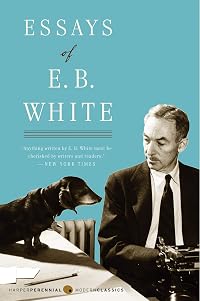
Essays of E.B. White
by E. B. White
On This Page
Description
The classic collection by one of the greatest essayists of our time.Tags
Recommendations












Member Reviews
New England writers have a mode - fascinated with nature, and the everyday workmanlike process of filtering the natural experience through the small routines of daily life. Frost did it with "Mending Wall", Updike with his petty domestic dramas, Thoreau with his canoe and tourist cabin. I'll throw Lowell and Dickinson's confessional poetry in with the lot, if only to support my claim that these are all fish out of water stories - what it means to be inside when you really want to be outside, to bridge the divide between the house and the forest. White famously did this with his animal stories for children, but in this collection, his neatest rhetorical trick is "Coon Tree" - a meditation on a nocturnal scavenger that segues into a show more discussion of Cold War politics and nuclear annihilation. show less
E.B. White, in my mind best known for his children's books like Charlotte's Web and Stuart Little, was also a prolific essayist. This collection brings together essays spanning 40 years of life in America. White writes about his life on a farm in Maine, his life in NYC, the changing culture and politics of America, and just living. He writes simply and directly, but has profound things to say that are still relevant today. He has a way with words and a lovely way of tying things together.
This collection was a good reminder that life in America has never been simple or straightforward. White lived through two World Wars, a huge shift in farm life and industry, difficult politics, divisive cultural differences, and more. He doesn't shy show more away from controversial topics, but keeps a civil tone and approaches topics with curiosity rather than supreme confidence.
And there are plenty of essays that just happen to be about a goose or a pig instead of heavy politics.
Loved these essays and will keep this to continue to dip into. show less
This collection was a good reminder that life in America has never been simple or straightforward. White lived through two World Wars, a huge shift in farm life and industry, difficult politics, divisive cultural differences, and more. He doesn't shy show more away from controversial topics, but keeps a civil tone and approaches topics with curiosity rather than supreme confidence.
And there are plenty of essays that just happen to be about a goose or a pig instead of heavy politics.
Loved these essays and will keep this to continue to dip into. show less
E.B. White is one of those authors who I just can't help but find interesting, for one reason or another. Sometimes his writing just hits the spot; sometimes he brings me a good solid belly-laugh like very few writers can; sometimes he makes me cry. The essays collected here had all of those effects, at various points.
Whether he's writing about packing an apartment ("Good-bye to Forty-Eighth Street"), watching a raccoon descend a tree ("Coon Tree"), the lives and deaths of geese ("The Geese) or about the state of the political world ("Bedfellows," "Sootfall and Fallout," "Unity), White's prose just crackles with an energy and a brilliance that few writers can command. At times he uses his powers to amuse, at others to provoke, at still show more others, it seems, simply to muse.
A book to enjoy at leisure, so that you can savor each well-chosen word and turn of phrase. show less
Whether he's writing about packing an apartment ("Good-bye to Forty-Eighth Street"), watching a raccoon descend a tree ("Coon Tree"), the lives and deaths of geese ("The Geese) or about the state of the political world ("Bedfellows," "Sootfall and Fallout," "Unity), White's prose just crackles with an energy and a brilliance that few writers can command. At times he uses his powers to amuse, at others to provoke, at still show more others, it seems, simply to muse.
A book to enjoy at leisure, so that you can savor each well-chosen word and turn of phrase. show less
This collection of thirty-one essays by E.B. White is as delightful as it is varied. The essays are arranged by subject - the farm, the city, and memories, to name a few - but even within these subjects, the collection showcases the breadth of White's thoughts and interests. In one, he discusses "The Death of a Pig," a short but powerful piece that gave me a glimpse of the man who would save the pig in Charlotte's Web. In another, he wrestles with the troubles of hydrogen bomb testing and disarmament, never giving a definite Answer, but provoking thought in himself and his reader.
I took several weeks to read these essays, not out of any lack of enjoyment but because of the need to savor each and pause between them. I've come to the show more conclusion that collections like this need to be owned rather than borrowed so that I can take my time and muse over each one instead of trying to hurry through and evaluate the book as a whole. I loved White's sense of humor, which permeates every essay and includes a few good one liners about politics, "progress," and even himself. In the foreword, he writes, "The essayist is a self-liberated man, sustained by the childish belief that everything he thinks about, everything that happens to him, is of general interest." Though I can't say much about general interest, I can say that this collection was to my interest, and I would love to own this collection to dip into whenever I like. show less
I took several weeks to read these essays, not out of any lack of enjoyment but because of the need to savor each and pause between them. I've come to the show more conclusion that collections like this need to be owned rather than borrowed so that I can take my time and muse over each one instead of trying to hurry through and evaluate the book as a whole. I loved White's sense of humor, which permeates every essay and includes a few good one liners about politics, "progress," and even himself. In the foreword, he writes, "The essayist is a self-liberated man, sustained by the childish belief that everything he thinks about, everything that happens to him, is of general interest." Though I can't say much about general interest, I can say that this collection was to my interest, and I would love to own this collection to dip into whenever I like. show less
E.B. White's essays are enduring classics, part of a rather small number of books that are enjoyable to re-read years later. His famous style does begin to seem stodgy and even a bit smug in our world, but his love of nature and ability to find humor in small details is still endearing. What struck me this time around, reading for a January 2016 book group, is his gentle approach to raging political problems of his time, the 1950s. On racism, he describes in leisurely style a vacation in Jim Crow Florida, and the astonishment of his Finnish cook that she shouldn't sit in the back of the bus. His deep identification with nature and animals implies a criticism of nuclear energy policies that threaten the environment. His appreciation of show more good writing brings along an implied criticism of the McCarthy era attacks on Hollywood screen writers he admires like Ring Lardner. After seeing the Trumbo film, this suddenly became much more obvious to me. Such a calm observational style could definitely improve our current political discourse if the public had the patience to think things through with care. These political implications are anything but stodgy and smug. Even his famous essay on racoons seemed to me this time like a very indirect commentary on motherhood in general. It's just easier to think about when transposed onto cute critters rather than real people. Here's a book that's definitely worth a another look. show less
Especially for "Mr Forbush's Friends...."
-----------
Ok, wow. So many observations, some made eight decades ago, are still relevant. The very first, about how 'stuff' accumulates so that when one tries to move to a new home one has to take the time to review one's life, is gorgeous. ("Good-Bye to Forty-Eighth Street") That whole first section, on farming, is a must-read for fans of [a:Michael Perry|2772479|Michael Perry|https://images.gr-assets.com/authors/1231631186p2/2772479.jpg]. The tale of his trip to Alaska, as a callow youth in the early 20s, is memorable. There are some references to current events and notable figures no longer known, but they are minimal. More interesting are the current events that are still current, for show more example urban sprawl and pollution. Included is the staple of Freshman English, "Once More to the Lake."
From "Unity:" "We cannot conceivably achieve [peace] merely by relaxing the tensions of sovereign nations; there is an unending supply of them.... You could relax every last tension tonight and wake tomorrow morning with all the makings of war, all the familiar promise of trouble." White goes on to explain very carefully why 'disarmament' is no solution. Very interesting.
(Fascinating how the man wrote so well on so many different subjects. From experiencing a hurricane to reminiscing about The St. Nicholas League to writing a tribute to [a:Don Marquis|16197|Don Marquis|https://images.gr-assets.com/authors/1349676344p2/16197.jpg] to political commentary as the above.)
I want to investigate [b:Thoughts Without Words|16176412|Thoughts Without Words|Clarence Day Jr.|https://s.gr-assets.com/assets/nophoto/book/50x75-a91bf249278a81aabab721ef782c4a74.png|22026325] and [a:Finley Peter Dunne|879668|Finley Peter Dunne|https://images.gr-assets.com/authors/1228097325p2/879668.jpg]. show less
-----------
Ok, wow. So many observations, some made eight decades ago, are still relevant. The very first, about how 'stuff' accumulates so that when one tries to move to a new home one has to take the time to review one's life, is gorgeous. ("Good-Bye to Forty-Eighth Street") That whole first section, on farming, is a must-read for fans of [a:Michael Perry|2772479|Michael Perry|https://images.gr-assets.com/authors/1231631186p2/2772479.jpg]. The tale of his trip to Alaska, as a callow youth in the early 20s, is memorable. There are some references to current events and notable figures no longer known, but they are minimal. More interesting are the current events that are still current, for show more example urban sprawl and pollution. Included is the staple of Freshman English, "Once More to the Lake."
From "Unity:" "We cannot conceivably achieve [peace] merely by relaxing the tensions of sovereign nations; there is an unending supply of them.... You could relax every last tension tonight and wake tomorrow morning with all the makings of war, all the familiar promise of trouble." White goes on to explain very carefully why 'disarmament' is no solution. Very interesting.
(Fascinating how the man wrote so well on so many different subjects. From experiencing a hurricane to reminiscing about The St. Nicholas League to writing a tribute to [a:Don Marquis|16197|Don Marquis|https://images.gr-assets.com/authors/1349676344p2/16197.jpg] to political commentary as the above.)
I want to investigate [b:Thoughts Without Words|16176412|Thoughts Without Words|Clarence Day Jr.|https://s.gr-assets.com/assets/nophoto/book/50x75-a91bf249278a81aabab721ef782c4a74.png|22026325] and [a:Finley Peter Dunne|879668|Finley Peter Dunne|https://images.gr-assets.com/authors/1228097325p2/879668.jpg]. show less
Time has not been kind to these essays. That isn't to say that the subjects are out of date (they aren't, or at least, the essays can be read and enjoyed as a part of their time) nor that the themes are not relevant. Nor is it to say that they are not well written. White's craftsmanship as a writer is highly visible, and every aspiring writer would do well to look at the way sentences are constructed, images are built, and words are chosen (to name just a few of the lessons) in order to learn about the craft.
No, the reason time has not been kind is that the actual style of writing feels old. And I think it is a testament to White's skill that these pieces have not fallen over with the ricketiness of age. But styles do change, and these show more essays are starting to show some of the dust.
That is not to say this collection should be avoided (even beyond my previous admonishment for all writers to read them.) While some pieces in particular do not hold up well, others are still quite enjoyable. Foremost among these is "The Years of Wonder" – a reminiscence of White's voyage to the Bering Strait while still a teenager.
Part of why this piece succeeds (while the others have slowed down with age) is that it brings a strong narrative to the essay. And, I guess that is why I felt the others didn't hold up as well. Reminiscences of moments in life (a big part of what White is writing about) are so "of the moment" that subsequent moments will leave the writing in the dust. "The Years of Wonder" is not about a moment; it is about the transition of an individual. And the more a piece is about the effect on people rather than what it is that affected the person, the better time has treated that particular essay.
There are certain people who will enjoy these essays. Primary among them will be the students – the ones who want to learn how to write. But, in spite of a number of essays that no longer resonate, there is content here that will be enjoyable to the individual that just calls him or herself a "reader". show less
No, the reason time has not been kind is that the actual style of writing feels old. And I think it is a testament to White's skill that these pieces have not fallen over with the ricketiness of age. But styles do change, and these show more essays are starting to show some of the dust.
That is not to say this collection should be avoided (even beyond my previous admonishment for all writers to read them.) While some pieces in particular do not hold up well, others are still quite enjoyable. Foremost among these is "The Years of Wonder" – a reminiscence of White's voyage to the Bering Strait while still a teenager.
Part of why this piece succeeds (while the others have slowed down with age) is that it brings a strong narrative to the essay. And, I guess that is why I felt the others didn't hold up as well. Reminiscences of moments in life (a big part of what White is writing about) are so "of the moment" that subsequent moments will leave the writing in the dust. "The Years of Wonder" is not about a moment; it is about the transition of an individual. And the more a piece is about the effect on people rather than what it is that affected the person, the better time has treated that particular essay.
There are certain people who will enjoy these essays. Primary among them will be the students – the ones who want to learn how to write. But, in spite of a number of essays that no longer resonate, there is content here that will be enjoyable to the individual that just calls him or herself a "reader". show less
Members
- Recently Added By
Lists

the preppy handbook
36 works; 1 member
Author Information

94+ Works 111,470 Members
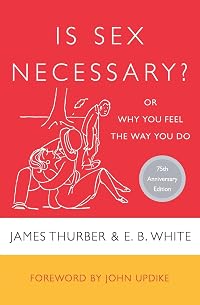
Born in Mount Vernon, New York, E. B. White was educated at Cornell University and served as a private in World War I. After several years as a journalist, he joined the staff of the New Yorker, then in its infancy. For 11 years he wrote most of the "Talk of the Town" columns, and it was White and James Thurber who can be credited with setting the show more style and attitude of the magazine. In 1938 he retired to a saltwater farm in Maine, where he wrote essays regularly for Harper's Magazine under the title "One Man's Meat." Like Thoreau, White preferred the woods; he also resembled Thoreau in his impatience and indignation. White received several prizes: in 1960, the gold medal of the American Academy of Arts and Letters; in 1963, the Presidential Medal of Freedom, the nation's highest civilian award (he was honored along with Thornton Wilder and Edmund Wilson); and in 1978, a special Pulitzer Prize. His verse is original and witty but with serious undertones. His friend James Thurber described him as "a poet who loves to live half-hidden from the eye." Three of his books have become children's classics: Stuart Little (1945), about a mouse born into a human family, Charlotte's Web (1952), about a spider who befriends a lonely pig, and The Trumpet of the Swan (1970). Among his best-known and most widely used books is The Elements of Style (1959), a guide to grammar and rhetoric based on a text written by one of his professors at Cornell, William Strunk, which White revised and expanded. White was married to Katherine Angell, the first fiction editor of the New Yorker. (Bowker Author Biography) Elwyn Brooks White was born on July 11, 1899, in Mt. Vernon, New York. After graduating from Cornell University, he worked briefly for an advertising agency and as a newspaper reporter before joining the staff of The New Yorker magazine in 1927. As a columnist for The New Yorker and a contributor to Harper's Magazine, White established a reputation as a prose stylist of exceptional elegance, clarity and wit. His interests, as reflected in his writing, were numerous and varied; his essays touched on such wide-ranging subjects as politics, farm animals, and life in New York City. White married Katharine S. Angell in 1929. They had one son, and in 1957 the family left New York for a farm in North Brookline, Maine. Writings from The New Yorker, 1927-1976 is a compilation of columns and essays produced during White's long relationship with the magazine. One Man's Meat, published in 1942, is a collection of his writings for Harper's. White adapted a short guide to English grammar and usage, The Elements of Style, from a college text written by one of his professors at Cornell, William Strunk Jr. It has sold millions of copies since it was first published in 1959 and has become a cherished resource for guidance in writing. White also co-authored Is Sex Necessary? with the humorist James Thurber, a fellow staff member at The New Yorker. E.B. White died on October 1, 1985 after succumbing to Alzheimer's. His diverse legacy also includes three children's books: Stuart Little, Charlotte's Web, and The Trumpet of the Swan. In 1970 the American Library Association presented White the Laura Ingalls Wilder Award in recognition of his "substantial and lasting contribution to literature for children." He was also awarded the Presidential Medal of Freedom in 1963 and received a special Pulitzer Prize citation for his body of work in 1970. (Bowker Author Biography) show less
Some Editions
Awards and Honors
Distinctions
Notable Lists
Series
Belongs to Publisher Series
Work Relationships
Common Knowledge
- Original publication date
- 1977
- Important places
- Maine, USA; New York, New York, USA; New York, USA; Florida, USA
- First words
- Turtle Bay, November 12, 1957 For some weeks now I have been engaged in dispersing the contents of this apartment, trying to persuade hunderds of inanimate objects to scatter and leave me alone. (Good-bye to Fourty-Eighth ... (show all)Street)
- Blurbers
- Yardley, Jonathan
Classifications
Statistics
- Members
- 1,671
- Popularity
- 13,334
- Reviews
- 22
- Rating
- (4.37)
- Languages
- Chinese, English, Spanish
- Media
- Paper, Audiobook, Ebook
- ISBNs
- 15
- ASINs
- 8