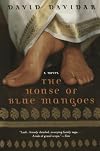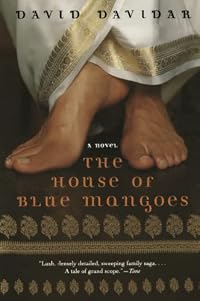
The House of Blue Mangoes: A Novel
by David Davidar
On This Page
Description
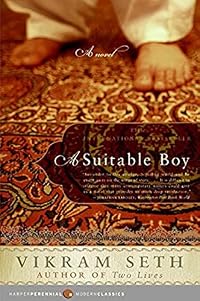
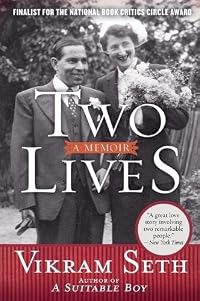
Like Vikram Seth's A SUITABLE BOY, THE HOUSE OF BLUE MANGOES tells many stories in one, each slipping effortlessly into the other and ultimately entwined. Three generations of an ancient family come and go in Chevathar, the village by the sea. First there is Solomon, the patriarch, manoevuring to keep the peace as caste struggles begin to encroach on the village. Then there is the story of Solomon's sons, their fortunes rising and falling as India begins its struggle for independence. show more Finally, there is the story of Solomon's grandson, perhaps the last of the line, making his own stand for independence. A host of characters enliven these pages - from Father Ashcroft, the English priest washed up in a forgotten corner of the empire, to Mrs Wilkins the planter's wife who clings to the old ascendancy, to Joshua, the prodigal son who leads the battle on the beach, to Daniel and Aaron, brothers at war, and to Helen, an Anglo-Indian beauty who brings about the final disintegration of the family. This is a glorious, generous, and exhilarating read. show lessTags
Recommendations

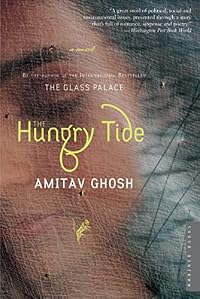
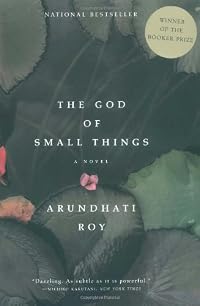
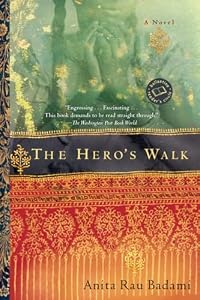
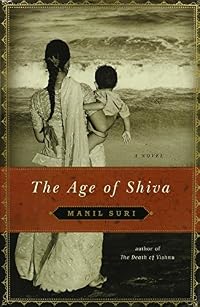













Member Reviews
Davidar, one of the founders of Penguin India, wrote this multi-generational saga of a family in South India—Davidar’s home. It is an easy read, well-plotted, informative, and pleasant. It’s not an especially thought-provoking book. Davidar is good at showing social change, and although there is some food for thought, it has a relatively narrow focus and seems most intent on the depiction of lives and intrafamily dynamics. Its themes are expected and expectable, the story line largely unsurprising, and there is an attractive wistfulness or nostalgia running throughout. Davidar has created a quite believable world, interesting characters, and just enough suspense to keep the reader engaged. If I didn’t have a to-be-read list of show more many (or maybe I should write “MANY!”) other works that I expect to challenge me more, I’d find time for one of his two other novels. I enjoyed the book, I just think I might have enjoyed something else more. show less
The House of Blue Mangos is a well told story of three generations of the "Dorai" family in South India, mostly in the modern day state of Tamil Nadu, but under the British Raj, the Madras Presidency. Davidar has a strong command of the sights, sounds, tastes and even smells of South India, and does a fantastic job of bringing these all to life. As a non-Indian currently living in South India I found that the book provided beautiful insights into the region while telling a good story.
The story itself is good, not great. As other reviewers have noted, the first section of the book about the first generation was by far the best told portion of the story. However, unlike some other reviewers, I did enjoy reading about the second and third show more generation of the Dorai family as Dravidar moves from village caste violence to "International caste violence" under the guise of Nationalism and WWII.
For the most part, Dravidar does a good job of developing the characters. The only flaw is his lack of fully explaining the decisions of the third-generation, Kannan. I often felt that his decisions were predictable and cliche, and Dravidar never fully explained how all of his decisions fit within the character mold Dravidar had developed for Kannan. His supposed "stubborn Dorai character" sometimes leads him to being fiercely loyal, and at other times led him to completely give up on certain relationships, but you never understood how that stubborness fully informed that decision.
Further, Dravidar could have made the book a bit more compelling by describing more of the changes to the South India region from the 1880s to 1946 (when the novel ends). To the reader, it almost seems as all customs and traditions remained completely static in village communities, which is certainly not accurate. Some of the characters could have fit within any generation of the story, which made it sometimes hard to believe that the novel was progressing through time. If there were no mentions of nationalism or WWII, the reader might completely forget that the story encompasses nearly a century.
In the end I thoroughly enjoyed this novel and recommend it. show less
The story itself is good, not great. As other reviewers have noted, the first section of the book about the first generation was by far the best told portion of the story. However, unlike some other reviewers, I did enjoy reading about the second and third show more generation of the Dorai family as Dravidar moves from village caste violence to "International caste violence" under the guise of Nationalism and WWII.
For the most part, Dravidar does a good job of developing the characters. The only flaw is his lack of fully explaining the decisions of the third-generation, Kannan. I often felt that his decisions were predictable and cliche, and Dravidar never fully explained how all of his decisions fit within the character mold Dravidar had developed for Kannan. His supposed "stubborn Dorai character" sometimes leads him to being fiercely loyal, and at other times led him to completely give up on certain relationships, but you never understood how that stubborness fully informed that decision.
Further, Dravidar could have made the book a bit more compelling by describing more of the changes to the South India region from the 1880s to 1946 (when the novel ends). To the reader, it almost seems as all customs and traditions remained completely static in village communities, which is certainly not accurate. Some of the characters could have fit within any generation of the story, which made it sometimes hard to believe that the novel was progressing through time. If there were no mentions of nationalism or WWII, the reader might completely forget that the story encompasses nearly a century.
In the end I thoroughly enjoyed this novel and recommend it. show less
it's always nice to be reminded that americans aren't the only racist imperialist assholes out there. i like getting some history with my fiction, so this was an interesting read.
It's a good long summer-reading type of book and there's some brushes with history and with Indian culture: food, religion, architecture. But somehow the characters were not compelling to me until I got to Kannan and that wasn't until more than halfway through the book. A huge obstacle for me was the use of unfamiliar vocabulary, especially in book 1 where you need to understand everything to get the nuance of what the characters are arguing about. Why does the author go to the trouble of putting a family tree in the front, when there are not that many people in the family, and omit the most basic glossary for non-Indian readers? If you're interested in India, this novel has aspects you don't encounter often: the time period (early 20th show more century), the region (deep south), the venues like the tea plantation and the family's home town, and the background of the family's Christian religion, all of which are interesting and nicely brought to life. show less
In 1899, in the south Indian village of Chevathar, Solomon Dorai is contemplating the imminent destruction of his world and everything he holds dear. As the thalaivar, or headman, of Chevathar, he seeks to preserve the village from both catastrophe and change, and the decisions he makes will mark his family for generations to come.
I didn't hate it, but I just could not connect with anything. It's more historical overview than story.
Heady and exotic. You can smell the seasalt as you read the first chapters and the fragrance of the tea bushes on the last chapters.
Members
- Recently Added By
Author Information

11 Works 598 Members
Common Knowledge
- Original title
- The House of Blue Mangoes
- Original publication date
- 2001
- People/Characters
- Solomon Dorai; Aaron Dorai; Daniel Dorai; Kannan Dorai; Muthu Vedhar
- Important places
- Kerala, India; India
- First words*
- Spring 1899. As the ordinary violence of dawn sweeps across the lower Coromandel coast, a sprawling village comes into view.
- Last words*
- (Click to show. Warning: May contain spoilers.)The heaviness lifts from his heart.
*Some information comes from Common Knowledge in other languages. Click "Edit" for more information.
Classifications
Statistics
- Members
- 454
- Popularity
- 66,946
- Reviews
- 8
- Rating
- (3.24)
- Languages
- 6 — Dutch, English, French, German, Italian, Spanish
- Media
- Paper, Audiobook, Ebook
- ISBNs
- 26
- ASINs
- 2