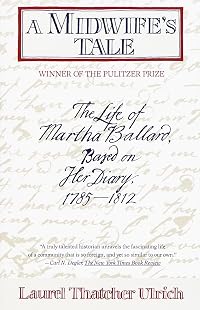
A Midwife's Tale: The Life of Martha Ballard, Based on Her Diary, 1785-1812
by Laurel Thatcher Ulrich, Martha Ballard
On This Page
Description
Drawing on the diaries of one woman in eighteenth-century Maine, this intimate history illuminates the medical practices, household economies, religious rivalries, and sexual mores of the New England frontier. Between 1785 and 1812, a midwife and healer named Martha Ballard kept a diary that recorded her arduous work (in twenty-seven years she attended 816 births) as well as her domestic life in Hallowell, Maine. On the basis of that diary, Laurel Thatcher Ulrich gives us an intimate and show more densely imagined portrait, not only of the industrious and reticent Martha Ballard but of her society. At once lively and impeccably scholarly, A Midwife's Tale is a triumph of history on a human scale. show lessTags
Recommendations












Member Recommendations

Member Reviews
Historian Laurel Thatcher Ulrich illuminates the life of Martha Ballard, a midwife who lived and worked in Hallowell, Massachusetts (what would later be Maine). She may have been forgotten and all but a footnote in history that kept records of her only in relation to her husband Ephraim, but for one thing: she kept a diary.
At the beginning of each chapter, Ulrich takes about a month's worth of entries, beginning with August 1787, and then uses an account that at first glance appears mundane, everyday comings and goings and a lot of mention of "I have been at home" to more broadly describe the people, community, and times it addresses. Whether she talks about the changing medical field where midwifery and birth was almost exclusively show more female until it became more medical than social, a rape case at which Martha gave a deposition, the ways in which men and women had distinct economic spheres in a town, or sex and marriage behavior in the late 1700s, Ulrich teases out a rich understanding of simple, everyday life not long after the U.S. was founded. show less
At the beginning of each chapter, Ulrich takes about a month's worth of entries, beginning with August 1787, and then uses an account that at first glance appears mundane, everyday comings and goings and a lot of mention of "I have been at home" to more broadly describe the people, community, and times it addresses. Whether she talks about the changing medical field where midwifery and birth was almost exclusively show more female until it became more medical than social, a rape case at which Martha gave a deposition, the ways in which men and women had distinct economic spheres in a town, or sex and marriage behavior in the late 1700s, Ulrich teases out a rich understanding of simple, everyday life not long after the U.S. was founded. show less
This is an account of the life of 18th century Maine midwife, Martha Ballard, based on the diaries/daybook that she kept. It won the Pulitzer Prize for history, and was the inspiration for Ariel Lawhorn's novel, "The Frozen River". As I had recently read that for my book club, I was interested to read a true account.
The diary was not the kind of emotional history we expect from a modern diary. It is more of a daily record of the weather, Martha's activities, and her medical call outs, as well as a rudimentary financial record. Dr. Ulrich has done an excellent job filling in the unspoken context from other accounts and records of the time.
The book is fascinating as a record of the time, and when I read about the sheer amount Martha show more Ballard did in the course of a typical day, and under what conditions, I feel like a major slacker! It is a bit dry, since the diary was in no way an autobiography, and Martha was quite circumspect when writing about her family and neighbors. But if you appreciate American history, from the often overlook perspective of women, it is well worth the reader's time. show less
The diary was not the kind of emotional history we expect from a modern diary. It is more of a daily record of the weather, Martha's activities, and her medical call outs, as well as a rudimentary financial record. Dr. Ulrich has done an excellent job filling in the unspoken context from other accounts and records of the time.
The book is fascinating as a record of the time, and when I read about the sheer amount Martha show more Ballard did in the course of a typical day, and under what conditions, I feel like a major slacker! It is a bit dry, since the diary was in no way an autobiography, and Martha was quite circumspect when writing about her family and neighbors. But if you appreciate American history, from the often overlook perspective of women, it is well worth the reader's time. show less
This is a really exemplary piece of scholarship, as Ulrich uses the diary of a rather obscure woman—Martha Moore Ballard, a midwife from the small town of Hallowell, Maine—to tease out a history of life in late eighteenth century America. Ulrich uses the diary as a springboard to talk about a wide range of social and political issues—everything from sexual morality (40% of the deliveries Martha carried out were births to unmarried women!) to changes in attitudes towards medicine to politics and religion—comparing and contrasting it with other surviving (male-authored) sources from the time.
The picture we get is of a world in which women had much greater involvement in the social and economic life of their communities than show more "traditional" historical narratives would have us believe. There are no "angels in the home" here, just women trying their best to make a living despite domestic strife and political turmoil. Ulrich writes clearly and I think how she uses her evidence is a model for all historians, no matter the field, because of how measured and balanced she is. Fascinating, and an impressive accomplishment—Ulrich has really succeeded in bringing back to life a woman who would otherwise be largely forgotten. show less
The picture we get is of a world in which women had much greater involvement in the social and economic life of their communities than show more "traditional" historical narratives would have us believe. There are no "angels in the home" here, just women trying their best to make a living despite domestic strife and political turmoil. Ulrich writes clearly and I think how she uses her evidence is a model for all historians, no matter the field, because of how measured and balanced she is. Fascinating, and an impressive accomplishment—Ulrich has really succeeded in bringing back to life a woman who would otherwise be largely forgotten. show less
This is an amazing book that I highly recommend. It's non-fiction based on a diary written by a midwife living in Maine at the end of the 18th century. Thatcher starts each chapter with 2-4 weeks of diary entries. These are generally 1-4 sentences describing the weather, how she felt, what she did (spun wool, planted beans, etc.), and if she delivered any babies she'd account for how she got there, how the mother and child did, and when she got paid. It is 27 years of a daily account of her life which can sound rather mundane, but Thatcher pulls an amazing amount of information out of this diary. She covers everything: midwife practices, the shift from midwives to doctors, a history of the settlement of Maine, a local murder, a local show more rape and the court proceedings that followed, debtors prisons, family relations, and the role of women in the local economy. As a midwife, Martha Ballard presided over more than 800 deliveries, only losing one mother. While Thatcher explores all of these topics through Martha's words, she never loses Martha's voice. This is so worth reading! show less
Laurel Thatcher Ulrich is a historian's historian, and a gifted writer. Not only has she brought to light a marvellous document of life in America's past, she has also used her considerable scholarship to add depth and clarity to what would otherwise be an obscure journal of an unknown woman. Reading it, you are so caught up in the lucid way in which she highlights the details of Martha's story that it is easy to miss the incredible amount of research, study, and analysis that made it all possible. An impressive and important accomplishment, and a wonderfully readable book.
This book is very interesting way to learn about everyday life in America in the late 1700's-early 1800s. The extracted diary entries themselves are not that interesting; it is Ulrich's extrapolation of events in Martha's life that makes it so. She ties in information from other entries not presented, writings from other contemporaries (usually men), and historical documents to make a cohesive subject. Each chapter seems to develop a specific theme, e.g. medical practice, crime & punishment, marital customs, gardening, local economy and women's contributions, the rebellion of squatters trying to settle land owned by a major corporation. It countered my current assumptions that "women weren't educated" or "women with children out of show more wedlock were shunned".
While I didn't read all the diary extracts, looking at Martha's spelling was quite interesting and made me wonder that maybe the current theory of encouraging young students to write without regard to spelling might be an excellent way to get them to express themselves.
I hope that Ulrich left a transcript of the diary with the Maine Historical Society for future researchers use. show less
While I didn't read all the diary extracts, looking at Martha's spelling was quite interesting and made me wonder that maybe the current theory of encouraging young students to write without regard to spelling might be an excellent way to get them to express themselves.
I hope that Ulrich left a transcript of the diary with the Maine Historical Society for future researchers use. show less
Excellent use of a rare diary of a woman, a self-described "gadder" — a woman who leaves home frequently to interact with neighbors — and a woman whose medical work impinged on the very separate world of men. The writing is fluid and fascinating, neither pedantic nor glib; Ms. Ulrich offers questions where questions are all we can have and suggests possibilities where she has support from within Ballard's diary or from other sources. Her footnotes are great, and support rather than interfere with the text if you're a reader who prefers to read the entire chapter/ book and then look at attributions, explanations, etc. I really enjoyed this book, and learned a lot from it.
Members
- Recently Added By
Lists

Must-Read Maine
146 works; 91 members

Ten books that most shaped your view of history
91 works; 12 members

One Book, Many Authors
441 works; 40 members

500 Great Books by Women
507 works; 60 members

Books Read in 2017
4,249 works; 130 members

r/AskHistorians' Recommended Books
1,068 works; 19 members

Club Read's Recommended Nonfiction Written by Women
618 works; 30 members

Best Biographies of Notable Women
279 works; 101 members

The Well-Educated Mind, Susan Wise Bauer, 2016
179 works; 3 members

Books That Changed Our Perspective
423 works; 168 members

Books recommended in the history category on FiveBooks.com
329 works; 4 members
Author Information

14+ Works 4,848 Members
Laurel Thatcher Ulrich is Phillips Professor of Early American History at Harvard University.

1+ Work 2,448 Members
Some Editions
Awards and Honors
Awards
Notable Lists
Work Relationships
Has the adaptation
Inspired
Common Knowledge
- Original title
- A Midwife’s Tale: The Life of Martha Ballard, Based on Her Diary, 1785–1812
- Original publication date
- 1990
- People/Characters
- Martha Ballard
- Important places
- Hallowell, Maine, USA; Augusta, Maine, USA; Kennebec River Valley, Maine, USA
- Related movies
- American Experience: A Midwife's Tale (1998 | IMDb)
- Dedication
- For Gael
- First words
- [Introduction] Eight months of the year Hallowell, Maine, was a seaport.
Clear and very hot.
[Epilogue] That Martha Ballard kept her diary is one small miracle; that her descendants saved it is another. - Quotations
- A house could be an adversary. Turn your back, and it rippled into disorder. Chairs tipped. Candles slumped. Egg yolks hardened in cold skillets. Dust settled like snow. Only by constant effort could a woman conquer her po... (show all)ssessions....scrubbing floors and linens into subjection, she restored a fragile order to a fallen world. (p.219)
A family labor system was inherently cyclical. A couple spent their first years of marriage raising workers and their last bereft of help. The middle years were the harvest time of family life: a man who was unable to clear... (show all) his land or fence his fields when he had grown sons at home would not have a second chance...(p.220) - Last words
- (Click to show. Warning: May contain spoilers.)[Epilogue] Ballard's diary rests safe in a vault at the Maine State Library, a monument to a remarkable life and a testimony to the fragile web that connects one generation with another.
(Click to show. Warning: May contain spoilers.)[Introduction] Knowing this much, the reader is prepared to open Martha Ballard's book. It is August 1787. The Kennebec flows calm and blue to the sea.
(Click to show. Warning: May contain spoilers.)No gravestone bears her name, though perhaps somewhere in the waste places along Belgrade Road there still grow clumps of camomile or feverfew escaped from her garden. - Blurbers
- Innes, Stephen
- Original language
- English
Classifications
- Genres
- History, Nonfiction, General Nonfiction, Biography & Memoir, Sexuality and Gender Studies
- DDC/MDS
- 974.16 — History & geography History of North America Northeastern United States (New England and Middle Atlantic states) Maine Kennebec
- LCC
- F29 .H15 .U47 — Local History of the United States, Canada and Latin America United States local history Maine
- BISAC
Statistics
- Members
- 2,450
- Popularity
- 7,947
- Reviews
- 37
- Rating
- (4.10)
- Languages
- English, Italian, Swedish
- Media
- Paper, Audiobook, Ebook
- ISBNs
- 14
- ASINs
- 13