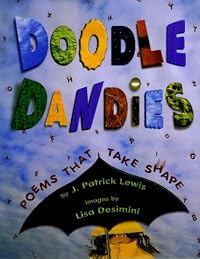
Doodle Dandies: Poems That Take Shape
by J. Patrick Lewis
On This Page
Description
A collection of poems each of which appears on the page in the shape of its subject so that the poem looks like whatever it's about.Tags
Recommendations


Member Reviews
Words and pictures effectively conjures images from seasons, to sports, to the jungle. Lines about a skyscraper take the form of that structure ("I /am/ a/ nee/dle /of/steel/glass &/cement...") and are set against a background of a clouded sky, small silhouettes of pedestrians, and rows of taxis. Every page of this book is well designed, creating words and images that work together in harmony. love this poetry book from beginning to end!
I thought this was a really fun way to introduce poetry to younger children. The way it is written is great. Each of the poems are either in shapes of the subject they are talking about or placed on interesting images. For example, there is a poem about a skyscraper; the words in the poem form an actual skyscraper. Overall the poems themselves are truly engaging and relate-able for a young reader. Each is written about something a child may think about. Baseball, tigers, skyscrapers are a few of the subjects. This book does not really have a message that it gives the reader, but more so provides them with an opportunity to become engaged in poetry at a young age.
In my opinion, this is a good book. The writing is engaging and organized. Each poem is unique because each is written in specific shape based on the poems subject. For example, there is a poem called “Dachshund” that is about a lady walking a dog that looks like “a sausage on a string”. This poem is written in brown letters in the shape of a dachshund. Another example is the poem called “giraffe” which describes a “tree-tall giraffe up to his neck in brown and yellow patchwork quilts”. This poem is written in yellow and orange letters in the shape of a giraffe. The way these poems are written makes readers follow the words in a specific shape in order to give them a sense of what the animal looks like. Another reason I show more think this is a good book is because the illustrations enhance the story. The poem called “weeping willow” says, “In a far field of sadness stands the wee widow weeping”. The illustration that corresponds to this text shows a woman wearing all black who is covering her face with her hands. This illustration makes me feel the sadness the woman is feeling because her appearance and body language expresses her dull emotions. The big idea of this story is to show readers how to powerfully use form in poetry. The author used shapes, bold colors, and detailed illustrations in order to give her poetry an intriguing form. This shows readers the impact form has on poetry. show less
Lewis's "Doodle Dandies: Poems That Take Shape" is a fun poetry book where the poem's subject is illustrated by the words in the poem. There is a different poem on each page; subjects ranging from animals, seasons, sports, and nature. The author uses a unique style of imagery, giving the reader an idea of what the poem's subject would be like. I thought the way he placed his words to create the shape of the subject of his poem would make a child excited to read.
I really liked this book, but some of the poems made me second guess my liking. I really liked the patterned language in the poems, the illustration style always fits the written text, but overall the book was not organized very well. The first thing I really liked was how the author patterned their writing, as each poem followed one theme, and how the writing was put down on the pages followed that. An example of this with the butterfly poem, the author uses fulfiller to rhythm with caterpillar, in the shape of butterfly. This also plays into why I like the illustrations; the author uses the poems to help create the illustrations. One clear example of this is the weeping willow poem as it has the poem flowing down as a weeping willow show more and shows the girl of the story, standing under the willow just like in the story. The only thing I really did not like is how disorganized the book was; some poems were a page, others just 6 words. For example, the tiger poem is 10 words and very short, where the frog poem a few pages later was 50+ words. I feel like the author could have organized it better and have had all of the poems be around the same. The main message for this book is that poems can be fun, short, long, but all poems are interesting and a new way to learn knowledge. show less
I would use this in a first or second grade classroom, because the poems take the shape of the subject. This can make it easier for students to understand the poem, and it may get them interested in poetry at a younger age. I would also use this in third, fourth, or maybe even fifth grade, because it is a good introduction to form. Form is what really makes a poem a poem, and concrete poems are very obvious examples of that.
I absolutely love this book for many reasons! First, it's a fun way to read poetry since the poems take shape with the context of the poem. For example, there is a poem about a giraffe and the words on the page form a picture of a giraffe. Second, the illustrations in this book are well done. They are eye catching and they create visuals for the poems. The main idea for this book is to learn about poetry in a fun way.
Members
- Recently Added By
Author Information

116+ Works 7,791 Members
J. Patrick Lewis was born on May 5, 1942. He is a poet and prose writer who is known for his children's poems. He worked as a professor of economics before devoting himself full-time to writing in 1998. He is the author of 90 children's books including: BoshBlobberBosh, Please Bury Me in the Library, A Hippopotamusn't, First Dog, Spot the Plot, show more The House, and The National Geographic Book of Animal Poetry. In 2014, his title Voices from the March on Washington, made the Hot Civil Rights Titles List. He has received many awards from the American Library Association, The Golden Kite Award from the Society of Children's Book Writers and Illustrators, the Claudia Lewis Award from The Bank Street School and others. He also received the 2010-11 National Council of Teachers of English (NCTE) Excellence in Children's Poetry Award. He was also named the third, U.S. Children's Poet Laureate for 2011-2013 by the Poetry Foundation in Chicago. (Bowker Author Biography) show less
All Editions
Awards and Honors
Awards
Common Knowledge
- Canonical title
- Doodle Dandies: Poems That Take Shape
Classifications
- Genres
- Poetry, Children's Books, Fiction and Literature, Picture Books
- DDC/MDS
- 811.54 — Literature & rhetoric American literature in English American poetry in English 20th Century 1945-1999
- LCC
- PS3562 .E9465 .D66 — Language and Literature American literature American literature Individual authors 1961-
- BISAC
Statistics
- Members
- 501
- Popularity
- 59,793
- Reviews
- 40
- Rating
- (3.69)
- Languages
- English
- Media
- Paper
- ISBNs
- 8