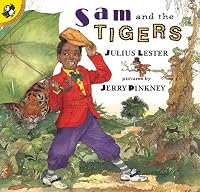
Sam and the Tigers; A New Telling of 'Little Black Sambo'
by Julius Lester
On This Page
Description
Follows the adventures of a little boy named Sam when he matches wits with several tigers that want to eat him.Tags
Recommendations


Member Reviews
An imaginative retelling of Little Black Sambo, with great illustrations. My only quibble was with the characters all being named Sam. At first I thought, this is brilliant! This is so folkloric or archetypal or something--it's like Brer Rabbit being all rabbits, or Brer Wolf representing all wolves. Sam is all people! But when I read it aloud to the kids, they were confused over which Sam was speaking or acting.
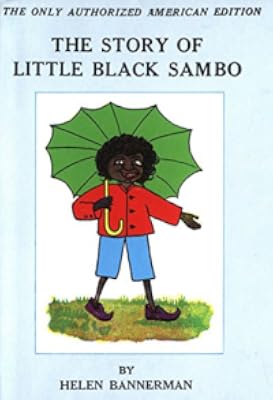
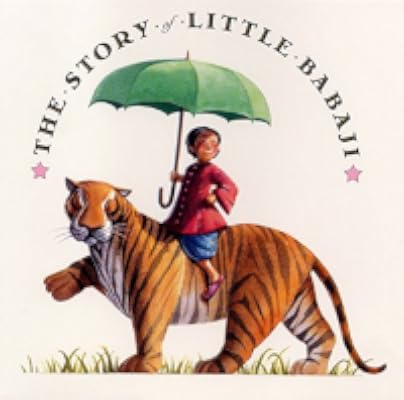
First things first - this is, as the title makes clear, a retelling of Little Black Sambo. If you're interested in a retelling that's closer to the original (it's the same text, but with modern illustrations and different names) try The Tale of Little Babaji.
Having read the original text of Little Black Sambo (which is hardly banned - you can find it at Project Gutenberg online), and the text of Little Babaji, I can see why people liked it. Aside from the unfortunate names and illustrations, it's a cute story. It is! As the author and illustrator note in their foreword and afterword, the author never meant to write a racist story and you're not racist if you loved hearing it from your mom when you were a kid.
(Those same foreword and show more afterword informed me that there are over FIFTY versions of the "original" Little Black Sambo, with 50 different sets of illustrations. Must have been a really popular book.)
At home, we have a copy of Little Babaji, and a copy of Sam and the Tigers. (We also have read 5 versions of Cinderella, 2 of Seven in one Blow, 4 of Rapunzel, 3 of Hansel and Gretel, 2 of The Gingerbread Man, and 2 of Rumpelstiltskin. But who's counting?) Any story which has existed long enough to enter into the public domain is going to find itself with multiple tellings. This is a good thing - everybody in the world alters stories to suit their tastes. We all read the same book, but we get different messages out of it. I love it!
And you know what else I love? I love this version. The original is a cute story, but this version expands upon it and fleshes things out better. Sam has a bit of attitude, something I always appreciate in my storybook characters. Sam's parents being named Sam and Sam makes for a couple of funny pages in the start of the book. The neighbors talking about the tigers' mysterious disappearance makes me giggle. In truth, this is a superior story. Not because it's "more PC", but because there's just more detail and more STORY there (and you can't beat those illustrations!)
So before you get your knee-jerk reaction of "OMG THEY RUINED IT!" (or maybe "OMG THE ORIGINAL WAS A HORROR, WHY DO THIS???") try it out with open eyes. Pretend it's a brand-new book - and maybe you'll like it after all.
(If not - go to google and get a printer. Honestly, nothing has been banned or censored, the original is simply not in print anymore.) show less
Having read the original text of Little Black Sambo (which is hardly banned - you can find it at Project Gutenberg online), and the text of Little Babaji, I can see why people liked it. Aside from the unfortunate names and illustrations, it's a cute story. It is! As the author and illustrator note in their foreword and afterword, the author never meant to write a racist story and you're not racist if you loved hearing it from your mom when you were a kid.
(Those same foreword and show more afterword informed me that there are over FIFTY versions of the "original" Little Black Sambo, with 50 different sets of illustrations. Must have been a really popular book.)
At home, we have a copy of Little Babaji, and a copy of Sam and the Tigers. (We also have read 5 versions of Cinderella, 2 of Seven in one Blow, 4 of Rapunzel, 3 of Hansel and Gretel, 2 of The Gingerbread Man, and 2 of Rumpelstiltskin. But who's counting?) Any story which has existed long enough to enter into the public domain is going to find itself with multiple tellings. This is a good thing - everybody in the world alters stories to suit their tastes. We all read the same book, but we get different messages out of it. I love it!
And you know what else I love? I love this version. The original is a cute story, but this version expands upon it and fleshes things out better. Sam has a bit of attitude, something I always appreciate in my storybook characters. Sam's parents being named Sam and Sam makes for a couple of funny pages in the start of the book. The neighbors talking about the tigers' mysterious disappearance makes me giggle. In truth, this is a superior story. Not because it's "more PC", but because there's just more detail and more STORY there (and you can't beat those illustrations!)
So before you get your knee-jerk reaction of "OMG THEY RUINED IT!" (or maybe "OMG THE ORIGINAL WAS A HORROR, WHY DO THIS???") try it out with open eyes. Pretend it's a brand-new book - and maybe you'll like it after all.
(If not - go to google and get a printer. Honestly, nothing has been banned or censored, the original is simply not in print anymore.) show less
This book was truly exceptional. The storytelling was rich and full of strong figurative language, and the research done to bring the story to life in this vibrant retelling was equally impressive. I truly enjoyed this book and would recommend it to anyone looking for strong similes as well as a good story.
Sam lives in a town where animals and people live and work alongside each other and everyone is named “Sam”. On his way to school, the colorfully-clad boy encounters hungry tigers threatening to eat him up. One by one, Sam outsmarts the tigers – but will he make it safely to his classroom? Julius Lester’s rich retelling of the controversial “Little Black Sambo” honors the elements from the original tale he loved as a child, while adding newer, fresher language and leaving the stereotypes behind. There is extensive explanation printed within the storybook’s inside covers and introduction that validates Lester’s intentions to save an imaginative story that was written in the wrong time and place and criticized for decades show more as racist and bigoted. His matchless black southern storytelling brightens up the pages and makes the reader admire all the characters and their lives. Award winning illustrator Jerry Pinkney’s gorgeous pencil and watercolor drawings lend emotion and beauty to every page. His sweeping brush strokes and vibrant color choices bring the jungle (and the tigers!) to life on the page. Over 50 versions of the story have been printed, but now little Sam has finally found an appropriate and endearing resting place that permits today’s children to fall in love with the classic tale without hesitation. Recommended for ages 3-7. show less
A retelling of Little Black Sambo in a southern African-American storytelling voice. The illustrations and the words are humorous from the start. The reader laughs with Sam and not at Sam. That helps to rid the story of its negative reputation. There’s a reference to Brer Rabbit, the trickster from African-American folktales. It is as if this modern version is now legitimately recognized as a folktale. The true trickster in this story is Sam, the boy who outwits the tigers.
Imagine animals and people living together in a town that doesn't require people to have more than one name... a world where you can be different, and others will accept you for who you are. Imagine a world where purple, red, green and silver match, and tigers actually want your clothes. Find the humor in Sam and the Tigers and you can look past the undeniable dialect and controversy this book may have caused. Use it to teach children that no two people are the same, and that while we may speak one way, others may not. Use Sam as a lesson, and use his story as reason to laugh and feel good inside and you can't go wrong. Let your problems "pool" around you and choose what you will let inside. Sam eats his issues. Similiarly, we can teach show more children to "deal" with theirs. show less
Lester rewrites Little Black Sambo to take back it's hero for young black readers. And what a great job he does, aided nobly by Jerry Pinkney's hilarious illustrations. As he says in his introduction, who can resist a story in which tigers turn into lovely stripey butter? And he reclaims the name Sam by giving the name to everyone in the story.
Members
- Recently Added By
Lists

Children's picture books with kids of color
129 works; 15 members

Black Authors
386 works; 32 members

Early Picture Books
467 works; 9 members
Author Information

56+ Works 11,088 Members
Julius Bernard Lester was born in St. Louis, Missouri on January 27, 1939. He received a bachelor's degree in English from Fisk University in 1960. He moved to New York to become a folk singer. He performed on the coffeehouse circuit as a singer and guitarist. He released two albums entitled Julius Lester in 1965 and Departures in 1967. His first show more published book, The Folksinger's Guide to the 12-String Guitar as Played by Leadbelly written with Pete Seeger, was published in 1965. In the 1960s, Lester was closely involved as a writer and photographer with the Student Nonviolent Coordinating Committee. He traveled to the South to document the civil rights movement and to North Vietnam to photograph the effects of American bombardment. He also hosted radio and television talk shows in New York City. He wrote more than four dozen nonfiction and fiction books for adults and children. His books for adults included Look Out, Whitey!: Black Power's Gon' Get Your Mama, Revolutionary Notes, All Is Well, Lovesong: Becoming a Jew, and The Autobiography of God. His children's books included To Be a Slave, Sam and the Tigers, and Day of Tears: A Novel in Dialogue, which won the American Library Association's Coretta Scott King Award in 2006. He also wrote reviews and essays for numerous publications including The New York Times Book Review, The Boston Globe, The Village Voice, Dissent, The New Republic, and the Los Angeles Times Book Review. After teaching for two years at the New School for Social Research in New York, Lester joined the faculty of the University of Massachusetts, Amherst in 1971. He originally taught in the Afro-American studies department, but transferred to the Judaic and Near Eastern studies department when Lester criticized the novelist James Baldwin for what he felt were anti-Semitic remarks. He died from complications of chronic obstructive pulmonary disease on January 18, 2018 at the age of 78. (Bowker Author Biography) show less
All Editions
Awards and Honors
Awards
Distinctions
Work Relationships
Is contained in
Is a retelling of
Common Knowledge
- Canonical title
- Sam and the Tigers; A New Telling of 'Little Black Sambo'
- Original publication date
- 1996
- Dedication
- To the Internet and those on rec.arts.books.children and Child Lit -JL ///For my grandchildren and those who share stories generation to generation -JP
- First words
- Once upon a time there was a place called Sam-sam-sa-mara, where the animals and the people lived and worked together like they didn't know they weren't supposed to.
Classifications
Statistics
- Members
- 562
- Popularity
- 52,800
- Reviews
- 23
- Rating
- (3.90)
- Languages
- English
- Media
- Paper
- ISBNs
- 12
- ASINs
- 3