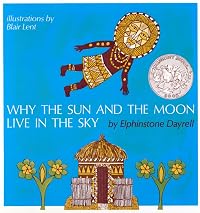
Why the Sun and the Moon Live In the Sky
by Elphinstone Dayrell, Blair Lent (Illustrator)
On This Page
Description
An African folktale tells how the sun and water once lived on earth as friends, but because the sun failed to build his house large enough, he and his wife, the moon, were driven into the sky when the water came to visit them.Tags
Recommendations













Member Reviews
The reason for the sun and moon living in the sky is set out in this picture book retelling of a traditional pourquoi story from Nigeria. Despite being good friends, Sun is unable to host his friend Water, because he does not possess a structure large enough to do so. Deciding to rectify this, Sun and his wife Moon build a large house, and invite their friend over, insisting that more and more of his people enter their house. As the house fills with water, Sun and Moon must climb higher and higher, eventually ending up on the roof, and then in the sky...
Published in 1968, Why the Sun and the Moon Live in the Sky pairs a story from Elphinstone Dayrell's 1910 collection, Folk Stories from Southern Nigeria, West Africa, with artwork from show more American children's book illustrator Blair Lent. A British civil servant who was the District Commissioner of southern Nigeria in the early 20th century, Dayrell apparently gathered traditional tales in the region, and had two collections published in his lifetime. The story presented here was taken from the Efik-Ibibio people. The text in this picture book presentation is almost exactly that of the 1910 collection, and is brief and to the point. Although I also enjoy more textually complex tales, I appreciated the brevity and matter-of-factness of this story, as I suspect it reflects the way in which it was originally related to Dayrell. True folktales, particularly those taken from oral tradition, are not always as polished as literary fairy-tales, and may reflect the storytelling traditions and methods from which they spring.
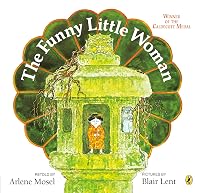
While enjoyable, this title would not have been such a stand-out for me, without the artwork from Lent, who was awarded a Caldecott Honor for the book, in 1969. Lent would go on to win a Caldecott Medal in 1973, for Arlene Mosel's The Funny Little Woman. In any case, I thought the artwork here was striking, and appreciated the way in which the figures of the Sun, Moon and Water were anthropomorphized, depicted as humans wearing traditional masks. I also appreciated the brief note at the end, indicating that the visual motifs used were inspired by various African traditions, rather than reflecting a specific Nigerian or Efik-Ibibio aesthetic. While the latter would have been interesting, I appreciate the transparency of the artist, in noting that his work was not taken from that tradition specifically.
All in all, this was an engaging read, and is a book I would recommend to young folklore enthusiasts. For my part, I hope to track down and reader Elphinstone Dayrell's larger collection of tales. show less
Published in 1968, Why the Sun and the Moon Live in the Sky pairs a story from Elphinstone Dayrell's 1910 collection, Folk Stories from Southern Nigeria, West Africa, with artwork from show more American children's book illustrator Blair Lent. A British civil servant who was the District Commissioner of southern Nigeria in the early 20th century, Dayrell apparently gathered traditional tales in the region, and had two collections published in his lifetime. The story presented here was taken from the Efik-Ibibio people. The text in this picture book presentation is almost exactly that of the 1910 collection, and is brief and to the point. Although I also enjoy more textually complex tales, I appreciated the brevity and matter-of-factness of this story, as I suspect it reflects the way in which it was originally related to Dayrell. True folktales, particularly those taken from oral tradition, are not always as polished as literary fairy-tales, and may reflect the storytelling traditions and methods from which they spring.
While enjoyable, this title would not have been such a stand-out for me, without the artwork from Lent, who was awarded a Caldecott Honor for the book, in 1969. Lent would go on to win a Caldecott Medal in 1973, for Arlene Mosel's The Funny Little Woman. In any case, I thought the artwork here was striking, and appreciated the way in which the figures of the Sun, Moon and Water were anthropomorphized, depicted as humans wearing traditional masks. I also appreciated the brief note at the end, indicating that the visual motifs used were inspired by various African traditions, rather than reflecting a specific Nigerian or Efik-Ibibio aesthetic. While the latter would have been interesting, I appreciate the transparency of the artist, in noting that his work was not taken from that tradition specifically.
All in all, this was an engaging read, and is a book I would recommend to young folklore enthusiasts. For my part, I hope to track down and reader Elphinstone Dayrell's larger collection of tales. show less
This is an interesting story regarding the creation of the world. I feel that the illustrations make this book more than the sum of its words. The illustrations are closely tied to the native cultures of Africa where this tale originated. The characters are portrayed in tribal masks and dress like they may have when first performing this story.
Why the Sun and the Moon Live in the Sky is a spunky, multicultural book that informs the reader about African culture and tradition. I like this book because it provides yet another different culture for kids to learn about. This would be suitable for kids in grades 1-4 for a unit on culture.
I was fortunate to have stumbled upon this delightful African folktale when I was browsing the folk story section at the library.
Here is a wonderful little story about why the sun and the moon live in the sky and not on Earth with the water. Sun and his wife Moon invited Water and his tribe to come visit them in their home. Water and his tribe came and were welcomed, and then they kept coming and coming and coming until the home of Sun and Moon filled up entirely with water and they were displaced up, up, up into the sky.
The drawings are richly detailed and colorful. It's a wonderful tale.
My only complaint is that the story ended too soon. I would have liked some kind of resolution between Sun, Moon and Water. The end of the story show more kind of leaves the reader hanging. That said, it's a fun, bedtime read. show less
Here is a wonderful little story about why the sun and the moon live in the sky and not on Earth with the water. Sun and his wife Moon invited Water and his tribe to come visit them in their home. Water and his tribe came and were welcomed, and then they kept coming and coming and coming until the home of Sun and Moon filled up entirely with water and they were displaced up, up, up into the sky.
The drawings are richly detailed and colorful. It's a wonderful tale.
My only complaint is that the story ended too soon. I would have liked some kind of resolution between Sun, Moon and Water. The end of the story show more kind of leaves the reader hanging. That said, it's a fun, bedtime read. show less
In Why the Sun and the Moon Live in the Sky, "Water" visits "Sun" (and "Sun's" wife "Moon") but there is no room for "Water" to come into "Sun's" house. "Sun" builds progressively bigger and bigger houses to try and allow "Water" to visit but eventually so much "Water" comes in that it forces "Sun" and "Moon" onto the roof of the house and up into the sky. I like this book for its humor and because of its unique and interesting aztec-like illustrations, for which the book won a Caldecott honor. I would want to use this book in my teaching to discuss legends, and more specifically themes surrounding pourquoi stories, with Grades 1-4.
This traditional tale is a tribal 'pourquoi' (por-kwa: french for 'why' - an old legend told to explain why something is the way it is) sharing how the Sun and the Moon came to live in the sky from an African point of view. While the story is decent, albeit predictable (following the typical format of this type of folklore), the illustrations really bring it to life! The use of cool tones (blues and greens) to represent the water is in perfect contrast to the warm, golden hues of the sun characters and bright white (silver?) tones of the moon character. Additionally, the detail paid to each individual water character (shape, line, pattern) is a marvel to behold as well.
The district commissioner of Southern Nigeria, Elphimstone Dayrell, show more first heard this story from the people of his region, the Efik-Ibibio, and recorded it in his book Folk Stories from Southern Nigeria, West Africa in 1910. The Illustrator, Blair Lent (who one a Caldecott Honor for his authentic depiction of tribesmen dressed to represent the elements and creatures of the sea) says his pictures are influenced by all of Africa and not one single tribe or country. show less
The district commissioner of Southern Nigeria, Elphimstone Dayrell, show more first heard this story from the people of his region, the Efik-Ibibio, and recorded it in his book Folk Stories from Southern Nigeria, West Africa in 1910. The Illustrator, Blair Lent (who one a Caldecott Honor for his authentic depiction of tribesmen dressed to represent the elements and creatures of the sea) says his pictures are influenced by all of Africa and not one single tribe or country. show less
I loved this version of the old African folk tale about how the sun and the moon came to live in the sky mostly because of the beautifully rendered illustrations, which are fairly one-dimensional, and reference those paintings which might have been found long ago in African cultures. This tale tells how the sun and the moon invited the water to their house, but it wasn't big enough to hold all of them. They built a bigger house, and water invited his friends from the sea to join in the party, and now there was no longer room for the sun and the moon, so they went up onto the roof. The creatures of the sea and the water also went up to the roof when the space filled below, and as a result, the sun and the moon had to move into the sky, show more where they have remained ever since. This tells a simple story which would complement a study of African culture or of folktales, and would be excellent to read as well if the them of friendship were being explored. show less
Members
- Recently Added By
Lists

Caldecott Honor Books
296 works; 23 members

African American
99 works; 3 members

Books Read in 2023
5,547 works; 145 members

Children's Picture Books
188 works; 1 member
Author Information
7+ Works 1,254 Members

Author and illustrator Blair Lent was born on January 20, 1929 in Boston, Massachusetts. He received a degree in art from the Boston Museum School in 1953. He travelled to Switzerland and Italy on a study grant and then worked for the Container Corporation of America designing tin-can labels and for the Bresnick Advertising Company designing bank show more loan advertisements. He wrote and illustrated Pistachio, which was published in 1964. He also wrote and illustrated John Tabor's Ride (1966); Baba Yaga (1966) using the name Ernest Small; Bayberry Bluff (1987); Molasses Flood (1992); and Ruby and Fred (2000). He specialized in illustrating international folk tales retold by other writers including The Wave (1964); Tikki Tikki Tembo (1968); Why the Sun and the Moon Live in the Sky (1968); Little Match Girl (1968); and The Funny Little Woman, which won the Caldecott Medal in 1973. He died of pneumonia on January 27, 2009 at the age of 80. (Bowker Author Biography) show less
Awards and Honors
Common Knowledge
- Canonical title
- Why the Sun and the Moon Live In the Sky
- Original publication date
- 1968
- People/Characters
- The Sun; The Moon; Water
- Important places
- Africa; Nigeria
- First words
- Many years ago the sun and water were great friends, and both lived on the earth together.
- Last words
- (Click to show. Warning: May contain spoilers.)The water very soon overflowed the top of the roof, and the sun and moon were forced to go up into the sky, where they have remained ever sine.
Classifications
Statistics
- Members
- 1,232
- Popularity
- 20,044
- Reviews
- 64
- Rating
- (3.73)
- Languages
- Chinese, English
- Media
- Paper, Audiobook
- ISBNs
- 11
- UPCs
- 2
- ASINs
- 6
