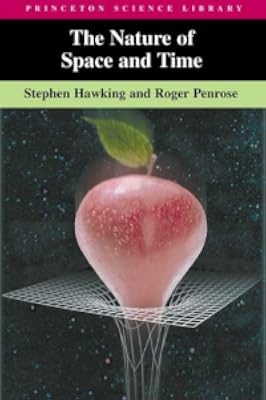
The Nature of Space and Time
by Stephen Hawking, Roger Penrose
On This Page
Description
Einstein said that the most incomprehensible thing about the universe is that it is comprehensible. But was he right? Can the quantum theory of fields and Einstein's general theory of relativity, the two most accurate and successful theories in all of physics, be united into a single quantum theory of gravity? Can quantum and cosmos ever be combined? In The Nature of Space and Time, two of the world's most famous physicists-Stephen Hawking (A Brief History of Time) and Roger Penrose (The show more Road to Reality)-debate these questions.The authors outline how their positions have further diverged on a number of key issues, including℗ the spatial geometry of the universe, inflationary versus cyclic theories of the cosmos, and the black-hole information-loss paradox. Though much progress has been made, Hawking and Penrose stress that physicists still have further to go in their quest for a quantum theory of gravity. show lessTags
Recommendations





Member Reviews
This delightful little volume is essentially the transcript of a series of lectures given by Stephen Hawking and Roger Penrose at the Isaac Newton Institute in Cambridge. While given to a technical audience, the book is fairly readable. Still, the more you know about general relativity, the more you will get out of it. I read it when I was a teenager and enjoyed it, even if I was often pretty puzzled. Even now, after obtaining a PhD in physics, I can still enjoy it and I am only a little bit puzzled.
"I have emphasized what I consider the two most remarkable features that I have learned in my research on space and time: (1) that gravity curls up space-time so that it has a beginning and an end; (2) that there is a deep connection between gravity and thermodynamics that arises because gravity itself determines the topology of the manifold on which it acts".
In “The Nature of Space and Time by Stephen Hawking and Roger Penrose” by Stephen Hawking in the lecture "Quantum Cosmology"
"We should think of twistor space as the space in terms of which we should describe physics."
In “The Nature of Space and Time by Stephen Hawking and Roger Penrose” by Roger Penrose in the lecture "The Twistor View of Spacetime"
"These lectures have show more shown very clearly the difference between Roger and me. He's a Platonist and a positivist. He's worried that Schrödinger's cat is in a quantum state, where it is held alive and held dead. He feels that can't correspond to reality. But that doesn't bother me. I don't demand that a theory correspond to reality because I don't know what it is. Reality is not a quality you can test with litmus pap. All I'm concerned with is that the theory should predict the results of measurements. Quantum theory does this very successfully. It predicts that the result of an observation is either that the cat is alive or that it is dead. It is like you can't be slightly pregnant: you either are or you aren't."
In “The Nature of Space and Time by Stephen Hawking and Roger Penrose” by Stephen Hawking in the lecture "The Debate"
Can I write a review on such a book? Hawking and Penrose... It's staggering...I don't even know what day the mailman comes...After having re-read this oldie after Hawking's passing, I'd say it depends on where you are in the universe, whether you're on/near some sizeable object (of mass), its rotation, distance from other masses, or whether you live in my neck of the woods...When in doubt I always follow "the flat earth" rule (Medieval behaviour is so "in" now). The world is the centre of (my own)) universe that you/I live in and it's getting flatter everyday. Which hopefully means you can see further and observe when others perform the same behaviour. Or ask them. Preferably in a suit of armour while riding a horse. Possibly a lance too. (Until you understand the society you live in). I'm all for a flat and cubist planet! Our time is here! And it'd be easier to fence. And we could launch spaceships off the corners. Uncannily, the mailman knows when I'm on the phone, asleep or having a quiet moment on the throne...I sniff a time conspiracy here (*It'll End in Tears theme music*)
When it comes to Quantum Theory, the math in the book includes every possible outcome, and the predictions it makes are simply probabilities - e.g. there's a 1% chance X will happen, 90% chance Y will happen and 9% chance Z will happen. How you choose to interpret this is still up for grabs, if you go with Everett's "Many Worlds Interpretation" idea then all possibilities are equally real and actually happen in different universes; if you go with the Copenhagen Interpretation then the wave-function of "possibilities" collapses down to one single result. On a fundamental level, whichever way you choose to interpret it (there's about 8 main contenders for interpretation) the math remains unchanged, and the possibility remains that the math itself is the "truth" and there is no further interpretation, usually called the "shut the fuck up and calculate" interpretation (my favourite).
Bottom-line: This is not a book à la Smolin, i.e., it's not for laymen. I still remember some of the reviews I read in 2010 when the second edition of the book came out. Hilarious! E.g., "Clearly the work of two great minds" (possible Translation - "I didn’t understand the bits I speed read, but they looked dead clever and I have to say summat"...). show less
In “The Nature of Space and Time by Stephen Hawking and Roger Penrose” by Stephen Hawking in the lecture "Quantum Cosmology"
"We should think of twistor space as the space in terms of which we should describe physics."
In “The Nature of Space and Time by Stephen Hawking and Roger Penrose” by Roger Penrose in the lecture "The Twistor View of Spacetime"
"These lectures have show more shown very clearly the difference between Roger and me. He's a Platonist and a positivist. He's worried that Schrödinger's cat is in a quantum state, where it is held alive and held dead. He feels that can't correspond to reality. But that doesn't bother me. I don't demand that a theory correspond to reality because I don't know what it is. Reality is not a quality you can test with litmus pap. All I'm concerned with is that the theory should predict the results of measurements. Quantum theory does this very successfully. It predicts that the result of an observation is either that the cat is alive or that it is dead. It is like you can't be slightly pregnant: you either are or you aren't."
In “The Nature of Space and Time by Stephen Hawking and Roger Penrose” by Stephen Hawking in the lecture "The Debate"
Can I write a review on such a book? Hawking and Penrose... It's staggering...I don't even know what day the mailman comes...After having re-read this oldie after Hawking's passing, I'd say it depends on where you are in the universe, whether you're on/near some sizeable object (of mass), its rotation, distance from other masses, or whether you live in my neck of the woods...When in doubt I always follow "the flat earth" rule (Medieval behaviour is so "in" now). The world is the centre of (my own)) universe that you/I live in and it's getting flatter everyday. Which hopefully means you can see further and observe when others perform the same behaviour. Or ask them. Preferably in a suit of armour while riding a horse. Possibly a lance too. (Until you understand the society you live in). I'm all for a flat and cubist planet! Our time is here! And it'd be easier to fence. And we could launch spaceships off the corners. Uncannily, the mailman knows when I'm on the phone, asleep or having a quiet moment on the throne...I sniff a time conspiracy here (*It'll End in Tears theme music*)
When it comes to Quantum Theory, the math in the book includes every possible outcome, and the predictions it makes are simply probabilities - e.g. there's a 1% chance X will happen, 90% chance Y will happen and 9% chance Z will happen. How you choose to interpret this is still up for grabs, if you go with Everett's "Many Worlds Interpretation" idea then all possibilities are equally real and actually happen in different universes; if you go with the Copenhagen Interpretation then the wave-function of "possibilities" collapses down to one single result. On a fundamental level, whichever way you choose to interpret it (there's about 8 main contenders for interpretation) the math remains unchanged, and the possibility remains that the math itself is the "truth" and there is no further interpretation, usually called the "shut the fuck up and calculate" interpretation (my favourite).
Bottom-line: This is not a book à la Smolin, i.e., it's not for laymen. I still remember some of the reviews I read in 2010 when the second edition of the book came out. Hilarious! E.g., "Clearly the work of two great minds" (possible Translation - "I didn’t understand the bits I speed read, but they looked dead clever and I have to say summat"...). show less
This is an interesting book because it exposes part of the undercurrent of troubles in modern physics. Indeed it should be commended for not glossing over the issues. Regrettably though, this book is only really accessible to those who already have a good background in general relativity. However, this restriction does not appear to have been the intention, as (for the most part) the chapters present general overviews without technical derivations. Thus readers without an adequate background will lament the lack of an adequate introduction to place the set of presentations in their wider context.
At its heart, this book demonstrates the contrast between a mathematical and a scientific approach to understanding nature. Penrose presents show more the mathematical viewpoint. He favours formal precise mathematics which he assumes will mirror reality. Hawking bats for the scientists. He starts with physically accessible conceptual representations with presumed mathematical approximations. Thus Hawking goes for physically reasonable methods, Penrose for mathematically realistic methods. Inevitably Penrose questions aspects of Hawking’s mathematics; Hawking questions Penrose’s relevance to physical reality. Both are trapped by their unexpressed belief that the laws of nature must be regulated by mathematics. In this context Hawking calls himself a positivist (reality=observation), and he calls Penrose a Platonist (reality=rational). However, Penrose prefers the moniker realist (reality=definite).
Now, the book explores our current understanding of gravity, which is separable from spacetime. Regrettably it is almost impossible to solve the equations of general relativity for the cosmos without making approximations eg spherical symmetry, flat-space boundaries, uniform distribution of matter or even no matter. It goes without saying that when we make approximations, we cannot be sure that the derived conclusions will apply to reality. Thus another approach is to seek some general theorems about the nature of spacetime.
Hence the book starts with the classical picture of spacetime as a continuum. The gravitational field (a distortion of spacetime) has energy, thus it cooks up a distortion of spacetime. Consequently spacetime can go haywire and introduce singularities – places where the spatial curvature becomes infinite. The book discusses the rules for singularities and their encapsulating space. What makes this extra awkward is that singularities will only appear in the rather limited classical theory. Quantum gravity should avoid singularities. The quantum nature will not just smooth out the classical theory, it should actually replace our notion of spacetime on the small scale. Hence even these general rules might not apply to the real cosmos.
Then the book moves on to discuss black holes. Hawking explains how black bodies take on a thermodynamic appearance with a temperature and entropy in the quantum theory. Indeed as thermodynamic entities, they become indistinguishable from white holes and they are fully time-reversal symmetric. In contrast classical general relativity distinguishes black and white holes (a white hole being the time-reverse of a black hole). Hawking claims that this matter-space interaction generates a new source of indeterminism in nature. Nevertheless that comment is debatable.
This black-hole thermodynamics is probably the only sure thing in the book. Hence one has to wonder whether the claims are correct that field of cosmology has become a science. The rigorously derived mathematical results push physical credulity too far; hence most results are of uncertain relevance. On the other hand, physically reasonable arguments are generally forced to use questionable mathematical techniques. Only occasionally in this intellectual minefield is a probable result found eg the thermodynamic behaviour of black holes. Put simply, it appears that the cosmos is too complex for our theories and mathematics to get a proper grip.
I am probably being a bit harsh, but these days it is easy to become blasé about black holes. show less
At its heart, this book demonstrates the contrast between a mathematical and a scientific approach to understanding nature. Penrose presents show more the mathematical viewpoint. He favours formal precise mathematics which he assumes will mirror reality. Hawking bats for the scientists. He starts with physically accessible conceptual representations with presumed mathematical approximations. Thus Hawking goes for physically reasonable methods, Penrose for mathematically realistic methods. Inevitably Penrose questions aspects of Hawking’s mathematics; Hawking questions Penrose’s relevance to physical reality. Both are trapped by their unexpressed belief that the laws of nature must be regulated by mathematics. In this context Hawking calls himself a positivist (reality=observation), and he calls Penrose a Platonist (reality=rational). However, Penrose prefers the moniker realist (reality=definite).
Now, the book explores our current understanding of gravity, which is separable from spacetime. Regrettably it is almost impossible to solve the equations of general relativity for the cosmos without making approximations eg spherical symmetry, flat-space boundaries, uniform distribution of matter or even no matter. It goes without saying that when we make approximations, we cannot be sure that the derived conclusions will apply to reality. Thus another approach is to seek some general theorems about the nature of spacetime.
Hence the book starts with the classical picture of spacetime as a continuum. The gravitational field (a distortion of spacetime) has energy, thus it cooks up a distortion of spacetime. Consequently spacetime can go haywire and introduce singularities – places where the spatial curvature becomes infinite. The book discusses the rules for singularities and their encapsulating space. What makes this extra awkward is that singularities will only appear in the rather limited classical theory. Quantum gravity should avoid singularities. The quantum nature will not just smooth out the classical theory, it should actually replace our notion of spacetime on the small scale. Hence even these general rules might not apply to the real cosmos.
Then the book moves on to discuss black holes. Hawking explains how black bodies take on a thermodynamic appearance with a temperature and entropy in the quantum theory. Indeed as thermodynamic entities, they become indistinguishable from white holes and they are fully time-reversal symmetric. In contrast classical general relativity distinguishes black and white holes (a white hole being the time-reverse of a black hole). Hawking claims that this matter-space interaction generates a new source of indeterminism in nature. Nevertheless that comment is debatable.
This black-hole thermodynamics is probably the only sure thing in the book. Hence one has to wonder whether the claims are correct that field of cosmology has become a science. The rigorously derived mathematical results push physical credulity too far; hence most results are of uncertain relevance. On the other hand, physically reasonable arguments are generally forced to use questionable mathematical techniques. Only occasionally in this intellectual minefield is a probable result found eg the thermodynamic behaviour of black holes. Put simply, it appears that the cosmos is too complex for our theories and mathematics to get a proper grip.
I am probably being a bit harsh, but these days it is easy to become blasé about black holes. show less
"Time is the fire in which we burn." Delmore Schwartz
"...time is a companion who goes with us on the journey and reminds us to cherish every moment, because it will never come again." Jean-Luc Picard
I found the information in this set of 3 lectures to be somewhat interesting but because I am not a student (or practitioner) of science I found it to be a bit too specific to the field of physics/quantum mechanics/advanced maths/etc. for my general interest.
That said, one big problem I have with this is that he mentions god several times, and given there is no proof of god, why is he continually referring to a scientific "nothing" in his lectures? Even though I am not a scientist, the fact he mentions god tells me his science is not show more completely rooted in reality but rather at least in some part is rooted in mythology, and that tells me he lives in a world in which I do not live. show less
"...time is a companion who goes with us on the journey and reminds us to cherish every moment, because it will never come again." Jean-Luc Picard
I found the information in this set of 3 lectures to be somewhat interesting but because I am not a student (or practitioner) of science I found it to be a bit too specific to the field of physics/quantum mechanics/advanced maths/etc. for my general interest.
That said, one big problem I have with this is that he mentions god several times, and given there is no proof of god, why is he continually referring to a scientific "nothing" in his lectures? Even though I am not a scientist, the fact he mentions god tells me his science is not show more completely rooted in reality but rather at least in some part is rooted in mythology, and that tells me he lives in a world in which I do not live. show less
Too much advanced mathematics for me, but, it still all comes down to that stupid cat ~
Too much advanced mathematics for me, but, it still all comes down to that stupid cat ~
Vent'anni fa Stephen Hawking e Roger Penrose hanno tenuto una serie di conferenze per raccontare come loro pensavano si potessero mettere insieme la teoria della relatività generale e la teoria quantistica dei campi. Non che ci si sia riusciti nemmeno ora a farlo, intendiamoci. Ad ogni modo questo libro raccoglie il testo di queste lezioni. Ve lo dico subito: se non avete studiato fisica a livello universitario non ci capirete molto, o almeno io non sono riuscito a cavarci molto, anche perché la versione epub che ho letto (e che tanto per dire ha un ISBN errato nel colophon...) ha perso dei caratteri una volta letta con Aldiko che è tra i pochi programmi che permettono di leggere un file protetto da DRM; una versione pdf sarebbe show more stata migliore. Penrose si fa capire un po' di più, Hawking è davvero tosto. Stranamente in un paio di punti mi è parso che Libero Sosio si sia perso: solo che non sono riuscito a copiarmi il testo, sempre per colpa del DRM :-( show less
Nov 19, 2017Italian
Members
- Recently Added By
Lists

In Our Time books
4,934 works; 2 members
Author Information

135+ Works 54,917 Members
Stephen William Hawking was born in Oxford, England on January 8, 1942. He received a first class honors degree in natural science from Oxford University and a Ph.D. from Cambridge University. He was a theoretical physicist and has held the post of Lucasian Professor of Mathematics at Cambridge University from 1982 until his death. In 1974, he was show more elected a Fellow of the Royal Society, the world's oldest scientific organization. In 1963, he learned he had amyotrophic lateral sclerosis, a neuromuscular wasting disease also known as Lou Gehrig's disease. The disease confined him to a wheelchair and reduced his bodily control to the flexing of a finger and voluntary eye movements, but left his mental faculties untouched. He became a leader in exploring gravity and the properties of black holes. He wrote numerous books including A Brief History of Time: From the Big Bang to Black Holes, Black Holes and Baby Universes, On the Shoulders of Giants, A Briefer History of Time, The Universe in a Nutshell, The Grand Design, and Brief Answers to the Big Questions. In 1982, he was named a commander of the British Empire. A film about his life, The Theory of Everything, was released in 2014 and was based on his first wife Jane Hawking's book Traveling to Infinity: My Life with Stephen. He died on March 14, 2018 at the age of 76. (Bowker Author Biography) show less

43+ Works 9,820 Members
Born in England, the son of a geneticist, Roger Penrose received a Ph.D. in 1957 from Cambridge University. Penrose then became a professor of applied mathematics at Birkbeck College in 1966 and a Rouse Ball Professor of Mathematics at Oxford University in 1973. Penrose, a mathematician and theoretical physicist, has done much to elucidate the show more fundamental properties of black holes. With Stephen Hawking, Penrose proved a theorem of Albert Einstein's general relativity, asserting that at the center of a black hole there must evolve a "space-time singularity" of zero volume and infinite density, in which the current laws of physics do not apply. He also proposed the hypothesis of "cosmic censorship," which claims that such singularities must possess an event horizon. In 1969 Penrose described a process for the extraction of energy from a black hole, as well as how rotational energy of the black hole is transferred to a particle outside the hole. In addition, Penrose has done much to develop the mathematics needed to unite general relativity, which deals with the gravitational interactions of matter, and quantum mechanics, which describes all other interactions. (Bowker Author Biography) show less
Some Editions
Awards and Honors
Notable Lists
Series
Belongs to Publisher Series
Work Relationships
Is abridged in
Common Knowledge
- Canonical title
- The Nature of Space and Time
- Original title
- The Nature of Space and Time
- Alternate titles
- Nature of Space & Time
- Original publication date
- 1996
- People/Characters
- Stephen Hawking; Roger Penrose
- First words
- In these lectures, Roger Penrose and I will put forward our related but rather different viewpoints on the nature of space and time.
- Quotations
- Roger is worried about Schrödinger's poor cat. Such a thought experiment would not be politically correct nowadays.
- Last words
- (Click to show. Warning: May contain spoilers.)This would reduce the necessary mass to be found.
- Original language
- English
Classifications
Statistics
- Members
- 817
- Popularity
- 33,895
- Reviews
- 7
- Rating
- (3.50)
- Languages
- 14 — Catalan, Chinese, Czech, Dutch, English, French, German, Hungarian, Italian, Polish, Portuguese, Russian, Spanish, Turkish
- Media
- Paper, Ebook
- ISBNs
- 37
- ASINs
- 8