On This Page
Description
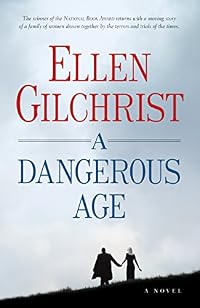
The winner of the National Book Award returns with a moving story of a family of women drawn together by the trials of the times.The women in the Hand family are no strangers to either controversy or sadness. Those traits seem, in fact, to be a part of their family's heritage, one that stretches back through several generations and many wars. A Dangerous Age is a celebration of the strength of these women and of the bonds of blood and shared loss that hold them together. Louise, Winifred, show more and Olivia are reconnecting the pieces of their lives and rediscovering love, but each is unwittingly on a collision course with a seemingly distant war that is really never more than a breath away. By turns humorous and heartbreaking, this finely honed novel about the centuries-old struggle for women who are left to carry on with life when their men go off to war is by a writer the Washington Post says "should be declared a national cultural treasure."
. show less
Tags
Recommendations










Member Reviews
I've put off this review for so long because I was so disappointed in the book that I had to go back and re-read her previous works. My, did this suffer in comparison. Despite its use of 9-11 and the war in Iraq as devices for plot and character development, it felt inconsequential, a strange combination of fluffy and trying too hard. I wept on that September morning, and I have deep feelings that we should never have started the war in Iraq, and yet I felt almost offended by Gilchrist's use of these events in what I felt wound up being obvious and almost patronizing ways. It's as if her own strong anti-war feelings overrode her ability to write about them in a way that would persuade rather than badger, or that could show war's horrors show more and homefront tragedies without shouting about how horrible and tragic they are. Worse, I knew where each character's plot was going before it got there, thanks to what felt like blatant telegraphing. When I finished it, I heaved a great sigh and I returned to The Anna Papers, Victory Over Japan, The Writing Life, and I, Rhoda Manning, Go Hunting With My Daddy, glad to find there the Ellen Gilchrist whose lovely prose was engaging rather than exhorting, intimate rather than irritating, and who let the reader find her way through, line by line, rather than flashing signpost after signpost to force me to the conclusion that war is bad and life will be forever changed by our losses. That's not a bad conclusion to come to, but it's not a good conclusion to be pushed to. show less
 This review was written for LibraryThing Early Reviewers.
This is a tale of privileged North Carolina cousins, young, modern, working women with brains and spunk looking for love. But be careful; don’t presume this book into the genre of young, modern, working women looking for love. A Dangerous Age isn’t something you’ll read lazily by the pool. In the Hand cousins, Gilchrist has created round and complicated women whose everyday lives are hit hard. And the rock that’s thrown? The War on Terror. Be careful again; don’t presume it’s one of those preachy anti-war rants. And don’t presume it’s a send-up to Bush’s doctrine. It’s both and neither.
Gilchrist is a writer of extreme talent. The story reads tight and matter-of-fact, accompanied by a subtle crescendo-rising force show more just waiting for the mallet to sound. From the moment the first plane hits on 9/11, our hearts hear the war drums ever presently beating in the background of the women’s lives. Each cousin’s individual story unfolds in as complicated a manner as the war itself, with no easy exit strategies and unanswered questions. This individualization of such a far-reaching topic, along with excellent writing, supplies depth into the human implications of nightly sound bytes. A brilliant, gut wrenching and thought-provoking book, I highly recommend A Dangerous Age for readers looking for more than fluff.
Review first published on Many A Quaint & Curious Volume show less
Gilchrist is a writer of extreme talent. The story reads tight and matter-of-fact, accompanied by a subtle crescendo-rising force show more just waiting for the mallet to sound. From the moment the first plane hits on 9/11, our hearts hear the war drums ever presently beating in the background of the women’s lives. Each cousin’s individual story unfolds in as complicated a manner as the war itself, with no easy exit strategies and unanswered questions. This individualization of such a far-reaching topic, along with excellent writing, supplies depth into the human implications of nightly sound bytes. A brilliant, gut wrenching and thought-provoking book, I highly recommend A Dangerous Age for readers looking for more than fluff.
Review first published on Many A Quaint & Curious Volume show less
This review was written for LibraryThing Early Reviewers."I'm searching the dictionary every day for new words to talk about the things I can't stop thinking", writes Winifred, as she grapples with what to do, and what is right in Ellen Gilchrist’s A Dangerous Age. This phenomenally intense and complicated look at the lives of three American women and their families from 2001 to 2006 acts as both an intriguing story and cutting social commentary. This very relevant story of love and loss focuses on three cousins, Louise, Winifred and Olivia, who stoically and bravely navigate their lives forever changed by 9/11 and by the seeming endless conflicts in Iraq and Afghanistan. Newspaper editor Olivia rails against America’s ambivalence toward the war and the sacrifices of servicemen from her show more editorial job for the Tulsa World, and her articles become poignantly personal when the war touches her life very deeply. As daily tragic headlines continue to bombard her senses, Olivia is buoyed by her extended Cherokee clan, and many warm and supporting characters float in and out the fabric of the story, comforting each other through the inexplicable events that unfold. Cherokee culture permeates the the sparse dialogue, pacing and descriptions, and provides a window into a proud and strong culture. I found the common bond of the family, and their determination to carry on, do the hard work and the good deeds, to defend and challenge their nation in the patriot tradition, a very real depiction of the conflict felt by many Americans.
"A poet is a painter, giving us images so beautifully worded that they have the power to become engraved upon our hearts" writes Olivia about Robert Frost's poetry. The same can be said of Ellen Gilchrists' story, as she paints an unforgettable portrait of beautifully rich characters who endure, both in the story and in the reader's heart.
I heartily recommend this novel, though I suspect some may find the subject matter too timely or politically charged for their taste. My recommendation to the author is that if anything, the story could be longer. I wanted to spend more time with each of the cousins and their worlds, to allow more time for the various stories to seep in.
Editorial note:
The Mary Oliver poem should be included in the text if at all possible, to spare the reader from pausing to read its beautiful words. The typo on the last page needs to be corrected:
Pray that we care for them as we have promise that we would - should be promised.
Footnote: The Hand family is featured in other short stories and novellas by Ellen Gilchrist, which helps explain why the characters feel so comfortable - they have history. I look forward to reading previous books featuring Olivia and the cousins to help fill in my blanks. show less
"A poet is a painter, giving us images so beautifully worded that they have the power to become engraved upon our hearts" writes Olivia about Robert Frost's poetry. The same can be said of Ellen Gilchrists' story, as she paints an unforgettable portrait of beautifully rich characters who endure, both in the story and in the reader's heart.
I heartily recommend this novel, though I suspect some may find the subject matter too timely or politically charged for their taste. My recommendation to the author is that if anything, the story could be longer. I wanted to spend more time with each of the cousins and their worlds, to allow more time for the various stories to seep in.
Editorial note:
The Mary Oliver poem should be included in the text if at all possible, to spare the reader from pausing to read its beautiful words. The typo on the last page needs to be corrected:
Pray that we care for them as we have promise that we would - should be promised.
Footnote: The Hand family is featured in other short stories and novellas by Ellen Gilchrist, which helps explain why the characters feel so comfortable - they have history. I look forward to reading previous books featuring Olivia and the cousins to help fill in my blanks. show less
This review was written for LibraryThing Early Reviewers.“A Dangerous Age” by Ellen Gilchrist. Published by Algonquin Books of Chapel Hill, 2008
Readers may wonder if Ellen Gilchrist chose her title, “A Dangerous Age” to reflect its time (post-9/11) or the biological time-clock of its characters, a close-knit group of 30-ish women.
Louise Hand, narrator of the opening chapter, is sister to Winifred, whose intended groom was killed in the World Trade Center. The cousins who were to have been in the wedding party rally to support the “widowed bride.” We follow them until December 2006 through a tangle of shifting relationships and, yes, pregnancies, births and deaths.
The strongest voice among the women is Olivia Hand, a cousin with Cherokee heritage. She remarries her ex-husband, show more Bobbie Tree, in a wedding ceremony that provides one of the book’s most vivid sections. The preparation and ritual take two days. Images of its beauty are memorable. We are convinced that the “Serpent Mound” will survive no matter what else happens in our chaotic world.
Gilchrist makes sure we see her characters as real people, not “types.” Bobby, tho not an Indian, fully participates in the intricate ceremonies. This balances out an impression of him as perhaps foolish: some time before, when he and Olivia resumed their relationship he had been so anxious to produce an heir that he insisted on buying a home-test pregnancy kit the morning after their reunion.
Later, when questioned about her pregnancy, Olivia remarks, “It’s just like normal except you can eat all the time and wear loose clothes.” This charming comment on pregnancy is in stark contrast to her firm denunciations of the government’s conduct of the war in the editorials she writes for a Tulsa newspaper. ( Note: The Academy Award winning documentary “Taxi to the Dark Side” matches her opinion closely.)
We learn there is no safe haven for the men. It is wartime and war is a widow-maker. Gilchrist spares no detail and we grieve with the cousins as they console each other. A measure of Gilchrist’s skill that we DO care for fictional characters so different from our own kin, and yet, like our own, at the mercy of fate and politics. show less
Readers may wonder if Ellen Gilchrist chose her title, “A Dangerous Age” to reflect its time (post-9/11) or the biological time-clock of its characters, a close-knit group of 30-ish women.
Louise Hand, narrator of the opening chapter, is sister to Winifred, whose intended groom was killed in the World Trade Center. The cousins who were to have been in the wedding party rally to support the “widowed bride.” We follow them until December 2006 through a tangle of shifting relationships and, yes, pregnancies, births and deaths.
The strongest voice among the women is Olivia Hand, a cousin with Cherokee heritage. She remarries her ex-husband, show more Bobbie Tree, in a wedding ceremony that provides one of the book’s most vivid sections. The preparation and ritual take two days. Images of its beauty are memorable. We are convinced that the “Serpent Mound” will survive no matter what else happens in our chaotic world.
Gilchrist makes sure we see her characters as real people, not “types.” Bobby, tho not an Indian, fully participates in the intricate ceremonies. This balances out an impression of him as perhaps foolish: some time before, when he and Olivia resumed their relationship he had been so anxious to produce an heir that he insisted on buying a home-test pregnancy kit the morning after their reunion.
Later, when questioned about her pregnancy, Olivia remarks, “It’s just like normal except you can eat all the time and wear loose clothes.” This charming comment on pregnancy is in stark contrast to her firm denunciations of the government’s conduct of the war in the editorials she writes for a Tulsa newspaper. ( Note: The Academy Award winning documentary “Taxi to the Dark Side” matches her opinion closely.)
We learn there is no safe haven for the men. It is wartime and war is a widow-maker. Gilchrist spares no detail and we grieve with the cousins as they console each other. A measure of Gilchrist’s skill that we DO care for fictional characters so different from our own kin, and yet, like our own, at the mercy of fate and politics. show less
This review was written for LibraryThing Early Reviewers.I found it a very quick read and enjoyed it but not so sure I really liked it completely. It lacked something that pulled it all together for me. It didn't seem to have a heart. Maybe it was the simplicity or the directness of the language that made it easy to read but less connecting. Yet there was some meat to it that had me pondering our place in the war. For that I can recommend it and give it 3 stars.
This review was written for LibraryThing Early Reviewers.Ellen Gilchrist, National Book Award winner for Victory Over Japan has become known primarily as one of the premier short story writers in America. But, as she reminds us in A Dangerous Age, her first novel in over ten years, she is also a first-rate novelist.
The United States has been engaged in a war since September 2001, a fact of which many Americans seem to have lost awareness. The war, of course, is very political and that, perhaps, explains why so many media outlets seem to have lost interest in it now that the American body count has dropped so significantly. As it becomes more and more difficult for big media to damage the current administration via bad news from Iraq and Afghanistan, those in charge seem more interested in show more changing the subject than in reporting war news.
Ellen Gilchrist is of another mind entirely. She wants us to realize how close we all are to being personally impacted by this long war and she uses the women of the fictional Hand family to illustrate her point.
The Hands appear to have everything: money, physical grace and beauty, social standing, a close family and work they love. But it has been a more than a decade since a new baby was born into the Hand family and cousins Winifred, Louise and Olivia have begun to think seriously about doing something about that situation. So when Winifred announced her engagement it was a happy time for the whole family. Little did any of them realize how suddenly their lives were about to change.
The Hands were first impacted by the war when Winifred’s young fiancé was on time for his early morning business meeting at the World Trade Center on September 11, 2001, making him one of the war’s first casualties. No remains were recovered but at the memorial service held in his honor, two cousins of the murdered man, identical twins, vowed to join the military so that they could personally avenge his death. True to their word, they did so, a decision that would directly impact the Hand cousins just a few months later.
Winifred, Louise and Olivia Hand soon learn what so many of their countrymen learned before them, that this is not some far-off war that can be ignored or studied with detachment if it involves those you love. But the Hand women are a strong bunch with a family tradition of coping well with whatever life throws their way and this war is no exception to their ability to adjust to life’s surprises. They are in full support of the men who leave them to go off to war and, just as importantly, they are always there for each other. Ellen Gilchrist beautifully describes the war as seen through the eyes of those left behind, reminding the reader that not all war heroes wear uniforms.
Rated at: 4.5 show less
The United States has been engaged in a war since September 2001, a fact of which many Americans seem to have lost awareness. The war, of course, is very political and that, perhaps, explains why so many media outlets seem to have lost interest in it now that the American body count has dropped so significantly. As it becomes more and more difficult for big media to damage the current administration via bad news from Iraq and Afghanistan, those in charge seem more interested in show more changing the subject than in reporting war news.
Ellen Gilchrist is of another mind entirely. She wants us to realize how close we all are to being personally impacted by this long war and she uses the women of the fictional Hand family to illustrate her point.
The Hands appear to have everything: money, physical grace and beauty, social standing, a close family and work they love. But it has been a more than a decade since a new baby was born into the Hand family and cousins Winifred, Louise and Olivia have begun to think seriously about doing something about that situation. So when Winifred announced her engagement it was a happy time for the whole family. Little did any of them realize how suddenly their lives were about to change.
The Hands were first impacted by the war when Winifred’s young fiancé was on time for his early morning business meeting at the World Trade Center on September 11, 2001, making him one of the war’s first casualties. No remains were recovered but at the memorial service held in his honor, two cousins of the murdered man, identical twins, vowed to join the military so that they could personally avenge his death. True to their word, they did so, a decision that would directly impact the Hand cousins just a few months later.
Winifred, Louise and Olivia Hand soon learn what so many of their countrymen learned before them, that this is not some far-off war that can be ignored or studied with detachment if it involves those you love. But the Hand women are a strong bunch with a family tradition of coping well with whatever life throws their way and this war is no exception to their ability to adjust to life’s surprises. They are in full support of the men who leave them to go off to war and, just as importantly, they are always there for each other. Ellen Gilchrist beautifully describes the war as seen through the eyes of those left behind, reminding the reader that not all war heroes wear uniforms.
Rated at: 4.5 show less
This review was written for LibraryThing Early Reviewers.Told through the voices of three 30-something cousins, this story of how terrorism and the war in Iraq has impacted their lives, should have resonated more with me than it did. The only character I could relate in any way to was Olivia with her Native American background. Just as the Trickster in Cherokee tradition reveals that the world is a confusing place, I was a bit confused as to how I was to relate to this book. Was it chick-lit or serious political commentary? I couldn't really decide.
I haven't read anything by Gilchrist before. I understand that she is known for her short stories, and, indeed, the three narrations read more like separate stories rather than a cohesive unit. While I did enjoy her simple, direct style of show more writing, I was distracted with some credibility issues and the abrupt transitions which interrupted the flow of the story. Despite the structural drawbacks and the gratuitous use of the F-word (a personal pet-peeve of mine), I can see why some readers would enjoy reading about the Hand cousins, but I'm not one of them. show less
I haven't read anything by Gilchrist before. I understand that she is known for her short stories, and, indeed, the three narrations read more like separate stories rather than a cohesive unit. While I did enjoy her simple, direct style of show more writing, I was distracted with some credibility issues and the abrupt transitions which interrupted the flow of the story. Despite the structural drawbacks and the gratuitous use of the F-word (a personal pet-peeve of mine), I can see why some readers would enjoy reading about the Hand cousins, but I'm not one of them. show less
This review was written for LibraryThing Early Reviewers.Members
- Recently Added By
Author Information

34+ Works 4,796 Members
She is the author of 16 works of fiction, including the story collection Victory Over Japan, which won the National Book Award & most recently, The Cabal & Other Stories. She lives in Fayetteville, Arkansas, Ocean Springs, Mississippi & New Orleans, Louisiana. (Bowker Author Biography)
Series

Common Knowledge
- Canonical title
- A Dangerous Age
Classifications
- Genres
- Fiction and Literature, General Fiction, Suspense & Thriller
- DDC/MDS
- 813.54 — Literature & rhetoric American literature in English American fiction in English 1900-1999 1945-1999
- LCC
- PS3557 .I34258 .D36 — Language and Literature American literature American literature Individual authors 1961-
- BISAC
Statistics
- Members
- 145
- Popularity
- 225,038
- Reviews
- 19
- Rating
- (3.10)
- Languages
- English
- Media
- Paper, Ebook
- ISBNs
- 5
- UPCs
- 1
- ASINs
- 3