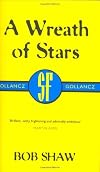
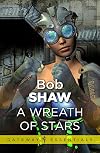
A Wreath of Stars
by Bob Shaw
On This Page
Description
Ironically, for Gilbert Snook - who considered himself the human equivalent of a neutrino, a particle able to travel through the Earth without disturbing any other particle - it all started with the panic that followed the sighting of the anti-neutrino planet as it approached Earth. Earth was unaffected but Snook ended up in a small African Republic teaching English to diamond miners. Then the miners started seeing ghosts and Snook found himself at the centre of a bizarre and far-reaching show more scientific discovery - and in the middle of some very dirty political infighting. show lessTags
Recommendations





Member Reviews
In the course of my on-going re-read of the works of Bob Shaw, I came to A Wreath of Stars. This was one of Bob's novels that I had only read once or twice, as opposed to his earlier books which I re-read voraciously when I was much younger.
My 1978 Pan first edition paperback came with fulsome praise from reviewers. My last Bob Shaw re-read, Orbitsville, was equally praised at the time, but came up very short for me. I was fearful that the same might happen here. I needn't have worried.
The novel follows one Gilbert Snook, an aircraft engineer on contract to a Middle Eastern air force. But when a strange astronomical phenomenon - an antineutrino planet - is discovered to be on a collision course with Earth, turmoil ensues, even though it show more is physically insubstantial and will have no direct effect on Earth. Snook gets caught up in this and ends up, rather against his will, in East Africa as an unwanted guest of a small and rather unstable republic. He might have stayed there, but then workers in the country's main diamond mine start reporting seeing ghosts (though only when wearing special low-light glasses), and matters spiral out of control.
Shaw tells this story in his usual, economic style, but in this novel he manages to fit the world-building, action, characterisation and the exploration of the wonderful - for there is indeed something wonderful behind the apparitions - into his usual short novel format. Somehow in this one, all the pacing works out just right. Characters are well-formed, and Bob even managed to get one of his personal obsessions, eye injuries, into the plot. You may never look at a plastic fork the same again.
Possibly twenty years ago, I serendipitously came across some of Bob's professional journalism: a piece he wrote when he was employed by the Belfast aircraft manufacturer Shorts, about flying Short Skyvans with the Sultan of Oman's air force in the Arabian peninsula. Bob used his easy and elegant way with prose just as much in the description of a desert air base at night as he did in his novels and the corresponding section in A Wreath of Stars draws heavily on this other piece. Equally, the setting for the bulk of the novel is equally well-drawn. In a few paragraphs, he gives us a convincing picture of an African diamond mine. I don't know if either of the aerospace companies he worked for - first Shorts, and then Vickers - actually ever sent him out to the places they asked him to write about (I've never seen any reference to long-haul travel for work in his other writings, though it must have been quite possible), but the scene setting in this novel has particular immediacy.
Having said that, it seems odd now to read a novel written in 1976 but set in 1993, which places its action in the Arabian peninsula and then in East Africa, which has no mention in it whatsoever of militant Islam. Furthermore, a number of the characters in the book are black Africans, but Bob writes them generally in a racially neutral way, although some of the miners are shown in ways that edge close to stereotyping. And some more sensitive readers may consider that Bob's use of these characters shows elements of cultural appropriation. But for a novel from fifty years ago, this book comes out with few if any seriously cringeworthy moments.
So, rather to my surprise, I found myself re-discovering one of Bob Shaw's better novels. It has been reprinted a number of times, including in Gollancz's SF Collectors series; I would say it deserves those reprints, and equally deserves your seeking a copy out. show less
My 1978 Pan first edition paperback came with fulsome praise from reviewers. My last Bob Shaw re-read, Orbitsville, was equally praised at the time, but came up very short for me. I was fearful that the same might happen here. I needn't have worried.
The novel follows one Gilbert Snook, an aircraft engineer on contract to a Middle Eastern air force. But when a strange astronomical phenomenon - an antineutrino planet - is discovered to be on a collision course with Earth, turmoil ensues, even though it show more is physically insubstantial and will have no direct effect on Earth. Snook gets caught up in this and ends up, rather against his will, in East Africa as an unwanted guest of a small and rather unstable republic. He might have stayed there, but then workers in the country's main diamond mine start reporting seeing ghosts (though only when wearing special low-light glasses), and matters spiral out of control.
Shaw tells this story in his usual, economic style, but in this novel he manages to fit the world-building, action, characterisation and the exploration of the wonderful - for there is indeed something wonderful behind the apparitions - into his usual short novel format. Somehow in this one, all the pacing works out just right. Characters are well-formed, and Bob even managed to get one of his personal obsessions, eye injuries, into the plot. You may never look at a plastic fork the same again.
Possibly twenty years ago, I serendipitously came across some of Bob's professional journalism: a piece he wrote when he was employed by the Belfast aircraft manufacturer Shorts, about flying Short Skyvans with the Sultan of Oman's air force in the Arabian peninsula. Bob used his easy and elegant way with prose just as much in the description of a desert air base at night as he did in his novels and the corresponding section in A Wreath of Stars draws heavily on this other piece. Equally, the setting for the bulk of the novel is equally well-drawn. In a few paragraphs, he gives us a convincing picture of an African diamond mine. I don't know if either of the aerospace companies he worked for - first Shorts, and then Vickers - actually ever sent him out to the places they asked him to write about (I've never seen any reference to long-haul travel for work in his other writings, though it must have been quite possible), but the scene setting in this novel has particular immediacy.
Having said that, it seems odd now to read a novel written in 1976 but set in 1993, which places its action in the Arabian peninsula and then in East Africa, which has no mention in it whatsoever of militant Islam. Furthermore, a number of the characters in the book are black Africans, but Bob writes them generally in a racially neutral way, although some of the miners are shown in ways that edge close to stereotyping. And some more sensitive readers may consider that Bob's use of these characters shows elements of cultural appropriation. But for a novel from fifty years ago, this book comes out with few if any seriously cringeworthy moments.
So, rather to my surprise, I found myself re-discovering one of Bob Shaw's better novels. It has been reprinted a number of times, including in Gollancz's SF Collectors series; I would say it deserves those reprints, and equally deserves your seeking a copy out. show less
3/5
A mysterious and unforeseen astronomical event occurs when a bright object made of neutrinos passes through our solar system. This event was only witnessed due to a new device in the world of optics that allows human eyes to see the neutrinos like light. Years later, this event is found to have caused the shift in orbit of a neutrino planet, with all its own life forms and society, that has been resting inside of earth itself. Gilbert Snook, the self-described human neutrino, ends up becoming caught in an attempt to contact the lifeforms on this planet as its orbit slowly shifts it outside of the earth's surface.
This is my first Shaw and an enjoyable one. Shaw is able to weave some hard-ish scientific concepts and explanations into show more the plot line in a smooth and enjoyable way. The premise itself is the real draw here, and it definitely was my favorite part of the novel. I also really enjoyed the description of the culture on this new planet, including the telepathic locals. Shaw's prose style tended to be understated, but with short moments of beauty, especially towards the beginning and end. I especially liked the light smattering of humor that he writes with. It actually tended to be pretty funny, which is saying something coming from someone who struggles to connect with humor through text. The plot moved along at a good pace, and the ending was pretty good if a bit saccharine.
Most of the characters were... bland at best. All of the characters, even the more minor ones, were well drawn in that they all had clearly described motivations that seemed believable, but that didn't stop them from being pretty transparent. The primary characters, Ambrose and Gilbert, were far more three-dimensional than the rest. I especially found the treatment of sex and race to be pretty dated. And speaking of being dated, the future world that Shaw draws is bland and tepid, barely feeling like things have progressed that far from the 1960s. The setting, a new and corrupt African nation-state, was a bit boring, which is a shame because that's ultimately where Shaw tries to summon most of the drama and suspense from. I think I would've enjoyed the novel more if these qualities were instead drawn from the freaking alien race of neutrinos. C'mon Mr. Shaw.
I don't know. It was pretty good, but maybe forgettable. Nothing really stuck with me strongly, even if it was a fun time. I could see this going over better for me if I was in a more 'beach-read' mood. I think there are some flashes of excellence that make me eager to get back to some of Shaw's other works. show less
A mysterious and unforeseen astronomical event occurs when a bright object made of neutrinos passes through our solar system. This event was only witnessed due to a new device in the world of optics that allows human eyes to see the neutrinos like light. Years later, this event is found to have caused the shift in orbit of a neutrino planet, with all its own life forms and society, that has been resting inside of earth itself. Gilbert Snook, the self-described human neutrino, ends up becoming caught in an attempt to contact the lifeforms on this planet as its orbit slowly shifts it outside of the earth's surface.
This is my first Shaw and an enjoyable one. Shaw is able to weave some hard-ish scientific concepts and explanations into show more the plot line in a smooth and enjoyable way. The premise itself is the real draw here, and it definitely was my favorite part of the novel. I also really enjoyed the description of the culture on this new planet, including the telepathic locals. Shaw's prose style tended to be understated, but with short moments of beauty, especially towards the beginning and end. I especially liked the light smattering of humor that he writes with. It actually tended to be pretty funny, which is saying something coming from someone who struggles to connect with humor through text. The plot moved along at a good pace, and the ending was pretty good if a bit saccharine.
Most of the characters were... bland at best. All of the characters, even the more minor ones, were well drawn in that they all had clearly described motivations that seemed believable, but that didn't stop them from being pretty transparent. The primary characters, Ambrose and Gilbert, were far more three-dimensional than the rest. I especially found the treatment of sex and race to be pretty dated. And speaking of being dated, the future world that Shaw draws is bland and tepid, barely feeling like things have progressed that far from the 1960s. The setting, a new and corrupt African nation-state, was a bit boring, which is a shame because that's ultimately where Shaw tries to summon most of the drama and suspense from. I think I would've enjoyed the novel more if these qualities were instead drawn from the freaking alien race of neutrinos. C'mon Mr. Shaw.
I don't know. It was pretty good, but maybe forgettable. Nothing really stuck with me strongly, even if it was a fun time. I could see this going over better for me if I was in a more 'beach-read' mood. I think there are some flashes of excellence that make me eager to get back to some of Shaw's other works. show less
La novela comienza con el descubrimiento de un astro que atraviese el Sistema Solar, invisible a los ojos humanos a no ser que se lleven unas gafas especiales. Cuando dicho astro atraviesa la Tierra, se descubre la existencia de un planeta en el interior del nuestro, ocupando el mismo espacio. Y aquí surge el conflicto, ya que cada poco tiempo, según la rotación de ambos planetas, sus habitantes se pueden ver, pareciendo fantasmas.
‘Una guirnalda de estrellas’ (A Wreath of Stars, 1976), de Bob Shaw, es una interesante novela de ciencia ficción de primer contacto, que empieza muy bien, con una idea alucinante, pero que se va desinflando según avanza. No es una maravilla, pero se lee con gusto.
‘Una guirnalda de estrellas’ (A Wreath of Stars, 1976), de Bob Shaw, es una interesante novela de ciencia ficción de primer contacto, que empieza muy bien, con una idea alucinante, pero que se va desinflando según avanza. No es una maravilla, pero se lee con gusto.
The story opens with the discovery of a large planet-like mass of anti-neutrinos that narrowly misses the Earth in a spiralling orbit around the sun. A scientific curiosity, spectacular even, but otherwise irrelevant to the everyday lives of people on Earth. But when miners in an equatorial African country start seeing ghosts in the deepest mine shafts a chain of events is set in motion that will have an impact on the lives of everyone on Earth.
Bob Shaw brilliantly blends conceptual hard sf ideas (though some of the science may now seem quaint) with his usual exceptional characterisation. His depiction of the political machinations in a post-colonial African nation is both humane and prophetic and the personal struggles of the main show more characters in the story are as gripping as the overall narrative. The book itself is short, the prose sleek and stylish, reminding us once again just how enjoyable it is to read the works of the 70s SF 'new wave' masters. This one is highly recommended. show less
Bob Shaw brilliantly blends conceptual hard sf ideas (though some of the science may now seem quaint) with his usual exceptional characterisation. His depiction of the political machinations in a post-colonial African nation is both humane and prophetic and the personal struggles of the main show more characters in the story are as gripping as the overall narrative. The book itself is short, the prose sleek and stylish, reminding us once again just how enjoyable it is to read the works of the 70s SF 'new wave' masters. This one is highly recommended. show less
7/10
An oddly enjoyable book from the 1970s. While there are a few despicable cardboard villains and stereotypical secondary characters, the "heroes", a remarkably mediocre scientist who runs a planetarium and a mechanic whose main purpose in life is avoiding human connections, are more three-dimensional. I cannot comment on the soundness of the science, but the descriptions of the interactions between the humans and the "ghosts" and the consequences of those interactions touched my emotions, sparked my imagination, and made for an engaging story.
An oddly enjoyable book from the 1970s. While there are a few despicable cardboard villains and stereotypical secondary characters, the "heroes", a remarkably mediocre scientist who runs a planetarium and a mechanic whose main purpose in life is avoiding human connections, are more three-dimensional. I cannot comment on the soundness of the science, but the descriptions of the interactions between the humans and the "ghosts" and the consequences of those interactions touched my emotions, sparked my imagination, and made for an engaging story.
A Wreath of Stars is plain, honest, old fashioned, one-big-idea SF, with a nice cast of characters with some depth to them, and a surprisingly light touch with the use of language both scientific and literary. Bob Shaw does a great job of conveying the events as they happen, but lacks something in the telling that gives the grand scope of an author like Arthur C Clarke. It's still an exciting story, though, and the ending is particularly satisfying.
An anti-neutrino world exists inside earth. An astronomical events disrupts synchonous rotation, and now 'people' from that world are being seen with special low-light lenses in mines in Africa. Eventually contact is made with unintended consequences. An enjoyable read.
Members
- Recently Added By
Author Information

118+ Works 6,002 Members
Some Editions
Series
Belongs to Publisher Series
Work Relationships
Is contained in
Common Knowledge
- Canonical title*
- Quando i neutri emergono dalla terra
- Original title
- A Wreath of Stars
- Original publication date
- 1976-06; 1976
- Epigraph*
- Per il Cosmo strano e selvaggio / me ne vado, da eterno straniero. / Il mio amore sono le sue strade / e i brillanti occhi del pericolo.
R. L. Stevenson - First words
- Gilbert Snook sometimes thought of himself as being the exact social equivalent of a neutrino.
- Last words
- (Click to show. Warning: May contain spoilers.)He said goodbye to Felleth and began walking back to his solitary house, picking his way with care on the steep and stony path.
- Original language*
- English
*Some information comes from Common Knowledge in other languages. Click "Edit" for more information.
Classifications
Statistics
- Members
- 360
- Popularity
- 87,439
- Reviews
- 11
- Rating
- (3.43)
- Languages
- 7 — Dutch, English, German, Italian, Lithuanian, Portuguese, Spanish
- Media
- Paper, Ebook
- ISBNs
- 12
- ASINs
- 8