On This Page
Description
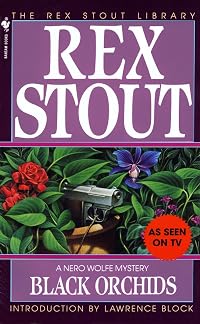
Fiction. Mystery. Suspense. Thriller. HTML:Nero Wolfe has left his comfortable brownstone for the promise of a remarkably rare black orchid at a flower show—but before Wolfe and his perennially hardy sidekick, Archie Goodwin, have a chance to stop and smell the roses, a diabolically daring murder takes place right under their noses and puts a blight on the proceedings. Now Wolfe's fancy turns to thoughts of weeding out a murderer—one who's definitely not a garden-variety killer. Only show more then will Wolfe be ready to throw his weight into a second thorny case, involving a rich society widow bedeviled by poison-pen letters—and a poisonous plot as black as Wolfe's orchids . . . with roots that are even more twisted.Introduction by Lawrence Block
“It is always a treat to read a Nero Wolfe mystery. The man has entered our folklore.”—The New York Times Book Review
A grand master of the form, Rex Stout is one of America’s greatest mystery writers, and his literary creation Nero Wolfe is one of the greatest fictional detectives of all time. Together, Stout and Wolfe have entertained—and puzzled—millions of mystery fans around the world. Now, with his perambulatory man-about-town, Archie Goodwin, the arrogant, gourmandizing, sedentary sleuth is back in the original seventy-three cases of crime and detection written by the inimitable master himself, Rex Stout. show less
Tags
Recommendations
















Member Reviews
Three stars in relation to his best work, which is usually 5.
Latest reading given. These novellas fell into two camps, and the second one pulled the first one down.
Both mysteries have the clues well and fairly laid, but the device used in the second one, although ingenious, is ultimately not convincing because the method would not have been easily concocted by the Murderer, and the denoument was much more risky than Wolfe declares.
Additionally, the second story begins with a client who refuses to give Wolfe any useful information, repeating "it's not relevant," which it clearly wasn't given her job for him, but would have ended the story in the first chapter if she had revealed it, so he puts up with the nonsense and throws her out show more without drawing attention to her stupidity.
He gets back on the case when she is murdered.
As with most of the early works written in the forties and fifties, Wolfe and Goodwin get away with things that would have put them in jail as accomplices in later times, but that was part of the general ethos of the era for Private Detectives.
I enjoy Stout's mysteries as much for the badinage among Wolfe, Goodwin, and Cramer as for the mysteries themselves.
Here, they have pretty much defined their relationships, and when to quit the sniping and get serious, but the interchanges have not yet gotten as stale as in the much later works. show less
Latest reading given. These novellas fell into two camps, and the second one pulled the first one down.
Both mysteries have the clues well and fairly laid, but the device used in the second one, although ingenious, is ultimately not convincing because the method would not have been easily concocted by the Murderer, and the denoument was much more risky than Wolfe declares.
Additionally, the second story begins with a client who refuses to give Wolfe any useful information, repeating "it's not relevant," which it clearly wasn't given her job for him, but would have ended the story in the first chapter if she had revealed it, so he puts up with the nonsense and throws her out show more without drawing attention to her stupidity.
He gets back on the case when she is murdered.
As with most of the early works written in the forties and fifties, Wolfe and Goodwin get away with things that would have put them in jail as accomplices in later times, but that was part of the general ethos of the era for Private Detectives.
I enjoy Stout's mysteries as much for the badinage among Wolfe, Goodwin, and Cramer as for the mysteries themselves.
Here, they have pretty much defined their relationships, and when to quit the sniping and get serious, but the interchanges have not yet gotten as stale as in the much later works. show less
This review is written with a GPL 4.0 license and the rights contained therein shall supersede all TOS by any and all websites in regards to copying and sharing without proper authorization and permissions. Crossposted at WordPress, Blogspot, & Librarything by Bookstooge’s Exalted Permission
Title: Black Orchids
Series: Nero Wolfe #9
Author: Rex Stout
Rating: 4 of 5 Stars
Genre: Mystery
Pages: 158
Words: 57.5K
Synopsis:
From Wikipedia
Black Orchids:
Millionaire orchid fancier Lewis Hewitt has hybridized three black orchid plants in his Long Island greenhouse. Nero Wolfe is wild to have one, so he and Archie Goodwin visit New York's annual flower show, where Hewitt's orchids are on exhibit. One of the other exhibits features a daily performance show more by a young couple miming a summer picnic. The woman, Anne Tracy, attracts the attentions of Archie, Hewitt, and a young exhibitor named Fred Updegraff.
During Wolfe's visit to the show, Anne's picnic partner Harry Gould is killed, shot in the head by a gun concealed in the foliage. The gun's trigger is attached to a long string that reaches to a hallway well behind the exhibit.
After a little inquiry, Wolfe shows Hewitt how his walking stick was used to pull the string and fire the shot that killed Gould. Hewitt is horrified by the prospect of the publicity that would ensue should his part in the shooting, however indirect and unwitting, become known. Wolfe offers Hewitt this arrangement: in exchange for all three black orchid plants, the only ones in existence, Wolfe will solve the murder and deliver the criminal to the police, without publicly disclosing Hewitt's connection to the crime. Hewitt terms it blackmail, but submits.
Earlier, Archie had noticed a woman waiting in the hallway behind the exhibit, at around the time that the murderer would have been deploying the string. He now finds her in the crowd that's gawking at the murder scene. Archie steals her handbag, removes it to the men's room, searches it for identification, and learns her name (Rose Lasher) and address. He returns the handbag to her – all without Rose or anyone else noticing.
The police want to know more about her and, finishing their questions, they let her go — but surreptitiously follow her. The police lose her trail but Archie knows her home address, where she has been living with Harry Gould. He arrives at Rose's apartment just as she is about to flee the city, and takes her to Wolfe's house. There Archie searches her suitcase and finds some printed matter that Rose cannot or will not explain: a clipping of an article by Hewitt on Kurume yellows,[a] a plant disease that is fatal to broadleaf evergreens; a postcard to Rose from Harry, postmarked Salamanca, New York (in the western part of the state); and a work order from a garage, also in Salamanca.
Wolfe gets Rose to discuss some of Gould's unsavory qualities. Wolfe learns that although Gould was employed as a gardener, he suddenly acquired a bank account containing several thousand dollars[b] and what Miss Lasher terms "a big roll of bills." From his general awareness of horticultural events, Wolfe knows that an attack of Kurume yellows devastated a plantation of a new hybrid of broadleaf evergreens, about eighty miles west of Salamanca and owned by Updegraff Nurseries. The same disease has affected the exhibit in which Anne and Gould were featured; W. G. Dill, one owner of the company sponsoring it, had asked Wolfe to investigate the source.
Weighing all this information, Wolfe assembles the principals in the fumigation chamber of his plant rooms. He accuses Hewitt of conspiring with Gould to infect the plantations of rival growers, and of killing Gould after the latter began to blackmail him. When a telephone call comes in for Hewitt, Wolfe sends Dill to answer it instead, closes the chamber door, and informs the rest of the group that Dill, not Hewitt, is the murderer. Dill is later found dead in the plant rooms, having turned on the flow of fumigation gas with the intent to kill everyone inside the chamber; however, Wolfe had anticipated this action and diverted the gas to fill the plant rooms instead.
Wolfe tells Cramer that Anne had previously confirmed his suspicions of Gould's and Dill's activities. He keeps the black orchids, but Cramer is unimpressed by their appearance, saying that he prefers geraniums. The orchids have a cameo role in the second novella in this collection, "Cordially Invited to Meet Death."
Cordially Invited to Meet Death:
Bess Huddleston arranges parties for New York society. She has been in contact with Wolfe once before, when she wanted him to play the detective at a party that would feature a mock murder; Wolfe declined to participate. Now, she comes with one anonymous letter in hand and a report of another. They were not sent to her, nor do they threaten her directly: rather, one was sent to a client and the other to a member of the circle in which her clients move. The letters imply strongly that Miss Huddleston has been gossiping about her clients' private lives.
She wants Wolfe to put an end to the smear campaign – if it continues, her monied clients will no longer trust her and will not hire her to arrange their parties. Miss Huddleston has two employees, an assistant party arranger named Janet Nichols and a secretary named Maryella Timms. Both have access to a box of stationery of the same kind used for the letters. The letters are typewritten, and appear to Miss Huddleston's eye to have been typed on one of her typewriters. Wolfe tells Miss Huddleston to have Miss Nichols and Miss Timms come to his office.
They do so, and arrive at a moment when Wolfe and Fritz are discussing another attempt at cooking corned beef. This has long been a problem in the brownstone's kitchen, one never satisfactorily resolved. Miss Timms hears about the dilemma and barges into the kitchen to help. Wolfe is so impressed by Miss Timms' expertise that he later allows her to link arms with him, and writes to a professor at Harvard concerning chitlins and corned beef.
Apart from the culinary, though, Wolfe obtains no useful information from Nichols and Timms, and sends Archie to Miss Huddleston's house and place of business to investigate further. There, Archie is bedeviled by a playful chimpanzee, two pet bears and an alligator. He also meets Miss Huddleston's brother Daniel, her nephew Larry, and Alan Brady, an MD who has been spending time with Janet Nichols. Archie does not get much further at the house than Wolfe did in his office, but he has cocktails on the terrace with the various players. As the butler is bringing more drinks, the chimpanzee startles him and a tray of glasses crashes to the ground. Most of the broken glass is cleaned up, but Miss Huddleston's foot is cut by a shard and, because of the presence of the animals, Dr. Brady treats the cut with iodine.
Less than one week later, Miss Huddleston is dead, having undergone an excruciatingly painful and drawn out death from tetanus. That, as far as Wolfe is concerned, ends his involvement, but Daniel Huddleston makes a nuisance of himself with the police: he believes his sister was murdered. Daniel is insistent enough that Inspector Cramer comes to Wolfe looking for information. Wolfe has none for him, but after Cramer leaves he drops Archie an exiguous hint: he thinks there is one thing that Cramer should have done during his investigation, and wonders if it has rained during the past week.
My Thoughts:
This collection of two novellas was perfect. Twice as much Wolfe and Archie is twice the fun. It is the essence of Stout's writing that we get here. Even though this is number 9 in the series, I would recommend this to someone who wants to get a taste for Nero Wolfe (no, not that way. I don't promote canniblism on this blog after all!) as you'll get two stories to see if the setting and writing works for you.
While I wouldn't want to live in the time period of Wolfe and Archie (I just realized, I use Nero Wolfe's last name for him but Archie Goodwin's first name for him. I wonder why?), I would be dead of my diabetes after all, I REALLY like how the author has Wolfe and Archie knowing their rights as citizens and forcing the police to abide by said rights and the police do it. They exist to solve the crime, not prevent it, and they take that job very seriously. What's more, both Wolfe and Archie expect that, and nothing more, from the police. They're not cowering in the brownstone waiting for somebody else to do everything for them. They take a whole heaping load of responsibility on themselves and don't whine and complain (well, Archie does, but that goes with the job I think) and write letters to the editor, etc. Reading about mature people is refreshing, and it's sickening that it's refreshing too.
The writing is as good as ever and once again, I would highly recommend this book if you want to experience Rex Stout's writing and to see if Wolfe and Archie will be your cup of tea. With two stories, you'll know for sure one way or another by the end. And you don't need to have read any of the previous books to understand anything here (I think). Stout does a good job of making each book stand on its own two legs. And there is only ONE perspective, Archie's. I'd poke this book into John Gwynne's eye if I could and make him eat dirt on the strength of that alone! (for those not in the know, Gwynne tends to have about 100 perspectives in his bloated novels and none of them are actually important or necessary)
★★★★☆ show less
Title: Black Orchids
Series: Nero Wolfe #9
Author: Rex Stout
Rating: 4 of 5 Stars
Genre: Mystery
Pages: 158
Words: 57.5K
Synopsis:
From Wikipedia
Black Orchids:
Millionaire orchid fancier Lewis Hewitt has hybridized three black orchid plants in his Long Island greenhouse. Nero Wolfe is wild to have one, so he and Archie Goodwin visit New York's annual flower show, where Hewitt's orchids are on exhibit. One of the other exhibits features a daily performance show more by a young couple miming a summer picnic. The woman, Anne Tracy, attracts the attentions of Archie, Hewitt, and a young exhibitor named Fred Updegraff.
During Wolfe's visit to the show, Anne's picnic partner Harry Gould is killed, shot in the head by a gun concealed in the foliage. The gun's trigger is attached to a long string that reaches to a hallway well behind the exhibit.
After a little inquiry, Wolfe shows Hewitt how his walking stick was used to pull the string and fire the shot that killed Gould. Hewitt is horrified by the prospect of the publicity that would ensue should his part in the shooting, however indirect and unwitting, become known. Wolfe offers Hewitt this arrangement: in exchange for all three black orchid plants, the only ones in existence, Wolfe will solve the murder and deliver the criminal to the police, without publicly disclosing Hewitt's connection to the crime. Hewitt terms it blackmail, but submits.
Earlier, Archie had noticed a woman waiting in the hallway behind the exhibit, at around the time that the murderer would have been deploying the string. He now finds her in the crowd that's gawking at the murder scene. Archie steals her handbag, removes it to the men's room, searches it for identification, and learns her name (Rose Lasher) and address. He returns the handbag to her – all without Rose or anyone else noticing.
The police want to know more about her and, finishing their questions, they let her go — but surreptitiously follow her. The police lose her trail but Archie knows her home address, where she has been living with Harry Gould. He arrives at Rose's apartment just as she is about to flee the city, and takes her to Wolfe's house. There Archie searches her suitcase and finds some printed matter that Rose cannot or will not explain: a clipping of an article by Hewitt on Kurume yellows,[a] a plant disease that is fatal to broadleaf evergreens; a postcard to Rose from Harry, postmarked Salamanca, New York (in the western part of the state); and a work order from a garage, also in Salamanca.
Wolfe gets Rose to discuss some of Gould's unsavory qualities. Wolfe learns that although Gould was employed as a gardener, he suddenly acquired a bank account containing several thousand dollars[b] and what Miss Lasher terms "a big roll of bills." From his general awareness of horticultural events, Wolfe knows that an attack of Kurume yellows devastated a plantation of a new hybrid of broadleaf evergreens, about eighty miles west of Salamanca and owned by Updegraff Nurseries. The same disease has affected the exhibit in which Anne and Gould were featured; W. G. Dill, one owner of the company sponsoring it, had asked Wolfe to investigate the source.
Weighing all this information, Wolfe assembles the principals in the fumigation chamber of his plant rooms. He accuses Hewitt of conspiring with Gould to infect the plantations of rival growers, and of killing Gould after the latter began to blackmail him. When a telephone call comes in for Hewitt, Wolfe sends Dill to answer it instead, closes the chamber door, and informs the rest of the group that Dill, not Hewitt, is the murderer. Dill is later found dead in the plant rooms, having turned on the flow of fumigation gas with the intent to kill everyone inside the chamber; however, Wolfe had anticipated this action and diverted the gas to fill the plant rooms instead.
Wolfe tells Cramer that Anne had previously confirmed his suspicions of Gould's and Dill's activities. He keeps the black orchids, but Cramer is unimpressed by their appearance, saying that he prefers geraniums. The orchids have a cameo role in the second novella in this collection, "Cordially Invited to Meet Death."
Cordially Invited to Meet Death:
Bess Huddleston arranges parties for New York society. She has been in contact with Wolfe once before, when she wanted him to play the detective at a party that would feature a mock murder; Wolfe declined to participate. Now, she comes with one anonymous letter in hand and a report of another. They were not sent to her, nor do they threaten her directly: rather, one was sent to a client and the other to a member of the circle in which her clients move. The letters imply strongly that Miss Huddleston has been gossiping about her clients' private lives.
She wants Wolfe to put an end to the smear campaign – if it continues, her monied clients will no longer trust her and will not hire her to arrange their parties. Miss Huddleston has two employees, an assistant party arranger named Janet Nichols and a secretary named Maryella Timms. Both have access to a box of stationery of the same kind used for the letters. The letters are typewritten, and appear to Miss Huddleston's eye to have been typed on one of her typewriters. Wolfe tells Miss Huddleston to have Miss Nichols and Miss Timms come to his office.
They do so, and arrive at a moment when Wolfe and Fritz are discussing another attempt at cooking corned beef. This has long been a problem in the brownstone's kitchen, one never satisfactorily resolved. Miss Timms hears about the dilemma and barges into the kitchen to help. Wolfe is so impressed by Miss Timms' expertise that he later allows her to link arms with him, and writes to a professor at Harvard concerning chitlins and corned beef.
Apart from the culinary, though, Wolfe obtains no useful information from Nichols and Timms, and sends Archie to Miss Huddleston's house and place of business to investigate further. There, Archie is bedeviled by a playful chimpanzee, two pet bears and an alligator. He also meets Miss Huddleston's brother Daniel, her nephew Larry, and Alan Brady, an MD who has been spending time with Janet Nichols. Archie does not get much further at the house than Wolfe did in his office, but he has cocktails on the terrace with the various players. As the butler is bringing more drinks, the chimpanzee startles him and a tray of glasses crashes to the ground. Most of the broken glass is cleaned up, but Miss Huddleston's foot is cut by a shard and, because of the presence of the animals, Dr. Brady treats the cut with iodine.
Less than one week later, Miss Huddleston is dead, having undergone an excruciatingly painful and drawn out death from tetanus. That, as far as Wolfe is concerned, ends his involvement, but Daniel Huddleston makes a nuisance of himself with the police: he believes his sister was murdered. Daniel is insistent enough that Inspector Cramer comes to Wolfe looking for information. Wolfe has none for him, but after Cramer leaves he drops Archie an exiguous hint: he thinks there is one thing that Cramer should have done during his investigation, and wonders if it has rained during the past week.
My Thoughts:
This collection of two novellas was perfect. Twice as much Wolfe and Archie is twice the fun. It is the essence of Stout's writing that we get here. Even though this is number 9 in the series, I would recommend this to someone who wants to get a taste for Nero Wolfe (no, not that way. I don't promote canniblism on this blog after all!) as you'll get two stories to see if the setting and writing works for you.
While I wouldn't want to live in the time period of Wolfe and Archie (I just realized, I use Nero Wolfe's last name for him but Archie Goodwin's first name for him. I wonder why?), I would be dead of my diabetes after all, I REALLY like how the author has Wolfe and Archie knowing their rights as citizens and forcing the police to abide by said rights and the police do it. They exist to solve the crime, not prevent it, and they take that job very seriously. What's more, both Wolfe and Archie expect that, and nothing more, from the police. They're not cowering in the brownstone waiting for somebody else to do everything for them. They take a whole heaping load of responsibility on themselves and don't whine and complain (well, Archie does, but that goes with the job I think) and write letters to the editor, etc. Reading about mature people is refreshing, and it's sickening that it's refreshing too.
The writing is as good as ever and once again, I would highly recommend this book if you want to experience Rex Stout's writing and to see if Wolfe and Archie will be your cup of tea. With two stories, you'll know for sure one way or another by the end. And you don't need to have read any of the previous books to understand anything here (I think). Stout does a good job of making each book stand on its own two legs. And there is only ONE perspective, Archie's. I'd poke this book into John Gwynne's eye if I could and make him eat dirt on the strength of that alone! (for those not in the know, Gwynne tends to have about 100 perspectives in his bloated novels and none of them are actually important or necessary)
★★★★☆ show less
I enjoy the framing of this book -- Archie's explanations for why the two stories are together -- at least as much as either story. But of the stories, I greatly prefer the first one. It introduces Lewis Hewitt! It tells me something about garden shows of the twentieth century! (And also something about plant people of every century, which is that they are cut-throat.) The second one is really not my favorite for a variety of reasons. But hey! Archie and Wolfe and (in the first story) Saul! I still enjoy this.
(Also, this is still a relatively early Wolfe novel, and so it does have some departures from the canon.)
(Also, this is still a relatively early Wolfe novel, and so it does have some departures from the canon.)
This is a twofer as it includes the title novella as well as a second novella, Cordially Invited to Meet Death. Black orchids form the connection between the two novellas. In the first story, Nero Wolfe sends Archie to visit a flower show on successive days. On the final day, Wolfe himself is present when Archie discovers a murdered man in one of the displays. In the second story, a party planner consults Wolfe regarding a series of poison pen letters. It soon turns into a murder investigation. While Archie does the leg work, Wolfe and Fritz receive instruction on the proper way to make corned beef hash…from a woman! The novella format works well for this series with Archie Goodwin as its narrator. Archie is quick-witted and show more quick-tongued, and the novella length seems like a natural fit. show less
We all know Nero Wolfe is loath to leave his New York City brownstone. The few exceptions readers have seen so far are when Wolfe thought Archie's life was in danger or when orchids were involved. This time, it is the allure of three rare hybrid black orchids at a flower show. Wolfe cannot resist their siren song. Lewis Hewitt is the wealthy business man who has three variations of a black orchid showcased at the exhibition, and Wolfe wants them all for himself. During this exhibition, additional entertainment includes a strange exhibit of a couple miming a picnic. Day in and day out, the couple pretends to enjoy a garden lunch. When the male companion, Harry Gould, is murdered, Wolfe sees an opportunity to gamble with Hewitt for the show more orchids. Hewitt is facing murder charges when it is discovered his walking stick was used in the commission of the murder. All evidence points to Hewitt as the guilty party. show less
I was introduced to Nero Wolfe through the amazing Nero Wolfe A&E series, so I see Maury Chaykin as Nero Wolfe and Timothy Hutton as Archie Goodwin, et al. So, after a hiatus of several years, I got a hold of And Be a Villain and liked it, so I decided to get them all so I could read them in order (from 1934 to 1975).
This one is number 9, from 1941 and 1942, two stories collected together as Black Orchids: "Black Orchids" and "Cordially Invited to Meet Death." Two shorter stories, which makes it easier to read them, but some of the character development is lost. The world war in Europe has begun, but there is no hint of rationing or America at war (which makes me think the latter story was written in 1941, but published only in early show more 1942). Archie is a wonderful narrator and fun to read. Wolfe, once again in one story, leaves the brownstone. Wolfe stories always have these odd characters and situations. A flower show. A party planner and "orangutan." Two decent mystery stories; a good diversion. show less
This one is number 9, from 1941 and 1942, two stories collected together as Black Orchids: "Black Orchids" and "Cordially Invited to Meet Death." Two shorter stories, which makes it easier to read them, but some of the character development is lost. The world war in Europe has begun, but there is no hint of rationing or America at war (which makes me think the latter story was written in 1941, but published only in early show more 1942). Archie is a wonderful narrator and fun to read. Wolfe, once again in one story, leaves the brownstone. Wolfe stories always have these odd characters and situations. A flower show. A party planner and "orangutan." Two decent mystery stories; a good diversion. show less
This isn't a novel but rather a pair of novellas. In the first story, Black Orchids, Archie is sent by the sedentary Wolfe to the Manhattan Flower Show to spy on an exhibition of extremely rare black orchids. Wolfe is miffed because the breeder refused to sell one to Wolfe. Along the way Archie falls in love with a pretty girl inhabiting one of the diorama-like scenes set up by a nursery, which leads him to be on the spot when a murder occurs. Wolfe manages to solve the murder and snag a black orchid plant all in one afternoon, which is pretty good.
The second novella, Cordially Invited to Meet Death finds Wolfe and Archie trying to solve the murder of a fancy party planner, who is deliberately dosed with tetanus. She had originally show more consulted Wolfe about some anonymous letters that were sent to some of her clients, so Wolfe is motivated to find her killer since he wasn't able to prevent her murder. The black orchids show up on the coffin at the funeral, which is framed by Archie as a mystery — why did Wolfe send one of his precious on someone he barely knew? That mystery isn't solved, but since I couldn't see the point of it other than to provide a tenuous thread between the two novellas, I'm not bothered by the dangling plot point.
This isn't one of my favorites, but it's fine. I probably wouldn't have re-read it without prompting but I'm not sorry to have done so. show less
The second novella, Cordially Invited to Meet Death finds Wolfe and Archie trying to solve the murder of a fancy party planner, who is deliberately dosed with tetanus. She had originally show more consulted Wolfe about some anonymous letters that were sent to some of her clients, so Wolfe is motivated to find her killer since he wasn't able to prevent her murder. The black orchids show up on the coffin at the funeral, which is framed by Archie as a mystery — why did Wolfe send one of his precious on someone he barely knew? That mystery isn't solved, but since I couldn't see the point of it other than to provide a tenuous thread between the two novellas, I'm not bothered by the dangling plot point.
This isn't one of my favorites, but it's fine. I probably wouldn't have re-read it without prompting but I'm not sorry to have done so. show less
Members
- Recently Added By
Lists

Crime and Mysteries to Read
746 works; 31 members

Detective Stories
343 works; 5 members

Books Read in 2016
4,666 works; 199 members
Author Information

376+ Works 50,368 Members
Author Rex Stout was born on December 1, 1886. A child prodigy with a gift for mathematics, Stout drifted as he became an adult, holding odd jobs in many places---cook, cabinetmaker, bellhop, hotel manager, salesman, bookkeeper, and even a guide in a pueblo. But his true talent lay in storytelling; he sold his first story, about William Howard show more Taft, in 1912. His most famous creation is Nero Wolfe, a 286-pound detective genius who, with sidekick Archie Goodwin, can often solve a case without leaving his room. It is the way in which the puzzle is solved that intrigues Nero Wolfe, who is much like Sherlock Holmes in his ability to use deductive reasoning. More than 60 million copies (in 24 languages) of Stout's books have been sold. Stout writes quickly, drawing upon a lifetime of impressions. He neither uses an outline nor revises; he lets his characters take over as the story develops. The classy, erudite Nero Wolfe presents for readers an alternative to the hard-boiled branch of the genre. He died on October 27, 1975 (Bowker Author Biography) show less

Rex Stout has a Legacy Library. Legacy libraries are the personal libraries of famous readers, entered by LibraryThing members from the Legacy Libraries group.
Some Editions
Series

Belongs to Publisher Series
Öölane (59)
Den svarte serie (263)
Work Relationships
Is contained in
Common Knowledge
- Canonical title
- Black Orchids
- Original title
- Black Orchids: A Nero Wolfe Double Mystery
- Original publication date
- 1942
- People/Characters
- Nero Wolfe; Archie Goodwin; Pete Arango; Fritz Brenner; Lionel T. Cramer; W. G. Dill (show all 13); Harry Gould; Jim Hawley; Lewis Hewitt; Theodore Horstmann; Rose Lasher; Anne Tracy; Fred Updegraff
- Important places
- New York, New York, USA
- First words
- I don't know how many guesses there have been in the past year; around bars and dinner tables, as to how Nero Wolfe got hold of the black orchids.
Monday at the Flower Show, Tuesday at the Flower Show, Wednesday at the Flower Show. ("Black Orchids")
That wasn't the first time I ever saw Bess Huddleston. ("Cordially Invited to Meet Death") - Quotations
- "Contact is not a verb under this roof."
I do not deny that flowers are pretty, but a million flowers are not a million times prettier than one flower. Oysters are good to eat, but who wants to eat a carload? - Last words
- (Click to show. Warning: May contain spoilers.)"I like geraniums better." ("Black Orchids")
(Click to show. Warning: May contain spoilers.)5. But it's still a mystery, and when he catches me looking at him in a certain way he knows darned well what's on my mind.
A.G. ("Cordially Invited to Meet Death")
Classifications
Statistics
- Members
- 1,250
- Popularity
- 19,658
- Reviews
- 28
- Rating
- (3.92)
- Languages
- 11 — English, Estonian, French, German, Italian, Norwegian (Bokmål), Norwegian, Portuguese, Russian, Spanish, Swedish
- Media
- Paper, Audiobook, Ebook
- ISBNs
- 24
- ASINs
- 34