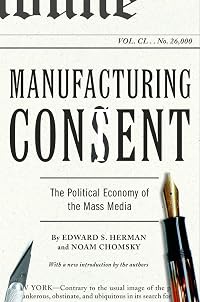
Manufacturing Consent: The Political Economy of the Mass Media
by Edward S. Herman, Noam Chomsky
On This Page
Description
In this pathbreaking work, now with a new introduction, Edward S. Herman and Noam Chomsky show that, contrary to the usual image of the news media as cantankerous, obstinate, and ubiquitous in their search for truth and defense of justice, in their actual practice they defend the economic, social, and political agendas of the privileged groups that dominate domestic society, the state, and the global order. Based on a series of case studies-including the media's dichotomous treatment of show more "worthy" versus "unworthy" victims, "legitimizing" and "meaningless" Third World elections, and devastating critiques of media coverage of the U.S. wars against Indochina-Herman and Chomsky draw on decades of criticism and research to propose a Propaganda Model to explain the media's behavior and performance. Their new introduction updates the Propaganda Model and the earlier case studies, and it discusses several other applications. show lessTags
Recommendations

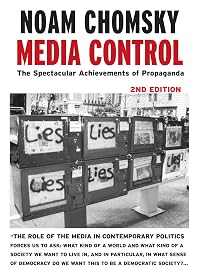
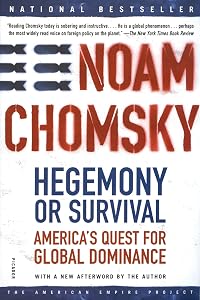
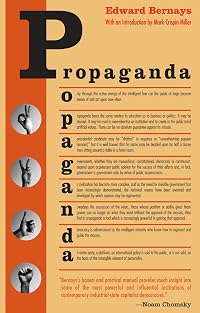

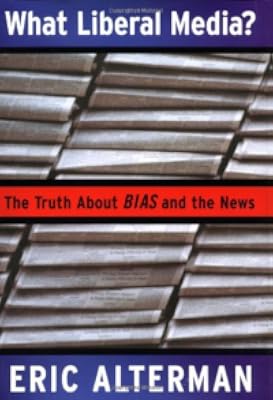
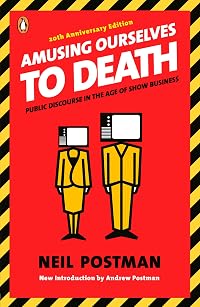

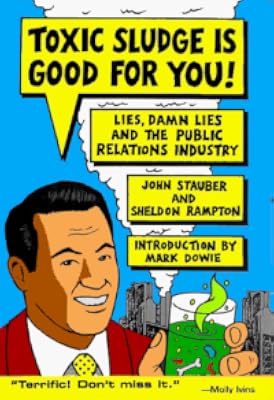
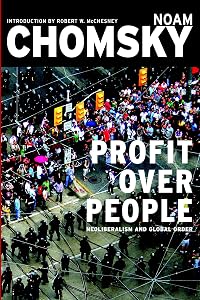
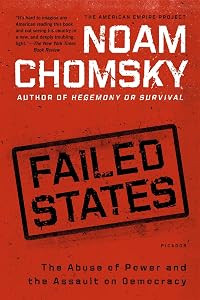














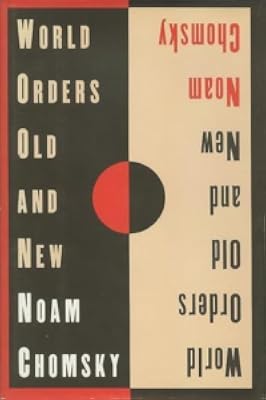

Member Recommendations
Member Reviews
An absolutely brilliant analysis of the ways in which individuals and organizations of the media are influenced to shape the social agendas of knowledge and, therefore, belief. Contrary to the popular conception of members of the press as hard-bitten realists doggedly pursuing unpopular truths, Herman and Chomsky prove conclusively that the free-market economics model of media leads inevitably to normative and narrow reporting. Whether or not you've seen the eye-opening movie, buy this book, and you will be a far more knowledgeable person and much less prone to having your beliefs manipulated as easily as the press.
The material in this book is a little dated focusing as is does mostly on Central America and Southeast Asia. I couldn't help substituting current events and groups while reading the historical ones. For instance Vietnam=Iraq, Cambodia=Syria, Khmer Rouge=Al Qaeda, and most recently, Nicaragua=Venezuela. Herman and Chomsky even touch on the disaster that was East Timor which is right now being played out again in Yemen.
A long and exhaustive read that was terribly fascinating, and definitely worth looking into if you’re interested in how contemporary mainstream media upholds existing hegemonies (in like, the leftist way, not the weird infowars “chemicals turning the frogs gay” way). To be honest I'd only really known about Chomsky's linguistic work, so finding out about his radical political beliefs kind of blindsided me. I'm eager to look into his other works sometime in the future
Let me make it clear that my three and a half star rating reflects my reading of this book in 2023: some 35 years after it was written. Unsurprisingly, things have moved on since then and, whilst there is much to take from this work, there are two provisos; the first is that I think we are a little more aware of cultural bias than we were, the second is that there has been a liberalisation of the media through on line blogs, etc. We now all have the ability to express our views. Corporate media and our political masters are much less likely to be believed in their ravings.
An updated version of this work would be a definite five star offeing.
An updated version of this work would be a definite five star offeing.
One of the founding motives of the United States was that it didn't and doesn't care about the rights of brown or red people. The silly British tried to respect the treaties with the natives in contrast to the Americans' god-given right to Western expansion. The big fault of Chomsky's book is his idealism, the faulty assumption that Americans care what their Buffalo soldiers do in places far away. They don't.
Firstly, caring would demand some minimal knowledge about geography and history. Even after a decade of war, most Americans would probably not be able to correctly identify Afghanistan or Iraq on a world map. Neither could they point out Guatemala or Laos. That the New York Times doesn't cover or relegate events is to a large extent show more due to customer demand. Americans prefer cheap, salty, fat and saccharine fast food not ugly stories about massacres and bad deeds from far-away places. The dis-intermediation of the media industry has shown that "news" is a poor business, even a loss leader.
Given the cost of reporting and the low demand on the one hand and the corporate ownership of the US media on the other, it is hardly surprising that US news is vastly different from what is served in other advanced countries. Cat pictures attract much more views at much lower cost. While Chomsky's explanation is fine, it is overly complex.
For this anniversary edition, Chomsky and co. revisited whether their cases presented held up: Depressingly, they passed with flying colors. The reality uncovered was in most cases even more damning. More helpful, though, would have been a look at the media in other countries. Just like commercial TV stations in European countries survive and prosper with vastly fewer ads and interruptions, the US could have a much more healthy media structure. show less
Firstly, caring would demand some minimal knowledge about geography and history. Even after a decade of war, most Americans would probably not be able to correctly identify Afghanistan or Iraq on a world map. Neither could they point out Guatemala or Laos. That the New York Times doesn't cover or relegate events is to a large extent show more due to customer demand. Americans prefer cheap, salty, fat and saccharine fast food not ugly stories about massacres and bad deeds from far-away places. The dis-intermediation of the media industry has shown that "news" is a poor business, even a loss leader.
Given the cost of reporting and the low demand on the one hand and the corporate ownership of the US media on the other, it is hardly surprising that US news is vastly different from what is served in other advanced countries. Cat pictures attract much more views at much lower cost. While Chomsky's explanation is fine, it is overly complex.
For this anniversary edition, Chomsky and co. revisited whether their cases presented held up: Depressingly, they passed with flying colors. The reality uncovered was in most cases even more damning. More helpful, though, would have been a look at the media in other countries. Just like commercial TV stations in European countries survive and prosper with vastly fewer ads and interruptions, the US could have a much more healthy media structure. show less
One of Noam Chomsky and Edward Herman's more substantial written contributions, Manufacturing Consent details a framework dubbed the "propaganda model," which can determine or explain many factors of media reporting found deficient, biased, or just plain incompetent. I found this book to be a poignant and effective review of a period in which media was supposedly keeping an "adversarial stance" towards those in power -- while the contrary continued to be the case.
Even for those who do not believe in the "propaganda model" as explained by the authors, Manufacturing Consent remains an important work for pointing out many circumstances of media bias and societal constraint during the turbulent times of the 1960s, 70s and 80s. For those who show more understand the model to be a reliable framework for viewing the behaviour of the media, it is easy to find many circumstances of institutional malfeasance throughout recent decades and up to the current day. For example, while the anti-communist filter, as mentioned, has evolved somewhat into being a general "anti-socialist" dogmatic brick wall, it continues to show itself in media across the spectrum, notably at outlets like Fox News.
I found the principles outlined by the authors described very well and backed with an exhaustive investigation of evidence, in all circumstances evaluated. Furthermore, the book's framework continues to show its relevance. Even though the rise of the internet has 'cracked' corporate media's grip, it still holds fast, as the vast majority of news consumed around the world is produced by corporate media. The version with the updated acknowledgement includes additional information to keep the text relevant in the modern day, including references to internet use, media consolidation and additional examples of the model's effectiveness.
For these reasons, the book is a very compelling read and I would recommend it to anyone interested in broadening their knowledge of how their world really works. show less
Even for those who do not believe in the "propaganda model" as explained by the authors, Manufacturing Consent remains an important work for pointing out many circumstances of media bias and societal constraint during the turbulent times of the 1960s, 70s and 80s. For those who show more understand the model to be a reliable framework for viewing the behaviour of the media, it is easy to find many circumstances of institutional malfeasance throughout recent decades and up to the current day. For example, while the anti-communist filter, as mentioned, has evolved somewhat into being a general "anti-socialist" dogmatic brick wall, it continues to show itself in media across the spectrum, notably at outlets like Fox News.
I found the principles outlined by the authors described very well and backed with an exhaustive investigation of evidence, in all circumstances evaluated. Furthermore, the book's framework continues to show its relevance. Even though the rise of the internet has 'cracked' corporate media's grip, it still holds fast, as the vast majority of news consumed around the world is produced by corporate media. The version with the updated acknowledgement includes additional information to keep the text relevant in the modern day, including references to internet use, media consolidation and additional examples of the model's effectiveness.
For these reasons, the book is a very compelling read and I would recommend it to anyone interested in broadening their knowledge of how their world really works. show less
Noam Chomsky is quite possibly the most intelligent man alive (this is being written after Stephen Hawking's death and noting that there are probably more intelligent women around but the media ignores them), and "Manufacturing Consent" covers his life and belief that the media is to blame for much of which ails the earth.
This is a well written polemic that points out times the mainstream media has twisted the truth or not covered at all. Of course, being a polemic means there is little nuance involved. Hermann and Chomsky are preaching to the converted, and while I agreed with them far more than disagreed, the preaching did grate after a while.
This is a well written polemic that points out times the mainstream media has twisted the truth or not covered at all. Of course, being a polemic means there is little nuance involved. Hermann and Chomsky are preaching to the converted, and while I agreed with them far more than disagreed, the preaching did grate after a while.
Members
- Recently Added By
Lists

LT picks: Blue Books
197 works; 44 members

Non-Fiction Worth Reading
1,016 works; 262 members

Investigations - a dissenting opinion
3 works; 1 member

Entender el mundo
46 works; 1 member

SOPA Book Recommendations
19 works; 1 member

Books
85 works; 1 member

Books available on Open Library
171 works; 4 members

Decolonize Palestine's Reading List
126 works; 3 members

Blindpill
20 works; 2 members

Political Theory
23 works; 1 member
Author Information

22+ Works 4,768 Members
Edward Samuel Herman was born in Philadelphia, Pennsylvania on April 7, 1925. He received bachelor's and master's degrees in economics from the University of Pennsylvania and a doctorate from the University of California, Berkeley. He joined the faculty of the Wharton School of Business in 1958 and taught finance there until he retired in 1989. He show more wrote and co-wrote several books including Corporate Control, Corporate Power: A Twentieth Century Fund Study, The Global Media written with Robert McChesney, and The Political Economy of Human Rights and Manufacturing Consent: The Political Economy of the Mass Media, both written with Noam Chomsky. He died from complications of bladder cancer on November 11, 2017 at the age of 92. (Bowker Author Biography) show less

584+ Works 47,593 Members
Noam Chomsky was born in Philadelphia, Pennsylvania on December 7, 1928. Son of a Russian emigrant who was a Hebrew scholar, Chomsky was exposed at a young age to the study of language and principles of grammar. During the 1940s, he began developing socialist political leanings through his encounters with the New York Jewish intellectual show more community. Chomsky received his Ph.D. from the University of Pennsylvania, where he studied linguistics, mathematics, and philosophy. He conducted much of his research at Harvard University. In 1955, he began teaching at MIT, eventually holding the Ferrari P. Ward Chair of Modern Language and Linguistics. Today Chomsky is highly regarded as both one of America's most prominent linguists and most notorious social critics and political activists. His academic reputation began with the publication of Syntactic Structures in 1957. Within a decade, he became known as an outspoken intellectual opponent of the Vietnam War. Chomsky has written many books on the links between language, human creativity, and intelligence, including Language and Mind (1967) and Knowledge of Language: Its Nature, Origin, and Use (1985). He also has written dozens of political analyses, including Manufacturing Consent: The Political Economy of the Mass Media (1988), Chronicles of Dissent (1992), and The Prosperous Few and the Restless Many (1993). (Bowker Author Biography) show less
Awards and Honors
Work Relationships
Has as a commentary on the text
Common Knowledge
Classifications
- Genres
- Sociology, General Nonfiction, Nonfiction, Politics and Government, Philosophy
- DDC/MDS
- 302.234 — Society, government, & culture Social sciences, sociology & anthropology Mass Communication & Media Communication Media (Means of communication) Motion pictures, radio, television
- LCC
- P95.82 .U6 — Language and Literature Philology. Linguistics Communication. Mass media
- BISAC
Statistics
- Members
- 3,937
- Popularity
- 4,004
- Reviews
- 29
- Rating
- (4.10)
- Languages
- 8 — English, French, German, Hungarian, Italian, Portuguese, Spanish, Turkish
- Media
- Paper, Audiobook, Ebook
- ISBNs
- 28
- ASINs
- 14