
Mindbridge
by Joe Haldeman
On This Page
Description
A remarkable alien technology could have devastating consequences for humanity in this novel by the Hugo and Nebula Award-winning author of The Forever War. In the far future, the accidental scientific breakthrough known as the Levant-Meyer Translation changes everything. Suddenly people can leap instantaneously across the universe, albeit temporarily, enabling teams of Tamers to explore far-flung worlds and prepare them for possible human habitation. But one expedition doesn't make it back show more alive. Jacque Lefavre achieves his lifelong dream of becoming a Tamer when he joins the Agency for Extraterrestrial Development. On his first exploratory mission to a planet known as Groombridge, Lefavre and his team encounter something truly extraordinary: a small, nonsentient creature that, when joined with another of its kind, creates a telepathic "bridge." But exploiting this psychic link could bring unanticipated perils, for it is about to bring Lefavre and his team into dangerously close contact with the L'vrai, an ancient, advanced, and hostile race of star travelers--an encounter that could prove to be the first step in humankind's salvation . . . or its doom. This ebook features an illustrated biography of Joe Haldeman including rare images from the author's personal collection. show lessTags
Recommendations




























Member Reviews
* spoiler alert*
It was a surprise to find that Mindbridge was published (1976) after the military scifi classic The Forever War (1974) because it feels like a potential precursor. It is certainly imaginative with that type of hard science approach that tends to boggle the mind of the humanities graduate.
The Forever War's interest lay in its use of time dilation so perhaps Mindbridge was an attempt to bypass the physical limitations of interstellar travel by postulating new types of physical effect in the Levant-Meyer Translation [LMT] and aliens who have evolved as a single interstellar entity.
It may not always quite convince but it is still well above average in conception (enough to have been a Hugo nominee) with an interesting idea show more in a rather dangerous (to first users) invertebrate that allows telepathic communication. This then enables communication with the aliens.
The hard science is all very well but hard science ideas generally do not stand up in literature if they do not have some deeper narrative behind them. Haldeman provides this in spades with a jumpy but effective narrative style centred on a potentially unstable human warrior, Jacque Lefavre.
It is also very well written with scenes on alien planets, relations between people and the speed of reaction necessary in fast-moving situations all well handled. This is the world of the militarism of the unquestioned mission and it strikes us as plausible.
Perhaps the link between the proto-Nietzschean Lefavre and chillingly hard to comprehend 'superior' aliens does not quite come off in the end. The book neatly leaves in the air how we would cope psychologically with such powerful distant creatures. This is a good thing.
There is an air of resistance being rather useless and that perhaps the best human strategy is adaptation, to become potentially easily crushed allies rather than enemies. This is perhaps how many nations may feel in relation to the United States. Humanity survives on notice.
Perhaps this is what is most psychologically interesting - a militarised sub-society of humanity faces something which, in conflict, it could not possibly defeat but which it has to placate, knowing that this something is not interested in destroying humanity unless it becomes a threat.
The book is also unusual in its ability not only to imagine new technologies and aliens (the stock in trade of science fiction) but new social forms which science fiction has often been quite bad at, usually merely extrapolating the world in which the work was written.
Mindbridge was written in the 1970s about the middle of our century (2050s and later) and, although we are unlikely to have a society like Haldeman's, his version is a genuine attempt to rethink how the society of his day might change significantly rather than simply be reshuffled.
The world is run by a representative democracy representing global corporations with agencies still having to endure the politics of budgetary appropriations. It is a crowded world with much continuing deprivation. The military is a dangerous career path (as it was in the Vietnam age).
The military in this case are extraterrestrial explorers (Tamers) looking to create new colonies of humanity 'just in case' the earth ends but having to do so under extremely complex and difficult conditions involving birthing of people on planet by female 'military' who double up as warriors.
It has to be admitted that the complexities are not entirely explained. There are holes in the plot on this score but a willing suspension of disbelief will have to suffice. As warrior explorers, Tamers bounce around the distance universe using LMT within massive complicated space suits.
Low life expectancy and a rather cool approach to sex - split between procreation strategies, sex as cool experimentation (with the mindbridge) and the existence of love - make this an unusual book. The attempt to tell the truth about what the mind does during sex is quite impressive.
Similarly life is not cheap but is easily expended for a greater cause. The suicidal are invited to volunteer for existentially important (to humanity) tasks from which they cannot return. Tamers are free not to go on mission but are shamed and pauperised if they do not.
The book misses a few beats short of being a great SciFi novel but its virtues outweigh its weaknesses. The treatment of sex, the imaginative hard science, the picture of what humanity may have to become to rule a portion of the stars, the brutal war realism, all impress.
It feels as if it should at least have a sequel and yet it is also a dead end. Military hard scifi has a serious problem with an unbeatable enemy. It always has to have the hope of an ultimate triumph. Haldeman takes that possibility away and so a series would be futile. show less
It was a surprise to find that Mindbridge was published (1976) after the military scifi classic The Forever War (1974) because it feels like a potential precursor. It is certainly imaginative with that type of hard science approach that tends to boggle the mind of the humanities graduate.
The Forever War's interest lay in its use of time dilation so perhaps Mindbridge was an attempt to bypass the physical limitations of interstellar travel by postulating new types of physical effect in the Levant-Meyer Translation [LMT] and aliens who have evolved as a single interstellar entity.
It may not always quite convince but it is still well above average in conception (enough to have been a Hugo nominee) with an interesting idea show more in a rather dangerous (to first users) invertebrate that allows telepathic communication. This then enables communication with the aliens.
The hard science is all very well but hard science ideas generally do not stand up in literature if they do not have some deeper narrative behind them. Haldeman provides this in spades with a jumpy but effective narrative style centred on a potentially unstable human warrior, Jacque Lefavre.
It is also very well written with scenes on alien planets, relations between people and the speed of reaction necessary in fast-moving situations all well handled. This is the world of the militarism of the unquestioned mission and it strikes us as plausible.
Perhaps the link between the proto-Nietzschean Lefavre and chillingly hard to comprehend 'superior' aliens does not quite come off in the end. The book neatly leaves in the air how we would cope psychologically with such powerful distant creatures. This is a good thing.
There is an air of resistance being rather useless and that perhaps the best human strategy is adaptation, to become potentially easily crushed allies rather than enemies. This is perhaps how many nations may feel in relation to the United States. Humanity survives on notice.
Perhaps this is what is most psychologically interesting - a militarised sub-society of humanity faces something which, in conflict, it could not possibly defeat but which it has to placate, knowing that this something is not interested in destroying humanity unless it becomes a threat.
The book is also unusual in its ability not only to imagine new technologies and aliens (the stock in trade of science fiction) but new social forms which science fiction has often been quite bad at, usually merely extrapolating the world in which the work was written.
Mindbridge was written in the 1970s about the middle of our century (2050s and later) and, although we are unlikely to have a society like Haldeman's, his version is a genuine attempt to rethink how the society of his day might change significantly rather than simply be reshuffled.
The world is run by a representative democracy representing global corporations with agencies still having to endure the politics of budgetary appropriations. It is a crowded world with much continuing deprivation. The military is a dangerous career path (as it was in the Vietnam age).
The military in this case are extraterrestrial explorers (Tamers) looking to create new colonies of humanity 'just in case' the earth ends but having to do so under extremely complex and difficult conditions involving birthing of people on planet by female 'military' who double up as warriors.
It has to be admitted that the complexities are not entirely explained. There are holes in the plot on this score but a willing suspension of disbelief will have to suffice. As warrior explorers, Tamers bounce around the distance universe using LMT within massive complicated space suits.
Low life expectancy and a rather cool approach to sex - split between procreation strategies, sex as cool experimentation (with the mindbridge) and the existence of love - make this an unusual book. The attempt to tell the truth about what the mind does during sex is quite impressive.
Similarly life is not cheap but is easily expended for a greater cause. The suicidal are invited to volunteer for existentially important (to humanity) tasks from which they cannot return. Tamers are free not to go on mission but are shamed and pauperised if they do not.
The book misses a few beats short of being a great SciFi novel but its virtues outweigh its weaknesses. The treatment of sex, the imaginative hard science, the picture of what humanity may have to become to rule a portion of the stars, the brutal war realism, all impress.
It feels as if it should at least have a sequel and yet it is also a dead end. Military hard scifi has a serious problem with an unbeatable enemy. It always has to have the hope of an ultimate triumph. Haldeman takes that possibility away and so a series would be futile. show less
Just prior to reading this book, I finished a bloated two-book slog by a very famous science fiction author – a book that won (I believe) a Hugo and a Nebula. That may be enough for you to determine of which book I speak, but no sense dragging the author’s name through the mud in the review of another book. In fact, no review should start with a reference to another book.
However, I bring it up because this book was a cold, deep, crisp, cleansing drink of water after my previous experience.
There is much to recommend in this book. To start with, it is a good, fast read. Just under 200 pages, it is amazing to see the experiences and ideas Haldeman squeezes in with so little writing. (And, in this day when bloatedness seems to rule, show more that makes it so much better.) There is the idea of instant transmission of humans, with a flaw that means we can’t just galivant everywhere. There is the idea of a creature which can cause instantaneous esp between those touching the animal (again, with flaws that create problems.) And then there are aliens that look new and fresh (hard to pull off when so many aliens have already been describe). In addition, our understanding of these aliens shifts many times throughout the book. All done effectively, and all done in such short order.
In addition, Haldeman experiments with content and plotting. Some works; some doesn’t. But it makes for an even better exploration through reading.
This could easily have been a short story/novelette and been successful. But the way Haldeman has told and expanded the story brings dimensions we would have missed through any other delivery.
Finally, there might be some concern that this 1977 book might be dated. I didn’t think so. Maybe I’m reading it with an old man’s eyes, but it seemed as fresh and interesting and relevant as anything I see today. Which means, read it today. show less
However, I bring it up because this book was a cold, deep, crisp, cleansing drink of water after my previous experience.
There is much to recommend in this book. To start with, it is a good, fast read. Just under 200 pages, it is amazing to see the experiences and ideas Haldeman squeezes in with so little writing. (And, in this day when bloatedness seems to rule, show more that makes it so much better.) There is the idea of instant transmission of humans, with a flaw that means we can’t just galivant everywhere. There is the idea of a creature which can cause instantaneous esp between those touching the animal (again, with flaws that create problems.) And then there are aliens that look new and fresh (hard to pull off when so many aliens have already been describe). In addition, our understanding of these aliens shifts many times throughout the book. All done effectively, and all done in such short order.
In addition, Haldeman experiments with content and plotting. Some works; some doesn’t. But it makes for an even better exploration through reading.
This could easily have been a short story/novelette and been successful. But the way Haldeman has told and expanded the story brings dimensions we would have missed through any other delivery.
Finally, there might be some concern that this 1977 book might be dated. I didn’t think so. Maybe I’m reading it with an old man’s eyes, but it seemed as fresh and interesting and relevant as anything I see today. Which means, read it today. show less
What a weird book. It seems like it's all about this one thing, but about ⅔ in, that thing it weirdly dismissed by a short explainer chapter, and then the _real_ plot starts. And abruptly stops and is wrapped up somehow both inconclusively and perfuntorily? But I still liked it. There were a lot of charts and graphs and switching media and storytelling styles, and I could really see it working well as a movie… if it didn't have such a lackluster ending.
Well, I'm not sure why I liked this story, my lack of an explanation is perhaps simply that I'm fighting a mid-winter writer's block and depression, but I suspect that it is because I believe that mankind will stumble into inter-stellar travel much in the accidental manner described by this book, with the unintended, and undesirable consequences. Naturally, it is fun to read something which basically confirms your own cherished prejudices. This was a quick and enjoyable read, I was interested in how man reacted to its encounter with other intelligent species and heartened that the writer believes (hopes) that the encounter will be benign when it happens. Another good story from Haldeman, thank you sir, and thanks to the publisher and show more NetGalley for the chance to read the work. show less
Well, that took a weird turn.
Idea has potential, not explored as adequately as I'd like before another coincidence ups the stakes again.
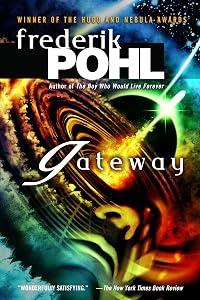
Nice space travel mechanism; remind's me of Pohl's classic Gateway.
Standard Haldeman sexin' without any real emotional, uh, anything. And nothing is really done with a fairly important revelation about the MC's psyche.
Last line's a pretty good stinger, though.
Idea has potential, not explored as adequately as I'd like before another coincidence ups the stakes again.
Nice space travel mechanism; remind's me of Pohl's classic Gateway.
Standard Haldeman sexin' without any real emotional, uh, anything. And nothing is really done with a fairly important revelation about the MC's psyche.
Last line's a pretty good stinger, though.
Excellent. Fascinating characters, interesting tech and an unusual and compelling premise, combined with a rather distinct style of story-telling made for a great read. I'd forgotten just how good Joe Haldeman is!
Jacque Lefavre, a Tamer, uses teleportation technology to prepare distant planets for human colonization. Humans discover alien telepathic organisms that allow them to share thoughts, aiding in the tense first contact with the advanced, collective-consciousness L'vrai aliens.
On a murky planet, explorers discover sentient, sponge-like organisms, nicknamed bridges, that, when touched simultaneously by two people, enable telepathic communication, allowing individuals to share thoughts, feelings, and memories.
The crew encounters the L'vrai, a superior, hive-mind alien species that views humanity as a threat due to their chaotic, fragmented consciousness. The telepathic organisms become vital for trying to communicate with them.
On a murky planet, explorers discover sentient, sponge-like organisms, nicknamed bridges, that, when touched simultaneously by two people, enable telepathic communication, allowing individuals to share thoughts, feelings, and memories.
The crew encounters the L'vrai, a superior, hive-mind alien species that views humanity as a threat due to their chaotic, fragmented consciousness. The telepathic organisms become vital for trying to communicate with them.
Members
- Recently Added By
Lists

Best Military Science Fiction
57 works; 26 members

Books Read in 2024
4,727 works; 128 members
Author Information

198+ Works 30,932 Members
Joe Haldeman has uniquely blended a strong interest in astronomy and with his love for writing to publish numerous novels, anthologies and short stories over three decades. He holds a B.S. in astronomy from the University of Maryland (1967), and an M.F.A. in English from the Iowa Writers Workshop (1975). An adjunct professor at Massachusetts show more Institute of Technology, Haldeman has also taught at Michigan State, Larion West Seattle, SUNY Buffalo, Princeton, University of North Dakota, Kent State and the University of North Florida Haldeman's works include War Year (1972), The Forever War (1975), Worlds (1981), Worlds Apart (1983), Tools of the Trade (1987), and The Hemingway Hoax (1990). He has also co-authored and edited numerous works of science fiction. Born in Oklahoma on June 9, 1943, Haldeman grew up in Puerto Rico, New Orleans, Washington D.C., and Alaska. He was drafted into the military in 1967, fighting in the Central Highlands of Vietnam as a combat engineer with the 4th Division (1/22nd Airmobile Battalion), for which he received the Purple Heart, among other medals. (Bowker Author Biography) show less
Some Editions
Awards and Honors
Awards
Series
Belongs to Publisher Series
Goldmann Science Fiction (23283)
Work Relationships
Is contained in
Common Knowledge
- Canonical title*
- Pontesprit
- Original title
- Mindbridge
- Original publication date
- 1976-09
- People/Characters
- Jacque Lefavre
- Important events
- Discovery of the Levant-Meyer Translation
- Dedication
- This book is for my teachers at the Iowa Writers' Workshop: Stephen Becker, vance Bourjaily, Ray Carver, John Cheever, Stanley Elkin, William Price Fox, John Leggett. Also for John Brunner, Dos Passos (pro forma)
- First words
- Denver pissed him off.
- Last words
- (Click to show. Warning: May contain spoilers.)After reading the book thoroughly they decided Lefavre would be a bad example for their children.
- Original language*
- Englisch
*Some information comes from Common Knowledge in other languages. Click "Edit" for more information.
Classifications
Statistics
- Members
- 1,043
- Popularity
- 24,906
- Reviews
- 9
- Rating
- (3.67)
- Languages
- 5 — English, French, German, Italian, Spanish
- Media
- Paper, Ebook
- ISBNs
- 19
- ASINs
- 16