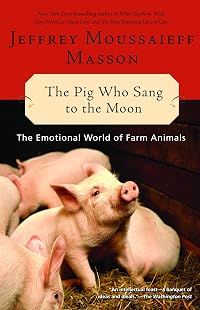
The Pig Who Sang to the Moon
by Jeffrey Moussaieff Masson 
On This Page
Description
Jeffrey Moussaieff Masson's groundbreaking bestseller, When Elephants Weep, was the first book since Darwin's time to explore emotions in the animal kingdom, particularly from animals in the wild. Now, he focuses exclusively on the contained world of the farm animal, revealing startling, irrefutable evidence that barnyard creatures have feelings too, even consciousness. Weaving history, literature, anecdotes, scientific studies, and Masson's own vivid experiences observing pigs, cows, sheep, show more goats, and chickens over the course of five years, this important book at last gives voice, meaning, and dignity to these gentle beasts that are bred to be milked, shorn, butchered, and eaten. Can we ever know what makes an animal happy? Many animal behaviorists say no. But Jeffrey Masson has a different view: An animal is happy if it can live according to its own nature. Farm animals suffer greatly in this regard. Chickens, for instance, like to perch in trees at night, to avoid predators and to nestle with friends. The obvious conclusion: They cannot be happy when confined twenty to a cage. From field and barn, to pen and coop, Masson bears witness to the emotions and intelligence of these remarkable farm animals, each unique with distinct qualities. Curious, intelligent, self-reliant-many will find it hard to believe that these attributes describe a pig. In fact, there is much that humans share with pigs. They dream, know their names, and can see colors. Mother cows mourn the loss of their calves when their babies are taken away to slaughter. Given a choice between food that is nutritious or lacking in minerals, sheep will select the former, balancing their diet and correcting the deficiency. Goats display quite a sense of humor, dignity, and fearlessness (Indian goats have been known to kill leopards). Chickens are naturally sociable-they will gather around a human companion and stand there serenely preening themselves or sit quietly on the ground beside someone they trust. For far too long farm animals have been denigrated and treated merely as creatures of instinct rather than as sentient beings. Shattering the abhorrent myth of the "dumb animal without feelings," Jeffrey Masson has written a revolutionary book that is sure to stir human emotions far and wide. show lessTags
Recommendations


Member Reviews
A beautifully tragic look at “food” animals
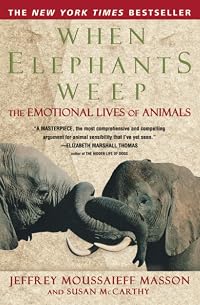
My first introduction to Jeffrey Moussaieff Masson’s work was in high school, when I read his 1996 book, When Elephants Weep: The Emotional Lives of Animals. At the time, I was a newbie vegetarian, just becoming involved in animal advocacy. When Elephants Weep helped validate my decision to go veg, and reinforced my resolve to stay that way.
Fast-forward thirteen years. I picked up Masson’s latest ethology tome, The Pig Who Sang to the Moon: The Emotional World of Farm Animals, on a whim. Remembering his earlier work, I expected a beautiful, brilliant, touching look at the inner lives and experiences of farmed animals. I was not disappointed.
In The Pig Who Sang to the Moon, Masson lays show more out the evidence – from the highly scientific to the folksy anecdotal – which points to a wide range of emotional experiences in farmed animals, including love, grief, sorrow, joy, empathy, altruism, fear, trust, friendship, contentment and the like. Far from being unfeeling brutes, the billions of animals bred, farmed and slaughtered for human consumption (10 billion annually in the U.S. alone) have complex emotional and intellectual lives. Some of their emotions – such as the strong maternal instinct – mirror our own, while other emotions and intellectual abilities far surpass those of humans. For example, when suffering egregious cruelties (such as those found on modern factory farms), non-human animals can’t always identify the source of or reason for their pain and abuse. This serves to heighten their fear, such that some species of non-human animals may actually have a greater capacity for suffering than humans. Clearly, this could – should – have profound implications vis-à-vis our treatment of non-human animals, particularly those of the “farmed” variety.
Masson structures the book so that each chapter covers a different species of farmed animals: pigs, chickens, sheep, goats, cows and ducks, in that order. He juxtaposes information about the animals’ emotional lives - thoughts, feelings, sentience, capacity for joy and sorrow, etc. - with the brutal reality for the vast majority of these “owned” animals. Treated like milk and meat machines, dehumanized and objectified, their individuality obscured and their needs ignored, farmed animals suffer the worst of humanity’s whims and wants.
A theme which threads its way through nearly every chapter is that of female suffering: the extra-special abuses (the collective) we mete out to the female members of the species. With brutal precision, farmers routinely turn the reproductive systems of female animals against them, finding newer and more callous ways in which to exploit them as science and technology allow. This isn’t to suggest that males don’t suffer as well - they do. But their suffering isn’t as prolonged or extensive as that of their female counterparts; veal calves, for example, are tortured for sixteen weeks and then, “mercifully,” (relatively speaking) slaughtered. Their sisters, meanwhile, are exploited as baby and milk machines for three to four years, after which they become ground beef. First, their babies and their babies’ food is stolen from them; and, finally, their lives are snatched away as well.
By the mere fact of their sex, sows, hens, ewes, does, nannies, cows and heifers - not to mention mares, bitches, jennies, jills, etc. - are ripe for especially cruel and prolonged exploitation. Oftentimes, this involves a constant cycle of pregnancy, birth, nursing and baby-napping, culminating with the female’s own death when she’s no longer able to breed or “produce” to her “owner’s” satisfaction. Given these parallels – women’s bodies, too, are used as tools of and rationalizations for their own subjugation - it’s a wonder why all Western feminists aren’t also vegans.
A beautifully tragic look at food animals, The Pig Who Sang to the Moon should be required reading for all “meat”-eaters. As Masson notes in the book’s conclusion – “On Not Eating Friends” –
“What has any of this got to do with you, you might ask? If you eat these animals, if you wear their skins as shoes or belts, then their lives must be of concern to you. It has something to do with you, because you have something to do with them. Our lives, all of our lives, are inextricably intertwined with the lives of farm animals, even when we would prefer that they not be. It would take a very hard-hearted person to say: ‘I don’t care what kind of lives they lead, how much they suffer, how far removed from their ordinary life, it just means nothing to me, holds no interest for me. I will continue to eat them and use them in any way I feel like without taking the slightest responsibility to know what kind of creatures they are, what they feel, what kinds of lives they lead in order to give me the products I want.’”
If you enjoy the taste of animal flesh – and dismiss concerns about the well-being of farmed animals with appeals to their emotional, intellectual and/or evolutionary inferiority – then you owe it to yourself to pick up a copy of The Pig Who Sang to the Moon and educate yourself. It’s the least you can do.
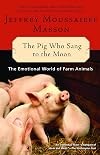
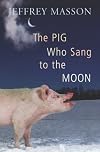
And yes, the book opens with a pig who quite enjoyed serenading the full moon!
Note: I “read” the audiobook version of this book. Though the narrator’s voice is disconcerting at first – as it seems to emanate from a family farmer of olden days, like Old MacDonald or somesuch, certainly kinder than the big agribusiness which now dominates farming, but an animal killer just the same – it grew on me rather quickly. Tim Jerrome’s narration has a gentle, lulling quality about it, which lends itself well to Masson’s storytelling style.
http://www.easyvegan.info/2009/03/18/book-review-the-pig-who-sang-to-the-moon-by...
http://www.easyvegan.info/tag/the-pig-who-sang-to-the-moon/ show less
My first introduction to Jeffrey Moussaieff Masson’s work was in high school, when I read his 1996 book, When Elephants Weep: The Emotional Lives of Animals. At the time, I was a newbie vegetarian, just becoming involved in animal advocacy. When Elephants Weep helped validate my decision to go veg, and reinforced my resolve to stay that way.
Fast-forward thirteen years. I picked up Masson’s latest ethology tome, The Pig Who Sang to the Moon: The Emotional World of Farm Animals, on a whim. Remembering his earlier work, I expected a beautiful, brilliant, touching look at the inner lives and experiences of farmed animals. I was not disappointed.
In The Pig Who Sang to the Moon, Masson lays show more out the evidence – from the highly scientific to the folksy anecdotal – which points to a wide range of emotional experiences in farmed animals, including love, grief, sorrow, joy, empathy, altruism, fear, trust, friendship, contentment and the like. Far from being unfeeling brutes, the billions of animals bred, farmed and slaughtered for human consumption (10 billion annually in the U.S. alone) have complex emotional and intellectual lives. Some of their emotions – such as the strong maternal instinct – mirror our own, while other emotions and intellectual abilities far surpass those of humans. For example, when suffering egregious cruelties (such as those found on modern factory farms), non-human animals can’t always identify the source of or reason for their pain and abuse. This serves to heighten their fear, such that some species of non-human animals may actually have a greater capacity for suffering than humans. Clearly, this could – should – have profound implications vis-à-vis our treatment of non-human animals, particularly those of the “farmed” variety.
Masson structures the book so that each chapter covers a different species of farmed animals: pigs, chickens, sheep, goats, cows and ducks, in that order. He juxtaposes information about the animals’ emotional lives - thoughts, feelings, sentience, capacity for joy and sorrow, etc. - with the brutal reality for the vast majority of these “owned” animals. Treated like milk and meat machines, dehumanized and objectified, their individuality obscured and their needs ignored, farmed animals suffer the worst of humanity’s whims and wants.
A theme which threads its way through nearly every chapter is that of female suffering: the extra-special abuses (the collective) we mete out to the female members of the species. With brutal precision, farmers routinely turn the reproductive systems of female animals against them, finding newer and more callous ways in which to exploit them as science and technology allow. This isn’t to suggest that males don’t suffer as well - they do. But their suffering isn’t as prolonged or extensive as that of their female counterparts; veal calves, for example, are tortured for sixteen weeks and then, “mercifully,” (relatively speaking) slaughtered. Their sisters, meanwhile, are exploited as baby and milk machines for three to four years, after which they become ground beef. First, their babies and their babies’ food is stolen from them; and, finally, their lives are snatched away as well.
By the mere fact of their sex, sows, hens, ewes, does, nannies, cows and heifers - not to mention mares, bitches, jennies, jills, etc. - are ripe for especially cruel and prolonged exploitation. Oftentimes, this involves a constant cycle of pregnancy, birth, nursing and baby-napping, culminating with the female’s own death when she’s no longer able to breed or “produce” to her “owner’s” satisfaction. Given these parallels – women’s bodies, too, are used as tools of and rationalizations for their own subjugation - it’s a wonder why all Western feminists aren’t also vegans.
A beautifully tragic look at food animals, The Pig Who Sang to the Moon should be required reading for all “meat”-eaters. As Masson notes in the book’s conclusion – “On Not Eating Friends” –
“What has any of this got to do with you, you might ask? If you eat these animals, if you wear their skins as shoes or belts, then their lives must be of concern to you. It has something to do with you, because you have something to do with them. Our lives, all of our lives, are inextricably intertwined with the lives of farm animals, even when we would prefer that they not be. It would take a very hard-hearted person to say: ‘I don’t care what kind of lives they lead, how much they suffer, how far removed from their ordinary life, it just means nothing to me, holds no interest for me. I will continue to eat them and use them in any way I feel like without taking the slightest responsibility to know what kind of creatures they are, what they feel, what kinds of lives they lead in order to give me the products I want.’”
If you enjoy the taste of animal flesh – and dismiss concerns about the well-being of farmed animals with appeals to their emotional, intellectual and/or evolutionary inferiority – then you owe it to yourself to pick up a copy of The Pig Who Sang to the Moon and educate yourself. It’s the least you can do.
And yes, the book opens with a pig who quite enjoyed serenading the full moon!
Note: I “read” the audiobook version of this book. Though the narrator’s voice is disconcerting at first – as it seems to emanate from a family farmer of olden days, like Old MacDonald or somesuch, certainly kinder than the big agribusiness which now dominates farming, but an animal killer just the same – it grew on me rather quickly. Tim Jerrome’s narration has a gentle, lulling quality about it, which lends itself well to Masson’s storytelling style.
http://www.easyvegan.info/2009/03/18/book-review-the-pig-who-sang-to-the-moon-by...
http://www.easyvegan.info/tag/the-pig-who-sang-to-the-moon/ show less
The Pig Who Sang to the Moon is a beautiful testament to the lives of the voiceless millions of farmed animals who are cruelly hurt and killed every day. I think it is the most important book I have ever read. Someone should speak up for the animals, and I admire Jeffery Moussaieff Masson for being the one to do it.
"Why is it generally considered ridiculous to point out that every one of those animals had a mother, almost all had siblings, and surely some were mourned by a parent or missed by a friend? Even though they were bred to be killed, their emotional capacities were not altered by such breeding. They had memories, they suffered, and they grieved. There is little justification for making a comparative scale of suffering where show more 'human' is weighted and animal is given little weight. To be concerned about one kind of suffering does not mean that you must have no interest in another, or that you think that one is somehow more important or more terrible than another." show less
"Why is it generally considered ridiculous to point out that every one of those animals had a mother, almost all had siblings, and surely some were mourned by a parent or missed by a friend? Even though they were bred to be killed, their emotional capacities were not altered by such breeding. They had memories, they suffered, and they grieved. There is little justification for making a comparative scale of suffering where show more 'human' is weighted and animal is given little weight. To be concerned about one kind of suffering does not mean that you must have no interest in another, or that you think that one is somehow more important or more terrible than another." show less
A relatively quick read about how farm animals are more sentient and emotional than most people will give them credit for. I find this a very interesting topic because while society is quick to ascribe feelings to beloved companion animals (my rabbit makes it very clear when she is not happy), there is a categorical divide in our psyche between "pets" and all other animals, particularly animals that we commoditize for food and clothing.
Mousaieff Masson provides anecdotes of various farm animals who have exhibited "human" traits, acknowledging that science does not consider anecdotal evidence evidence at all, but that is all the evidence we have at the moment because the question of farm animal sentience is poo-pooed and not taken show more seriously by the scientific community.
While I enjoyed the book, I found it a bit incomplete. As in a number of books I've read dealing with animal welfare, animal rights, etc., the author relies on one facet only to make the case for moving to vegetarianism or veganism - in this case that animals are sentient and suffer, and our exploitation of them is immoral. But given how ingrained this exploitation and the mindset that animals are for our use is, I doubt that argument will not bring about widespread or lasting change. show less
Mousaieff Masson provides anecdotes of various farm animals who have exhibited "human" traits, acknowledging that science does not consider anecdotal evidence evidence at all, but that is all the evidence we have at the moment because the question of farm animal sentience is poo-pooed and not taken show more seriously by the scientific community.
While I enjoyed the book, I found it a bit incomplete. As in a number of books I've read dealing with animal welfare, animal rights, etc., the author relies on one facet only to make the case for moving to vegetarianism or veganism - in this case that animals are sentient and suffer, and our exploitation of them is immoral. But given how ingrained this exploitation and the mindset that animals are for our use is, I doubt that argument will not bring about widespread or lasting change. show less
Wonderful, interesting book that will make you think, if you're open to it, about things as varied as our place in the whole scheme of things, the benefits & drawbacks of the ways we eat and live, and especially, about the probable lives, loves and thoughts of other creatures we humans so often take for granted, knowing them mainly simply by how we eat them, and nothing more.Masson is a bit strong in his views on vegetarianism, I think, and I don't always agree with him, but you can easily read around this as long as you're somewhat confident and aware of your own feelings about that. I think many people are not so confident & aware, though -- I wasn't as much as I thought I was before reading this -- so the book is one that offers show more something for everyone... everyone, that is, who cares to rediscover how compassion, happiness and a consciousness o the world around them are not traits shared by humans alone. Anyone who has and loves any kind of pet will understand this. Why should it be any different for farm animals, who give to us so we can live.Those who criticize the book for being "pompous" or "unscientific, unbalanced, and anthropomorphic" are missing the point. In fact, without sounding "pompous" myself, I'm not sure they get one of the basic messages underlying the entire book, which is that farm creatures have lives that can be equally as fulfilling as ours, and that it's perhaps time we stop and ponder how we treat them in our gusto to feed ourselves. Any of the various labels thrown at the book, like being "anthropomorphic" I feel are just excuses to avoid thinking deeply about these things, of course while maintaining humans as some kind of ideal creature above all others. We are human, not any other creature, so how else can we -- as humans -- observe, interact and hopefully understand pigs, chickens, sheep, goats, cows and ducks (all the animals explored in the book) except anthropomorphically? Sure, it's a limitation not because the animals can't talk like us and perhaps think like us, but rather because we can't talk like them or perhaps think like them. The book offers us a chance to change our human-centered perspective for a spell, and at least try to see things from the animals' perspectives. Difficult, for sure, and likely not entirely accurate, yet, but certainly worth the effort (and it's really not that much effort).Taking time to better understand other creatures, like farm animals, whom we share our lives with not only will likely help them, but surely can help us better understand ourselves as well. Originally written on Feb 10, 2010 at 03:25AM show less
You will learn a lot about the emotions of cows, pigs, chickens, ducks, sheep, goats, horses . . . well-researched and very enlightening, and unfortunately, few people who need to will read this. :( It makes you ache for the poor animals whose only sin was to be born into a world with cruel human animals. Going vegan.
All in all a good book, if I wasn't already a vegan I could see this book being the tipping point since it does such a good job of pointing out the cruelty to dairy cows, sheep raised for wool, geese used for their down feathers..etc. What prevented me from giving it 4 stars was that the author, at least at the time it was written states he is "mostly" vegan while at the same time advocating others go vegan.
A very emotional book for me to read being a vegan, many times I had to put it down sobbing as my heart broke reading this compelling book.
Members
- Recently Added By
Lists

Books about Animals
86 works; 4 members
Author Information

39+ Works 4,728 Members
Jeffrey Moussaieff Masson is the author of "Dogs Never Lie About Love: Reflections on the Emotional World of Dogs"; "When Elephants Weep: The Emotional Lives of Animals"; "My Father's Guru: A Journey Through Spirituality & Disillusion"; "Final Analysis: The Making & Unmaking of a Psychoanalyst"; & "The Assault on Truth: Freud's Suppression of the show more Seduction Theory", among other books. After receiving his undergraduate degree & a Ph.D. in Sanskrit & Indian Studies from Harvard University, he completed a full clinical training program in psychoanalysis at the Toronto Psychoanalytic Institute from 1970 to 1978. Masson served for one year as Projects Director of the Sigmund Freud Archives in London. (Bowker Author Biography) show less
Jeffrey Moussaieff Masson is a LibraryThing Author, an author who lists their personal library on LibraryThing.
Common Knowledge
- Canonical title
- The Pig Who Sang to the Moon
- Alternate titles
- The Pig Who Sang to the Moon
- Original publication date
- 2003
Classifications
Statistics
- Members
- 347
- Popularity
- 91,228
- Reviews
- 13
- Rating
- (3.92)
- Languages
- 5 — English, French, German, Italian, Portuguese
- Media
- Paper, Audiobook, Ebook
- ISBNs
- 18
- ASINs
- 2