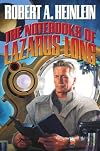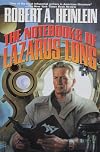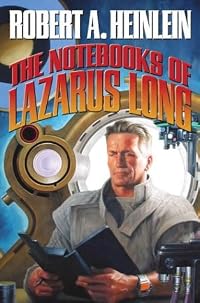
The Notebooks of Lazarus Long
by Robert A. Heinlein
Lazarus Long (Collections and Selections — anecdotes)
On This Page
Description
Lazarus Long, the protagonist of Robert A. Heinlein's masterful science fiction series of "future history" novels, is the oldest living member of the human race. His observations and comments, collected here -- from the smallest details of everyday life to overarching abstractions on the nature of the human condition -- are acute, lively, and intelligent. Long's adventures and experiences, his inexhaustible zest for life, and his ironic appreciation of the successes and failures of show more civilization make the observations contained in the Notebooks highly entertaining reading. In this book, Long's witty words of wisdom are beautifully illustrated by noted calligrapher Donald F. Vassallo. show lessTags
Recommendations






















Member Reviews
The Notebooks of Lazarus Long is one of those thrown-together little books looking for impulse purchases on the front counter of a bookstore. It has found a new life as an e-book.
It compiles a random set of remarks by Lazarus Long, who, one suspects, is Robert Heinlein’s wish-fulfilling alter-ego. David Hartwell’s introduction tells us something about Lazarus, but I wish the selections were individually sourced and dated.
Long, who, Hartwell tells us, fathered billions of offspring, has a lot to say about sex. Of course, this bit could be about engineering: “Moving parts in rubbing contact require lubrication to avoid excessive wear.” Here is one that Oscar Wilde would have liked: “Yield to temptation; it may not pass your way show more again.”
Sometimes, Long’s quips about money sound like they might have come from Poor Richard’s Almanac: “Anything free is worth what you pay for it.” Sometimes, he echoes George Ade’s “In God We Trust, All Others Pay Cash”: “Money is truthful. If a man speaks of his honor, make him pay cash.” All too often, he channels his inner Ayn Rand: “The greatest productive force is human selfishness.”
He offers us this version of John Campbell’s ideal of the competent man: “A human being should be able to change a diaper, plan an invasion, butcher a hog, conn a ship, design a building, write a sonnet, balance accounts, build a wall, set a bone, comfort the dying, take orders, give orders, cooperate, act alone, solve equations, analyze a new problem, pitch manure, program a computer, cook a tasty meal, fight efficiently, die gallantly. Specialization is for insects.”
And finally, “Writing is not necessarily something to be ashamed of—but do it in private and wash your hands afterwards.” Indeed. show less
It compiles a random set of remarks by Lazarus Long, who, one suspects, is Robert Heinlein’s wish-fulfilling alter-ego. David Hartwell’s introduction tells us something about Lazarus, but I wish the selections were individually sourced and dated.
Long, who, Hartwell tells us, fathered billions of offspring, has a lot to say about sex. Of course, this bit could be about engineering: “Moving parts in rubbing contact require lubrication to avoid excessive wear.” Here is one that Oscar Wilde would have liked: “Yield to temptation; it may not pass your way show more again.”
Sometimes, Long’s quips about money sound like they might have come from Poor Richard’s Almanac: “Anything free is worth what you pay for it.” Sometimes, he echoes George Ade’s “In God We Trust, All Others Pay Cash”: “Money is truthful. If a man speaks of his honor, make him pay cash.” All too often, he channels his inner Ayn Rand: “The greatest productive force is human selfishness.”
He offers us this version of John Campbell’s ideal of the competent man: “A human being should be able to change a diaper, plan an invasion, butcher a hog, conn a ship, design a building, write a sonnet, balance accounts, build a wall, set a bone, comfort the dying, take orders, give orders, cooperate, act alone, solve equations, analyze a new problem, pitch manure, program a computer, cook a tasty meal, fight efficiently, die gallantly. Specialization is for insects.”
And finally, “Writing is not necessarily something to be ashamed of—but do it in private and wash your hands afterwards.” Indeed. show less
this is a collection of aphorisms in a special edition illuminated by calligrapher D. F. Vassallo. these bon mots at times reminded me of Twain, like expecting climate and getting weather. I like the nerdier ones like specialization being for insects and "anyone who cannot cope with mathematics is not fully human. At best he is a tolerable subhuman who has learned to wear shoes..."
Mind you, before you purchase this, you need to know that it is not a novel, but a collection of quotes and such from Lazarus Long, hence the title, although given its length, it should be 'notebook', not 'notebooks'. Some of these quotes you can find in various books with the character, but this book does come in handy because there's some pretty clever quotes here.
The compiler, David G. Hartwell, introduces the Notebooks and Lazarus Long. Lazarus first appeared in 1941, the Golden Age of Science Fiction, as a central character in "Methuselah's Children", by Robert Heinlein. Lazarus did not appear again, as the oldest living member of the human race, until "Time Enough for Love", the longest and most unifying of Heinlein's novels.
Lazarus is lovable and wily, with a finely-tuned sense of self-interest and a zest for life. He appreciates irony. The notebooks are entertaining and intelligent, if not always "deep" or sometimes too deep. The Notebooks were written in the course of a well-traveled life of a thousand years, by a veteran of fifteen interstellar wars who survived lynch mobs and many wives, show more to father a progeny which numbers in the billions. show less
Lazarus is lovable and wily, with a finely-tuned sense of self-interest and a zest for life. He appreciates irony. The notebooks are entertaining and intelligent, if not always "deep" or sometimes too deep. The Notebooks were written in the course of a well-traveled life of a thousand years, by a veteran of fifteen interstellar wars who survived lynch mobs and many wives, show more to father a progeny which numbers in the billions. show less
You'll find most of this in "Time Enough for Love" & other books. Having all that preaching together in one place is just too much. Lazarus is the oldest man alive & while he's entertaining, he's overbearing & full of himself. After "Time Enough for Love" he was a major figure in other books & it all got to be too much for me. Too little story, too much 'father figure' preaching.I absolutely love a lot of the sayings attributed to Lazarus Long, though. They're witty & very often true. Stuff like (paraphrase) 'An elephant is a mouse built to government specs.' or 'A committee is the only animal that has 6 or more bellies & no brain.'
Wow. I know it's a classic, and required reading for several of Heinlein's other character arcs, but the middle of this was a slog.
A short book filled with uncommon wisdom and common sense.
Members
- Recently Added By
Author Information

461+ Works 173,918 Members
Robert Anson Heinlein was born on July 7, 1907 in Butler, Mo. The son of Rex Ivar and Bam Lyle Heinlein, Robert Heinlein had two older brothers, one younger brother, and three younger sisters. Moving to Kansas City, Mo., at a young age, Heinlein graduated from Central High School in 1924 and attended one year of college at Kansas City Community show more College. Following in his older brother's footsteps, Heinlein entered the Navel Academy in 1925. After contracting pulmonary tuberculosis, of which he was later cured, Heinlein retired from the Navy and married Leslyn MacDonald. Heinlein was said to have held jobs in real estate and photography, before he began working as a staff writer for Upton Sinclair's EPIC News in 1938. Still needing money desperately, Heinlein entered a writing contest sponsored by the science fiction magazine Thrilling Wonder Stories. Heinlein wrote and submitted the story "Life-Line," which went on to win the contest. This guaranteed Heinlein a future in writing. Using his real name and the pen names Caleb Saunders, Anson MacDonald, Lyle Monroe, John Riverside, and Simon York, Heinlein wrote numerous novels including For Us the Living, Methuselah's Children, and Starship Troopers, which was adapted into a big-budget film for Tri-Star Pictures in 1997. The Science Fiction Writers of America named Heinlein its first Grand Master in 1974, presented 1975. Officers and past presidents of the Association select a living writer for lifetime achievement. Also, the Science Fiction and Fantasy Hall of Fame inducted Heinlein in 1998. Heinlein died in 1988 from emphysema and other related health problems. Heinlein's remains were scattered from the stern of a Navy warship off the coast of California. (Bowker Author Biography) show less
All Editions
Some Editions
Series

Common Knowledge
- Original publication date
- 1978
- First words
- Always store beer in a dark place.
- Quotations
- Most people can't think, most of the remainder won't think,
the small fraction who do think mostly can't do it very well.
The extremely tiny fraction who think regularly, accurately,
creatively, and without self-d... (show all)elusion- in the long run
these are the only people who count...
-- Lazarus Long (Robert A. Heinlein) - Last words
- (Click to show. Warning: May contain spoilers.)Don't try to have the last word, you might get it.
- Original language
- English
Classifications
Statistics
- Members
- 767
- Popularity
- 36,351
- Reviews
- 10
- Rating
- (3.81)
- Languages
- English, German
- Media
- Paper, Ebook
- ISBNs
- 4
- ASINs
- 6