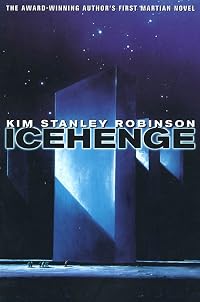
Icehenge
by Kim Stanley Robinson
On This Page
Description
On the North Pole of Pluto there stands an enigma: a huge circle of standing blocks of ice, built on the pattern of Earth's Stonehenge-but ten times the size, standing alone at the farthest reaches of the Solar System. What is it? Who came there to build it? The secret lies, perhaps, in the chaotic decades of the Martian Revolution, in the lost memories of those who have lived for centuries.Tags
Recommendations










Member Recommendations
Member Reviews
4/5
Icehenge was a surprise to me. I randomly picked this, Kim Stanley Robinson's first published novel, from my collection and was subsequently bewildered that it isn't a more discussed work. I'm partially convinced that the name itself is what prevented it from reaching a wider audience. It's a boring and uninspired name that speaks of space adventure more than the political mystery that it is.
Icehenge is a fix-up of two novellas written earlier tied together with one more that was written for the novel itself. It loosely follows a climate system specialist named Emma Weil, who lives through a mutiny on their ship and is subsequently brought into the fold of a planet-wide revolution taking place on her home world, Mars. The exact show more details of Emma's involvement in this revolution, and her subsequent disappearance, become the focal point of two archaeologists hundreds of years later, as they try to connect Emma and her peers to a mysterious landmark on Pluto. Each of the three novellas is told from a different perspective, each with a unique voice and emotions.
I can see how the novel would not be for everybody. It could be characterized as being dull and dry, even I found it to be so at points. There are certainly moments of faster paced action but that's not Robinson's strong suit here. It doesn't really have any 'big ideas' that the genre is famous for. Point being that I can see someone picking up this book (perhaps because of it's name and cover) expecting certain hallmarks of the genre, and upon not finding many being disappointed.
And yet Robinson still created something deeply human. It's a story of quiet and heartbreaking emotions, some that tie the three main characters together, and some that they shoulder alone. Despite being separated by time and space from each other they have significant cause and effect with each other. The humans in Icehenge live for over 500 years, which creates an unique set of emotional challenges that are described in detail. All three characters struggle to find purpose, an identity, and with the memory of their own lives as they age. These similarities bring real cohesion in the story, which is hard to attain when stitching pieces together from previous writing. This is something that I have seen other accomplished writers fail to do in their own fix-up novels, which raises my opinion of Robinson in his craft.
Icehenge is also hard science fiction book, concerned with some important ideas. Planetary- scale colonialism, government overreach, revolution, political activism, and the difficulties of science and academic work. It's a deep and textured work that take time to piece apart. The writing is strong and clear, sometimes even elegant or clever. I appreciate that Robinson writes the conclusion in a way that leaves you trying to answer some lingering questions yourself, which actively inspires critical thought and consideration. I'm looking forward to exploring more of Robinson's bibliography to see if he carries/improves on this excellent start. show less
Icehenge was a surprise to me. I randomly picked this, Kim Stanley Robinson's first published novel, from my collection and was subsequently bewildered that it isn't a more discussed work. I'm partially convinced that the name itself is what prevented it from reaching a wider audience. It's a boring and uninspired name that speaks of space adventure more than the political mystery that it is.
Icehenge is a fix-up of two novellas written earlier tied together with one more that was written for the novel itself. It loosely follows a climate system specialist named Emma Weil, who lives through a mutiny on their ship and is subsequently brought into the fold of a planet-wide revolution taking place on her home world, Mars. The exact show more details of Emma's involvement in this revolution, and her subsequent disappearance, become the focal point of two archaeologists hundreds of years later, as they try to connect Emma and her peers to a mysterious landmark on Pluto. Each of the three novellas is told from a different perspective, each with a unique voice and emotions.
I can see how the novel would not be for everybody. It could be characterized as being dull and dry, even I found it to be so at points. There are certainly moments of faster paced action but that's not Robinson's strong suit here. It doesn't really have any 'big ideas' that the genre is famous for. Point being that I can see someone picking up this book (perhaps because of it's name and cover) expecting certain hallmarks of the genre, and upon not finding many being disappointed.
And yet Robinson still created something deeply human. It's a story of quiet and heartbreaking emotions, some that tie the three main characters together, and some that they shoulder alone. Despite being separated by time and space from each other they have significant cause and effect with each other. The humans in Icehenge live for over 500 years, which creates an unique set of emotional challenges that are described in detail. All three characters struggle to find purpose, an identity, and with the memory of their own lives as they age. These similarities bring real cohesion in the story, which is hard to attain when stitching pieces together from previous writing. This is something that I have seen other accomplished writers fail to do in their own fix-up novels, which raises my opinion of Robinson in his craft.
Icehenge is also hard science fiction book, concerned with some important ideas. Planetary- scale colonialism, government overreach, revolution, political activism, and the difficulties of science and academic work. It's a deep and textured work that take time to piece apart. The writing is strong and clear, sometimes even elegant or clever. I appreciate that Robinson writes the conclusion in a way that leaves you trying to answer some lingering questions yourself, which actively inspires critical thought and consideration. I'm looking forward to exploring more of Robinson's bibliography to see if he carries/improves on this excellent start. show less
Kim Stanley Robinsons Bücher und ich haben eine sehr angespannte Beziehung miteinander. Während mich eines seiner Bücher maßlos begeistern kann, schafft ein anderes mich zu Tode zu langweilen. Trotzdem klang der Klappentext so spannend, dass ich es einfach mal wieder ausprobieren musste. Und ich wurde dieses Mal nicht enttäuscht. Erstveröffentlicht wurde der Roman 1984, also fast 10 Jahre bevor er den ersten Band seiner Mars-Trilogie veröffentlicht hat. Überhaupt scheint das Buch keinen allzu großen Bekanntheitsgrad zu haben im Vergleich zu seinen Nachfolgern.
Mich selbst packte es von der ersten Seite an. Wir folgen drei Personen, Emma Weil im Jahre 2248, Professor Hjalmar Nederland im Jahre 2547 und Edmond Doya im Jahre 2610. show more Während die drei Personen nie wirklich direkt miteinander zu tun haben, sind ihre einzelnen Geschichten faszinierend. Und während unser Sonnensystem, seine besiedelten Planten und die Gesellschaft drum herum ein absolut interessantes Setting bieten, so sind es doch diese drei Figuren, die die Geschichte vorantreiben und mich fasziniert haben. Dabei beleuchtet Robinson wieder Themen, der auch in seinen späteren Romanen von Bedeutung sind. Hier ganz vordergründig: wenn der Mensch viele Hunderte von Jahren leben kann, wie wirkt sich das auf den einzelnen und auf die Gesellschaft aus. Welche Wirkungen hat das auf die Psyche. Und auch wenn Robinson keine sicheren Antworten liefert, so regen seine Analysen zum Nachdenken an. Dabei gefiel mir im Buch besonders, dass ich den Figuren immer wieder wechselnde Gefühle entgegenbrachte. Erst war ich fasziniert, dann abgestoßen, dann genervt, dann voller Mitleid. Besonders Nederland ist eine Figur voll Egozentrik, Selbstzweifel und schwerstem Gefühlchaos. Es war einfach eine faszinierende Lesereise, ihn durch seinen Teil zu begleiten. Aber auch Emma und Edmond bin ich sehr gern gefolgt und ich wünschte, das Buch hätte zum Ende hin Antworten auf all meine Fragen geliefert. Leider hat es das nicht getan. Auch ob meine Vermutung, die ich mit der Figur Theophilus Jones am Ende des Buches teile, richtig war, werde ich wohl nie erfahren.
Fazit
Ein echt interessantes Buch, das es schafft, durch die Figuren einen eigentlich minimalen Handlungsstrang so erfolgreich von Anfang bis Ende voranzutreiben, dass es an Spannung bis zur letzten Seite nicht zu überbieten war. Und auch wenn viele Fragen offen bleiben und man als Leser selbst alles weiterspinnen kann, so war es doch ein geniales Buch, das mich echt begeistert hat und über das ich sicherlich noch so einige Zeit nachdenken werde. show less
Mich selbst packte es von der ersten Seite an. Wir folgen drei Personen, Emma Weil im Jahre 2248, Professor Hjalmar Nederland im Jahre 2547 und Edmond Doya im Jahre 2610. show more Während die drei Personen nie wirklich direkt miteinander zu tun haben, sind ihre einzelnen Geschichten faszinierend. Und während unser Sonnensystem, seine besiedelten Planten und die Gesellschaft drum herum ein absolut interessantes Setting bieten, so sind es doch diese drei Figuren, die die Geschichte vorantreiben und mich fasziniert haben. Dabei beleuchtet Robinson wieder Themen, der auch in seinen späteren Romanen von Bedeutung sind. Hier ganz vordergründig: wenn der Mensch viele Hunderte von Jahren leben kann, wie wirkt sich das auf den einzelnen und auf die Gesellschaft aus. Welche Wirkungen hat das auf die Psyche. Und auch wenn Robinson keine sicheren Antworten liefert, so regen seine Analysen zum Nachdenken an. Dabei gefiel mir im Buch besonders, dass ich den Figuren immer wieder wechselnde Gefühle entgegenbrachte. Erst war ich fasziniert, dann abgestoßen, dann genervt, dann voller Mitleid. Besonders Nederland ist eine Figur voll Egozentrik, Selbstzweifel und schwerstem Gefühlchaos. Es war einfach eine faszinierende Lesereise, ihn durch seinen Teil zu begleiten. Aber auch Emma und Edmond bin ich sehr gern gefolgt und ich wünschte, das Buch hätte zum Ende hin Antworten auf all meine Fragen geliefert. Leider hat es das nicht getan. Auch ob meine Vermutung, die ich mit der Figur Theophilus Jones am Ende des Buches teile, richtig war, werde ich wohl nie erfahren.
Fazit
Ein echt interessantes Buch, das es schafft, durch die Figuren einen eigentlich minimalen Handlungsstrang so erfolgreich von Anfang bis Ende voranzutreiben, dass es an Spannung bis zur letzten Seite nicht zu überbieten war. Und auch wenn viele Fragen offen bleiben und man als Leser selbst alles weiterspinnen kann, so war es doch ein geniales Buch, das mich echt begeistert hat und über das ich sicherlich noch so einige Zeit nachdenken werde. show less
A superb wheels-within-wheels Sci-Fi mystery yarn: Icehenge stands on it's own as a minor classic of SF, an absorbing story with strong characters and the wit to leave some of its mysteries unexplained.The story starts with a woman who finds herself unwillingly caught up in a revolution against the rulers of Mars, before jumping ahead to an Archaeologist determined to prove that the official history of the revolution is a hoax. Finding the unwilling revolutionary's diary proves it to him - but what about the rest of Mars? And just what is their connection with the strange arrangement of Ice Blocks at the North Pole of Pluto?
A couple of hundred years later, one of his descendants is unsatisfied with even the revised explanations, and show more the search continues: who put Icehenge there? Is it a hoax? Is the whole thing a set up? There is only one way to find out - but will even that unravel every thread?
I enjoyed Icehenge immensely, and it is possibly one of the best introductions to Kim Stanley Robinson's work. It fully deserves a five star rating, and a place in the collection of anyone who enjoys serious SF. show less
Told from three different points of view, this is the story of how an ice monolith similar to Stonehenge, made from ice taken from Saturn’s rings, is discovered on Pluto and its possible origins debated and reformulated. It is also the story of a futuristic society that has colonized the solar system and expanded the human lifespan such that people are practically immortal and memory has become meaningless.
The novel spans an immense length of time, beginning with the adventures of an expert in life-support systems; her ship is shanghaied, and she is pressed into the service of revolutionaries venturing on a manned mission out of the solar system for the first time, then released into an uprising on her home planet Mars. The story then show more jumps several hundred years into the future when an archaeologist discovers this woman’s journal in the remains of a Martian city destroyed during the revolution and theorizes that the ship that left the solar system built Icehenge as a monument to its achievement. Finally, the story shifts again to the point of view of an intellectual dilettante who visits Icehenge and exposes the truth — but never satisfactorily.
There is a lot to chew on here, too much to properly summarize, from grasping the nuances of life in the future solar system to parsing out the various speculations on the meaning of the mysterious monolith. Icehenge will hold the attention of the hard science fiction fan — particularly those who have already read and enjoyed Robinson’s Mars trilogy — until the final, puzzling revelations on Pluto. show less
The novel spans an immense length of time, beginning with the adventures of an expert in life-support systems; her ship is shanghaied, and she is pressed into the service of revolutionaries venturing on a manned mission out of the solar system for the first time, then released into an uprising on her home planet Mars. The story then show more jumps several hundred years into the future when an archaeologist discovers this woman’s journal in the remains of a Martian city destroyed during the revolution and theorizes that the ship that left the solar system built Icehenge as a monument to its achievement. Finally, the story shifts again to the point of view of an intellectual dilettante who visits Icehenge and exposes the truth — but never satisfactorily.
There is a lot to chew on here, too much to properly summarize, from grasping the nuances of life in the future solar system to parsing out the various speculations on the meaning of the mysterious monolith. Icehenge will hold the attention of the hard science fiction fan — particularly those who have already read and enjoyed Robinson’s Mars trilogy — until the final, puzzling revelations on Pluto. show less
Three connected stories spread over 400 years as humans explore the solar system from the Martian settlements and discover a Stonehenge-like monument on Pluto. Humans who can afford the treatments live 800-1000 years, so 400 isn’t too long to expect the same characters may show up from one story to another.
Published before the Mars trilogy, there are some familiar place names and developments mentioned here (e.g., the city of Burroughs, the progress towards a breathable atmosphere), so there was a sense of familiarity in reading this, although the overall future envisioned is more bleak than that explored in the later books. So while it’s a stand-alone novel, it was a welcome return to the Martian world so beautifully explored in show more the trilogy. It was also neat to see Robinson’s speculation on the development of self-publication on an Internet-like network (this was written in 1984) and find Pluto still described as the ninth planet. show less
Published before the Mars trilogy, there are some familiar place names and developments mentioned here (e.g., the city of Burroughs, the progress towards a breathable atmosphere), so there was a sense of familiarity in reading this, although the overall future envisioned is more bleak than that explored in the later books. So while it’s a stand-alone novel, it was a welcome return to the Martian world so beautifully explored in show more the trilogy. It was also neat to see Robinson’s speculation on the development of self-publication on an Internet-like network (this was written in 1984) and find Pluto still described as the ninth planet. show less
I loved "Red Mars" back in the day, and had somewhat diminishing returns from the two subsequent books. It was good to step back into that world, and fascinating to see what Robinson does with a society with a medical treatment that makes people live for a thousand years. The book is divided into several sections, each with a different narrator, and a few hundred years apart. The arc follows the events that may (or may not) involved the creation of a monolith built from ice. Read it for how characters are affected by eternal life, with very non-eternal memories.
...I liked this book a lot when I first read it and this second read has probably raised my admiration of the author another notch. It's a very well constructed tale, designed to make the reader doubt, puzzle and think. Icehenge is a good read for people who enjoyed the author's Mars trilogy but it's also a good place to start if you are not sure you're ready for three large volumes of detail on the red planet. Personally I loved the descriptive passages in those books but quite a few readers seem to think it could have done with a little more editing. In Icehenge Robinson keeps that aspect of his writing a bit more in the background. Whatever your preferences Icehenge is a fascinating read and I highly recommend it.
Full Random Comments show more Review show less
Full Random Comments show more Review show less
Members
- Recently Added By
Lists

What Makes This Book So Great
102 works; 16 members

Books Read in 2006
421 works; 8 members

Books With Winter Words in the Title
42 works; 6 members

Best Science Fiction Novels
816 works; 430 members
Author Information

146+ Works 49,413 Members
Kim Stanley Robinson was born in Orange County, California on March 23, 1952. He received a B. A. and Ph. D. from the University of California at San Diego and an M. A. from Boston University. His first trilogy of books, Orange County, collectively won a Nebula Award and two Hugo Awards. His other works include the Mars trilogy, 2312, and Aurora. show more He has won an Asimov Award, a World Fantasy Award, a Locus Reader's Poll Award, and a John W. Campbell Award. (Bowker Author Biography) show less
Awards and Honors
Awards
Series
Belongs to Publisher Series
Common Knowledge
- Canonical title*
- Die eisigen Säulen des Pluto
- Original publication date
- 1984
- People/Characters
- Emma Weil; Hjalmar Nederland; Edmond Doya; Eric Swann; Oleg Davydov; Shrike (show all 7); Theophilus Jones
- Important places
- Hidalgo (spaceship); Lermontov (spaceship); Rust Eagle (spaceship); New Houston, Mars; Burroughs, Mars; Snowflake (spaceship) (show all 8); Mars; Pluto
- Epigraph
- "A ship is floating in the harbor now, / A wind is hovering o'er the mountain's brow; / There is a path on the sea's azure floor, / No keel has ever plowed that path before; / The halcyons brood around the foamless isles; / T... (show all)he treacherous Ocean has forsworn its wiles; / The merry mariners are bold and free: / Say, my heart's sister, wilt thou sail with me?" -- Shelley, "Epipsychidion"
- Dedication
- For Damon Knight and Kate Wilhelm
- First words
- The first indication that I had of the mutiny came as we approached the inner limit of the first asteroid belt.
- Last words
- (Click to show. Warning: May contain spoilers.)Jones shook his head, spoke in a sort of singsong: "We dream, we wake on a cold hillside, we pursue the dream again. In the beginning was the dream, and the work of disenchantment never ends."
- Original language
- English
- Disambiguation notice
- This is a short story, do NOT combine with the collection.
*Some information comes from Common Knowledge in other languages. Click "Edit" for more information.
Classifications
Statistics
- Members
- 1,004
- Popularity
- 25,965
- Reviews
- 12
- Rating
- (3.46)
- Languages
- 6 — Czech, English, French, German, Italian, Spanish
- Media
- Paper, Audiobook, Ebook
- ISBNs
- 21
- ASINs
- 9