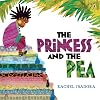
The Princess and the Pea
by Rachel Isadora
On This Page
Description
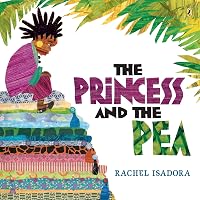
A simplified version of the tale in which a girl proves that she is a real princess by feeling a pea through twenty mattresses and twenty featherbeds.Tags
Recommendations
Member Reviews
Absolutely gorgeous illustrations. The story is a very stripped-down version of the classic fairytale/folktale, which may be a good thing if the kids are the questioning type or if you are good at asking questions of the kids to involve them in the story.
I found this book on the Black History Month shelves at the Billings Public Library. The beautiful artwork that reminded me a bit of Eric Carl enticed me to pick it up. The artwork is indeed beautiful, depicting African royalty in a variety of features colorful and dress, but the story is condensed from the original fairy tale. Nothing is added that appears to represent anything African besides three separate greetings in African languages. There is no context for the reader to decipher what is being said; only at the end of the book are the words translated and identified as to which language they are. The story itself doesn’t give any reasoning for why the first three princesses were not satisfactory to the prince; the last one is a show more bit disheveled, wet and windblown, so perhaps the moral is that one cannot judge someone based on outward appearances. There is just no clear message for children to understand why a “true princess” would be so delicate or sensitive to a pea under a few dozen mattresses.
I don’t know if I would use this story book with children unless it were to help them discern why we common folk tend to marry for love and royalty are stuck with a few prospective mates. This was a very disappointing read. show less
I don’t know if I would use this story book with children unless it were to help them discern why we common folk tend to marry for love and royalty are stuck with a few prospective mates. This was a very disappointing read. show less
A retold take on the fairytale "The Princess and the Pea" still has a happy ending. This story is set in Africa with a young prince looking for a real princess. The language used in this story is very unique. Words such as: Selam, Iska Waran, and Jambo,Habri are used. During the story, one can only guess what this means unless one can speak these certain languages. At the very end of the book, we learn what these words mean. Selam is part of the Amharic language and means Ethiopia, Iska Waran is part of the Somali language and means Somolia, and lastly Jambo, Habari is part of the Swahili language and means Kenya. Now that I know the meanings of these words, I can understand that they were used to describe which parts of Africa each show more princess was from that the prince encountered. I really enjoyed the way that the author did this. She added a factor of diversity by incorporating princesses from different parts of Africa. show less
It's nice to see a book with a black princess - heck, a non-blonde princess!
But this is an incredibly bare-bones version of the story. There's no detail here, no emotion, no digging into anybody's motivation. You can read it in two minutes flat. If you dawdle. That's not what I'm used to, and not what I like. (I'm also a little uncomfortable with the idea that the prince visited three different princesses but "something wasn't right" with each one. What... because of their clothes? They're each from a different part of the continent...? There's no detail given, so we have to figure it out for ourselves. Of course.)
The illustrations are nicely done, but the text is so sparse.... Just read it before you buy it, is all.
But this is an incredibly bare-bones version of the story. There's no detail here, no emotion, no digging into anybody's motivation. You can read it in two minutes flat. If you dawdle. That's not what I'm used to, and not what I like. (I'm also a little uncomfortable with the idea that the prince visited three different princesses but "something wasn't right" with each one. What... because of their clothes? They're each from a different part of the continent...? There's no detail given, so we have to figure it out for ourselves. Of course.)
The illustrations are nicely done, but the text is so sparse.... Just read it before you buy it, is all.
Well, it's both my personal favorite fairy tale, and it's Rachel Isadora - it's gotta be great!
------------
Finally bought a used copy. What a shame: [a:Hans Christian Andersen|6378|Hans Christian Andersen|http://d202m5krfqbpi5.cloudfront.net/authors/1183230200p2/6378.jpg]'s story is so abridged that it reads like a summary retold by a boring child. The art is attractive, and I appreciate the reminder that there's no such thing as a single monolithic African culture, but it doesn't really help the story. There's no magic, or sense, left. I'd give it 2.5 stars if we had the option, but I round up because I love the vibrant colors.
------------
Finally bought a used copy. What a shame: [a:Hans Christian Andersen|6378|Hans Christian Andersen|http://d202m5krfqbpi5.cloudfront.net/authors/1183230200p2/6378.jpg]'s story is so abridged that it reads like a summary retold by a boring child. The art is attractive, and I appreciate the reminder that there's no such thing as a single monolithic African culture, but it doesn't really help the story. There's no magic, or sense, left. I'd give it 2.5 stars if we had the option, but I round up because I love the vibrant colors.
Rachel Isadora's illustrations, done with oil paints, printed paper, and palette paper, set her version of the Hans Christian Andersen tale in Africa. Back matter includes "three ways to say hello in Africa" (Amharic for Ethiopia, Somali for Somalia, and Swahili for Kenya). A good choice for storytime.
The price wants to marry a princess but is having a hard time finding one. Then one night there is a storm and a knock on the door and the palace gate and the Prince's life will never be the same. I love the way Isadora adds different ethic backgrounds to the retelling of fairy tales.
Members
- Recently Added By
Lists

African American
99 works; 3 members
Author Information

70+ Works 14,393 Members
Rachel Isadora was born and raised in New York City. Rachel studied at the School of American Ballet and was a dancer with the Boston Ballet until a foot injury. She went from being a ballet dancer to an author and illustrator. The first title she wrote and illustrated was Max. Since then she has written many others including Golden Bear, Ben's show more Trumpet, Nick Plays Baseball, Caribbean Dream, Mr. Moon and Not Just Tutus. Her works have earned her several awards including the Caldecott Honor Award and the Boston Globe-Horn Book Honor Award. Her title Max, was named an ALA Notable Book. (Bowker Author Biography) show less
Classifications
Statistics
- Members
- 656
- Popularity
- 44,037
- Reviews
- 30
- Rating
- (3.68)
- Languages
- English, Portuguese
- Media
- Paper
- ISBNs
- 7
- ASINs
- 1