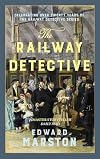
On This Page
Description
London 1851. With the opening of the Great Exhibition at hand, interest is mounting in the engineering triumphs of the railways, but not everyone feels like celebrating...In an audacious attack, the London to Birmingham mail train is robbed and derailed, causing many casualties. Planned with military precision, this crime proves a challenge to Detective Inspector Robert Colbeck who fights to untangle a web of murder, blackmail and destruction. As Colbeck closes in on the criminal show more masterminds, events take an unexpected turn when the beautiful Madeleine, daughter of the injured train driver, becomes a pawn in the criminals' game. With time running out, good and evil, new and old, battle against each other. But will the long arm of the law have speed on its side?
Full of historical detail, The Railway Detective is an action-packed dip into murky 1850s London.
. show less
Tags
Recommendations










Member Reviews
Needed to grab something quickly before heading off for the weekend, and Hubby has been reading this series, so took the first one. Actually quite good. Set in Victorian London, with DI Colbeck as the lead character. he has problems with his superior officer (who's a bit of an idiot, if truth be told) but has a way about him that gets results. Dresses nicely and isn't a typical copper at all (slightly dishy, if I'm honest). Has to solve a rather nasty train robbery, where the gold soverigns being transported to birmingham were stolen, the train driver beaten up and the train run off the rails. Goes about it to the best of his ability and finally prevents an attempt to blow up the Great exhibition. Along the way he meets the train show more driver's daughter and there's certainly something between them, especially when she ends up being kidnapped, in order to distract him from finding the crinimal mastermind. But he comes through and saves the day and the girl in fine style. As he solves a railway crime, the press nickname him the railway detective, and so the series begins. Nicely written, well paced, not terribly hard headed, or difficult to read, but it rolled along well and the steps are logical and sensible. Nothing worse than a far-fetched piece of deduction that you just can't believe, and that's not what happens here. Nicely put together & I'm about to raid his bookshelf for book 2... show less
The Railway Detective –Edward Marsten
Audio performance by Simon Prebble
3.5 stars (round to 3)
Detective Inspector Robert Colbeck is charged with solving a recent daring railway robbery before the villains can interfere with London’s much anticipated 1851 Great Exposition. The setting is rich in railroad history and 19th century ambiance. The characters are likable and the storyline is very predictable.
This is what I call a ‘cozy’ historical mystery. The inspector is handsome, educated and far more intelligent than his bumbling superior. The villains are thoroughly evil. The lovely damsel in distress is feisty and independent. The historical setting is interesting and as far as I can tell accurate.
Simon Prebble created an easy, show more entertaining listening experience with varied regional accents for characters that ranged from an Irish tavern bouncer, to prostitutes and corrupt aristocrats. This was the perfect light reading to use while driving or doing chores. Unfortunately, it appears the Prebble does not read any of the other books in this series, and very few audios are available in my library or on line. show less
In 1850′s England railways were expanding all over the countryside and were being lauded by authorities as a safe, fast form of transport. So when the London to Birmingham mail train is robbed and its driver badly bashed and left to die Detective Inspector Robert Colbeck is immediately dispatched to uncover the culprits and return Britain’s faith in its rail system.
The first thing I always look for in historical fiction is interesting period details and this book is brimming with them. Clever use has been made of real events from the time, such as London’s Great Exhibition of 1851, and there are loads more tidbits as well. I was particularly struck by the realism of such things as the fact that the train driver was never consigned show more to a hospital despite his severe injuries and the descriptions of Devil’s Acre, London’s darkest and seediest corner at the time. For steam train enthusiasts there are plenty of wonderful details of locomotives and the various companies that were in operation during this era and overall it’s a jolly good depiction of the era.
Robert Colbeck is a fairly stereotypical super-sleuth: well-educated, more intelligent than everyone around him and impossibly knowledgeable about a wide variety of subjects. But he’s not arrogant about it and he does have some foibles to make him more human and I thoroughly enjoyed meeting him. He is ably assisted by Sergeant Leeming who unquestioningly does whatever is asked of him, including riding on the railways he doesn’t much care for. There is, of course, the somewhat bumbling senior officer for Colbeck to contend with but on the bright side there’s a hint of romance for him too so life is not all bad for him. The villain of the story is also quite thoughtfully depicted and lent a bit of gravity to the light tale.
The story rips along at a cracking pace and while the resolution to the mystery is not particularly complicated it all hangs together properly and there are a few unexpected twists. I enjoyed both the way the book depicted a general opposition to technological change which seems to happen repeatedly in human history and the wealth of historical detail to become lost in. Highly recommended as a ‘summer read’ for the historically inclined. show less
The first thing I always look for in historical fiction is interesting period details and this book is brimming with them. Clever use has been made of real events from the time, such as London’s Great Exhibition of 1851, and there are loads more tidbits as well. I was particularly struck by the realism of such things as the fact that the train driver was never consigned show more to a hospital despite his severe injuries and the descriptions of Devil’s Acre, London’s darkest and seediest corner at the time. For steam train enthusiasts there are plenty of wonderful details of locomotives and the various companies that were in operation during this era and overall it’s a jolly good depiction of the era.
Robert Colbeck is a fairly stereotypical super-sleuth: well-educated, more intelligent than everyone around him and impossibly knowledgeable about a wide variety of subjects. But he’s not arrogant about it and he does have some foibles to make him more human and I thoroughly enjoyed meeting him. He is ably assisted by Sergeant Leeming who unquestioningly does whatever is asked of him, including riding on the railways he doesn’t much care for. There is, of course, the somewhat bumbling senior officer for Colbeck to contend with but on the bright side there’s a hint of romance for him too so life is not all bad for him. The villain of the story is also quite thoughtfully depicted and lent a bit of gravity to the light tale.
The story rips along at a cracking pace and while the resolution to the mystery is not particularly complicated it all hangs together properly and there are a few unexpected twists. I enjoyed both the way the book depicted a general opposition to technological change which seems to happen repeatedly in human history and the wealth of historical detail to become lost in. Highly recommended as a ‘summer read’ for the historically inclined. show less
Like other readers, I found the Holmesian similarities readily apparent. On the positive side, the characters are likable and the plot flows along smoothly, though not complexly. On the negative side, Inspector Colbeck's leaps of intuition are a bit unconvincing and I found the dialog slightly unnatural.
On the whole, a pleasant-enough mystery with which to while away a few hours. I'll probably read the next one in the series though there's no sense of urgency.
On the whole, a pleasant-enough mystery with which to while away a few hours. I'll probably read the next one in the series though there's no sense of urgency.
This is the first in a series of detective novels set in the mid-19th century around the then quite new railway system. The sleuth is police Inspector Robert Colbeck, a cultured and intelligent man who originally trained as a lawyer before turning to police work. It is 1851 and the run up to the Great Exhibition. A daring robbery takes place of a mail train carrying gold coins. This is followed by an explosion in a rail tunnel and then two murders. All of these crimes are linked through a particular individual with a very personal motive for undermining the railway system and the wider economy. This is a good page turner of a novel with a dramatic plot, but I found much of the dialogue slightly stilted. Colbeck is an appealing central show more protagonist, though his colleagues are pretty cliched: the unintelligent but loyal and brave deputy, the overbearing and constantly critical senior officer. There are at least 16 novels in this series, and the period is an interesting one, with the railways poised to transform the British economy by revolutionising transport and providing unprecedented opportunities for ordinary people to travel more widely than ever before - though not everyone appreciates these advantages. show less
I love historical mysteries and tried to give this one the benefit of the doubt. But . . .There is no character development; the only character to be more than a cardboard archetype was the detective's assistant. There's little suspense as the villain is revealed (out of nowhere) about halfway through the book. The characters often serve as mouthpieces to impart statistical information about Victorian railroads. If you are looking for historical mysteries in this time period, you'd do much better with Anne Perry, Charles Finch, Nancy Springer's Enola Holmes, or on the American side of the pond, Victoria Thompson.
It's 1852 and Victorian railway building is in full swing. Then one of the trains carrying gold from the Royal Mint is robbed in an audacious theft. The main character is Detective Inspector Robert Colbeck of Scotland Yard, a young, good-looking, impeccably dressed man, a cabinet maker's son who attended law school and successfully stood for the bar, but later decided to enter police work as a result of a personal tragedy. Unmarried and with no other family ties, he's married to his job. Colbeck loves trains and other forms of technological progress. Three other characters are his colleagues at Scotland Yard: Sergeant Victor Leeming, a family man who much prefers to travel by horse-drawn conveyance; Colbeck's immediate supervisor show more Superintendent Edward Tallis, a pompous ex-Army man who regards Colbeck as a threat to his own authority; and Senior Commissioner Richard Mayne, who appreciates Colbeck's problem-solving skills and courage. Two other groups of secondary characters include employees of the London and Northwestern Railway and their immediate family members (including the attractive and intelligent Madeleine Andrews) and the various members of the gang that robs the train.
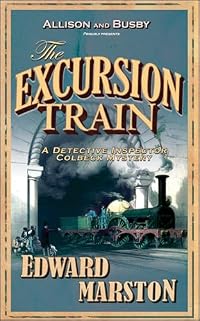
Railway Detective has an excellent plot and even though murders occur, the murder does not form the central premise of the book. This is a historical novel and Edward Marston has created a rather unique and engaging storyline and character. All of the historical details are highly accurate to the time and it is an interesting insight to the Victorian railways. The story moves along quickly, and while the resolution to the mystery is not particularly complicated it all hangs together well. I definitely recommend it to any historically inclined mystery lover and plan to continue the series with the next book, The Excursion Train. show less
Railway Detective has an excellent plot and even though murders occur, the murder does not form the central premise of the book. This is a historical novel and Edward Marston has created a rather unique and engaging storyline and character. All of the historical details are highly accurate to the time and it is an interesting insight to the Victorian railways. The story moves along quickly, and while the resolution to the mystery is not particularly complicated it all hangs together well. I definitely recommend it to any historically inclined mystery lover and plan to continue the series with the next book, The Excursion Train. show less
Members
- Recently Added By
Published Reviews
ThingScore 50
My only real problem with Marston's narrative style was the somewhat repetitive way he introduced characters, with name, approximate age and physical appearance all bundled into one pithy sentence. His descriptions of places are fine, his understanding of trains impressively detailed, his dialogue generally believable and easy to follow.
added by JulesJones
Lists

British Mystery
469 works; 14 members

Books Read in 2014
2,341 works; 89 members
Author Information

Series

Work Relationships
Is contained in
Common Knowledge
- Canonical title
- The Railway Detective
- Original publication date
- 2004-11-01
- People/Characters
- Robert Colbeck (Inspector); Victor Leeming (Sergeant); Edward Tallis (Superintendent); Caleb Andrews; Madeleine Andrews; Brendan Mulryne (show all 7); Richard Mayne (Police Commissioner)
- Important places
- England, UK
- Dedication
- In loving memory of my father, who spent his working life as an engine driver, and who instructed me in the mystery of steam locomotion.
With thanks to Janet Cutler for her expert advice on Victorian railway companies - First words
- Euston Station was one of the architectural marvels of the day.
- Last words
- (Click to show. Warning: May contain spoilers.)"Yes," said Colbeck over her happy laughter, "there are one or two locomotives that I'd like to show you."
- Original language
- English UK
Classifications
Statistics
- Members
- 482
- Popularity
- 62,559
- Reviews
- 30
- Rating
- (3.48)
- Languages
- English, French
- Media
- Paper, Audiobook, Ebook
- ISBNs
- 12
- ASINs
- 5