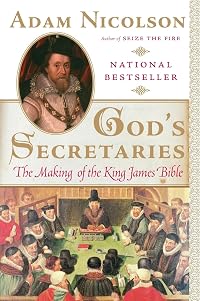
God's Secretaries: The Making of the King James Bible
by Adam Nicolson
On This Page
Description
NATIONAL BESTSELLER - A NEW YORK TIMES NOTABLE BOOK "This scrupulously elegant account of the creation of what four centuries of history has confirmed is the finest English-language work of all time, is entirely true to its subject: Adam Nicolson's lapidary prose is masterly, his measured account both as readable as the curious demand and as dignified as the story deserves." - Simon Winchester, author of Krakatoa In God's Secretaries, Adam Nicolson gives a fascinating and dramatic account of show more the era of the King James Bible and its translation, immersing us in an age whose greatest monument is not a painting or a building but a book. A network of complex currents flowed across Jacobean England. This was the England of Shakespeare, Jonson, and Bacon; the era of the Gunpowder Plot and the worst outbreak of the plague. Jacobean England was both more godly and less godly than the country had ever been, and the entire culture was drawn taut between these polarities. This was the world that created the King James Bible. It is the greatest work of English prose ever written, and it is no coincidence that the translation was made at the moment "Englishness," specifically the English language itself, had come into its first passionate maturity. The English of Jacobean England has a more encompassing idea of its own scope than any form of the language before or since. It drips with potency and sensitivity. The age, with all its conflicts, explains the book. This P.S. edition features an extra 16 pages of insights into the book, including author interviews, recommended reading, and more. show lessTags
Recommendations







Member Reviews
This is not a Christian work. It is a history of the people and the times surrounding the translation and publication of the world's best-selling book. And it is an engaging account, with only a little bit of bias exhibited in the writing.
The author used and credited the research of others, expanding it whenever possible with recent discoveries from the ancient libraries of England. Unfortunately the majority of documentation was lost over the centuries, especially in the Great Fire of London in 1666, and the full history is hidden. The people involved in the making of the King James Bible are not vilified (for the most part), but are shown for what they were: flawed but mainly sincere men from religious and non-religious vocations show more within seventeenth century Britain.
Having already read about the religious persecutions of the time, I was disappointed in what I perceived as a recurring bias against the Puritan and Separatist movements, but the author did a good job recounting the history of the group that would later land in the new world and be known as the Pilgrims. I was also disappointed that he repeated the oft-told but disputable claims of some regarding manuscript evidence, but for most readers it won't matter.
Overall, a good though flawed history. show less
The author used and credited the research of others, expanding it whenever possible with recent discoveries from the ancient libraries of England. Unfortunately the majority of documentation was lost over the centuries, especially in the Great Fire of London in 1666, and the full history is hidden. The people involved in the making of the King James Bible are not vilified (for the most part), but are shown for what they were: flawed but mainly sincere men from religious and non-religious vocations show more within seventeenth century Britain.
Having already read about the religious persecutions of the time, I was disappointed in what I perceived as a recurring bias against the Puritan and Separatist movements, but the author did a good job recounting the history of the group that would later land in the new world and be known as the Pilgrims. I was also disappointed that he repeated the oft-told but disputable claims of some regarding manuscript evidence, but for most readers it won't matter.
Overall, a good though flawed history. show less
According to God’s Secretaries author Adam Nicolson, the King James Bible is the only great work of literature ever produced by a committee. I concur with that, and might go a little further- it’s the only great work of any kind ever produced by a committee. Nicolson is perhaps an odd choice for this work, as he’s primarily a travel writer; but perhaps being used to describing strange locales makes him suitable for describing Jacobean England. The bulk of the book does just that, establishing the “look and feel” of the translator’s milieu; and if it rambles a little Nicholson can be forgiven; the 17th century is, after all, a strange locale and wandering around there exposes the traveler to astonishing sights.
James I/VI was show more an interesting sort; fond of handsome boys yet apparently perfectly happy with his wife; amazed by the wealth of England compared to impoverished Scotland (and quite willing to spend that wealth on his favorites); personally unprepossessing (he had some sort of jaw or mouth defect that caused him to drool continuously); one of the more intelligent English monarchs (admittedly, that’s not saying much, but he is the only one to have his collected works published) yet passionately devoted to hunting. He saw himself as a bringer of peace to both politics – one of his first acts on ascending the throne was a treaty with Spain ending the decades-old war – and religion. The religious divides in England were between Catholics, who didn’t really count, especially after the Gunpowder Plot; Presbyterians, who were willing to remain in The Church of England but with some cavils about the Book of Common Prayer (particularly whether the Greek πρεσβύτεροι meant “priest” or “elder”); Separatists, who were later called Puritans (an insult at the time) and who wanted nothing not sanctioned by the Bible*; and the Church of England. The Catholics were still nominally illegal, as were the Separatists; both were subject to varying degrees of persecution. The King’s new Bible translation was supposed to unite the various groups in harmony. Didn’t, of course, but a noble attempt.
The translators for the King James Bible were divided into “companies”, each charged with a certain section (Old Testament Torah and histories, except Chronicles; Old Testament Chronicles, Psalms and some prophets; Old Testament rest of the prophets; Apocrypha; New Testament Gospels, Acts, and Revelation; New Testament Epistles). The after completing their translations, each company circulated them to all the other companies for further comment and correction. The process seems guaranteed to produce an incomprehensible muddle, if anything at all; it sounds like the government procurement specifications behind some of history’s more unfortunate failed projects. Remarkably, it didn’t turn out that way.
There are few clues to how the process actually worked; some letters and diaries from the translators with comments and a “life” of one of the translators noting that he read aloud to the company; if there were any objections they were noted and discussed; if not he read on. Nicolson makes an important point here; the frontispiece of the King James Bible contains the statement “Appointed to be Read in Churches”, the key being that it was intended to be read aloud and the language and meter were chosen to suit that; Nicholson notes a couple of examples where the words of earlier versions were left intact but punctuation was added to imply pauses and stops in the reading. James used the word “circumlocution” to describe the kind of language he wanted; modern definitions of “circumlocution” imply confusion and unnecessary verbiage but in Jacobean time the word implied “richness” of language. Earlier English Bible versions – most notably the Geneva Bible, put together by English Protestants exiled during the reign of Mary – although read aloud in church, were more intended to be reference works for private study; the Geneva Bible notably had numerous marginal notes on how to interpret Scripture, plus maps of the Holy Land, diagrams of the Temple, and similar aids, while James specifically prohibited marginal notes except to reference other passages or to give precise Hebrew or Greek translations of phrases that had been modified to sound better in English. To my surprise, the King James Bible didn’t catch on right away; published in 1611, it wasn’t made mandatory for church use until 1616 (and even that was done in a roundabout fashion; rather than ban and collect the old Bibles the law simply prohibited printing new editions).
Ironically what was supposed to be a “standard” Bible ended up full of printer’s errors, to the extent that scholars have cataloged better than 25,000 (!) different text versions. (The most famous is probably the “Wicked Bible”, in which a crucial “not” was left out of the commandment “Thou shalt not commit adultery”). For the initial 1611 edition, it seems that the printer somehow got two “final” manuscripts from the translators and intermingled pages from each.
This is the Bible I grew up with and the language still resonates; updated English versions may be more doctrinally correct but just don’t carry the same majesty of language. Compare:
“Lord now lettest thou thy servant depart in peace, according to thy word
For mine eyes have seen thy salvation,
Which thou hast prepared before the face of all people,
A light to lighten the Gentiles, and the glory of thy people Israel.
”
With
“Lord, I am your servant, and now I can die in peace, because you have kept your promise to me.
With my own eyes I have seen what you have done
To save your people, and foreign nations will also see this
Your mighty power is a light for all nations, and it will bring honor to your people Israel.
It’s Bach versus Barry Manilow.
Nicolson is satisfying on several levels; this a good description of Jacobean England, a good analysis of the religious feeling of the time, and full of capsule biographies of notably people. Highly recommended.
*This was sometimes carried to an extreme extent; one Separatists preacher, assuming that if God wanted an English Bible he would have seen to it that is was written in that language, gave all his sermons in Hebrew or Greek. Since his congregation was almost all illiterate farmers, this must have been singularly trying for them; it was bad enough to have to sit alertly through the traditional three-hour Puritan sermon but listening to it in an alien language must have strained the patience of even the most devout. show less
James I/VI was show more an interesting sort; fond of handsome boys yet apparently perfectly happy with his wife; amazed by the wealth of England compared to impoverished Scotland (and quite willing to spend that wealth on his favorites); personally unprepossessing (he had some sort of jaw or mouth defect that caused him to drool continuously); one of the more intelligent English monarchs (admittedly, that’s not saying much, but he is the only one to have his collected works published) yet passionately devoted to hunting. He saw himself as a bringer of peace to both politics – one of his first acts on ascending the throne was a treaty with Spain ending the decades-old war – and religion. The religious divides in England were between Catholics, who didn’t really count, especially after the Gunpowder Plot; Presbyterians, who were willing to remain in The Church of England but with some cavils about the Book of Common Prayer (particularly whether the Greek πρεσβύτεροι meant “priest” or “elder”); Separatists, who were later called Puritans (an insult at the time) and who wanted nothing not sanctioned by the Bible*; and the Church of England. The Catholics were still nominally illegal, as were the Separatists; both were subject to varying degrees of persecution. The King’s new Bible translation was supposed to unite the various groups in harmony. Didn’t, of course, but a noble attempt.
The translators for the King James Bible were divided into “companies”, each charged with a certain section (Old Testament Torah and histories, except Chronicles; Old Testament Chronicles, Psalms and some prophets; Old Testament rest of the prophets; Apocrypha; New Testament Gospels, Acts, and Revelation; New Testament Epistles). The after completing their translations, each company circulated them to all the other companies for further comment and correction. The process seems guaranteed to produce an incomprehensible muddle, if anything at all; it sounds like the government procurement specifications behind some of history’s more unfortunate failed projects. Remarkably, it didn’t turn out that way.
There are few clues to how the process actually worked; some letters and diaries from the translators with comments and a “life” of one of the translators noting that he read aloud to the company; if there were any objections they were noted and discussed; if not he read on. Nicolson makes an important point here; the frontispiece of the King James Bible contains the statement “Appointed to be Read in Churches”, the key being that it was intended to be read aloud and the language and meter were chosen to suit that; Nicholson notes a couple of examples where the words of earlier versions were left intact but punctuation was added to imply pauses and stops in the reading. James used the word “circumlocution” to describe the kind of language he wanted; modern definitions of “circumlocution” imply confusion and unnecessary verbiage but in Jacobean time the word implied “richness” of language. Earlier English Bible versions – most notably the Geneva Bible, put together by English Protestants exiled during the reign of Mary – although read aloud in church, were more intended to be reference works for private study; the Geneva Bible notably had numerous marginal notes on how to interpret Scripture, plus maps of the Holy Land, diagrams of the Temple, and similar aids, while James specifically prohibited marginal notes except to reference other passages or to give precise Hebrew or Greek translations of phrases that had been modified to sound better in English. To my surprise, the King James Bible didn’t catch on right away; published in 1611, it wasn’t made mandatory for church use until 1616 (and even that was done in a roundabout fashion; rather than ban and collect the old Bibles the law simply prohibited printing new editions).
Ironically what was supposed to be a “standard” Bible ended up full of printer’s errors, to the extent that scholars have cataloged better than 25,000 (!) different text versions. (The most famous is probably the “Wicked Bible”, in which a crucial “not” was left out of the commandment “Thou shalt not commit adultery”). For the initial 1611 edition, it seems that the printer somehow got two “final” manuscripts from the translators and intermingled pages from each.
This is the Bible I grew up with and the language still resonates; updated English versions may be more doctrinally correct but just don’t carry the same majesty of language. Compare:
“Lord now lettest thou thy servant depart in peace, according to thy word
For mine eyes have seen thy salvation,
Which thou hast prepared before the face of all people,
A light to lighten the Gentiles, and the glory of thy people Israel.
”
With
“Lord, I am your servant, and now I can die in peace, because you have kept your promise to me.
With my own eyes I have seen what you have done
To save your people, and foreign nations will also see this
Your mighty power is a light for all nations, and it will bring honor to your people Israel.
It’s Bach versus Barry Manilow.
Nicolson is satisfying on several levels; this a good description of Jacobean England, a good analysis of the religious feeling of the time, and full of capsule biographies of notably people. Highly recommended.
*This was sometimes carried to an extreme extent; one Separatists preacher, assuming that if God wanted an English Bible he would have seen to it that is was written in that language, gave all his sermons in Hebrew or Greek. Since his congregation was almost all illiterate farmers, this must have been singularly trying for them; it was bad enough to have to sit alertly through the traditional three-hour Puritan sermon but listening to it in an alien language must have strained the patience of even the most devout. show less
I must confess: A saint in church loaned this book to me months ago; it has been sitting on my shelf ignored. Until today when, on the most random of impulses (mainly guilt that I had kept the book so long), I picked it up to thumb through it as I'd done a couple times before. That was 10 am; I finished it just after 11 pm. Let me be clear: I. Could. Not. Stop. I can't tell you the last time that I completely ignored my "to-do" list and finished an ENTIRE book in a day.
Here's what I think was most amazing about Nicolson's achievement: He manages to tell the story of Jacobean England through the lens of the King James Bible while simultaneously telling the story of the King James Bible through the lens of Jacobean England. (If that show more sentence sounds like a tautology, read the section where he compares Hatfield House with the KJV and you'll see what I mean.)
Perhaps most intriguing to me is that I didn't find out until the very final pages of the very last chapter Nicholson's religious leanings which were quite cleverly summarized: " I'm no atheist, but I'm no churchgoer either." I suspected as much; however, that makes this work even more intriguing because of his very evident awe of this translation. This book is a testament to the KJV's cultural power as a shaper of English language and as an expression of English (e.g. British & American) culture.
I think the book's greatest strength is found in Nicholson's comparisons of the KJV with other translations (especially Tyndale's and the NEB). Though he only looks at snippets of text (at most 4-5 verses each), he has chosen well; the passage demonstrate that, in many important ways, the KJV could still claim to be a "superior" translation. In fact, Nicholson's distaste for modern translations I think plays no small part in his "non-churchgoer" status.
I am by no means a "KJV-only" radical...but neither have I ever desired to be seen as one who despises it. Nicholson's approach to the KJV mirrors my own; stunned admiration at its monumental achievement for its time dosed with the reality of its antiquarian nature. And, underneath it all, the yearning that, someday, perhaps we will reach another cultural nexus that will produce a work of the spiritual and cultural magnitude achieved in 1611. show less
Here's what I think was most amazing about Nicolson's achievement: He manages to tell the story of Jacobean England through the lens of the King James Bible while simultaneously telling the story of the King James Bible through the lens of Jacobean England. (If that show more sentence sounds like a tautology, read the section where he compares Hatfield House with the KJV and you'll see what I mean.)
Perhaps most intriguing to me is that I didn't find out until the very final pages of the very last chapter Nicholson's religious leanings which were quite cleverly summarized: " I'm no atheist, but I'm no churchgoer either." I suspected as much; however, that makes this work even more intriguing because of his very evident awe of this translation. This book is a testament to the KJV's cultural power as a shaper of English language and as an expression of English (e.g. British & American) culture.
I think the book's greatest strength is found in Nicholson's comparisons of the KJV with other translations (especially Tyndale's and the NEB). Though he only looks at snippets of text (at most 4-5 verses each), he has chosen well; the passage demonstrate that, in many important ways, the KJV could still claim to be a "superior" translation. In fact, Nicholson's distaste for modern translations I think plays no small part in his "non-churchgoer" status.
I am by no means a "KJV-only" radical...but neither have I ever desired to be seen as one who despises it. Nicholson's approach to the KJV mirrors my own; stunned admiration at its monumental achievement for its time dosed with the reality of its antiquarian nature. And, underneath it all, the yearning that, someday, perhaps we will reach another cultural nexus that will produce a work of the spiritual and cultural magnitude achieved in 1611. show less
This is about the men who prepared the King James Bible, along with some of the political and religious history of the early part of the reign of King James. It is not about the actual translation, beyond the praise that the author has for the use of the English language by the translators, especially when compared with modern translations. There is a list of the translators along with the books of the Old and New Testaments that they worked on, for each of the six companies assigned to do the translation. (Nicolson talks about the new concept of "company.") And parallel chronologies of England from 1603 to 1611 and the translators and the translation.
I continue to be amazed and appalled by the torture and execution of people in the show more name of a religion that says it is about love and kindness. Nicolson seems to feel that this passion for the right way to worship results in the splendid phrases of this bible; our more tolerant era is bland and uninspiring.
In any case, knowing very little about this time, I learned a lot. Including the value placed on writing: George Abbot, one of the translators, also wrote A briefe Description of the whole worlde, in which he describes Native Americans , of whom he has no personal knowledge, as
"without all kinde of learning, hauing no remembrance of historie or writing among them ...."
Nicolson explains "Not only were they not like the English, they were not like the people of the Old World, who, for all their differences, were united from here to China by this one thread: they all wrote and read. . . . the textlessness of the Americans, that was the radical and shocking difference. Abbot could only imagine that it was the work of the devil." [p. 161] show less
I continue to be amazed and appalled by the torture and execution of people in the show more name of a religion that says it is about love and kindness. Nicolson seems to feel that this passion for the right way to worship results in the splendid phrases of this bible; our more tolerant era is bland and uninspiring.
In any case, knowing very little about this time, I learned a lot. Including the value placed on writing: George Abbot, one of the translators, also wrote A briefe Description of the whole worlde, in which he describes Native Americans , of whom he has no personal knowledge, as
"without all kinde of learning, hauing no remembrance of historie or writing among them ...."
Nicolson explains "Not only were they not like the English, they were not like the people of the Old World, who, for all their differences, were united from here to China by this one thread: they all wrote and read. . . . the textlessness of the Americans, that was the radical and shocking difference. Abbot could only imagine that it was the work of the devil." [p. 161] show less
Jacobean England was the England of Shakespeare, Jonson, and Bacon. Jacobean England was both more godly and less godly than the country had ever been, and the entire culture was drawn taut between these polarities. This was the world that created the King James Bible. It is no coincidence that the translation was made at the moment "Englishness." The English language had come into its first passionate maturity. The English of Jacobean England has a more encompassing idea of its scope than any form of the language before or since. It drips with potency and sensitivity.
This is a very well written book, as befits the language of its subject, and it describes marvellously the atmosphere of England at a time of great change - the end of the Tudor/Elizabethan age and the birth of the Stuart/Jacobean age. It puts across very effectively the point that the Jacobean view of the world is very different from more modern viewpoints, for example in assumptions about the relationship between religion and the state and the nature of both types of authority. Unfortunately there is comparatively little surviving detail about the actual compilation of the Bible itself, beyond the rules set out for the translation and a few scattered examples of the thought processes behind it as revealed through a tiny amount of show more surviving documentation. This is complemented by vignettes of the lives of some of the translators themselves. The language of the King James Bible is without a doubt wonderful and it deserves its place as a cornerstone of English literature, though one must not forget that it is based very largely on earlier Bibles and the Tynedale version in particular also deserves its own reputation. The King James version is very much a product of its own time and place. 4/5 show less
The compilation of the Authorised Version must have been one of the few thoroughly succesful government-sponsored IT projects ever. Completed on time and within budget, despite the fact that all the developers involved were clergymen and/or academics (unfortunately the project sponsor had spent the money on something else in the meantime...), run according to strict project-management principles that sound like PRINCE2 avant la lettre, and resulting in a product that became an industry standard internationally, with no serious competitor for over 350 years. Admittedly, initial acceptance of the product was slow, and some of the early versions did have serious bugs (the celebrated missing "not" in the 10 commandments), but that sort of show more thing is inevitable.
Nicolson gives us a very readable, if slightly gossipy account of the project and its background. He's rather limited in what he can do because most of the official documentation has been lost, and he obviously doesn't think his readers would be interested in technical discussions of Greek and Hebrew texts, so he tends to fall back a great deal on character sketches of the people involved, which can get a little wearing after a while. There's surprisingly little about the actual English of the translation, but the chapters where he does get into comparing the text of the AV with Tyndale and its other predecessors are some of the most rewarding parts of the book, and also the parts where Nicolson is most willing to intrude himself and give an opinion. show less
Nicolson gives us a very readable, if slightly gossipy account of the project and its background. He's rather limited in what he can do because most of the official documentation has been lost, and he obviously doesn't think his readers would be interested in technical discussions of Greek and Hebrew texts, so he tends to fall back a great deal on character sketches of the people involved, which can get a little wearing after a while. There's surprisingly little about the actual English of the translation, but the chapters where he does get into comparing the text of the AV with Tyndale and its other predecessors are some of the most rewarding parts of the book, and also the parts where Nicolson is most willing to intrude himself and give an opinion. show less
Members
- Recently Added By
Lists

Books about Books
149 works; 24 members

Books Read in 2024
4,623 works; 126 members
Author Information

34+ Works 5,779 Members
Adam Nicolson has been both a publisher and a travel writer, and is the author of many award-winning books. He lives on a farm with his family near Burwash, England
Awards and Honors
Distinctions
Common Knowledge
- Original title
- Power and Glory: Jacobean England and the Making of the King James Bible
- Alternate titles
- When God Spoke English: The Making of the King James Bible
- Original publication date
- 2003-04-29
- People/Characters
- James VI and I, King of Scots and King of England; Elizabeth I, Queen of England; Robert Cecil, 1st Earl of Salisbury
- Important events
- Jacobean Era; Stuart Era; 17th century
- First words
- Few moments in English history have been more hungry for the future, its mercurial possibilities and its hope of richness, than the spring of 1603.
- Quotations
- . . . James Ussher . . . famous, along with the puritan preacher John Lightfoot of Cambridge, as the man who calculated that God had created the earth on Sunday 23 October 4004 BC, at nine o'clock in the morning, London time,... (show all) or midnight in the Garden of Eden. [p. 149]
- Last words
- (Click to show. Warning: May contain spoilers.)A lament written in the seventh or eighth century BC, translated 400 years ago, by Laurence Chaderton's company in Cambridge, communicating itself now in a way which is quite unaffected, neither literary nor academic, not historical, nor reconstructionist, but transmitting a nearly incredible immediacy from one end of human civilisation to another. That is the everlasting miracle of this book. As Miles Smith wrote in the Preface: Translation it is that openeth the window, to let in the light, that breaketh the shell, that we may eat the kernel; that putteth aside the curtain, that we may look into the most Holy place; that removeth the cover of the well, that we may come by the water. [p. 243]
- Blurbers
- Hitchens, Christopher; Winchester, Simon; Maslin, Janet; Fraser, John
- Original language
- English UK
- Disambiguation notice
- God's Secretaries: the Making of the King James Bible (U.S. title) was published in the UK as "Power and Glory: Jacobean England and the Making of the King James Bible."
Classifications
Statistics
- Members
- 1,971
- Popularity
- 10,728
- Reviews
- 38
- Rating
- (3.74)
- Languages
- English
- Media
- Paper, Audiobook, Ebook
- ISBNs
- 18
- UPCs
- 1
- ASINs
- 14