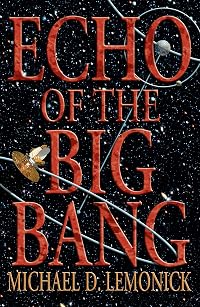
Echo of the Big Bang
by Michael D. Lemonick
On This Page
Description
A tight-knit, high-powered group of scientists and engineers spent eight years building a satellite designed, in effect, to read the genome of the universe. Launched in 2001, the Wilkinson Microwave Anisotropy Probe (WMAP) reported its first results two years later with a set of brilliant observations that added focus, detail, and insight to our formerly fuzzy view of the cosmos. For more than a year, the WMAP satellite hovered in the cold of deep space, a million miles from Earth, in an show more effort to determine whether the science of cosmology--the study of the origin and evolution of the universe--has been on the right track for the past two decades. What WMAP was looking for was a barely perceptible pattern of hot and cold spots in the faint whisper of microwave radiation left over from the Big Bang, the event that almost 14 billion years ago gave birth to all of space, time, matter, and energy. The pattern encoded in those microwaves holds the answers to some of the great unanswered questions of cosmology: What is the universe made of? What is its geometry? How much of it consists of the mysterious dark matter and dark energy that continue to baffle astronomers? How fast is it expanding? And did it undergo a period of inflationary hyper-expansion at the very beginning? WMAP has now given definitive answers to these mysteries. On February 11, 2003, the team of researchers went public with the results. Just some of their extraordinary findings: The universe is 13.7 billion years old. The first stars--turned on--when the universe was only 200 million years old, five times earlier than anyone had thought. It is now certain that a mysterious dark energy dominates the universe. Michael Lemonick, who had exclusive access to the researchers as WMAP gathered its data, here tells the full story of WMAP and its surprising revelations. This book is both a personal and a scientific tale of discovery. In its pages, readers will come to know the science of cosmology and the people who, seventy-five years after we first learned that the universe is expanding, deciphered some of its deepest mysteries in the patterns of its oldest light. show lessTags
Recommendations



















Member Reviews
Books written by science journalists are always suspect, but Lemonick does a good job of parsing the science while still keeping the language of the layman. He discusses the history of the Big Bang theory, and the process of collecting evidence to support or disprove Big Bang. The book goes into great detail about the process of acquiring and launching the satellite, and as such is probably more interesting to engineers and technophiles than to those who are interested in the actual science of the Big Bang. There is a decent discussion of what was discovered, but it is condensed into small bits that are less than fully satisfying. If you're interested in the ins and outs of the building of the satellites, or the process of obtaining show more grants from NASA and others, than this is the book for you. If you're looking for the actual science in detail, there are books that do a better job of covering this, and several that are more recent, which is crucial in cosmology. show less
Easy-reading account of the Wilkinson Microwave Anisotropy Probe (WMAP satellite) which determined in 2003 that the observable universe is 13.7 gigayears old and consists of 4% ordinary matter, 23% dark matter, and 73% "dark energy" (connected with accelerating expansion).
Members
- Recently Added By
Author Information

8 Works 413 Members
Michael D. Lemonick is senior science writer at Time magazine, where he has written more than forty cover stories on a wide range of science-related topics. He has also written for Discover, Playboy, and other publications
Classifications
Statistics
- Members
- 57
- Popularity
- 539,747
- Reviews
- 2
- Rating
- (2.50)
- Languages
- English
- Media
- Paper
- ISBNs
- 2