On This Page
Description
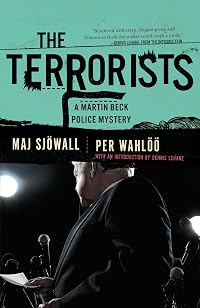
Fiction. Mystery. Thriller. HTML:The final novel in the Martin Beck mystery series by Maj Sjöwall and Per Wahlöö is a masterful, all consuming tale that rushes toward a thrilling, unexpected climax. With a new introduction by Dennis Lehane: "Tension so thick the reader could crack a tooth."An American senator is visiting Stockholm and Martin Beck must lead a team to protect him from an international gang of terrorists. However, in the midst of the fervor created by the diplomatic show more visit, a young, peace-loving woman is accused of robbing a bank. Beck is determined to prove her innocence, but gets trapped in the maze of police bureaucracy. To complicate matters a millionaire pornographer has been bludgeoned to death in his own bathtub. Filled with the twists and turns and the pulse pounding excitement that are the hallmarks of the Martin Beck novels, The Terrorists is the stunning conclusion to the incredible series that changed crime fiction forever. show less
Tags
Recommendations






















Member Reviews
This review contains spoilers.
****
In this suspenseful final novel in the Martin Beck series, the Swedish police and security forces have their work cut out for them: preventing a terrorist attack during the visit of a U.S. senator to Sweden. It will require diplomatic manoeuvring and keeping the idiots out of harm’s way. There are a couple of other cases as well: a young woman accused of robbing a bank holds the entire capitalist system up to the light, and a sleazy filmmaker is found murdered (and probably not much mourned).
I was so relieved that Martin Beck didn’t die at the end! I feared he would because this was billed as the “last” novel in the series, but it is the last novel because one of the authors (Wahlöö) died. show more Plot-wise, this ranks as a 4, but I deducted half a star for the excessive descriptions of women’s breasts. Too much male gaze in those chapters. show less
****
In this suspenseful final novel in the Martin Beck series, the Swedish police and security forces have their work cut out for them: preventing a terrorist attack during the visit of a U.S. senator to Sweden. It will require diplomatic manoeuvring and keeping the idiots out of harm’s way. There are a couple of other cases as well: a young woman accused of robbing a bank holds the entire capitalist system up to the light, and a sleazy filmmaker is found murdered (and probably not much mourned).
I was so relieved that Martin Beck didn’t die at the end! I feared he would because this was billed as the “last” novel in the series, but it is the last novel because one of the authors (Wahlöö) died. show more Plot-wise, this ranks as a 4, but I deducted half a star for the excessive descriptions of women’s breasts. Too much male gaze in those chapters. show less
If Cop Killer felt like the final volume of Maj Sjöwall’s and Per Wahlöö’s series of police procedurals (I simply refuse to call it the “Martin Beck” series like the covers of my edition do, because that goes blatantly against the spirit of the series), then The Terrorists reads like its epilogue.
The first nine volumes demonstrated how Sweden went from there (a comparatively enlightened state granting great liberties to its citizens) to here (an almost police state whose bureaucracy grinds down everyone who does not conform to the system), volume ten now presents a picture of how things are going to remain from now on. It is by far the longest novel in the series, and this is in part because it presents something like a summa show more of what the series has been about.
And in part this is because we almost get two novels in one here – one making up roughly the first half of the novel, consisting of a traditional whodunnit, the second telling of the attempts of Martin Beck and a team of (what often feels like the last few competent) policemen to prevent the assassination of a visiting right-wing politician from the United States. This repeats on a smaller scale the Before & After relation in which The Terrorists seems to me to stand to the rest of the series – the first crime appears almost old-fashioned, not only a crime of passion but one where the criminal actually used his crime to correct the shortcomings of the justice system. Sjöwall / Wahlöö don’t quite advocate vigilante justice here, but they also leave no doubt that the murder victim has ample deserved his fate and was killed to avenge a wrong.
In sharp contrast to this, the new, worse times have brought with them a new, worse kind of crime and criminals which simultaneously reflect the deteriorating state of things and contribute to accelerate that deterioration. These new criminals are professionals and mercenaries for whom killing is merely a business, profit their only motive. They are also ruthlessly efficient, and while Martin Beck and his colleagues manage to thwart the plans of the terrorists here, the novel leaves no doubt that the general level of competence of the Swedish police force is such that in the long run the criminals will eventually gain the upper hand.
And there is another kind of new criminal, produced by a system that mercilessly ostracizes everyone who does not fit its conception of what a citizen should be. I do not want to give too much of the plot away, so this is going to be a bit vague, but basically what Sjöwall and Wahlöö do here is to confront the ruthless, efficient mercenary criminal to someone victimized by precisely the welfare state which is supposed to protect people like them, people who ultimately are left with no resort to violence – both types of criminals subsumed into the category of “terrorists” and yet, vastly different. By the mid-seventies the Swedish state has become a merciless juggernaut, driven only by the momentum of its bureaucracy, crushing everything and everyone that is in its way because they does not conform.
As in previous novels, The Terrorists is kept from being utterly bleak and depressing by its main characters, who bring some human warmth into police proceedings and who increasingly appear like the last stand of humanity and compassion against the encroaching darkness of bureaucracy and incompetence. At the end of this novel, and thus the end of the series, we see several of them assembled during a companionable dinner – it is a surprisingly mellow final scene for a series that has been so scathing in its criticism of and so bleak in its outlook for Swedish society, but I for one am not complaining – it’s nice to leave the characters one has accompanied over the course of ten novels to some degree of private happiness.
It’s been a long ride through ten years of Swedish history with Martin Beck and his colleagues, but it has never been less than fascinating, and now that I have re-read the whole series, I have to say that it every single word of praise that has been heaped upon it has been well deserved. show less
The first nine volumes demonstrated how Sweden went from there (a comparatively enlightened state granting great liberties to its citizens) to here (an almost police state whose bureaucracy grinds down everyone who does not conform to the system), volume ten now presents a picture of how things are going to remain from now on. It is by far the longest novel in the series, and this is in part because it presents something like a summa show more of what the series has been about.
And in part this is because we almost get two novels in one here – one making up roughly the first half of the novel, consisting of a traditional whodunnit, the second telling of the attempts of Martin Beck and a team of (what often feels like the last few competent) policemen to prevent the assassination of a visiting right-wing politician from the United States. This repeats on a smaller scale the Before & After relation in which The Terrorists seems to me to stand to the rest of the series – the first crime appears almost old-fashioned, not only a crime of passion but one where the criminal actually used his crime to correct the shortcomings of the justice system. Sjöwall / Wahlöö don’t quite advocate vigilante justice here, but they also leave no doubt that the murder victim has ample deserved his fate and was killed to avenge a wrong.
In sharp contrast to this, the new, worse times have brought with them a new, worse kind of crime and criminals which simultaneously reflect the deteriorating state of things and contribute to accelerate that deterioration. These new criminals are professionals and mercenaries for whom killing is merely a business, profit their only motive. They are also ruthlessly efficient, and while Martin Beck and his colleagues manage to thwart the plans of the terrorists here, the novel leaves no doubt that the general level of competence of the Swedish police force is such that in the long run the criminals will eventually gain the upper hand.
And there is another kind of new criminal, produced by a system that mercilessly ostracizes everyone who does not fit its conception of what a citizen should be. I do not want to give too much of the plot away, so this is going to be a bit vague, but basically what Sjöwall and Wahlöö do here is to confront the ruthless, efficient mercenary criminal to someone victimized by precisely the welfare state which is supposed to protect people like them, people who ultimately are left with no resort to violence – both types of criminals subsumed into the category of “terrorists” and yet, vastly different. By the mid-seventies the Swedish state has become a merciless juggernaut, driven only by the momentum of its bureaucracy, crushing everything and everyone that is in its way because they does not conform.
As in previous novels, The Terrorists is kept from being utterly bleak and depressing by its main characters, who bring some human warmth into police proceedings and who increasingly appear like the last stand of humanity and compassion against the encroaching darkness of bureaucracy and incompetence. At the end of this novel, and thus the end of the series, we see several of them assembled during a companionable dinner – it is a surprisingly mellow final scene for a series that has been so scathing in its criticism of and so bleak in its outlook for Swedish society, but I for one am not complaining – it’s nice to leave the characters one has accompanied over the course of ten novels to some degree of private happiness.
It’s been a long ride through ten years of Swedish history with Martin Beck and his colleagues, but it has never been less than fascinating, and now that I have re-read the whole series, I have to say that it every single word of praise that has been heaped upon it has been well deserved. show less
The last of the superb Martin Beck novels, about a methodical police detective in Stockholm. Every one of the books has been wonderful, and Beck has come to be a beloved figure in my collection of crime fiction. This one deals primarily with the threatened assassination of an American politician on a visit to Sweden, but as always, the deeply felt concerns of the authors about social and political matters is at the heart of their story.
Sad to come to the end of this series, read magnificently by Tom Weiner, who ability to create distinct character voices is amazing. Not sad to stop being bashed over the head with Marxist politics--incredibly naive, but at least with an understanding that capitalists rule the world for their own benefit, and to hell with everyone else--but very sad not to continue to be immersed in the lives of such as fascinating set of characters. This book is not well structured, with too many climaxes and the usual unbelievable mingling of plotlines, but watching Martin Beck and Gunvald Larsson try to catch terrorists who have come to Sweden to blow up a Barry Goldwater-like US Senator during a visit, is fascinating. Just as we have come to show more appreciate Gunvald's skills despite his personality, Martin Beck has begun to do so also--and it is their partnership throughout that is the secret to success. More than a few awful things happen along the way, and the scenes near the end of the book with Beck, Larsson, and others are not very believable--in one case, absolutely ridiculous, but a good chance for the authors to exercise their fascination with describing the female body in minute detail. But, as I said, it isn't the plots I'll miss--they tend to be very sordid and more than a bit contrived--it is the interplay between all these characters. At least as we leave Martin Beck, he looks well set for a happy future. Perhaps he should be thankful the series ends where it does--who knows what horrors these authors may have had in store for him had it continued? show less
The Terrorists is one of the better pieces of plotting you're likely to find in detective fiction. The book opens with a courtroom scene, a young woman accused of robbing a bank at knife point. Martin Beck has been called to testify for the defense. In a scene designed to make Sweden's justice system cringe, the defense is able to prove that a woman who walked out of a bank with a canvas bag full of bills that were not hers was completely innocent of any wrong doing. At first, while I enjoyed the scene, I felt it a bit unfair and a bit artificial, inserting an apparently superfluous subplot just to make the justice system look bad. Were Sjowall and Wahloo extending their critique of Sweden's police force to the judicial system just to show more get in a few bonus before the series ended? As soon as the girl left the courtroom a free woman, the plot shifted into the story of an American senator, visiting Sweden and the terrorists who have threatened to kill him. I should have trusted Sjowall and Wahloo more. There never was any chance that they would let the reader down in this the final Martin Beck book. The girl comes back in a shocking way that I really should have expected all along. That's the best possible ending for a story like "The Story of a Crime," a shocking finish that should have been expected.
This is not to say that the authors don't allow themselves a little bit of self-indulgence in The Terrorists. After nine books, I think they're entitled. Chapter 16 opens with an assessment of what makes Martin Beck such a good detective. It's easy to imagine that the authors were responding to critics and fans of their books alike in this couple of pages spent reviewing their detective's career. They admit that some argue he has very few cases and that they are easy to solve. But they also lay out a their case for why he is a good detective, and I imagine by extenstion a good case for what makes a good detective in general. He has a "systematic mind, common sense and conscientiousness," "his good memory; his obstinancy, which was occasionally mulelike; and his capacity for logical thought. Another was that he found time for everything that had anything to do with a case, even if this meant following up small details that later turned out to be of no significanse. Occasionally these minute considerations led to important clues."
This description of what makes Beck a good detective could easly be a description of what makes Sjowall and Wahloo's detective stories so good. Consider it advice for the would be writer of police procedurals. You won't find anyone escaping from a moving freight car via a hole in the floor, or an intricately planned revenge plot involving bondage and tatoos in anything by Sjowall and Wahloo. What you will find is attention to detail, logical thought, conscientiousne, stories and people much closer to Simenon's Maigret than to the Hollywood plotlines so typical in today's crime fiction-- crime fiction Sjowall and Wahloo helped make possible.
You'll also find a wicked sense of humor. The kind of humor that manages to end a ten volume critique of Sweden's socialist government with the phrase "X as in Marx." I think that's pretty good. show less
This is not to say that the authors don't allow themselves a little bit of self-indulgence in The Terrorists. After nine books, I think they're entitled. Chapter 16 opens with an assessment of what makes Martin Beck such a good detective. It's easy to imagine that the authors were responding to critics and fans of their books alike in this couple of pages spent reviewing their detective's career. They admit that some argue he has very few cases and that they are easy to solve. But they also lay out a their case for why he is a good detective, and I imagine by extenstion a good case for what makes a good detective in general. He has a "systematic mind, common sense and conscientiousness," "his good memory; his obstinancy, which was occasionally mulelike; and his capacity for logical thought. Another was that he found time for everything that had anything to do with a case, even if this meant following up small details that later turned out to be of no significanse. Occasionally these minute considerations led to important clues."
This description of what makes Beck a good detective could easly be a description of what makes Sjowall and Wahloo's detective stories so good. Consider it advice for the would be writer of police procedurals. You won't find anyone escaping from a moving freight car via a hole in the floor, or an intricately planned revenge plot involving bondage and tatoos in anything by Sjowall and Wahloo. What you will find is attention to detail, logical thought, conscientiousne, stories and people much closer to Simenon's Maigret than to the Hollywood plotlines so typical in today's crime fiction-- crime fiction Sjowall and Wahloo helped make possible.
You'll also find a wicked sense of humor. The kind of humor that manages to end a ten volume critique of Sweden's socialist government with the phrase "X as in Marx." I think that's pretty good. show less
While working on the case of the murder of an erotic film producer, Martin Beck is selected to lead an anti-terrorism task force. A controversial US senator is due for a state visit to Sweden and seems a ripe candidate for a recent organisation by the name of ULAG. Not much is known about this group other than they've been very successful in their missions to date. They utilise different methods and don't care about collateral damage as long as they eliminate their target in the process. Can Beck and his team find his murderer while ensuring the diplomatic visit goes off without a bang as well as continuing to build a relationship with Rhea Nielsen?
This is the tenth and final volume of the series that not only looks at the life and show more career of a senior policeman but also of the Swedish welfare state and the effects this has on the country as a whole. The authors depict a decline in almost every area they document. Drugs and sex are rife throughout the cities and the police force is heading towards a more militaristic approach to dealing with crimes. So it's not just the obvious aspects of terrorism that is written about here. This provides a fitting conclusion to what's been a very good police procedural series. show less
This is the tenth and final volume of the series that not only looks at the life and show more career of a senior policeman but also of the Swedish welfare state and the effects this has on the country as a whole. The authors depict a decline in almost every area they document. Drugs and sex are rife throughout the cities and the police force is heading towards a more militaristic approach to dealing with crimes. So it's not just the obvious aspects of terrorism that is written about here. This provides a fitting conclusion to what's been a very good police procedural series. show less
The final book of the Martin Beck series sees Martin and his team given the responsibility of providing security for a visiting US Senator. In doing so, Martin comes up against a ruthlessly efficient mercenary outfit performing assassinations for hire.
As always, the authors use their plot to air social concerns, in this case about excessive police powers and the helplessness of some individuals in what is supposd to be a welfare state. While the plot is at least partly inspired by the assassination of Olof Palme, it has much relevance for modern audiences, for whom political terrorism continues to be an issue.
The book is taut and exciting, and a triumphant finish to the series. It's a shame there are no more of these gems.
As always, the authors use their plot to air social concerns, in this case about excessive police powers and the helplessness of some individuals in what is supposd to be a welfare state. While the plot is at least partly inspired by the assassination of Olof Palme, it has much relevance for modern audiences, for whom political terrorism continues to be an issue.
The book is taut and exciting, and a triumphant finish to the series. It's a shame there are no more of these gems.
Members
- Recently Added By
Lists

Scandinavian Crime Fiction
224 works; 37 members

Reading List - Scandinavian Fiction
134 works; 3 members

Books Read in 2016
4,666 works; 199 members

Books Read in 2022
5,226 works; 115 members
Author Information

74+ Works 14,652 Members
Writer and journalist Maj Sjöwall was born in Sweden in 1935. She was a reporter and art director at several newspapers and magazines. From 1959 to 1961, she was an editor with the publishing house Wahlström and Widstrad. She met Per Wahlöö in 1961 and they married the following year. Together they wrote all ten novels in the Martin Beck show more Police Mystery series from 1965 to 1975. In 1971, The Laughing Policeman (a translation of Den Skrattande Polisen) won an Edgar Award for Best Novel. (Bowker Author Biography) show less

49+ Works 15,333 Members
Writer and journalist Per Wahlöö was born in Sweden on August 5, 1926. He graduated from the University of Lund in 1946 and found work covering criminal and social issues for numerous newspapers and magazines. He also wrote a number of television and radio plays and was managing editor for several magazines. His first book, Himmelsgeten, was show more published in 1956 and numerous novels followed. He also wrote all ten novels in the Martin Beck Police Mystery series with his wife Maj Sjöwall. In 1971, The Laughing Policeman (a translation of Den Skrattande Polisen) won an Edgar Award for Best Novel. He died from cancer on June 22, 1975. (Bowker Author Biography) show less
Some Editions
Awards and Honors
Notable Lists
Series

Belongs to Publisher Series
Work Relationships
Is contained in
Common Knowledge
- Canonical title
- The Terrorists
- Original title
- Terroristerna
- Original publication date
- 1975; 1976 (English translation) (English translation)
- People/Characters
- Martin Beck; Sten Lennart Kollberg; Gunvald Larsson; Benny Skacke; Rhea Nielsen; Einar Rönn (show all 14); Stig Malm; Frederik Melander; Sten "Bulldozer" Robert Olsson; Karl Kristiansson; Kurt Kvant; Oskar Hjelm; Per Månsson; Herrgott Allwright
- Important places
- Stockholm, Sweden; Malmö, Sweden
- Related movies
- Stockholm Marathon (1994 | IMDb)
- First words
- The National Commissioner of Police smiled.
- Last words
- (Click to show. Warning: May contain spoilers.)'Then I say X - X as in Marx.'
- Original language
- Swedish
Classifications
- Genres
- Fiction and Literature, Mystery
- DDC/MDS
- 839.7374 — Literature & rhetoric German & related literatures Other Germanic literatures Swedish literature Swedish fiction 1900-1999 1945-1999
- LCC
- PT9876.29 .J63 .T413 — Language and Literature German, Dutch and Scandinavian literatures Swedish literature Individual authors or works 1961-2000
- BISAC
Statistics
- Members
- 1,044
- Popularity
- 24,880
- Reviews
- 29
- Rating
- (3.84)
- Languages
- 14 — Danish, Dutch, English, Estonian, Finnish, French, German, Italian, Norwegian (Bokmål), Norwegian, Polish, Russian, Spanish, Swedish
- Media
- Paper, Audiobook, Ebook
- ISBNs
- 77
- ASINs
- 16