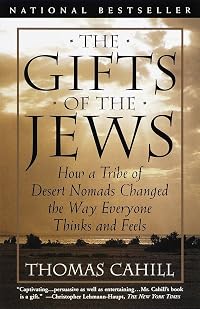
The Gifts of the Jews: How a Tribe of Desert Nomads Changed the Way Everyone Thinks and Feels
by Thomas Cahill
Hinges of History (2)
On This Page
Description
In this insightful book, Thomas Cahill, internationally-acclaimed historian and author of the runaway bestseller How the Irish Saved Civilization (RB# 94747), reveals the changes in thinking that made Western civilization possible. A New York Times best-seller, The Gifts of the Jews is his accessible portrait of an ancient society and their vision that would later inspire the concept of individual worth. Until the third millennium, it was a widely-held belief that people were pawns in an show more endless cycle of birth and death, with no hope of altering their fate. But when Abraham followed God's command in ancient Sumer to "go forth" into the wilderness, a remarkable shift in thought emerged. As Abraham led his tribe through strange lands, these people called Jews began to view time as having starting and ending points-and holding the possibility of a better tomorrow. Through compelling stories, insights, and humor, Thomas Cahill demonstrates how many of your treasured values really are gifts from the Jews. Narrator Richard M. Davidson transports you to the distant past to rub elbows with such renowned biblical characters as Sarah, Moses, Job, and Ruth. show lessTags
Recommendations
















Member Reviews
For the first 50 pages I was intrigued. The next 190 pages retold a story I know very well. The last 8 pages made me want to throw the book across the room in frustration. Let me explain.
In the Beginning.
In The Gift of the Jews, Thomas Cahill explains how the Jewish people changed the way Western culture thinks and operates. It's an overlooked theme that deserves attention. During the first 50 pages, Cahill reconstructs the culture and thought life of the ancient Sumerians (the culture Abram was called out of).
Life in Sumeria was cyclical. Crops grew, died, and came to life again. The sun rose and set only to rise again. The rainy season came and went and returned. The ancient Israelites were the first culture to break out of this show more mindset. For Abraham and his lineage, life and history was more than cyclical—it had a purpose.
The Middle.
The bulk of the book is a summary of the Hebrew Bible. If you're fuzzy on your Old Testament, this would be an interesting fast-forward through a lot of history. For me, it seemed like a somewhat patchwork retelling of Israelite history, picking and choosing what to focus on. At a few junctions, I wondered how well Cahill knew the Hebrew Bible.
When Cahill discussed the time before Jerusalem's fall and the Babylonian captivity, he spoke at length about Isaiah while ignoring Jeremiah and Ezekiel. Another time he commented about how some of the books in the Hebrew Bible seem existentialist—only to describe Song of Solomon while completely ignoring Ecclesiastes! If you're going to give any writer in the Bible a proto-existentialist award, it has to be the Qohelet!
Besides all the picking-and-choosing (which, I admit, had to be done in such a condensed retelling), I had a few other frustrations. Cahill's use of unfamiliar spellings (Avraham for Abraham and Moshe for Moses, for example) felt a bit pretentious. His viewpoint on miracles was also inconsistent. Cahill has no problem with a person hearing the voice of God, but he tried to offer rational foundations for other miraculous events such as the crossing of the Sea of Reeds (low tide). I would respect a consistent anti-supernatural position, but you can't have it both ways.
The End.
You're probably wondering why I wanted to throw this book across the room. Here's why:
"It is no longer possible to believe that every word of the Bible was inspired by God. Fundamentalists still do, but they can keep up such self-delusion only by scrupulously avoiding all forms of scientific inquiry. ... But even without resorting to modern scientific methodology or noticing what an inconsistent palimpsest the Hebrew Bible can be, we must reject certain parts of the Bible as unworthy of a God we would be willing to believe in. ... If God is to be God the Creator of all, he must be utterly beyond our comprehension—and, therefore, awfully scary. More than this, I, for one, am willing to give God the benefit of the doubt in certain dubious cases—even in an episode as grotesque as the near-sacrifice of Yitzhak [Isaac—see my earlier critique]. He had to jump-start this new religion, and he didn't always have the best material to work with" (245-6).
Where should I start? I could critique Cahill's ignorance about what "inspired" means—anyone can beat up a fundamentalist straw-man. I could point out the obvious: yes, God "must be utterly beyond our comprehension" ... unless he chose to reveal himself to us in history which is precisely what your entire book is about!
No, the thing that drove me crazy was the modernist arrogance. Cahill and the rest of us moderns are somehow qualified to determine what God can and cannot do because our societal norms dictate what's right and wrong.
Clearly a God that doesn't meet our enlightened ethical understanding isn't "worth believing in" (246). show less
In the Beginning.
In The Gift of the Jews, Thomas Cahill explains how the Jewish people changed the way Western culture thinks and operates. It's an overlooked theme that deserves attention. During the first 50 pages, Cahill reconstructs the culture and thought life of the ancient Sumerians (the culture Abram was called out of).
Life in Sumeria was cyclical. Crops grew, died, and came to life again. The sun rose and set only to rise again. The rainy season came and went and returned. The ancient Israelites were the first culture to break out of this show more mindset. For Abraham and his lineage, life and history was more than cyclical—it had a purpose.
The Middle.
The bulk of the book is a summary of the Hebrew Bible. If you're fuzzy on your Old Testament, this would be an interesting fast-forward through a lot of history. For me, it seemed like a somewhat patchwork retelling of Israelite history, picking and choosing what to focus on. At a few junctions, I wondered how well Cahill knew the Hebrew Bible.
When Cahill discussed the time before Jerusalem's fall and the Babylonian captivity, he spoke at length about Isaiah while ignoring Jeremiah and Ezekiel. Another time he commented about how some of the books in the Hebrew Bible seem existentialist—only to describe Song of Solomon while completely ignoring Ecclesiastes! If you're going to give any writer in the Bible a proto-existentialist award, it has to be the Qohelet!
Besides all the picking-and-choosing (which, I admit, had to be done in such a condensed retelling), I had a few other frustrations. Cahill's use of unfamiliar spellings (Avraham for Abraham and Moshe for Moses, for example) felt a bit pretentious. His viewpoint on miracles was also inconsistent. Cahill has no problem with a person hearing the voice of God, but he tried to offer rational foundations for other miraculous events such as the crossing of the Sea of Reeds (low tide). I would respect a consistent anti-supernatural position, but you can't have it both ways.
The End.
You're probably wondering why I wanted to throw this book across the room. Here's why:
"It is no longer possible to believe that every word of the Bible was inspired by God. Fundamentalists still do, but they can keep up such self-delusion only by scrupulously avoiding all forms of scientific inquiry. ... But even without resorting to modern scientific methodology or noticing what an inconsistent palimpsest the Hebrew Bible can be, we must reject certain parts of the Bible as unworthy of a God we would be willing to believe in. ... If God is to be God the Creator of all, he must be utterly beyond our comprehension—and, therefore, awfully scary. More than this, I, for one, am willing to give God the benefit of the doubt in certain dubious cases—even in an episode as grotesque as the near-sacrifice of Yitzhak [Isaac—see my earlier critique]. He had to jump-start this new religion, and he didn't always have the best material to work with" (245-6).
Where should I start? I could critique Cahill's ignorance about what "inspired" means—anyone can beat up a fundamentalist straw-man. I could point out the obvious: yes, God "must be utterly beyond our comprehension" ... unless he chose to reveal himself to us in history which is precisely what your entire book is about!
No, the thing that drove me crazy was the modernist arrogance. Cahill and the rest of us moderns are somehow qualified to determine what God can and cannot do because our societal norms dictate what's right and wrong.
Clearly a God that doesn't meet our enlightened ethical understanding isn't "worth believing in" (246). show less
Another excellent book from Thomas Cahill and a cogent and timely reminder that the Judeo-Christian tradition created nearly everything that we today recognize as normal human life. Our views of time, of personhood and interpersonal relationships, our views of the self, of society, and of morality -- all of them have been created and passed down to us by a small group of nomads bred in the deserts of the Middle East. Cahill's book will make you look at yourself, the society you live in, and the Bible all in a new and brilliant light. I have only two complaints: 1. While Cahill rightly criticizes some of the violent aspects of the Old Testament, he fails to take his presentation full circle and state why it is that we find the slaughters show more and wars of ancient times so repulsive: because of the very mindset that this same book has instilled in us; 2. Cahill cuts the story short, ending with the Old Testament and never tells us how these values became the world's values: Christianity. show less
This book's perspective offers the freshness of a different lens on the history of Judaism. I enjoyed how it allowed me to see a new view of the cultural interactions and developments of the tribe of the nominal Jews and their neighboring ancient civilizations that grew into kingdoms and city states. You learn new information about origins of labels like Hebrew, plus contextual changes in the purpose and way stories were told and recorded. The diverse and often unknown perspective of the authors' purposes in various written histories were discussed. Concepts of faith and Godly power and holy writings, along with the corresponding developments of spiritual practices were unwoven with humor. Presentation is well organized and may be more show more like an academic lecture than some may appreciate. This was well worth the time for me, as it opened up some new insights regarding the cultural possibilities that fed into the puzzles of early written histories leading up to medieval times. Sorting reality from tradition in the confusing oral histories that were later written seems to be an art and a science across cultures regardless of the continent. The theory of the Jews originating the concept of an individual purpose that developed into Western thought is well developed and proofed. We will fail to get the truth of early history right without a breadth of knowledge and an acceptance that we may never know the whole of what we do not know and how it fed into what we are now. But, I truly enjoyed this piece of the puzzle! show less
This book's perspective offers the freshness of a different lens on the history of Judaism. I enjoyed how it allowed me to see a new view of the cultural interactions and developments of the tribe of the nominal Jews and their neighboring ancient civilizations that grew into kingdoms and city states. You learn new information about origins of labels like Hebrew, plus contextual changes in the purpose and way stories were told and recorded. The diverse and often unknown perspective of the authors' purposes in various written histories were discussed. Concepts of faith and Godly power and holy writings, along with the corresponding developments of spiritual practices were unwoven with humor. Presentation is well organized and may be more show more like an academic lecture than some may appreciate. This was well worth the time for me, as it opened up some new insights regarding the cultural possibilities that fed into the puzzles of early written histories leading up to medieval times. Sorting reality from tradition in the confusing oral histories that were later written seems to be an art and a science across cultures regardless of the continent. The theory of the Jews originating the concept of an individual purpose that developed into Western thought is well developed and proofed. We will fail to get the truth of early history right without a breadth of knowledge and an acceptance that we may never know the whole of what we do not know and how it fed into what we are now. But, I truly enjoyed this piece of the puzzle! show less
This book requires a more than fair amount of biblical familiarity. It is written by a non-Jew. I enjoyed it very much, except for the last chapter where he gives his personal points of view. My recommendation is read everything, except the final part (chapter 7).
Notes and sources, Bible index, subject index, Books of the Hebrew Bible, Old Testament Chronology.
Readers might think that this subject matter is covered as Jewish influence throughout world history, but it sticks exclusively to the Old Testament and the main story lines found there: Abraham, Moses, Saul, David, Solomon, some of the prophets, & Ruth. Cahill argues that the Jews brought to human consciousness the individual identity, the spiritual awareness that is needed for show more a person, a nation to fully encounter God. Cahill's many personal points of view in this book might mislead a normal reader in the christian religious tradition. A studied reader will notice these and move on. Cahill opines that the Israelites didn't really cross the Red Sea and that there was a wind and dry wash where the Sea of Reeds was traversed. Cahill says that the entire Hebrew scriptures aren't inspired down to every detail, but that the overall message is inspired. Apparently, he has heard this from other academics and also accepts that position for his own point of view.
One thing Cahill says which can illustrate his methodology is regarding the Ten Commandments.
He say that: "They have been received by billions as reasonable, necessary, even unalterable because they were written on human hearts and always have been. They were always there in the inner core of the human person -- in the deep silence that each of us carries within. They needed only to be spoken aloud."
Even though Cahill went to Fordham and was taught by Jesuits this veers widely from the Roman Catholic point of view. Thomas Aquinas on his treatise on Law says that the Natural Light of Reason (Natural Law) tells us to do good, avoid evil and discern the difference between the two. Divine Law is higher and is comprised by the Ten Commandments. According to Roman Catholic teaching, no one could have ever formulated the commandments on their own initiative. They are above human reason's capability. Hence the reason for Moses to have received them on Mount Sinai from God Himself. What is however written on human hearts, contra Cahill, is the natural law which all humans share in common. Cahill says that Moses merely made explicit what people already knew to be true. Roman Catholic teaching disagrees, but this is a major point of contention since no other people had such a specific code of conduct as the Israelites. Prohibitions against murder and theft are usually the extent of the natural laws that have come down to us (Code of Hammurabi). So in this Catholic understanding personal property takes on a bigger significance, as do marriage and religious observance. God in the Catholic tradition does not just want people to do good and avoid evil, but must obey the Commandments to avoid sin against God himself and not be mere transgressions of human positive law.
I recommend this book but only as a way to look at Biblical narratives stretched throughout the whole Hebrew scriptures. The more I learn about the Bible, the more I marvel at our Judeo-Christian tradition and that it continues in the United States of America show less
Notes and sources, Bible index, subject index, Books of the Hebrew Bible, Old Testament Chronology.
Readers might think that this subject matter is covered as Jewish influence throughout world history, but it sticks exclusively to the Old Testament and the main story lines found there: Abraham, Moses, Saul, David, Solomon, some of the prophets, & Ruth. Cahill argues that the Jews brought to human consciousness the individual identity, the spiritual awareness that is needed for show more a person, a nation to fully encounter God. Cahill's many personal points of view in this book might mislead a normal reader in the christian religious tradition. A studied reader will notice these and move on. Cahill opines that the Israelites didn't really cross the Red Sea and that there was a wind and dry wash where the Sea of Reeds was traversed. Cahill says that the entire Hebrew scriptures aren't inspired down to every detail, but that the overall message is inspired. Apparently, he has heard this from other academics and also accepts that position for his own point of view.
One thing Cahill says which can illustrate his methodology is regarding the Ten Commandments.
He say that: "They have been received by billions as reasonable, necessary, even unalterable because they were written on human hearts and always have been. They were always there in the inner core of the human person -- in the deep silence that each of us carries within. They needed only to be spoken aloud."
Even though Cahill went to Fordham and was taught by Jesuits this veers widely from the Roman Catholic point of view. Thomas Aquinas on his treatise on Law says that the Natural Light of Reason (Natural Law) tells us to do good, avoid evil and discern the difference between the two. Divine Law is higher and is comprised by the Ten Commandments. According to Roman Catholic teaching, no one could have ever formulated the commandments on their own initiative. They are above human reason's capability. Hence the reason for Moses to have received them on Mount Sinai from God Himself. What is however written on human hearts, contra Cahill, is the natural law which all humans share in common. Cahill says that Moses merely made explicit what people already knew to be true. Roman Catholic teaching disagrees, but this is a major point of contention since no other people had such a specific code of conduct as the Israelites. Prohibitions against murder and theft are usually the extent of the natural laws that have come down to us (Code of Hammurabi). So in this Catholic understanding personal property takes on a bigger significance, as do marriage and religious observance. God in the Catholic tradition does not just want people to do good and avoid evil, but must obey the Commandments to avoid sin against God himself and not be mere transgressions of human positive law.
I recommend this book but only as a way to look at Biblical narratives stretched throughout the whole Hebrew scriptures. The more I learn about the Bible, the more I marvel at our Judeo-Christian tradition and that it continues in the United States of America show less
In this bestselling book, Cahill sets out to show that the world we live in and everything we do and think, is purportedly a result of the Jewish "revolution" in history. The concepts expounded in the Bible were a dramatic break from the ancient religions and philosophies, that viewed the world as an endless cycle of birth and death in which human beings had no control over their lives. The Jews broke this way of thinking by defining time as continuous, as moving towards a better future through the decisions of men and women living here and now, in the present. Were it not for the Jews, argues Cahill, the world as we know it would not have come to be; we would have been unable to grasp concepts such as history, future, freedom, faith, show more hope, individual, justice and pretty much everything else.
What a wonderful theory and, as a Jew, I'm obviously all for it. But unfortunately Cahill devotes most of the book not to providing evidence to support this theory, but rather to a recounting of the major stories of the Bible from his perspective. The few profound points he makes about the contribution of the Jews to the world are lost in the endless quotes from the Bible and in Cahill's somewhat simplistic theories about what really happened. For example, do we really need to know that he believes the Red Sea was a marsh and not a sea, or that the Manna the Israelites ate in the desert was most likely some white plant secretion? Such details are numerous and do not contribute to the main idea offered by the author.
Cahill does not come through as a particularly believing person and he certainly does not view the Bible as the word of God. Therefore, it is interesting that he uses the following definition for the existence of God:
...the Jews developed a whole new way of experiencing reality, the only alternative to all ancient worldviews and all ancient religions. If one is ever to find the finger of God in human affairs, one must find it here. (p. 246)
I wonder if Cahill was aware that this very definition was given by Benjamin Disraeli, Prime Minister of Britain. When asked by Queen Victoria if he can provide proof that God exists, Disraeli (born Jewish himself) thought for a moment and replied: "The Jews, your Majesty".
As a believing Jew I particularly liked the way Cahill defines how each and every one of us hears the Voice of God:
Each reader must decide if the Voice that spoke to the patriarchs and prophets speaks to him, too. If it does, there is no question of needing proof, any more than we require proof of anyone we believe in... one does not believe that God exists, as one believes that Timbuktu or the constellation Andromeda exists. One believes in God, as one believes in a friend - or one believes nothing." (p.250) show less
What a wonderful theory and, as a Jew, I'm obviously all for it. But unfortunately Cahill devotes most of the book not to providing evidence to support this theory, but rather to a recounting of the major stories of the Bible from his perspective. The few profound points he makes about the contribution of the Jews to the world are lost in the endless quotes from the Bible and in Cahill's somewhat simplistic theories about what really happened. For example, do we really need to know that he believes the Red Sea was a marsh and not a sea, or that the Manna the Israelites ate in the desert was most likely some white plant secretion? Such details are numerous and do not contribute to the main idea offered by the author.
Cahill does not come through as a particularly believing person and he certainly does not view the Bible as the word of God. Therefore, it is interesting that he uses the following definition for the existence of God:
...the Jews developed a whole new way of experiencing reality, the only alternative to all ancient worldviews and all ancient religions. If one is ever to find the finger of God in human affairs, one must find it here. (p. 246)
I wonder if Cahill was aware that this very definition was given by Benjamin Disraeli, Prime Minister of Britain. When asked by Queen Victoria if he can provide proof that God exists, Disraeli (born Jewish himself) thought for a moment and replied: "The Jews, your Majesty".
As a believing Jew I particularly liked the way Cahill defines how each and every one of us hears the Voice of God:
Each reader must decide if the Voice that spoke to the patriarchs and prophets speaks to him, too. If it does, there is no question of needing proof, any more than we require proof of anyone we believe in... one does not believe that God exists, as one believes that Timbuktu or the constellation Andromeda exists. One believes in God, as one believes in a friend - or one believes nothing." (p.250) show less
The moment, or hinge, in history that a changed occurred to allow Western civilization possible is the primary focus of Thomas Cahill’s The Gifts of the Jews. Over the course of less than 304 pages and the scope of two millennia of Jewish history from its birth with Abraham to their return from exile, Cahill examines the evolving birth of a new worldview that was entirely different from what had been thought before.
The focus of Cahill’s book is the beginning of Western civilization, which to him is a change in mindset on how to view the world and the reason was the Jews. Before getting to Abraham however, Cahill looked to what had come before, the “cyclical” worldview and culture of Sumer in which he went out of. With this in show more mind, Cahill emphasizes how big a step Abraham’s journey at God’s direction was. Then throughout the course of the book, Cahill examines step-by-step the development of the “processive” worldview that the Jews were exhibiting for the first time from successive revelations of God and the development of individuality in language and philosophy, but most importantly the role of justice in society.
Cahill’s argument is very compelling, as was his discussions on the Epic of Gilgamesh and the various Biblical individuals and their actions. Yet the problem I have with this book is with some of Cahill’s interpretation and subsequent logical construction of his evidence whether through scripture or an analysis of non-Biblical sources to weave his thesis. For example some of the evidence Cahill uses to date the Exodus is erroneous by misinterpretation of both Biblical and non-Biblical sources, yet that is only of several examples I could have given.
Yet while Cahill’s interpretations aren’t the best part of this book, his argument that the Jews brought forth a new worldview that would lead to Western civilization is compelling. Because of that, The Gifts of the Jews is worth a close read as it describes the first and most significant hinge of historical change. show less
The focus of Cahill’s book is the beginning of Western civilization, which to him is a change in mindset on how to view the world and the reason was the Jews. Before getting to Abraham however, Cahill looked to what had come before, the “cyclical” worldview and culture of Sumer in which he went out of. With this in show more mind, Cahill emphasizes how big a step Abraham’s journey at God’s direction was. Then throughout the course of the book, Cahill examines step-by-step the development of the “processive” worldview that the Jews were exhibiting for the first time from successive revelations of God and the development of individuality in language and philosophy, but most importantly the role of justice in society.
Cahill’s argument is very compelling, as was his discussions on the Epic of Gilgamesh and the various Biblical individuals and their actions. Yet the problem I have with this book is with some of Cahill’s interpretation and subsequent logical construction of his evidence whether through scripture or an analysis of non-Biblical sources to weave his thesis. For example some of the evidence Cahill uses to date the Exodus is erroneous by misinterpretation of both Biblical and non-Biblical sources, yet that is only of several examples I could have given.
Yet while Cahill’s interpretations aren’t the best part of this book, his argument that the Jews brought forth a new worldview that would lead to Western civilization is compelling. Because of that, The Gifts of the Jews is worth a close read as it describes the first and most significant hinge of historical change. show less
Members
- Recently Added By
Author Information

Awards and Honors
Awards
Distinctions
Series

Common Knowledge
- Canonical title
- The Gifts of the Jews: How a Tribe of Desert Nomads Changed the Way Everyone Thinks and Feels
- Original publication date
- 1998
- Dedication
- To Kristin. How but in custom and in ceremony Are innocence and beauty born? Ceremony's a name for the rich horn, And custom for the spreading laurel tree.
The Elster - DeFlaun Family - First words
- The Jews started it all--and by 'it' I mean so many of the things we care about, the underlying values that make all of us, Jew and gentile, believer and atheist, tick.
- Quotations
- The Sabbath is surely one of the simplest and sanest recommendations any god has ever made; and those who live without such septimanal punctuation are emptier and less resourceful.
But this gift of the Commandments allows us to live in the present, in the here and now. What I have done in the past is past mending; what I will do in the future is a worry not worth the candle, for there is no way I can kn... (show all)ow what will happen next. But in this moment--and only in this moment--I am in control. - Last words
- (Click to show. Warning: May contain spoilers.)For without justice, there is no God.
- Blurbers
- Eder, Richard; Keneally, Thomas
- Original language*
- English
*Some information comes from Common Knowledge in other languages. Click "Edit" for more information.
Classifications
- Genres
- Religion & Spirituality, History, General Nonfiction, Nonfiction
- DDC/MDS
- 909.04924 — History & geography History World history History with respect to ethnic and national groups Other Semites Jews, Hebrews, Israelis
- LCC
- BM165 .C25 — Philosophy, Psychology and Religion Judaism Judaism General History
- BISAC
Statistics
- Members
- 3,160
- Popularity
- 5,495
- Reviews
- 32
- Rating
- (3.76)
- Languages
- 9 — Czech, Danish, Dutch, English, German, Italian, Norwegian (Bokmål), Portuguese, Spanish
- Media
- Paper, Audiobook, Ebook
- ISBNs
- 31
- ASINs
- 13