On This Page
Description
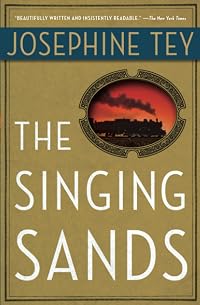
Bestselling author Josephine Tey's classic final mystery featuring her best-loved character, Inspector Alan Grant, filled with "all the Tey magic and delight" and now featuring a new introduction by Robert Barnard. On sick leave from Scotland Yard, Inspector Alan Grant is planning a quiet holiday with an old school chum to recover from overwork and mental fatigue. Traveling on the night train to Scotland, however, Grant stumbles upon a dead man and a cryptic poem about "the stones that walk" show more and "the singing sand," which send him off on a fascinating search into the verse's meaning and the identity of the deceased. Grant needs just this sort of casual inquiry to quiet his jangling nerves, despite his doctor's orders. But what begins as a leisurely pastime eventually turns into a full-blown investigation that leads Grant to discover not only the key to the poem but the truth about a most diabolical murder. show lessTags
Recommendations















Member Reviews
Sadly Tey wrote only eight mysteries, and this is her last, published posthumously. I don't think it's among her best. I'd rate it perhaps sixth out of the eight, but it's still a great read, and stands out as a character study of her detective, Inspector Alan Grant of Scotland Yard.
When he first appeared in The Man in the Queue he struck me as rather bland especially compared to such sleuths as Sherlock Holmes, Hercule Poirot and Lord Peter Wimsey. With the possible exception of The Daughter of Time, he also strikes me in the books he appears in as the most fallible detective protagonist I've ever read. He's not notable for brilliant logical deductions like Holmes or Poirot. What he has is what he calls "flair"--intuition, instinct, show more imagination--and that doesn't always steer him the right way.
At the beginning of The Singing Sands we see a mentally fragile Grant. Suffering from overwork, he's subject to a crippling claustrophobia. Taking leave to visit his cousin Laura in the Scottish Highlands, he encounters a dead body in one of the sleeping berths, seemingly the result of an accident. On a newspaper is scribbled some verse:
The beasts that talk,
The streams that stand,
The stones that walk,
The singing sands,
That guard the way to Paradise.
He finds that verse teasing his mind, and it pushes him to solve the mystery of the meaning of the verses and the young man's death, taking him to the Hebrides and to Marsaille.
The introduction to the newest editions of the Tey books by Robert Barnard don't hold up Tey to a flattering light. I don't think Barnard really likes Tey. I came across on the internet at one point a list by Barnard of favorite works of crime fiction--notably Tey wasn't on his list. In his introduction he accuses Tey of "anti-Semitism, contempt for the working class, a deep uneasiness about any enthusiasm (for example Scottish Nationalism) that, to her, smacks of crankiness."
Having recently reread all the books, there are definitely ethnic stereotypes expressed by characters, especially Grant. However, notably the only identifiably Jewish character, in A Shilling for Candles, is a positive one who rightly twits Grant about his class prejudices--Grant is entirely wrong about him. I also can't see anything but respect for working people in Tey's books. What she does express contempt for are self-styled radical champions of the working class--quite a different thing. Her attitude there is especially evident in The Franchise Affair.
The Singing Sands is the book where the digs against Scottish Nationalism are primarily made. They don't strike me as cranky though. If anything they strike me as refreshing and relevant, as a slap at those who try to flare back to life age-old historical grievances. And I can certainly see Wee Archie in a lot of current political activists. Tey definitely shows a conservative sensibility that might offend the politically correct, and this is definitely one of her novels where that attitude is to the fore. And actually the tic I find most disconcerting throughout the novels isn't one Barnard picked up on. Tey has a tendency to judge people on their looks--not on whether they're attractive or not. But Grant believes someone is adventurous because of the shape of his eyebrows and in The Franchise Affair a woman is believed promiscuous because of the shade of blue of her eyes. As often is the case with Tey, this book also isn't the strongest of mysteries in a puzzle box sense. I found the way the mystery is resolved by a confession in a letter particularly weak. This definitely wouldn't be the Tey work I'd recommend as an introduction--I'd choose either The Daughter of Time or Brat Farrar if you haven't yet tried her before. But as with all Tey's books, this is strong in prose style, humor and unforgettable characters. And it's somehow fitting her last book is one where we get to delve a bit deeper into the psyche of her detective hero. show less
When he first appeared in The Man in the Queue he struck me as rather bland especially compared to such sleuths as Sherlock Holmes, Hercule Poirot and Lord Peter Wimsey. With the possible exception of The Daughter of Time, he also strikes me in the books he appears in as the most fallible detective protagonist I've ever read. He's not notable for brilliant logical deductions like Holmes or Poirot. What he has is what he calls "flair"--intuition, instinct, show more imagination--and that doesn't always steer him the right way.
At the beginning of The Singing Sands we see a mentally fragile Grant. Suffering from overwork, he's subject to a crippling claustrophobia. Taking leave to visit his cousin Laura in the Scottish Highlands, he encounters a dead body in one of the sleeping berths, seemingly the result of an accident. On a newspaper is scribbled some verse:
The beasts that talk,
The streams that stand,
The stones that walk,
The singing sands,
That guard the way to Paradise.
He finds that verse teasing his mind, and it pushes him to solve the mystery of the meaning of the verses and the young man's death, taking him to the Hebrides and to Marsaille.
The introduction to the newest editions of the Tey books by Robert Barnard don't hold up Tey to a flattering light. I don't think Barnard really likes Tey. I came across on the internet at one point a list by Barnard of favorite works of crime fiction--notably Tey wasn't on his list. In his introduction he accuses Tey of "anti-Semitism, contempt for the working class, a deep uneasiness about any enthusiasm (for example Scottish Nationalism) that, to her, smacks of crankiness."
Having recently reread all the books, there are definitely ethnic stereotypes expressed by characters, especially Grant. However, notably the only identifiably Jewish character, in A Shilling for Candles, is a positive one who rightly twits Grant about his class prejudices--Grant is entirely wrong about him. I also can't see anything but respect for working people in Tey's books. What she does express contempt for are self-styled radical champions of the working class--quite a different thing. Her attitude there is especially evident in The Franchise Affair.
The Singing Sands is the book where the digs against Scottish Nationalism are primarily made. They don't strike me as cranky though. If anything they strike me as refreshing and relevant, as a slap at those who try to flare back to life age-old historical grievances. And I can certainly see Wee Archie in a lot of current political activists. Tey definitely shows a conservative sensibility that might offend the politically correct, and this is definitely one of her novels where that attitude is to the fore. And actually the tic I find most disconcerting throughout the novels isn't one Barnard picked up on. Tey has a tendency to judge people on their looks--not on whether they're attractive or not. But Grant believes someone is adventurous because of the shape of his eyebrows and in The Franchise Affair a woman is believed promiscuous because of the shade of blue of her eyes. As often is the case with Tey, this book also isn't the strongest of mysteries in a puzzle box sense. I found the way the mystery is resolved by a confession in a letter particularly weak. This definitely wouldn't be the Tey work I'd recommend as an introduction--I'd choose either The Daughter of Time or Brat Farrar if you haven't yet tried her before. But as with all Tey's books, this is strong in prose style, humor and unforgettable characters. And it's somehow fitting her last book is one where we get to delve a bit deeper into the psyche of her detective hero. show less
I loved this detective mystery. The settings, the characters, the subterfuge, the writing, all of it just perfect. The final, written confession was a little overblown but the descriptions of claustrophobia were poignant and the full circle ending where Inspector Alan Grant feels he has re-paid the debt he owed to the dead boy in B seven was touching.
This is one of my favourite Alan Grant stories, and excellently read by Stephen Thorne. Grant is a very attractive character with his fascination with faces and his detached analysis of those around him - including his nearest and dearest. I particularly enjoy his inner arguments with himself in this tale.
The story opens with him on a night train to Scotland, suffering from a breakdown through overwork that has left him with claustrophobia. In a daze after a sleepless night he sees a notoriously despised porter known as "Yughourt" shaking a passenger to wake him, so that he can clear the train. The man is dead and Grant straightens his jacket from the mauling Yughourt has given him. Absent-mindedly he picks up a newspaper which has show more fallen to the floor,and later on finds some verse scribbled on it. The verse and the dead man's face become something of an obsession, and Grant tries to find the source of the verse:
The beasts that talk,
The streams that stand,
The stones that walk,
The singing sand
: :
: :
That guard the way
To Paradise
His hunt for answers takes Grant to Cladda in the Hebrides, to France, and an early return to his home in London. Along the way we meet his cousin Laura with whom he had a budding romance in their youth, her outspoken miniature rebel of a son, Patrick, a draggle-tailed revolutionary called Wee Archie, a young American pilot, and a world famous explorer, with a host of minor, though well-drawn, characters.
It is a mystery rather than a crime story, though there is a crime behind it all. It is about people - their characters and relationships - and about the beauty of Scotland. I have read and listened to it a number of times over the years, and still enjoy it every time. show less
The story opens with him on a night train to Scotland, suffering from a breakdown through overwork that has left him with claustrophobia. In a daze after a sleepless night he sees a notoriously despised porter known as "Yughourt" shaking a passenger to wake him, so that he can clear the train. The man is dead and Grant straightens his jacket from the mauling Yughourt has given him. Absent-mindedly he picks up a newspaper which has show more fallen to the floor,and later on finds some verse scribbled on it. The verse and the dead man's face become something of an obsession, and Grant tries to find the source of the verse:
The beasts that talk,
The streams that stand,
The stones that walk,
The singing sand
: :
: :
That guard the way
To Paradise
His hunt for answers takes Grant to Cladda in the Hebrides, to France, and an early return to his home in London. Along the way we meet his cousin Laura with whom he had a budding romance in their youth, her outspoken miniature rebel of a son, Patrick, a draggle-tailed revolutionary called Wee Archie, a young American pilot, and a world famous explorer, with a host of minor, though well-drawn, characters.
It is a mystery rather than a crime story, though there is a crime behind it all. It is about people - their characters and relationships - and about the beauty of Scotland. I have read and listened to it a number of times over the years, and still enjoy it every time. show less
Minor spoilers here but nothing about the mystery itself
I did not enjoy this book. It's not a typical mystery - the death occurs in the first few pages but it's not for a long time that it's thought of as in any way interesting or suspicious. And until you get to this point you get a very unconvincing story of a holiday in Scotland. That's full of hatred of Scotland and Scottish people - or at least highland ones, ones from Glasgow and god help you if you speak Gaelic. The anti-Scot thing is the biggest thing in the book but later on near the very end she gives us a paragraph where she mentions how horrible it'd be if the French had colonised India - no colour-bar and "so racially intermarried that it had lost its identity" - and says show more how all Americans "look like Red Indians even if they begun as Saxons". It's vile.
The first half of the book or so is concerned with Inspector Grant travelling to Scotland, staying with old friends, going fishing, and having panic attacks when he's in cars due to claustrophobia. I was genuinely surprised to see a plot point about panic attacks and it's described pretty well but at a certain point in the book he just gets magically cured. So ok. He meets a guy literally called "Wee Archie" who's some kind of Scottish nationalist and described as a "revolutionary" (in what sense is never explained). He's given as nasty a description as the author can manage. Apparently the fact he's from Glasgow and has a Glasgow accent is awful enough, but he apparently taught himself Gaelic and now goes around talking about... Scottish Gaelic culture and stuff? I dunno it's really not explained except the author wants us to know it's *really bad* for some reason. She mentions that he's bad at Gaelic but given her later treatment of Scottish Gaelic culture it seems more the problem that he speaks Gaelic at all.
The story moves along because he gets fascinated by some words written on a newspaper he accidentally stole from the dead guy's compartment. He makes tentative inquiries into them throughout the first half, decides they refer to an island in the Hebrides, goes there. And goes on and on about how stupid people are for talking about how beautiful they are, mocks the literature on them as people "romanticising primitiveness" or something and when he meets the people and they invite him to a ceilidh he mocks them some more. And the reverend or priest or whoever mocks the island people because they use a hall intended for making stuff for dances. Because they're idiots. And who should he meet but "Wee Archie". Who's giving a talk at the ceilidh. For some reason. But the author gets more digs in at him by having people leave while he's talking. Because they want to watch the ballet on TV. Which is presented as more mockery of the people. Oh and there's a load of insults aimed at the dancing style of people and of the way they sing. Oh and the cook at the hotel can't cook and he won't eat what she makes. For some reason all this heals his claustrophobia and although he seems to be enjoying (?) himself kinda by the end he still says he couldn't bear to be there another hour.
So he goes back to his friends' place. And fishes some more. And meets this guy who responded to an ad he put in the newspaper who came all the way to him from London based on Grant putting an ad containing the verses written by the dead guy in the ad. And apparently he's heard the verse before because the dead guy said it randomly a few months before and he remembered. Bit of a stroke of luck. Anyway this kicks off the "mystery" portion of the book, such as it is. It's impossible to solve anything before the ending, except to roll your eyes at the guy for not imagining murder for ages. He has multiple strokes of luck and the help of a certified genius in a remote Scottish town library. There's also a random plot where his friend tries to set him up with a noble lady but he's apparently totally unable to recognise a very obvious attempt to set them up together. And the author uses this to talk about how incredibly good aristocrats are and how class isn't a thing because the grandfather of Elizabeth I was Lord Mayor of London. And how it's terrible how aristocrats have to live in poor quality houses because of death duties and if her house was a prison the House would have condemned it as unfit for human habitation. It's nauseating.
The book moves towards its conclusion but there's not enough time for any real detecting. The ending is abysmal and a cop-out.The guy writes a letter confessing his crimes and kills himself. Because it'd have been hard to pin it on him and you certainly couldn't have got the facts of how it happened from detective work Even then it makes little sense the person who does find this mysterious place apparently found it with help from the dead guy but it's not made clear how on earth this is possible - there's mentions of a plane, which is presumably supposed to be him, but if he was in a plane there why did he need to go to someone to fund an expedition? Also surely he was in the UK at the time so he couldn't be flying a plane. But it's stated directly he helped out somehow so I have no idea. The method of murder is very simple mistaken identity stuff and from the *start of the book* I was thinking "obviously those identity papers are not his. really obviously" but apparently Grant couldn't work that one out. There are no proper clues throughout the whole thing so you just find out right at the end. And it's a pretty poor ending. Oh and it turns out that Wee Archie is working as a spy? or a foreign agent? or something It makes no sense at all. And the ending also has some weird kind o
Poor as a mystery, terrible as a general story. It seems to want to be 2 things at once and it's awful at both. A strange vehicle for her own hatred of Scottish Gaelic, Scottish nationalists and the Scottish in general - which is especially baffling because she was Scottish, and her own detective is Scottish! Her writing is generally good but in this book her grasp of characters is weak and nothing fits together to give any satisfaction. Big disappointment. show less
I did not enjoy this book. It's not a typical mystery - the death occurs in the first few pages but it's not for a long time that it's thought of as in any way interesting or suspicious. And until you get to this point you get a very unconvincing story of a holiday in Scotland. That's full of hatred of Scotland and Scottish people - or at least highland ones, ones from Glasgow and god help you if you speak Gaelic. The anti-Scot thing is the biggest thing in the book but later on near the very end she gives us a paragraph where she mentions how horrible it'd be if the French had colonised India - no colour-bar and "so racially intermarried that it had lost its identity" - and says show more how all Americans "look like Red Indians even if they begun as Saxons". It's vile.
The first half of the book or so is concerned with Inspector Grant travelling to Scotland, staying with old friends, going fishing, and having panic attacks when he's in cars due to claustrophobia. I was genuinely surprised to see a plot point about panic attacks and it's described pretty well but at a certain point in the book he just gets magically cured. So ok. He meets a guy literally called "Wee Archie" who's some kind of Scottish nationalist and described as a "revolutionary" (in what sense is never explained). He's given as nasty a description as the author can manage. Apparently the fact he's from Glasgow and has a Glasgow accent is awful enough, but he apparently taught himself Gaelic and now goes around talking about... Scottish Gaelic culture and stuff? I dunno it's really not explained except the author wants us to know it's *really bad* for some reason. She mentions that he's bad at Gaelic but given her later treatment of Scottish Gaelic culture it seems more the problem that he speaks Gaelic at all.
The story moves along because he gets fascinated by some words written on a newspaper he accidentally stole from the dead guy's compartment. He makes tentative inquiries into them throughout the first half, decides they refer to an island in the Hebrides, goes there. And goes on and on about how stupid people are for talking about how beautiful they are, mocks the literature on them as people "romanticising primitiveness" or something and when he meets the people and they invite him to a ceilidh he mocks them some more. And the reverend or priest or whoever mocks the island people because they use a hall intended for making stuff for dances. Because they're idiots. And who should he meet but "Wee Archie". Who's giving a talk at the ceilidh. For some reason. But the author gets more digs in at him by having people leave while he's talking. Because they want to watch the ballet on TV. Which is presented as more mockery of the people. Oh and there's a load of insults aimed at the dancing style of people and of the way they sing. Oh and the cook at the hotel can't cook and he won't eat what she makes. For some reason all this heals his claustrophobia and although he seems to be enjoying (?) himself kinda by the end he still says he couldn't bear to be there another hour.
So he goes back to his friends' place. And fishes some more. And meets this guy who responded to an ad he put in the newspaper who came all the way to him from London based on Grant putting an ad containing the verses written by the dead guy in the ad. And apparently he's heard the verse before because the dead guy said it randomly a few months before and he remembered. Bit of a stroke of luck. Anyway this kicks off the "mystery" portion of the book, such as it is. It's impossible to solve anything before the ending, except to roll your eyes at the guy for not imagining murder for ages. He has multiple strokes of luck and the help of a certified genius in a remote Scottish town library. There's also a random plot where his friend tries to set him up with a noble lady but he's apparently totally unable to recognise a very obvious attempt to set them up together. And the author uses this to talk about how incredibly good aristocrats are and how class isn't a thing because the grandfather of Elizabeth I was Lord Mayor of London. And how it's terrible how aristocrats have to live in poor quality houses because of death duties and if her house was a prison the House would have condemned it as unfit for human habitation. It's nauseating.
The book moves towards its conclusion but there's not enough time for any real detecting. The ending is abysmal and a cop-out.
Poor as a mystery, terrible as a general story. It seems to want to be 2 things at once and it's awful at both. A strange vehicle for her own hatred of Scottish Gaelic, Scottish nationalists and the Scottish in general - which is especially baffling because she was Scottish, and her own detective is Scottish! Her writing is generally good but in this book her grasp of characters is weak and nothing fits together to give any satisfaction. Big disappointment. show less
This is one of the best mysteries I have downloaded as an audio book, not only because the narration by Karen Cass is so excellent, but also because I admire Josephine Tey's unique plotting in this book. Not all about the whodunit storyline, but about the novel's characters with the detective, Alan Grant, who needs a getaway from work while striving to overcome his claustrophobia. The denouncement of the mystery is presented in the form of a letter, which sort of acts as a murder's manifesto, yet I think in this case it works well. I've read and listened to others of Josephine Tey's book, yet I think this is her best. I highly recommend this to anyone interested in Golden Age detective fiction.
Another excellent mystery from Tey. This time the investigation is more to do with solving a puzzle than a crime. By going on a visit to his cousin in Scotland, Alan Grant is trying to control or recover from severe claustrophobia brought on by overwork. When the train arrives, one of the passengers was found dead in his cabin. Grant absently picks up the dead man's newspaper where he finds a scribbled verse:
The beasts that talk,
The streams that stand,
The stones that walk,
The singing sands,
--
--
That guard the way to Paradise.
The words suggest places in the Hebrides and a fine way to take his mind off his problem. This fishing holiday was the part that I enjoyed most and I would have been content if Grant had remained there to contemplate show more the puzzle - with the help of an exceptional local librarian!
Excellent characters and setting, but the conclusion was less satisfying with the solution provided in a letter from the perpetrator. show less
The beasts that talk,
The streams that stand,
The stones that walk,
The singing sands,
--
--
That guard the way to Paradise.
The words suggest places in the Hebrides and a fine way to take his mind off his problem. This fishing holiday was the part that I enjoyed most and I would have been content if Grant had remained there to contemplate show more the puzzle - with the help of an exceptional local librarian!
Excellent characters and setting, but the conclusion was less satisfying with the solution provided in a letter from the perpetrator. show less
The first half of this book is beautifully written. We get a lovely vision of Alan Grant on vacation, following up on a puzzling clue found next to a dead man -- a few lines of scribbled poetry -- and fishing in the highlands with friends and family. The description, characterization, and plot are engaging, albeit slowly paced. There's a very convincing rendition of someone with claustrophobia, so good which makes me wonder if Tey suffered from that herself.
But then something happens, the story becomes something else entirely and Grant follows dead end after dead end. Characters become wooden and the plot ever more unlikely and farfetched. The end is wrapped up untidily with a letter of confession. It's almost as though Tey didn't know show more what to do with the novel and just started throwing everything in but the kitchen sink. I did find Alan Grant's ruminations on vanity in criminals to be intriguing. I think he was referring to what we now all know is narcissism. In any case, Tey seems more conversant with mental and emotional health issues than other Golden Age authors.
Since the novel was published posthumously, it could be that someone else finished it. Or that she hadn't fully envisioned or revised it. In any case, the first half is worth reading; the second, not so much.
My version, published in 1975, doesn't include some of the more egregious racist statements cited by other reviewers.
POV: Omniscient.
Structure: linear show less
But then something happens, the story becomes something else entirely and Grant follows dead end after dead end. Characters become wooden and the plot ever more unlikely and farfetched. The end is wrapped up untidily with a letter of confession. It's almost as though Tey didn't know show more what to do with the novel and just started throwing everything in but the kitchen sink. I did find Alan Grant's ruminations on vanity in criminals to be intriguing. I think he was referring to what we now all know is narcissism. In any case, Tey seems more conversant with mental and emotional health issues than other Golden Age authors.
Since the novel was published posthumously, it could be that someone else finished it. Or that she hadn't fully envisioned or revised it. In any case, the first half is worth reading; the second, not so much.
My version, published in 1975, doesn't include some of the more egregious racist statements cited by other reviewers.
POV: Omniscient.
Structure: linear show less
Members
- Recently Added By
Lists

Crime and Mysteries to Read
746 works; 31 members

British Mystery
469 works; 14 members

Anthony Boucher's Best Crime Fiction of the Year
115 works; 5 members

Arresting Police Procedurals
29 works; 4 members

Books Set in Scotland
21 works; 5 members

Stories where trains play a supporting character
13 works; 2 members

Detective Stories
343 works; 5 members

Barzun and Taylor's Classics of Crime
93 works; 3 members

Allie's Favourite 150 Books
145 works; 3 members

My favourite books
96 works; 3 members

Books Read in 2020
4,379 works; 124 members

Folio Society
831 works; 53 members
Author Information

52+ Works 20,167 Members
Josephine Tey is a pseudonym used by Elizabeth Mackintosh. She was born in 1896 in Inverness and died in 1952. She is a Scottish author best known for her mystery novels. She attended Inverness Royal Academy and then Anstey Physical Training College in Erdington, a suburb of Birmingham. She taught physical training at various schools in England show more and Scotland, but in 1926 she had to return to Inverness to care for her invalid father. There she began her career as a writer. In five of the mystery novels, the hero is Scotland Yard Inspector Alan Grant. The most famous of these is The Daughter of Time, in which Grant, laid up in hospital, has friends research reference books and contemporary documents so that he can puzzle out the mystery of whether King Richard III of England murdered his nephews, the Princes in the Tower. Grant comes to the firm conclusion that King Richard was totally innocent of the death of the Princes. In 1990, The Daughter of Time was selected by the British Crime Writers' Association as the greatest mystery novel of all time; The Franchise Affair was 11th on the same list of 100 books. (Bowker Author Biography) show less
Some Editions
Awards and Honors
Series

Belongs to Publisher Series
Work Relationships
Is contained in
Is abridged in
Common Knowledge
- Canonical title
- The Singing Sands
- Original title
- The Singing Sands
- Alternate titles*
- Sabbie che cantano
- Original publication date
- 1952
- People/Characters
- Alan Grant (Inspector); Marta Hallard; Heron Lloyd; Charles Martin; Laura Rankin (Lalla); Pat Rankin (show all 13); Mrs. Tinker; Tommy Rankin; Tad Cullen; Bill Kenrick; Wee Archie; Zoe Kentallen; Sergeant Williams
- Important places
- London, England, UK; Scotland, UK; Rub' al Khali (Empty Quarter); Outer Hebrides, Scotland, UK
- Related movies
- "Detective" The Singing Sands (1969 | IMDb)
- First words
- It was six o'clock of a March morning, and still dark.
- Last words
- (Click to show. Warning: May contain spoilers.)What a most extraordinary idea.
- Blurbers
- Knox, E.V.; Shanks, Edward
- Original language
- English
*Some information comes from Common Knowledge in other languages. Click "Edit" for more information.
Classifications
Statistics
- Members
- 1,640
- Popularity
- 13,815
- Reviews
- 55
- Rating
- (3.84)
- Languages
- 9 — Dutch, English, Finnish, French, German, Italian, Russian, Spanish, Swedish
- Media
- Paper, Audiobook, Ebook
- ISBNs
- 46
- ASINs
- 33