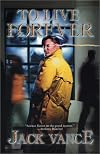
To Live Forever
by Jack Vance
There is 1 current discussion about this work.
On This Page
Description
Waylock had been granted eternal life-but now he was killing on borrowed time. Gavin Waylock had waited seven years for the scandal surrounding his former immortal self to be forgotten and had kept his identity concealed so that he could once again join the ranks of those who lived forever. He had been exceedingly careful about hiding his past. Then he met the Jacynth. She was a beautiful nineteen-year-old, and Gavin wanted her. But he recognized that a wisdom far beyond her years marked her show more as one who knew too much about him to live. As far as she was concerned, death was a mere inconvenience. But once the Jacynth came back, Gavin Waylock's life would be an everlasting hell. show lessTags
Recommendations

















Member Reviews
Jack Vance is known for the inventive settings he places his stories in: Dying Earth, the Alastor novels, Planet of Adventure, and of course the Magnus Ridolph stories each contain throwaway societies and cultures that a less imaginitive writer might base an entire career on.
To Live Forever has a unique setting, to be sure, but like Emphyrio it is more of a thought experiment, and the society in which the action takes place is an integral part of the plot. What is more interesting is the many themes Vance covers in this brief novel: overpopulation, elitism, ambition, justifiable homicide, overwork, deviants and dropouts, the court of public opinion ... the list could go on and on.
The moral ambiguity of the protagonist keeps things show more interesting. As events progress, The Monster, as he is called, turns out to be no more amoral or violent than his peers: he is simply more effective, having, as he puts it, a "ruthlessness beyond your understanding". show less
To Live Forever has a unique setting, to be sure, but like Emphyrio it is more of a thought experiment, and the society in which the action takes place is an integral part of the plot. What is more interesting is the many themes Vance covers in this brief novel: overpopulation, elitism, ambition, justifiable homicide, overwork, deviants and dropouts, the court of public opinion ... the list could go on and on.
The moral ambiguity of the protagonist keeps things show more interesting. As events progress, The Monster, as he is called, turns out to be no more amoral or violent than his peers: he is simply more effective, having, as he puts it, a "ruthlessness beyond your understanding". show less
This is the first Vance novel I have read. It is definitely old-school science fiction, almost pulp-ish, with a many-twisted plot that is sometimes hard to follow and some thinly drawn characters (particularly the women). But I appreciated Vance’s big ideas about the lure of immortality and the lengths people will go to achieve it.
ORIGINALLY POSTED AT Fantasy Literature.
In Clarges, a city in the far future, humans have conquered death. Unfortunately, there's just not enough room for billions of immortal people to live forever, so they've passed the fair-play act which divides society into 5 phyle which must be maintained at certain population ratios. Those who choose to participate in fair-play must register in Brood, the lowest phyle, and receive 82 years of life, after which an "assassin" visits and takes them away in a black hearse. By significantly contributing to society, citizens may move up through the phyle, adding several years of life with each step. A very select few will reach Amaranth and may have their bodies genetically modified (with 5 copies show more made, in case of accidents), making them youthful forever. This social climbing causes a lot of anxiety for the people of Clarges, so their mental hospital is full of people who've gone "catto" (alternating periods of catatonia and mania).
Gavin Waylock has been in hiding for seven years, but now he's ready to return to the immortal society that shunned him. He's back at the bottom and must use all of his wits to work his way up to the place he knows he deserves. Things would be a lot easier, though, if he hadn't just met The Jacynth Martin, because she's determined to keep him out of Amaranth.
One thing I love about Jack Vance is that he writes about things that fascinate me. As Gavin is trying to figure out how he can contribute something creative and meaningful to society, and thereby push himself ahead of everyone else, he tackles the field of psychology. I found it great fun to read Vance's ideas about the future of my field.
To Live Forever was written in 1956, at a time when "insane asylums" in the United States were full. Vance must have thought this to be a hopeless situation because while his characters are zipping around in aircars and have plenty of other cool future technologies, one of their psychotherapists tells Gavin that their hospital is full, and psychology is the only science that isn't progressing, because it's impossible to see inside the human brain.
I'm not surprised that Vance didn't foresee brain imaging techniques (though he actually uses a similar technology in this novel!), but it's amusing that it was only a few years later that asylums in developed countries were nearly emptied after antipsychotic, antidepressant, and anti-anxiety drugs became common. It's also amusing that, for fun, citizens of Clarges use different types of "stimmo" pills, some of which are basically antidepressant or anti-anxiety drugs. Hmmm… I wonder if they thought to try those on the cattos...
Though Mr. Vance's vision didn't seem to foresee much beyond Freud and Jung, at the same time one of his characters comes up with an idea to treat catatonic-mania that is stunningly brilliant and something very much like what is only now being tested as a treatment for post-traumatic stress disorder! Wow!
You don’t have to be a psychologist to love To Live Forever. This is a fun, fast-paced, and clever science fiction novel, but it isn't at all "gadgetty," so it will probably appeal even to those who think they don't like scifi. It's also, as is common for Jack Vance, part humorously scathing social commentary.
www.fantasyliterature.com show less
In Clarges, a city in the far future, humans have conquered death. Unfortunately, there's just not enough room for billions of immortal people to live forever, so they've passed the fair-play act which divides society into 5 phyle which must be maintained at certain population ratios. Those who choose to participate in fair-play must register in Brood, the lowest phyle, and receive 82 years of life, after which an "assassin" visits and takes them away in a black hearse. By significantly contributing to society, citizens may move up through the phyle, adding several years of life with each step. A very select few will reach Amaranth and may have their bodies genetically modified (with 5 copies show more made, in case of accidents), making them youthful forever. This social climbing causes a lot of anxiety for the people of Clarges, so their mental hospital is full of people who've gone "catto" (alternating periods of catatonia and mania).
Gavin Waylock has been in hiding for seven years, but now he's ready to return to the immortal society that shunned him. He's back at the bottom and must use all of his wits to work his way up to the place he knows he deserves. Things would be a lot easier, though, if he hadn't just met The Jacynth Martin, because she's determined to keep him out of Amaranth.
One thing I love about Jack Vance is that he writes about things that fascinate me. As Gavin is trying to figure out how he can contribute something creative and meaningful to society, and thereby push himself ahead of everyone else, he tackles the field of psychology. I found it great fun to read Vance's ideas about the future of my field.
To Live Forever was written in 1956, at a time when "insane asylums" in the United States were full. Vance must have thought this to be a hopeless situation because while his characters are zipping around in aircars and have plenty of other cool future technologies, one of their psychotherapists tells Gavin that their hospital is full, and psychology is the only science that isn't progressing, because it's impossible to see inside the human brain.
I'm not surprised that Vance didn't foresee brain imaging techniques (though he actually uses a similar technology in this novel!), but it's amusing that it was only a few years later that asylums in developed countries were nearly emptied after antipsychotic, antidepressant, and anti-anxiety drugs became common. It's also amusing that, for fun, citizens of Clarges use different types of "stimmo" pills, some of which are basically antidepressant or anti-anxiety drugs. Hmmm… I wonder if they thought to try those on the cattos...
Though Mr. Vance's vision didn't seem to foresee much beyond Freud and Jung, at the same time one of his characters comes up with an idea to treat catatonic-mania that is stunningly brilliant and something very much like what is only now being tested as a treatment for post-traumatic stress disorder! Wow!
You don’t have to be a psychologist to love To Live Forever. This is a fun, fast-paced, and clever science fiction novel, but it isn't at all "gadgetty," so it will probably appeal even to those who think they don't like scifi. It's also, as is common for Jack Vance, part humorously scathing social commentary.
www.fantasyliterature.com show less
Halfway though this book, I wasn't sure what to think. The main character was a nice enough guy, but also a murderous, conniving opportunist. And he's the main POV character, so it was difficult to feel much involvement in the story, because I really thought he deserved to die. It became much more enjoyable once I realized that the story wasn't about him; rather, it's a story about the downfall of a society that rations out immortality to its citizens, with the protagonist as the catalyst, not the hero. (And it's absolutely not a love story, contrary to the blurb on the back; whoever wrote that bit obviously didn't read past the first chapter.) Vance's prose here isn't anything special, and the technology is amusingly out-of-date (being show more a book of the far future written in 1956), and though I was never bored, the story never really engaged me either. 3 out of 5 stars, but juuuust barely. show less
This is a pretty good sci-fi story from a 1940s-1950s master of sci fi. There are some really interesting themes and questions but the characters and plot weren't the best.
Vance describes a meritocratic world, where life extension is available only to those who measure up in contributing to society. There are 5 tiers, and progression extends life -- 10 years for routine "good behavior", all the way to essentially godhood for extreme achievement.
Three interesting consequences are described. First, that overall society works well due to concrete motivation for achievement. The scoring for achievement is explicit and conducted by a powerful computer, and the consequences of failing to measure up are a visit from broadly-socially-accepted show more assassins. Second, that this pressure to achieve leads to some percentage of the population becoming neurotic. Third, the complexity of succession when cloning and other forms of identity-linking are possible, specifically how the artificial scarcity of top-tier immortal status is allocated. show less
Vance describes a meritocratic world, where life extension is available only to those who measure up in contributing to society. There are 5 tiers, and progression extends life -- 10 years for routine "good behavior", all the way to essentially godhood for extreme achievement.
Three interesting consequences are described. First, that overall society works well due to concrete motivation for achievement. The scoring for achievement is explicit and conducted by a powerful computer, and the consequences of failing to measure up are a visit from broadly-socially-accepted show more assassins. Second, that this pressure to achieve leads to some percentage of the population becoming neurotic. Third, the complexity of succession when cloning and other forms of identity-linking are possible, specifically how the artificial scarcity of top-tier immortal status is allocated. show less
From what I've read, this is his third novel out, after two YA novels about space pirates. Starts out great, tries to do too much, runs into a little trouble in the third act, but manages to finish off okay.
Gavin Waylock at times almost seems like a serious version of Cugel: getting himself into a jam, using whatever resources he has on hand to get himself out of it, doing a lot collateral damage in the process, and not caring so much.
The immortal society that is the setting for this novel is interesting, but ultimately, it's a china shop at the destructive disposal of the rogue protagonist. Waylock's ability to move around from career position to career position like J Pierpont Finch, is a little unacceptable considering how show more difficult upward advancement is supposed to be in this society. That gives the proceedings a pulpish, or cartoonish feel. Equally irritating, Vance bothers to create in Jaycynth Martin, a potentially interesting female character, but then finds more use for her as a two dimensional harpy.
Not an essential Vance read. Despite that, it's fun enough, and fans will enjoy it. show less
Gavin Waylock at times almost seems like a serious version of Cugel: getting himself into a jam, using whatever resources he has on hand to get himself out of it, doing a lot collateral damage in the process, and not caring so much.
The immortal society that is the setting for this novel is interesting, but ultimately, it's a china shop at the destructive disposal of the rogue protagonist. Waylock's ability to move around from career position to career position like J Pierpont Finch, is a little unacceptable considering how show more difficult upward advancement is supposed to be in this society. That gives the proceedings a pulpish, or cartoonish feel. Equally irritating, Vance bothers to create in Jaycynth Martin, a potentially interesting female character, but then finds more use for her as a two dimensional harpy.
Not an essential Vance read. Despite that, it's fun enough, and fans will enjoy it. show less
Wikipedia quotes Floyd C. Gale as saying "frighteningly logical...[t]he sick, inbred society of Vance's imagination comes fully alive, even though his characters remain mere symbols."
I really can't say it better than that. Where most Vance work is focused on atmosphere, attitude, and of course punctilio, Clarges (previously and better titled To Live Forever), is unusual in being a fairly direct exploration of a concept. The Clarges society is tightly restricted in space, and the bulk of the population work toward the goal of eternal life. The book imagines the effect and logical outcome of such a society. While Vancian characters are here, they're fairly low-key, and much less aloof than normal. The book is short, but effective. show more
Overall, recommended as an introduction to the Vance voice, or just as a good social SF thought experiment (that's also a good read).
CVIE vol IV
PS Why was this not retitled The Graven Waylock? show less
I really can't say it better than that. Where most Vance work is focused on atmosphere, attitude, and of course punctilio, Clarges (previously and better titled To Live Forever), is unusual in being a fairly direct exploration of a concept. The Clarges society is tightly restricted in space, and the bulk of the population work toward the goal of eternal life. The book imagines the effect and logical outcome of such a society. While Vancian characters are here, they're fairly low-key, and much less aloof than normal. The book is short, but effective. show more
Overall, recommended as an introduction to the Vance voice, or just as a good social SF thought experiment (that's also a good read).
CVIE vol IV
PS Why was this not retitled The Graven Waylock? show less
Members
- Recently Added By
Lists

Best Science Fiction Novels
816 works; 430 members

Stories of Immortality and Reincarnation
17 works; 5 members

1950s
340 works; 22 members

Books Read in 2010
631 works; 11 members

Books With Time Words in the Title
160 works; 4 members

Books Read in 2022
5,164 works; 113 members
Talk Discussions
Current Discussions
Big Boy in Good Show Sir! — bad science fiction and fantasy covers (March 21)
Author Information

373+ Works 34,750 Members
John Holbrook Vance (August 28, 1916 - May 26, 2013) was an American mystery, fantasy and science fiction writer. Most of his work was published under the name Jack Vance. He also wrote 11 mystery novels as John Holbrook Vance and three as Ellery Queen, and once each used pseudonyms Alan Wade, Peter Held, John van See, and Jay Kavanse. Vance won show more the World Fantasy Award for Life Achievement in 1984. The Science Fiction Hall of Fame inducted him in 2001. Among his awards for particular works were: Hugo Awards, in 1963 for The Dragon Masters, in 1967 for The Last Castle, and in 2010 for his memoir This is Me, Jack Vance!; a Nebula Award in 1966, also for The Last Castle; the Jupiter Award in 1975; the World Fantasy Award in 1990 for Lyonesse: Madouc. He also won an Edgar (the mystery equivalent of the Nebula) for the best first mystery novel in 1961 for The Man in the Cage. He died at his home in Oakland, California, on May 26, 2013, aged 96. (Bowker Author Biography) show less
Some Editions
Series
Belongs to Publisher Series
Moewig Science Fiction (3609)
Work Relationships
Common Knowledge
- Canonical title
- To Live Forever
- Original title
- To Live Forever
- Alternate titles*
- Start ins Unendliche
- Original publication date
- 1956
- People/Characters
- Gavin Waylock (a murdering "Monster"); Jacynth Martin (a victim); Basil Thinkoup; Seth Caddigan; Pladge Caddigan; Reinhold Biebursson (show all 17); Jacob Nile; Vincent Rodenave; The Anastasia de Fancourt; Claude Imish; The Abel Mandeville; Rolf Amersham; Carleon; Caspar Jarvis; Rubel; The Roland Zygmont; The Olaf Maybow
- Important places
- Clarges (a closed and controlled community); Carnevalle (the fun place to be)
- First words
- Clarges, the last metropolis of the world, stretched thirty miles along the north shore of the Chant River, not far above the broadening of the Chant into its estuary.
- Last words
- (Click to show. Warning: May contain spoilers.)The blue fire became a bright star, then dimmed and was gone.
- Blurbers*
- Boucher, Anthony
- Original language*
- Englisch
*Some information comes from Common Knowledge in other languages. Click "Edit" for more information.
Classifications
Statistics
- Members
- 553
- Popularity
- 53,293
- Reviews
- 14
- Rating
- (3.70)
- Languages
- 6 — Dutch, English, French, German, Italian, Russian
- Media
- Paper, Audiobook, Ebook
- ISBNs
- 29
- ASINs
- 18