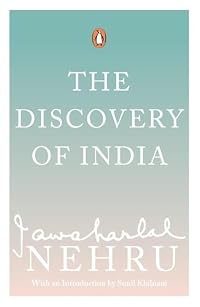
The Discovery of India
by Jawaharlal Nehru
On This Page
Description
In conjunction with the Jawaharlal Nehru Memorial Fund in New Delhi, Oxford proudly announces the reissue of Glimpses of World History and The Discovery of India, two famous works by Jawaharlal Nehru. One of modern day's most articulate statesmen, Jawaharlal Nehru wrote a on a wide variety of subjects. Describing himself as "a dabbler in many things," he committed his life not only to politics but also to nature and wild life, drama, poetry, history, and science, as well as many other show more fields. These two volumes help to illuminate the depth of his interests and knowledge and the skill and elegance with which he treated the written word. show lessTags
Recommendations









Member Reviews
If you're Indian and can read English, you should definitely read this book (or a translation)! But why this ancient tome now? Aren't there newer history books with topics and narratives that match our interests? The book's selling point used to be that its author is Jawaharlal Nehru. But what appeal does that have today, given that the past eighty years have rubbed some shine off his name?
For me at least, the book stood this test of time and even felt relevant for today. Nehru’s “history” spans the Indus Valley Civilization to the Quit India movement, and is fun and engrossing enough to be read for its own sake. You will find him writing memorably about Sanskrit dramas and comparing them to Greek tragedies, about mathematics in show more ancient India, the Upanishads, Mahabharata, the Gita, Yoga, Indian philosophical ideas (Satt Darshanas), multiple dives into Buddhism and some exquisite exposition on it, the many invasions in ancient times, India's caste system, the expansion of Indian kingdoms into South East Asia, the Guptas, Chanakya's ideas, Adi Shankara, connections between India and Iran/Persia, the spread of Islam between the 7th and 12th Century AD, Akbar's claim to fame, Amir Khusrau's popularity, descriptions of Nalanda University, India-China connections, how different cities and communities reacted to British rule, and much else.
But it’s also not “learning a mass of facts and dates and drawing conclusions and inferences from them, unrelated to my life's course". Nehru pauses to reflect on what these facts imply, what could have been, why it was so, and so on. In theory, anyone can attempt such a book. But the depth and staying power of this one could have only come from the historic life-experiences of its author. Consider this: "There is, in the Upanishads, a continual emphasis on the fitness of the body and clarity of mind, on the discipline of both body and mind, before effective progress can be made. The acquisition of knowledge, or any achievement, requires restraint, self-suffering, self-sacrifice. This idea of some kind of penance, tapasya, is inherent in Indian thought, both among the thinkers at the top and the unread masses below. It is present today as it was present some thousands of years ago, and it is necessary to appreciate it in order to understand the psychology underlying the mass movements which have convulsed India under Gandhiji’s leadership". You can dismiss that as romanticization of some cherry-picked text. But you could also look at it as an honest effort by someone to examine a slice of India through their own intellect and experience - and I believe the bulk of this book will lead you to the latter viewpoint.
As a basic qualification, Nehru was well read in history and had done some amount of history writing. But more crucially, by this time he had spent around thirty years in intense political action and thought. He had worked closely with people of the calibre of Gandhi, Patel and Rajagopalachari. He had front row seats or an active role in major political events. Thanks to his teenage and student years at Harrow and Cambridge, he is well versed in European ideas and culture. When he explains Indian philosophy he is taking help from Sarvepalli Radhakrishnan, and his prison mate is the highly educated Abul Kalam Azad who knew Islamic history like few others!
Thus this book takes all his theoretical knowledge and world-historic life experiences, and tries to figure out logical links in a long chain of events with an eye on the future: "The roots of that present lay in the past and so I made voyages of discovery into the past, ever seeking a clue in it, if any such existed, to the understanding of the present". It raises and tries to answer big questions: What are the foundations of Indian social life? What kind of unity can be seen across this large and old country? How could the caste system have started? Did ancient India have democratic practices? How does one approach "Hinduism"? How was British rule qualitatively different from earlier foreign rulers? Was India falling behind even in the medieval era? What are “The Two Englands”? However, beware (or rejoice?) that half the book is about British rule and its aftermath.
Nehru is not an academic historian or columnist who is paid to write, and far from a full time propagandist who twists history to confound. He is primarily a political activist who has an irrepressible urge to communicate. Due to this the book is shot through with a rare, vivid earnestness. "For only they can sense life who stand often on the verge of it, only they whose lives are not governed by the fear of death". He does not hang his hat on any one ideology or way of understanding history. “Life is too complicated and, as far as we can understand it in our present state of knowledge, too illogical, for it to be confined within the four corners of a fixed doctrine”. And, "... within these limitations, the general Marxist approach, fitting in as it more or less does with the present state of scientific knowledge, seemed to me to offer considerable help". He is not blind to historical inequities although they don't exhaust his version of India: "India’s success and achievements were on the whole confined to the upper classes; those lower down in the scale had very few chances and their opportunities were strictly limited".
Generally speaking, he doesn’t view history along sectarian lines and urges the same outlook from the reader: "What is my inheritance? To what am I an heir? To all that humanity has achieved during tens of thousands of years, to all that it has thought and felt and suffered and taken pleasure in, to its cries of triumph and its bitter agony of defeat, to that astonishing adventure of man …". Thanks to this outlook and Nehru’s keen perception, this book can transcend barriers and serve as a long and wonderful account of humanity and the human condition itself. His own contribution towards what he yearns for here: "it seems more essential than ever that a synthetic view of human life and man's adventure through the ages should be encouraged. This view will have to take into consideration the past and the present, and include in its scope all countries and peoples".
On the whole, it is still worth seeing through Nehru's own words what the long past of a country like India meant to people like him. You will feel also the intensity of his desire for India's freedom and unity, the scale of his ambition for modernisation, industrialization and economic progress, and his impatience with communal politics, feudal landlords or anything else that stood in the way of all that. Today's "Congress" is not a patch on the movement that spearheaded India's freedom struggle, despite keeping the name and (due to?) having his descendants in it. ".. able, earnest, and courageous persons were drawn into the Congress", he writes at one place. Not to forget his famous intro to Gandhi which has this bit: "The essence of his teaching was fearlessness and truth, and action allied to these, always keeping the welfare of the masses in view". More tragic are the efforts to tarnish the image of a Nehru or a Gandhi, because the common sense, integrity and drive of leaders from that era are exactly what’s missing in India's public life.
Towards the end of this book is pretty much a manifesto for the soon-to-be independent nation, where Nehru outlines his expectations from both the new State and (enlightened?) citizenry. And these suggestions tie back quite nicely to the history of India that you just read! If today we can sit back and choose from a wide variety of books about the splendours (and horrors) of this country, we owe that to people like Nehru who worked hard to set the stage.
An analytical tone
However great the temptation, Nehru sticks for the most part to a modern, analytical approach - whether he is discussing the Vedas, Adi Shankara, the Buddha, Akbar or Jinnah. The book neither glorifies India nor is despondent about it. From a great section titled "Mathematics in Ancient India": "We must assume then that these momentous inventions were not just due to the momentary illumination of an erratic genius, much in advance of his time, but that they were essentially the product of the social milieu and that they answered some insistent demand of the times. Genius of a high order was certainly necessary to find this out and fulfil the demand, but if the demand had not been there the urge to find some way out would have been absent, and even if the invention had been made it would have been forgotten…”.
And: ".. Shankara was a man of amazing energy and vast activity. He was no escapist retiring into his shell or into a corner of the forest, seeking his own individual perfection and oblivious of what happened to others. Born in Malabar in the far south of India, he travelled incessantly all over India, meeting innumerable people, arguing, debating, reasoning, convincing, and filling them with a part of his own passion and tremendous vitality. He was evidently a man who was intensely conscious of his mission, a man who looked upon the whole of India from Cape Comorin to the Himalayas as his field of action and as something that held together culturally and was infused by the same spirit".
It's safe to say that there's no political nuance that escapes his attention, no big social trend that doesn't merit some remark, and no paradigm shift he is not capable of conceptualizing. For example, "The idea of progress is modern and relatively new even in the west; the ancient and medieval civilizations thought far more in terms of a golden past and of subsequent decay. In India also the past has always been glorified. The civilization that was built up here was essentially based on stability and security, and from this point of view it was far more successful than any that arose in the west. The social structure, based on the caste system and joint families, served this purpose and was successful in providing social security for the group and a kind of insurance for the individual… "
He cites the newest scholarly works, many of them from European authors who wouldn't likely be partial to India. He has no qualms diving into primary sources/translations (Chanakya, Megasthenes, Hiuen Tsang, Alberuni etc) but prefers to skip commentaries ("Nor was I interested in long commentaries and glossaries"). And luckily for us emerges repeatedly with brilliant summaries and observations.
The book is remarkably consistent over hundreds of pages as far as the basic problems underlying India and the shape of solutions are concerned. This again points to decades of contemplation, not rote learning done for press meets and TV debates. There are passages that stay with you long after you've read them: "In the constructive schemes that we may make, we have to pay attention to the human material we have to deal with, to the background of its thought and urges, and to the environment in which we have to function. To ignore all this and to fashion some idealistic scheme in the air, or merely to think in terms of imitating what others have done elsewhere would be folly". Or, "Whether we are conscious of it or not most of us worship at the invisible altar of some unknown god and offer sacrifices to it - some ideal, personal, national or international; some distant objective that draws us on, though reason itself may find little substance in it".
Curiosity and joy
A sense of curiosity, wonder and joy prevail for large chunks of the book. The history starts with the Indus Valley civilization, which was relatively recent knowledge when he was writing in 1944. That section ends with a quintessentially Nehruvian observation: "... creating not only things of beauty, but also the utilitarian and more typical emblems of modern civilization - good baths and drainage systems"! This is followed by descriptions of the Aryans and the Vedas. There are caveats about how hard it is to arrive at a definition for Hinduism, and the fact that even the word "Hindu" does not find a mention in ancient texts (for obvious reasons, since it's a corruption of the word "Sindhu").
As he is picking out his favourite verses from the Vedas and pondering over their meaning, we get pulled deeper into his mode of exploration. If the Vedas are full of the "spirit of inquiry" at the world, how can you not apply that mode to the scriptures themselves? What is of permanent value in them? What was temporary? How do you see them now in the light of Buddhism and many later developments that followed? What could be the temptation for someone in Nehru's particular predicament: "A country under foreign domination seeks escape from the present in dreams of a vanished age, and finds consolation in visions of past greatness. That is a foolish and dangerous pastime ...".
At one point he writes, "I have digressed and made a sudden jump to modern times, and must go back to the medieval period after the Afghans had established themselves in Delhi". Except that a few pages later we are treated to a top notch set of essays about the foundations of Indian social life. In his opinion they are: the joint family, caste and village self-government. And that, "All the three pillars of the Indian social structure were thus based on the group and not on the individual." After this wonderful digression, he again chides himself with, "To go back. The Afghans had settled down in India …"! Such reflections are present throughout. Somewhere in the beginning he admits that, "my reaction to India thus was often an emotional one, conditioned and limited in many ways. It took the form of nationalism".
What I wasn't expecting was a grudging admiration for political expansion! He doesn't find political fights and conquest deplorabe per se. He writes in detail and in praise of "colonization" by South Indian kings stretching into what are today Indonesia, Malaysia, Thailand, Cambodia. Similarly, he notes that Arabian political influence ("this triumphant career of a people") was expanding even before Prophet Mohammed, but still "the Prophet of Islam vitalized his people and filled them with faith and enthusiasm". He finds striking "the intellectual curiosity, the adventures in rationalist speculation, the spirit of scientific inquiry among the Arabs of the eighth and ninth centuries". This history of Islam during the many centuries before it entered India as a political force (traversing Syria, Northern Africa, Iraq and Persia) is refreshingly non-polemical and makes an apt preface to his later analysis of the Afghan and Turkish/Turanian kings who were the ones to actually embed the religion in (North) India. Of the latter lot he is far less appreciative: "It was nearly 600 years before it reached the heart of India and when it came to the accompaniment of political conquest, it had already changed much and its standard-bearers were different". I thought that these bits and in general his admiration for ancient and medieval kings who ruled vast swathes, betrayed his own political ambition and inspirations! He makes a clear distinction between these "foreign" kings and the colonial British rule (more on that further below).
As he gradually turns serious about recent events, you realize that the first half of this book turns out to be like those moments in the morning where you’re admiring the scenery from your balcony with coffee in hand, before the real work of the day begins!
Anarchy and the quest for unity
In any country, and especially in a huge country like India with its complicated history and mixed culture, it is always possible to find facts and trends to justify a particular thesis, and then this becomes the accepted basis for a new argument. That previous sentence isn't by me! It is from a para deep inside the book where Nehru is about to explain the decline of India under British rule. Evidently, Nehru knew history and the narrative potential of history writing quite well, So what could be his thesis and the facts and trends he marshals?
I'd call out "unity" (of India) as the predominant theme. A simple search for "unity" in the book yields nearly hundred occurrences. To foreign observers this book might have come across as a response to British claims that India is not even a "country". But Nehru's initial tepidity that he's approaching India just like a "friendly Westerner" is soon forgotten. Be it the Indus Valley civilization, the Vedic era, Guptas, the South Indian kingdoms, or medieval Mughals, Rajputs etc, he looks for common themes and feels a sense of kinship. "Some kind of a dream of unity has occupied the mind of India since the dawn of civilization", "the mass of the Indian people, in their infinite diversity and yet their amazing unity", "the unity of India was no longer merely an intellectual conception for me: it was an emotional experience which overpowered me. That essential unity had been so powerful that no political division, no disaster or catastrophe, had been able to overcome it”. Towards the end ("The Importance of the National Idea"), he identifies one specific pattern in India's "unity" across time: "Sometimes the new, though very different, appears in terms of pre-existing patterns, and thus creates a feeling of a continuous development from the past", and, "... Because of this there is no sense of cultural break in it and there is that continuity, in spite of repeated change, from the far distinct days of Mohenjo Daro to our own age".
The motivation behind this quest for unity isn't hard to find. Because just before this, in a long chapter about the 18th Century, he describes how India fell to the British, piece by piece. The antics of Aurangzeb led to the decline of the Mughal empire and multiple political rivalries were ongoing. The Marathas were a major force and so was Tipu Sultan. There was Ranjit Singh in Punjab and the remnants of the Mughal empire in UP-Bihar-Bengal. The French were not a negligible power. But over the course of 60-70 years of political upheavals, the British East India Company ended up defeating or subjugating all the rest. This long period of anarchy and the lack of political unity as a "nation" was to set India back disastrously (recently this period was investigated by William Dalrymple's "The Anarchy" - my review: https://www.goodreads.com/review/show/3845802514). Nehru replays in fairly honest and painful detail those events, and analyzes why the British reigned supreme. What could have been their military, economic and social advantages? Was it India alone that was subjugated thus? I found this to be one of the high points of the book. Later, a last attempt in 1857 is also squashed (Nehru's own grandfather fled from Delhi to Agra after this). The British started by taking sides, ended up as rulers, and then kept playing different groups of Indians against each other for nearly a hundred more years. Thereby stems Nehru's determination to put to rest once and for all Indians' tendency to fight each other giving foreigners a chance to get a foothold.
Colonization and racism
During his analysis of medieval India he's noticing how India is already starting to fall behind the West. In a great section titled "The Contrast between Asia and Europe in Mechanical Advance and Creative Energy", he looks at what developments were not happening in India vis-a-vis the West. The Mughals did not invest in a navy, did not develop inhouse military expertise and did not take to the technology of the printing press. "This lack of mechanical bent is remarkable, especially as there were very fine craftsmen and artisans in India". Nehru concludes there is a "paralysis of creative energy and inventive faculty". Whether this withstands scholarly scrutiny I do not know, but is at least a good example of his style of thinking and what deficits he saw in India. From much earlier in the book, "[India] fell behind in the march of technique, and Europe, which had long been backward in many matters, took the lead in technical progress. Behind this technical progress was the spirit of science and a bubbing life and spirit which displayed itself in many activities and in adventurous voyages of discovery. New techniques gave military strength to the countries of western Europe, and it was easy for them to spread out and dominate the East. That is the story not only of India, but of almost the whole of Asia". These cumulative advantages of centuries allowed the British to triumph militarily, as he reiterates again in the section, "The Backwardness of India and the Superiority of the English in Organization and Technique".
How was British rule different from the earlier foreigners like the Afghans or Turks and how damaging was it? This is among the most searing parts of the book, and of course the raison d'etre of India's freedom struggle. The section titles tell the tale: "The Plunder of Bengal Helps the Industrial Revolution in England", "The Destruction of India’s Industry and the Decay of Her Agriculture", "India Becomes for the First Time a Political and Economic Appendage of Another Country", "The Great Revolt of 1857. Racialism". He notes that, "those parts of India which have been longest under British rule are the poorest today. Indeed some kind of chart might be drawn up to indicate the close connection between length of British rule and progressive growth of poverty". And, "Nearly all our major problems today have grown up during British rule and as a direct result of British policy: the princes; the minority problem; various vested interests, foreign and Indian; the lack of industry and the neglect of agriculture; the extreme backwardness in the social services; and, above all, the tragic poverty of the people". Of course no political leader back then could have missed the racist undertones of Empire: "Imperialism and the domination of one people over another is bad, and so is racialism. But imperialism plus racialism can only lead to horror and ultimately to the degradation of all concerned with them".
These latter parts of the book are heavy on political theory and ideological musings. Since his previous book ("An Autobiography" - my review: https://www.librarything.com/work/10659683/reviews/261410392) recounts in detail the events of the first three decades of the 20th Century (mainly the Gandhian activities but also briefly the revolutionary attempts, the expansion of Congress and all the sparring with the British), Nehru revisits them only in terms of their theoretical background, consequences and broad trends. Detailed treatment is reserved for newer developments like the rise of the Muslim League, the Cripps Mission and the Quit India movement. There is a fascinating section ("The Question of Minorities") about the stalemate with the Muslim League and his opinion of Mohammed Ali Jinnah.
The British were keen on propping up the Muslim League, and as per Nehru, the League used "nazi methods of propaganda" to paint the Congress as anti-Muslim (somewhat similar to today’s horrible Whatsapp forwards and industrialist-controlled TV channels)! He wonders if Jinnah intentionally wants things to not change and keep drifting, due to personal limitations: "If conditions were different and he had to face real problems, political and economic, it is difficult to say how far his ability would carry him. Perhaps he is himself doubtful of this, although he has no small opinion of himself. This may be an explanation for that subconscious urge in him against change, to keep things going as they are … ".
The politics of solutions
It is not for whining about British rule that Nehru is famous. Many of the concrete steps the Congress took were based on sound reasoning, and so was their analysis of what kept the British regime going. His "The Techniques of British Rule: Balance and Counterpoise" goes into how the British played different social and economic factions against each other. The princes and landlords were co-opted into British rule. Farmers and landlords were kept opposed to each other, and so were people of different castes and religions. Educated Indians entering government service were also beholden to them. Given that Indian nationalism was still a nascent thing, it's not hard to imagine you could seed doubts about the intentions of other Indians in distant regions.
But such a political structure is not without weaknesses. Nehru notes the "inherent contradiction" in British rule: "Having brought about the political unification of the country and thus let loose new dynamic forces which thought not only in terms of that unity, but aimed at the freedom of India, the British Government tried to disrupt that very unity it had helped to create". By day the British sought to impose their uniform footprint all over the country and exploit it efficiently through railways and telecommunication, by night they would turn around and thwart Indians from unifying, proclaiming there is no country here! In an earlier section ("Contradictions of British Rule in India"), Nehru notes how sharply this last phase differed from the 18th Century, when the British had arrived as a dynamic force that upstaged a staid India: "The British became dominant in India, and the foremost power in the world, because they were the heralds of the new big-machine industrial civilization. They represented a new historic force which was going to change the world, and were thus, unknown to themselves, the forerunners and representatives of change and revolution; and yet they deliberately tried to prevent change, except in so far as this was necessary to consolidate their position and help them in exploiting the country and its people". And somewhere later, "The very thing India lacked, the modern West possessed, and possessed to excess. It had the dynamic outlook… It was active, aggressive, acquisitive, seeking power and domination, living in the present and ignoring the future consequences of its actions". As time went by the quality of the British ruling class had degraded: "The most obvious fact is the sterility of British rule in India and the thwarting of Indian life by it. Alien rule is inevitably cut off from the creative energies of the people it dominates".
In contrast to sterile British rule stood the open, dynamic and truth-based activities of the Congress. From "The Congress becomes a dynamic organization": "Realizing that the main props of British rule were fear, prestige, the co-operation, willing or unwilling, of the people, and certain classes whose vested interests were centred in British rule, Gandhi attacked these foundations". The down-to-earth nature of Congress leaders made the pomp and pageantry of the British officials and princes look embarrassing, and their oppression more stark. They embraced and modelled the future: "The Congress organization is certainly one of the most democratic organizations that I know of anywhere in the world, both in theory and practice. Through its tens of thousands of local committees spread out all over the country, it had trained the people in democratic ways and achieved striking success in this". "Every reform that he [Gandhi] suggests, every advice that he gives to others, he straightaway applies to himself. He is always beginning with himself and his words and actions fit into each other like a glove on the hand".
The ruling classes shrank from the masses, the Congress plunged into them. "[Gandhi] sent us to the villages, and the countryside hummed with the activity of innumerable messengers of the new gospel of action", "We learnt our Indian economics more from these visits than from books and learned discourses", "... the peasants rolled in and, in its new garb, it [Congress] began to assume the look of a vast agrarian organization with a strong sprinkling of the middle classes". They came up with "constructive" programs even though they were not in power: "... organizing and developing cottage industries, in raising the depressed classes, and later in the spread of basic education".
The goal was a psychological transformation of the masses: "our main purpose was to raise the whole level of the Indian people, psychologically and spiritually and also, of course, politically and economically. It was the building up of that real inner strength of the people that we were after, knowing that the rest would inevitably follow. We had to wipe out some generations of shameful subservience and timid submission to an arrogant alien authority".
Independence and democracy became linked in people's minds to the eradication of poverty and improved standards of living. From "The National Planning Committee": "we could not consider any problem, much less plan, without some definite aim and social objective. That aim was declared to be to ensure an adequate standard of living for the masses, in other words, to get rid of the appalling poverty of the people". If everyone were given the right to vote, in no sensible world would the masses choose the colonizers and their cabal of princes and landlords: "election evils most prevalent where the electorate was small", "I was prepared to trust that wide electorate far more than a restricted one, based on a property qualification or even an educational test".
Sporadic observations on caste
Caste doesn't feature much in this book, although it is listed among the "principal planks" of the Congress. He postulates some theories when discussing the Aryans ("Synthesis and Adjustment. The Beginnings of the Caste System"). But the most detailed treatment is probably in the section "The Theory and Practice of Caste". There he acknowledges that "the ultimate weaknesses and failing of the caste system and the Indian social structure were that they degraded a mass of human beings and gave them no opportunities to get out of that condition". And much earlier ("Buddha and Mahavira: Caste"): "slowly, imperceptibly, … caste has grown and spread and seized every aspect of Indian life in its strangling grip".
Still, he problematizes it narrowly and tries to evaluate it against conditions prevailing in India and worldwide: "The organization of society being, generally speaking, noncompetitive and non-acquisitive, these divisions into castes did not make as much difference as they might otherwise have done". And a little later, "The contrasts between this social structure and those existing elsewhere in the past were not great, but with the changes that have taken place all over the world during the past few generations they have become far more pronounced. In the context of society today, the caste system and much that goes with it are wholly incompatible, reactionary, restrictive, and barriers to progress". He sees caste as one pillar of the group-ish nature of Indian society, in "The Indian Social Structure. Importance of the Group".
Throughout the book he comments on one oddity: In India there was enormous freedom of thought for individuals and all types of new philosophies were proposed, but the social structure stayed rigid and bounded by caste! He doesn't quite cross over into cynicism and suggest that the former always worked to perpetuate the latter.
Capitalism and socialism
Nehru's socialist leaning shows itself only at the end. As mentioned earlier, for much of the book he praises exploration, adventure, trade and so on. In the long arc of history, he probably sees modern capitalism as just one more enabler of a basic human instinct? He is of course against colonial extraction and the impoverishment of people. He doesn't even see the profit motive as having a big role in Indians' lives. From "The Importance of the National Idea. Changes Necessary in India": "It would be absurd to say that the profit motive does not appeal to the average Indian, but it is nevertheless true that there is no such admiration for it in India as there is in the West". To him, our modern notions of private property were coeval with colonialism, and hence don't attract much admiration either. From "Village Self-Government. The Shukra Nitisara": "in India there was no landlord system, as known in the west, nor was the individual peasant the full owner of his patch of land. Both these concepts were introduced much later by the British with disastrous results". But he calls for a "democratic collectivism" that would have public ownership of critical industrial sectors, and for "an upsetting of the present-day acquisitive society based primarily on the profit motive".
He cribs bitterly about Indian industry being throttled by the British and favourable treatment for British firms operating in India. From "Growth of Industry: Provincial Differences": "Nothing, perhaps, reveals the police-state policy of the Government of India more than the fact that they had no department of agriculture and no department of commerce and industry till the twentieth century". From "Heavy Industry Begins": "In 1911 Jamshedji Tata laid the foundations of heavy industry in India by starting steel and iron works in what came to be known as Jamshedpur. Government looked with disfavour on this and other attempts to start industries and in no way encouraged them". His anger turns acute during the Second World War. Britain could have benefited from utilizing India's resources and manpower for wartime manufacturing, but their reluctance to do this ended up hurting everyone. Here we find him at his technocratic best, quoting statistics, economists and journals: "The apparent stability of the index of India’s industrial activity during war-time indicates that no fundamental advance has been made". After going through this I think I know why big Indian businessmen threw their weight behind the freedom struggle. Usually, capitalists are inclined to support those in power, but in that moment the opposition promised them more opportunities and a level playing field!
Centuries long stagnation of Indian industry and the predominance of politics made it inevitable that the new political leaders would go on to occupy the commanding heights of the economy. This impulse reveals itself in the chapter "The National Planning Committee" (and its subsequent ones): "the urge for rapid progress, and the conviction that only thus could we solve our problems of poverty and unemployment, were so great that all of us were forced out of our grooves and compelled to think on new lines". The Planning Committee sought "fundamental changes in the social and economic structure". "The more we thought of this planning business, the vaster it grew in its sweep and range till it seemed to embrace almost every activity"! Their starting point is dire poverty (an annual average income of 65 rupees!). They set targets for nutrition, clothing, housing etc. There is a suspicion of the major economic powers due to their imperialist tendencies: "The first charge on the country’s produce should be to meet the domestic needs of food, raw materials, and manufactured goods". I think this and the next couple of chapters are a fascinating snapshot of the conditions and motivations that were to play a major role in India's future. "The three fundamental requirements of India, if she is to develop industrially and otherwise, are a heavy engineering and machine-making industry, scientific research institutes, and electric power. These must be the foundations of all planning, and the national planning committee laid the greatest emphasis on them". Planning provided much needed creative satisfaction for Nehru: "To me the spirit of cooperation of the members of the Planning Committee was peculiarly soothing and gratifying, for I found it a pleasant contrast to the squabbles and conflicts of politics".
It is ironic that the same stranglehold that British rule had over Indian commercial life went on to be replicated by all these good intentions. And Nehru writes about Jinnah: "Of economics, which overshadow the world to-day, he appeared to be entirely ignorant"!
The new Nation and State
Nehru's definition of nationalism is simple and flexible, although hard to operationalize. From "The Importance of the National Idea": "Nationalism is essentially a group memory of past achievements, traditions, and experiences". Perhaps karma has a role in seeding this group? "... past Karma is a powerful factor in shaping the individual and the nation, and nationalism itself is a shadow of it with all its good and bad memories of the past". There was no dearth of pre-existing groups and factions in Nehru’s India, and hence his nationalist appeals are framed explicitly to transcend those: "The people of India are very real to me in their great variety and, in spite of their vast numbers, I try to think of them as individuals rather than as vague groups". He believes fiercely in the existence of the category of "Indians" and desires to access their minds: "My eyes held those thousands of eyes: we looked at each other, not as strangers meeting for the first time, but with recognition, though of what this was none could say".
A modern and aggressive new State is promised that aims to catch up with the rest of the world. From "India's Growth Arrested": “When the British came to India, though technologically somewhat backward, she was still among the advanced commercial nations of the world”, "Most of our problems today are due to this arrested growth and the prevention by British authority of normal adjustments taking place". "We have arrived in India at a stage when no half measures can solve our problems, no advance on one sector is enough. There has to be a big jump and advance all along the line, or the alternative may be overwhelming catastrophe".
Nehru has been reaching out to millions of Indians as individuals, narrating past achievements, and what a new government will do. But what about all those people? What traditions and experiences should they build upon and take forward?
Truth, Goodness, Beauty, Freedom
First, he calls for not allowing the past to dominate the present. “Our lives are encumbered with the dead wood of this past; all that is dead and has served its purpose has to go. But that does not mean a break with, or a forgetting of, the vital and life-giving in that past. We can never forget the ideals that have moved our race, the dreams of the Indian people through the ages, the wisdom of the ancients, the buoyant energy and love of life and nature of our forefathers, their spirit of curiosity and mental adventure, the daring of their thought, their splendid achievements in literature, art and culture …”
Here it’s worth recalling again Nehru’s sentiment described earlier to not be sectarian when reading history. And also his observation about one practicality: "Greatly attached as I am to India, I have long felt that something more than national attachment is necessary for us in order to understand and solve even our own problems, and much more so those of the world as a whole”.
Next Nehru invokes what he'd earlier called "the philosophical ideal of Indian culture - the integration of man and the stress on goodness, beauty and truth [note: in other words Satyam, Shivam, Sundaram] rather than acquisitiveness", but now he brings in freedom: "We have to revive the passion for truth and beauty and freedom which gives meaning to life".
Then follows a series of extraordinary reflections on the nature of truth, religion, philosophy and science. If truth be infinite, it stands to reason that it's only apprehended partially at any one point in time, and if it is eternal, it has "ever to be sought and renewed". Gradually he leads up to: "It is therefore with the temper and approach of science, allied to philosophy, and with reverence for all that lies beyond, that we must face life". The spirit of the age demands equality, and hence the caste system needs to be discarded. Similarly, "We have to get rid of that narrowing religious outlook, that obsession with the supernatural and metaphysical speculations".
Again, you can dismiss all this as a politician massaging ideas to suit predefined ends, a part of that "continuous adaptation of old ideas to a changing environment, of old patterns to new". Or if you find his ends noble enough, cut some slack? "In spite of all the mistakes that we may have made, we have saved ourselves from triviality and an inner shame and cowardice. That, for our individual selves, has been some achievement".
Truth, Goodness, Beauty, Freedom - these are what Nehru seems to want in India and its life. And what you’ll find echoing throughout this book. show less
For me at least, the book stood this test of time and even felt relevant for today. Nehru’s “history” spans the Indus Valley Civilization to the Quit India movement, and is fun and engrossing enough to be read for its own sake. You will find him writing memorably about Sanskrit dramas and comparing them to Greek tragedies, about mathematics in show more ancient India, the Upanishads, Mahabharata, the Gita, Yoga, Indian philosophical ideas (Satt Darshanas), multiple dives into Buddhism and some exquisite exposition on it, the many invasions in ancient times, India's caste system, the expansion of Indian kingdoms into South East Asia, the Guptas, Chanakya's ideas, Adi Shankara, connections between India and Iran/Persia, the spread of Islam between the 7th and 12th Century AD, Akbar's claim to fame, Amir Khusrau's popularity, descriptions of Nalanda University, India-China connections, how different cities and communities reacted to British rule, and much else.
But it’s also not “learning a mass of facts and dates and drawing conclusions and inferences from them, unrelated to my life's course". Nehru pauses to reflect on what these facts imply, what could have been, why it was so, and so on. In theory, anyone can attempt such a book. But the depth and staying power of this one could have only come from the historic life-experiences of its author. Consider this: "There is, in the Upanishads, a continual emphasis on the fitness of the body and clarity of mind, on the discipline of both body and mind, before effective progress can be made. The acquisition of knowledge, or any achievement, requires restraint, self-suffering, self-sacrifice. This idea of some kind of penance, tapasya, is inherent in Indian thought, both among the thinkers at the top and the unread masses below. It is present today as it was present some thousands of years ago, and it is necessary to appreciate it in order to understand the psychology underlying the mass movements which have convulsed India under Gandhiji’s leadership". You can dismiss that as romanticization of some cherry-picked text. But you could also look at it as an honest effort by someone to examine a slice of India through their own intellect and experience - and I believe the bulk of this book will lead you to the latter viewpoint.
As a basic qualification, Nehru was well read in history and had done some amount of history writing. But more crucially, by this time he had spent around thirty years in intense political action and thought. He had worked closely with people of the calibre of Gandhi, Patel and Rajagopalachari. He had front row seats or an active role in major political events. Thanks to his teenage and student years at Harrow and Cambridge, he is well versed in European ideas and culture. When he explains Indian philosophy he is taking help from Sarvepalli Radhakrishnan, and his prison mate is the highly educated Abul Kalam Azad who knew Islamic history like few others!
Thus this book takes all his theoretical knowledge and world-historic life experiences, and tries to figure out logical links in a long chain of events with an eye on the future: "The roots of that present lay in the past and so I made voyages of discovery into the past, ever seeking a clue in it, if any such existed, to the understanding of the present". It raises and tries to answer big questions: What are the foundations of Indian social life? What kind of unity can be seen across this large and old country? How could the caste system have started? Did ancient India have democratic practices? How does one approach "Hinduism"? How was British rule qualitatively different from earlier foreign rulers? Was India falling behind even in the medieval era? What are “The Two Englands”? However, beware (or rejoice?) that half the book is about British rule and its aftermath.
Nehru is not an academic historian or columnist who is paid to write, and far from a full time propagandist who twists history to confound. He is primarily a political activist who has an irrepressible urge to communicate. Due to this the book is shot through with a rare, vivid earnestness. "For only they can sense life who stand often on the verge of it, only they whose lives are not governed by the fear of death". He does not hang his hat on any one ideology or way of understanding history. “Life is too complicated and, as far as we can understand it in our present state of knowledge, too illogical, for it to be confined within the four corners of a fixed doctrine”. And, "... within these limitations, the general Marxist approach, fitting in as it more or less does with the present state of scientific knowledge, seemed to me to offer considerable help". He is not blind to historical inequities although they don't exhaust his version of India: "India’s success and achievements were on the whole confined to the upper classes; those lower down in the scale had very few chances and their opportunities were strictly limited".
Generally speaking, he doesn’t view history along sectarian lines and urges the same outlook from the reader: "What is my inheritance? To what am I an heir? To all that humanity has achieved during tens of thousands of years, to all that it has thought and felt and suffered and taken pleasure in, to its cries of triumph and its bitter agony of defeat, to that astonishing adventure of man …". Thanks to this outlook and Nehru’s keen perception, this book can transcend barriers and serve as a long and wonderful account of humanity and the human condition itself. His own contribution towards what he yearns for here: "it seems more essential than ever that a synthetic view of human life and man's adventure through the ages should be encouraged. This view will have to take into consideration the past and the present, and include in its scope all countries and peoples".
On the whole, it is still worth seeing through Nehru's own words what the long past of a country like India meant to people like him. You will feel also the intensity of his desire for India's freedom and unity, the scale of his ambition for modernisation, industrialization and economic progress, and his impatience with communal politics, feudal landlords or anything else that stood in the way of all that. Today's "Congress" is not a patch on the movement that spearheaded India's freedom struggle, despite keeping the name and (due to?) having his descendants in it. ".. able, earnest, and courageous persons were drawn into the Congress", he writes at one place. Not to forget his famous intro to Gandhi which has this bit: "The essence of his teaching was fearlessness and truth, and action allied to these, always keeping the welfare of the masses in view". More tragic are the efforts to tarnish the image of a Nehru or a Gandhi, because the common sense, integrity and drive of leaders from that era are exactly what’s missing in India's public life.
Towards the end of this book is pretty much a manifesto for the soon-to-be independent nation, where Nehru outlines his expectations from both the new State and (enlightened?) citizenry. And these suggestions tie back quite nicely to the history of India that you just read! If today we can sit back and choose from a wide variety of books about the splendours (and horrors) of this country, we owe that to people like Nehru who worked hard to set the stage.
An analytical tone
However great the temptation, Nehru sticks for the most part to a modern, analytical approach - whether he is discussing the Vedas, Adi Shankara, the Buddha, Akbar or Jinnah. The book neither glorifies India nor is despondent about it. From a great section titled "Mathematics in Ancient India": "We must assume then that these momentous inventions were not just due to the momentary illumination of an erratic genius, much in advance of his time, but that they were essentially the product of the social milieu and that they answered some insistent demand of the times. Genius of a high order was certainly necessary to find this out and fulfil the demand, but if the demand had not been there the urge to find some way out would have been absent, and even if the invention had been made it would have been forgotten…”.
And: ".. Shankara was a man of amazing energy and vast activity. He was no escapist retiring into his shell or into a corner of the forest, seeking his own individual perfection and oblivious of what happened to others. Born in Malabar in the far south of India, he travelled incessantly all over India, meeting innumerable people, arguing, debating, reasoning, convincing, and filling them with a part of his own passion and tremendous vitality. He was evidently a man who was intensely conscious of his mission, a man who looked upon the whole of India from Cape Comorin to the Himalayas as his field of action and as something that held together culturally and was infused by the same spirit".
It's safe to say that there's no political nuance that escapes his attention, no big social trend that doesn't merit some remark, and no paradigm shift he is not capable of conceptualizing. For example, "The idea of progress is modern and relatively new even in the west; the ancient and medieval civilizations thought far more in terms of a golden past and of subsequent decay. In India also the past has always been glorified. The civilization that was built up here was essentially based on stability and security, and from this point of view it was far more successful than any that arose in the west. The social structure, based on the caste system and joint families, served this purpose and was successful in providing social security for the group and a kind of insurance for the individual… "
He cites the newest scholarly works, many of them from European authors who wouldn't likely be partial to India. He has no qualms diving into primary sources/translations (Chanakya, Megasthenes, Hiuen Tsang, Alberuni etc) but prefers to skip commentaries ("Nor was I interested in long commentaries and glossaries"). And luckily for us emerges repeatedly with brilliant summaries and observations.
The book is remarkably consistent over hundreds of pages as far as the basic problems underlying India and the shape of solutions are concerned. This again points to decades of contemplation, not rote learning done for press meets and TV debates. There are passages that stay with you long after you've read them: "In the constructive schemes that we may make, we have to pay attention to the human material we have to deal with, to the background of its thought and urges, and to the environment in which we have to function. To ignore all this and to fashion some idealistic scheme in the air, or merely to think in terms of imitating what others have done elsewhere would be folly". Or, "Whether we are conscious of it or not most of us worship at the invisible altar of some unknown god and offer sacrifices to it - some ideal, personal, national or international; some distant objective that draws us on, though reason itself may find little substance in it".
Curiosity and joy
A sense of curiosity, wonder and joy prevail for large chunks of the book. The history starts with the Indus Valley civilization, which was relatively recent knowledge when he was writing in 1944. That section ends with a quintessentially Nehruvian observation: "... creating not only things of beauty, but also the utilitarian and more typical emblems of modern civilization - good baths and drainage systems"! This is followed by descriptions of the Aryans and the Vedas. There are caveats about how hard it is to arrive at a definition for Hinduism, and the fact that even the word "Hindu" does not find a mention in ancient texts (for obvious reasons, since it's a corruption of the word "Sindhu").
As he is picking out his favourite verses from the Vedas and pondering over their meaning, we get pulled deeper into his mode of exploration. If the Vedas are full of the "spirit of inquiry" at the world, how can you not apply that mode to the scriptures themselves? What is of permanent value in them? What was temporary? How do you see them now in the light of Buddhism and many later developments that followed? What could be the temptation for someone in Nehru's particular predicament: "A country under foreign domination seeks escape from the present in dreams of a vanished age, and finds consolation in visions of past greatness. That is a foolish and dangerous pastime ...".
At one point he writes, "I have digressed and made a sudden jump to modern times, and must go back to the medieval period after the Afghans had established themselves in Delhi". Except that a few pages later we are treated to a top notch set of essays about the foundations of Indian social life. In his opinion they are: the joint family, caste and village self-government. And that, "All the three pillars of the Indian social structure were thus based on the group and not on the individual." After this wonderful digression, he again chides himself with, "To go back. The Afghans had settled down in India …"! Such reflections are present throughout. Somewhere in the beginning he admits that, "my reaction to India thus was often an emotional one, conditioned and limited in many ways. It took the form of nationalism".
What I wasn't expecting was a grudging admiration for political expansion! He doesn't find political fights and conquest deplorabe per se. He writes in detail and in praise of "colonization" by South Indian kings stretching into what are today Indonesia, Malaysia, Thailand, Cambodia. Similarly, he notes that Arabian political influence ("this triumphant career of a people") was expanding even before Prophet Mohammed, but still "the Prophet of Islam vitalized his people and filled them with faith and enthusiasm". He finds striking "the intellectual curiosity, the adventures in rationalist speculation, the spirit of scientific inquiry among the Arabs of the eighth and ninth centuries". This history of Islam during the many centuries before it entered India as a political force (traversing Syria, Northern Africa, Iraq and Persia) is refreshingly non-polemical and makes an apt preface to his later analysis of the Afghan and Turkish/Turanian kings who were the ones to actually embed the religion in (North) India. Of the latter lot he is far less appreciative: "It was nearly 600 years before it reached the heart of India and when it came to the accompaniment of political conquest, it had already changed much and its standard-bearers were different". I thought that these bits and in general his admiration for ancient and medieval kings who ruled vast swathes, betrayed his own political ambition and inspirations! He makes a clear distinction between these "foreign" kings and the colonial British rule (more on that further below).
As he gradually turns serious about recent events, you realize that the first half of this book turns out to be like those moments in the morning where you’re admiring the scenery from your balcony with coffee in hand, before the real work of the day begins!
Anarchy and the quest for unity
In any country, and especially in a huge country like India with its complicated history and mixed culture, it is always possible to find facts and trends to justify a particular thesis, and then this becomes the accepted basis for a new argument. That previous sentence isn't by me! It is from a para deep inside the book where Nehru is about to explain the decline of India under British rule. Evidently, Nehru knew history and the narrative potential of history writing quite well, So what could be his thesis and the facts and trends he marshals?
I'd call out "unity" (of India) as the predominant theme. A simple search for "unity" in the book yields nearly hundred occurrences. To foreign observers this book might have come across as a response to British claims that India is not even a "country". But Nehru's initial tepidity that he's approaching India just like a "friendly Westerner" is soon forgotten. Be it the Indus Valley civilization, the Vedic era, Guptas, the South Indian kingdoms, or medieval Mughals, Rajputs etc, he looks for common themes and feels a sense of kinship. "Some kind of a dream of unity has occupied the mind of India since the dawn of civilization", "the mass of the Indian people, in their infinite diversity and yet their amazing unity", "the unity of India was no longer merely an intellectual conception for me: it was an emotional experience which overpowered me. That essential unity had been so powerful that no political division, no disaster or catastrophe, had been able to overcome it”. Towards the end ("The Importance of the National Idea"), he identifies one specific pattern in India's "unity" across time: "Sometimes the new, though very different, appears in terms of pre-existing patterns, and thus creates a feeling of a continuous development from the past", and, "... Because of this there is no sense of cultural break in it and there is that continuity, in spite of repeated change, from the far distinct days of Mohenjo Daro to our own age".
The motivation behind this quest for unity isn't hard to find. Because just before this, in a long chapter about the 18th Century, he describes how India fell to the British, piece by piece. The antics of Aurangzeb led to the decline of the Mughal empire and multiple political rivalries were ongoing. The Marathas were a major force and so was Tipu Sultan. There was Ranjit Singh in Punjab and the remnants of the Mughal empire in UP-Bihar-Bengal. The French were not a negligible power. But over the course of 60-70 years of political upheavals, the British East India Company ended up defeating or subjugating all the rest. This long period of anarchy and the lack of political unity as a "nation" was to set India back disastrously (recently this period was investigated by William Dalrymple's "The Anarchy" - my review: https://www.goodreads.com/review/show/3845802514). Nehru replays in fairly honest and painful detail those events, and analyzes why the British reigned supreme. What could have been their military, economic and social advantages? Was it India alone that was subjugated thus? I found this to be one of the high points of the book. Later, a last attempt in 1857 is also squashed (Nehru's own grandfather fled from Delhi to Agra after this). The British started by taking sides, ended up as rulers, and then kept playing different groups of Indians against each other for nearly a hundred more years. Thereby stems Nehru's determination to put to rest once and for all Indians' tendency to fight each other giving foreigners a chance to get a foothold.
Colonization and racism
During his analysis of medieval India he's noticing how India is already starting to fall behind the West. In a great section titled "The Contrast between Asia and Europe in Mechanical Advance and Creative Energy", he looks at what developments were not happening in India vis-a-vis the West. The Mughals did not invest in a navy, did not develop inhouse military expertise and did not take to the technology of the printing press. "This lack of mechanical bent is remarkable, especially as there were very fine craftsmen and artisans in India". Nehru concludes there is a "paralysis of creative energy and inventive faculty". Whether this withstands scholarly scrutiny I do not know, but is at least a good example of his style of thinking and what deficits he saw in India. From much earlier in the book, "[India] fell behind in the march of technique, and Europe, which had long been backward in many matters, took the lead in technical progress. Behind this technical progress was the spirit of science and a bubbing life and spirit which displayed itself in many activities and in adventurous voyages of discovery. New techniques gave military strength to the countries of western Europe, and it was easy for them to spread out and dominate the East. That is the story not only of India, but of almost the whole of Asia". These cumulative advantages of centuries allowed the British to triumph militarily, as he reiterates again in the section, "The Backwardness of India and the Superiority of the English in Organization and Technique".
How was British rule different from the earlier foreigners like the Afghans or Turks and how damaging was it? This is among the most searing parts of the book, and of course the raison d'etre of India's freedom struggle. The section titles tell the tale: "The Plunder of Bengal Helps the Industrial Revolution in England", "The Destruction of India’s Industry and the Decay of Her Agriculture", "India Becomes for the First Time a Political and Economic Appendage of Another Country", "The Great Revolt of 1857. Racialism". He notes that, "those parts of India which have been longest under British rule are the poorest today. Indeed some kind of chart might be drawn up to indicate the close connection between length of British rule and progressive growth of poverty". And, "Nearly all our major problems today have grown up during British rule and as a direct result of British policy: the princes; the minority problem; various vested interests, foreign and Indian; the lack of industry and the neglect of agriculture; the extreme backwardness in the social services; and, above all, the tragic poverty of the people". Of course no political leader back then could have missed the racist undertones of Empire: "Imperialism and the domination of one people over another is bad, and so is racialism. But imperialism plus racialism can only lead to horror and ultimately to the degradation of all concerned with them".
These latter parts of the book are heavy on political theory and ideological musings. Since his previous book ("An Autobiography" - my review: https://www.librarything.com/work/10659683/reviews/261410392) recounts in detail the events of the first three decades of the 20th Century (mainly the Gandhian activities but also briefly the revolutionary attempts, the expansion of Congress and all the sparring with the British), Nehru revisits them only in terms of their theoretical background, consequences and broad trends. Detailed treatment is reserved for newer developments like the rise of the Muslim League, the Cripps Mission and the Quit India movement. There is a fascinating section ("The Question of Minorities") about the stalemate with the Muslim League and his opinion of Mohammed Ali Jinnah.
The British were keen on propping up the Muslim League, and as per Nehru, the League used "nazi methods of propaganda" to paint the Congress as anti-Muslim (somewhat similar to today’s horrible Whatsapp forwards and industrialist-controlled TV channels)! He wonders if Jinnah intentionally wants things to not change and keep drifting, due to personal limitations: "If conditions were different and he had to face real problems, political and economic, it is difficult to say how far his ability would carry him. Perhaps he is himself doubtful of this, although he has no small opinion of himself. This may be an explanation for that subconscious urge in him against change, to keep things going as they are … ".
The politics of solutions
It is not for whining about British rule that Nehru is famous. Many of the concrete steps the Congress took were based on sound reasoning, and so was their analysis of what kept the British regime going. His "The Techniques of British Rule: Balance and Counterpoise" goes into how the British played different social and economic factions against each other. The princes and landlords were co-opted into British rule. Farmers and landlords were kept opposed to each other, and so were people of different castes and religions. Educated Indians entering government service were also beholden to them. Given that Indian nationalism was still a nascent thing, it's not hard to imagine you could seed doubts about the intentions of other Indians in distant regions.
But such a political structure is not without weaknesses. Nehru notes the "inherent contradiction" in British rule: "Having brought about the political unification of the country and thus let loose new dynamic forces which thought not only in terms of that unity, but aimed at the freedom of India, the British Government tried to disrupt that very unity it had helped to create". By day the British sought to impose their uniform footprint all over the country and exploit it efficiently through railways and telecommunication, by night they would turn around and thwart Indians from unifying, proclaiming there is no country here! In an earlier section ("Contradictions of British Rule in India"), Nehru notes how sharply this last phase differed from the 18th Century, when the British had arrived as a dynamic force that upstaged a staid India: "The British became dominant in India, and the foremost power in the world, because they were the heralds of the new big-machine industrial civilization. They represented a new historic force which was going to change the world, and were thus, unknown to themselves, the forerunners and representatives of change and revolution; and yet they deliberately tried to prevent change, except in so far as this was necessary to consolidate their position and help them in exploiting the country and its people". And somewhere later, "The very thing India lacked, the modern West possessed, and possessed to excess. It had the dynamic outlook… It was active, aggressive, acquisitive, seeking power and domination, living in the present and ignoring the future consequences of its actions". As time went by the quality of the British ruling class had degraded: "The most obvious fact is the sterility of British rule in India and the thwarting of Indian life by it. Alien rule is inevitably cut off from the creative energies of the people it dominates".
In contrast to sterile British rule stood the open, dynamic and truth-based activities of the Congress. From "The Congress becomes a dynamic organization": "Realizing that the main props of British rule were fear, prestige, the co-operation, willing or unwilling, of the people, and certain classes whose vested interests were centred in British rule, Gandhi attacked these foundations". The down-to-earth nature of Congress leaders made the pomp and pageantry of the British officials and princes look embarrassing, and their oppression more stark. They embraced and modelled the future: "The Congress organization is certainly one of the most democratic organizations that I know of anywhere in the world, both in theory and practice. Through its tens of thousands of local committees spread out all over the country, it had trained the people in democratic ways and achieved striking success in this". "Every reform that he [Gandhi] suggests, every advice that he gives to others, he straightaway applies to himself. He is always beginning with himself and his words and actions fit into each other like a glove on the hand".
The ruling classes shrank from the masses, the Congress plunged into them. "[Gandhi] sent us to the villages, and the countryside hummed with the activity of innumerable messengers of the new gospel of action", "We learnt our Indian economics more from these visits than from books and learned discourses", "... the peasants rolled in and, in its new garb, it [Congress] began to assume the look of a vast agrarian organization with a strong sprinkling of the middle classes". They came up with "constructive" programs even though they were not in power: "... organizing and developing cottage industries, in raising the depressed classes, and later in the spread of basic education".
The goal was a psychological transformation of the masses: "our main purpose was to raise the whole level of the Indian people, psychologically and spiritually and also, of course, politically and economically. It was the building up of that real inner strength of the people that we were after, knowing that the rest would inevitably follow. We had to wipe out some generations of shameful subservience and timid submission to an arrogant alien authority".
Independence and democracy became linked in people's minds to the eradication of poverty and improved standards of living. From "The National Planning Committee": "we could not consider any problem, much less plan, without some definite aim and social objective. That aim was declared to be to ensure an adequate standard of living for the masses, in other words, to get rid of the appalling poverty of the people". If everyone were given the right to vote, in no sensible world would the masses choose the colonizers and their cabal of princes and landlords: "election evils most prevalent where the electorate was small", "I was prepared to trust that wide electorate far more than a restricted one, based on a property qualification or even an educational test".
Sporadic observations on caste
Caste doesn't feature much in this book, although it is listed among the "principal planks" of the Congress. He postulates some theories when discussing the Aryans ("Synthesis and Adjustment. The Beginnings of the Caste System"). But the most detailed treatment is probably in the section "The Theory and Practice of Caste". There he acknowledges that "the ultimate weaknesses and failing of the caste system and the Indian social structure were that they degraded a mass of human beings and gave them no opportunities to get out of that condition". And much earlier ("Buddha and Mahavira: Caste"): "slowly, imperceptibly, … caste has grown and spread and seized every aspect of Indian life in its strangling grip".
Still, he problematizes it narrowly and tries to evaluate it against conditions prevailing in India and worldwide: "The organization of society being, generally speaking, noncompetitive and non-acquisitive, these divisions into castes did not make as much difference as they might otherwise have done". And a little later, "The contrasts between this social structure and those existing elsewhere in the past were not great, but with the changes that have taken place all over the world during the past few generations they have become far more pronounced. In the context of society today, the caste system and much that goes with it are wholly incompatible, reactionary, restrictive, and barriers to progress". He sees caste as one pillar of the group-ish nature of Indian society, in "The Indian Social Structure. Importance of the Group".
Throughout the book he comments on one oddity: In India there was enormous freedom of thought for individuals and all types of new philosophies were proposed, but the social structure stayed rigid and bounded by caste! He doesn't quite cross over into cynicism and suggest that the former always worked to perpetuate the latter.
Capitalism and socialism
Nehru's socialist leaning shows itself only at the end. As mentioned earlier, for much of the book he praises exploration, adventure, trade and so on. In the long arc of history, he probably sees modern capitalism as just one more enabler of a basic human instinct? He is of course against colonial extraction and the impoverishment of people. He doesn't even see the profit motive as having a big role in Indians' lives. From "The Importance of the National Idea. Changes Necessary in India": "It would be absurd to say that the profit motive does not appeal to the average Indian, but it is nevertheless true that there is no such admiration for it in India as there is in the West". To him, our modern notions of private property were coeval with colonialism, and hence don't attract much admiration either. From "Village Self-Government. The Shukra Nitisara": "in India there was no landlord system, as known in the west, nor was the individual peasant the full owner of his patch of land. Both these concepts were introduced much later by the British with disastrous results". But he calls for a "democratic collectivism" that would have public ownership of critical industrial sectors, and for "an upsetting of the present-day acquisitive society based primarily on the profit motive".
He cribs bitterly about Indian industry being throttled by the British and favourable treatment for British firms operating in India. From "Growth of Industry: Provincial Differences": "Nothing, perhaps, reveals the police-state policy of the Government of India more than the fact that they had no department of agriculture and no department of commerce and industry till the twentieth century". From "Heavy Industry Begins": "In 1911 Jamshedji Tata laid the foundations of heavy industry in India by starting steel and iron works in what came to be known as Jamshedpur. Government looked with disfavour on this and other attempts to start industries and in no way encouraged them". His anger turns acute during the Second World War. Britain could have benefited from utilizing India's resources and manpower for wartime manufacturing, but their reluctance to do this ended up hurting everyone. Here we find him at his technocratic best, quoting statistics, economists and journals: "The apparent stability of the index of India’s industrial activity during war-time indicates that no fundamental advance has been made". After going through this I think I know why big Indian businessmen threw their weight behind the freedom struggle. Usually, capitalists are inclined to support those in power, but in that moment the opposition promised them more opportunities and a level playing field!
Centuries long stagnation of Indian industry and the predominance of politics made it inevitable that the new political leaders would go on to occupy the commanding heights of the economy. This impulse reveals itself in the chapter "The National Planning Committee" (and its subsequent ones): "the urge for rapid progress, and the conviction that only thus could we solve our problems of poverty and unemployment, were so great that all of us were forced out of our grooves and compelled to think on new lines". The Planning Committee sought "fundamental changes in the social and economic structure". "The more we thought of this planning business, the vaster it grew in its sweep and range till it seemed to embrace almost every activity"! Their starting point is dire poverty (an annual average income of 65 rupees!). They set targets for nutrition, clothing, housing etc. There is a suspicion of the major economic powers due to their imperialist tendencies: "The first charge on the country’s produce should be to meet the domestic needs of food, raw materials, and manufactured goods". I think this and the next couple of chapters are a fascinating snapshot of the conditions and motivations that were to play a major role in India's future. "The three fundamental requirements of India, if she is to develop industrially and otherwise, are a heavy engineering and machine-making industry, scientific research institutes, and electric power. These must be the foundations of all planning, and the national planning committee laid the greatest emphasis on them". Planning provided much needed creative satisfaction for Nehru: "To me the spirit of cooperation of the members of the Planning Committee was peculiarly soothing and gratifying, for I found it a pleasant contrast to the squabbles and conflicts of politics".
It is ironic that the same stranglehold that British rule had over Indian commercial life went on to be replicated by all these good intentions. And Nehru writes about Jinnah: "Of economics, which overshadow the world to-day, he appeared to be entirely ignorant"!
The new Nation and State
Nehru's definition of nationalism is simple and flexible, although hard to operationalize. From "The Importance of the National Idea": "Nationalism is essentially a group memory of past achievements, traditions, and experiences". Perhaps karma has a role in seeding this group? "... past Karma is a powerful factor in shaping the individual and the nation, and nationalism itself is a shadow of it with all its good and bad memories of the past". There was no dearth of pre-existing groups and factions in Nehru’s India, and hence his nationalist appeals are framed explicitly to transcend those: "The people of India are very real to me in their great variety and, in spite of their vast numbers, I try to think of them as individuals rather than as vague groups". He believes fiercely in the existence of the category of "Indians" and desires to access their minds: "My eyes held those thousands of eyes: we looked at each other, not as strangers meeting for the first time, but with recognition, though of what this was none could say".
A modern and aggressive new State is promised that aims to catch up with the rest of the world. From "India's Growth Arrested": “When the British came to India, though technologically somewhat backward, she was still among the advanced commercial nations of the world”, "Most of our problems today are due to this arrested growth and the prevention by British authority of normal adjustments taking place". "We have arrived in India at a stage when no half measures can solve our problems, no advance on one sector is enough. There has to be a big jump and advance all along the line, or the alternative may be overwhelming catastrophe".
Nehru has been reaching out to millions of Indians as individuals, narrating past achievements, and what a new government will do. But what about all those people? What traditions and experiences should they build upon and take forward?
Truth, Goodness, Beauty, Freedom
First, he calls for not allowing the past to dominate the present. “Our lives are encumbered with the dead wood of this past; all that is dead and has served its purpose has to go. But that does not mean a break with, or a forgetting of, the vital and life-giving in that past. We can never forget the ideals that have moved our race, the dreams of the Indian people through the ages, the wisdom of the ancients, the buoyant energy and love of life and nature of our forefathers, their spirit of curiosity and mental adventure, the daring of their thought, their splendid achievements in literature, art and culture …”
Here it’s worth recalling again Nehru’s sentiment described earlier to not be sectarian when reading history. And also his observation about one practicality: "Greatly attached as I am to India, I have long felt that something more than national attachment is necessary for us in order to understand and solve even our own problems, and much more so those of the world as a whole”.
Next Nehru invokes what he'd earlier called "the philosophical ideal of Indian culture - the integration of man and the stress on goodness, beauty and truth [note: in other words Satyam, Shivam, Sundaram] rather than acquisitiveness", but now he brings in freedom: "We have to revive the passion for truth and beauty and freedom which gives meaning to life".
Then follows a series of extraordinary reflections on the nature of truth, religion, philosophy and science. If truth be infinite, it stands to reason that it's only apprehended partially at any one point in time, and if it is eternal, it has "ever to be sought and renewed". Gradually he leads up to: "It is therefore with the temper and approach of science, allied to philosophy, and with reverence for all that lies beyond, that we must face life". The spirit of the age demands equality, and hence the caste system needs to be discarded. Similarly, "We have to get rid of that narrowing religious outlook, that obsession with the supernatural and metaphysical speculations".
Again, you can dismiss all this as a politician massaging ideas to suit predefined ends, a part of that "continuous adaptation of old ideas to a changing environment, of old patterns to new". Or if you find his ends noble enough, cut some slack? "In spite of all the mistakes that we may have made, we have saved ourselves from triviality and an inner shame and cowardice. That, for our individual selves, has been some achievement".
Truth, Goodness, Beauty, Freedom - these are what Nehru seems to want in India and its life. And what you’ll find echoing throughout this book. show less
This is a very beautiful nationalistic treatise written by Jawaharlal Nehru while he was imprisoned in Ahmednagar fort. An impressionistic and romanticised work. The title “Discovery of India” reveals the orientalist nature of the work. Nehru approaches India’s past like an outsider. He wrote this book as his own attempt to “discover” India. What Nehru here was trying to do is to romanticise some part of the past as “the quintessential India”. To determine a cultural identity and identify himself with it. The search is for a timeless Indian culture. To rekindle the pride of a generation that suffered under the colonial yoke. The tone used in this book is to look at the Indian civilisation as something that has once been show more great but is now in degeneration.
I wouldn’t recommend this as a good text on history of India. This must rather be read as a work of literature that gives us interesting glimpses into the Indian past, as something that gives us a glimpse into the mind of a very learned man. show less
I wouldn’t recommend this as a good text on history of India. This must rather be read as a work of literature that gives us interesting glimpses into the Indian past, as something that gives us a glimpse into the mind of a very learned man. show less
I wish I had known about the existence of this book during my school years. History was one of my favourite subjects and reading this simultaneously would have put so many things into perspective for me. While I understand that a sizeable part of the narrative is biased and comes from Nehru’s personal point of view, reading it was a spiffing experience. (Nehru’s enormous vocabulary inspired me to upgrade mine)
Pandit Jawaharlal Nehru, India’s first Prime Minister, wrote ‘The Discover of India’ during 1942-1945 while incarcerated at Ahmednagar fort. He is a well-read man and it is obvious from the way he used his knowledge of the Vedas, Upanishads, and other available literature at the time of writing the book to bring a unique show more outlook to India’s freedom struggle. I have always admired our freedom fighters who selflessly dedicated their lives to our people. But I seldom had the opportunity to understand the struggle for freedom through their eyes.
He talks about everything starting from ancient India’s Indus Valley Civilization to the current (the 1940s) struggle for freedom. He goes into detail about religion, politics, art and culture. The most striking part of the book, apart from Nehru’s impeccable vocabulary, is how progressive his ideologies were. He was truly a man born ahead of his time.
I, as someone without any reservations, understand the mixed emotions that the author generates among the people. We blame him for the reservation system. We blame him for the inequalities. I read the book without any prejudice to the best of my ability.
Whether you are a history buff or not, this deserves a reading. It will surely leave an impact on you. If nothing, you will at least be left with knowledge about India’s freedom struggle. I do want to reiterate that this is a first-hand account of events by the author and may not be historically accurate. show less
Pandit Jawaharlal Nehru, India’s first Prime Minister, wrote ‘The Discover of India’ during 1942-1945 while incarcerated at Ahmednagar fort. He is a well-read man and it is obvious from the way he used his knowledge of the Vedas, Upanishads, and other available literature at the time of writing the book to bring a unique show more outlook to India’s freedom struggle. I have always admired our freedom fighters who selflessly dedicated their lives to our people. But I seldom had the opportunity to understand the struggle for freedom through their eyes.
He talks about everything starting from ancient India’s Indus Valley Civilization to the current (the 1940s) struggle for freedom. He goes into detail about religion, politics, art and culture. The most striking part of the book, apart from Nehru’s impeccable vocabulary, is how progressive his ideologies were. He was truly a man born ahead of his time.
I, as someone without any reservations, understand the mixed emotions that the author generates among the people. We blame him for the reservation system. We blame him for the inequalities. I read the book without any prejudice to the best of my ability.
Whether you are a history buff or not, this deserves a reading. It will surely leave an impact on you. If nothing, you will at least be left with knowledge about India’s freedom struggle. I do want to reiterate that this is a first-hand account of events by the author and may not be historically accurate. show less
This is a fascinating book. First off, I must say that the writing style is extremely fluid, and easy to follow. I also like the way in which Nehru has been injecting his own insights into India's development through the ages. It does give some insight into Nehru the man. His references to Jinnah as "Mr Jinnah" also, to me, give an indication of the formality of their relationship. He was clearly not a great admirer of Jinnah. Neither was he a great admirer of the British, and the way in which they pillaged India for their own economic gains.
The book, while being extremely interesting from an academic perspective with regards to India's ancient history, is much more fascinating in the way that it gives an insight into the times that show more Nehru lived in. History, seen from the eyes of a person who played such an influential role in shaping it, is truly fascinating.
I was thoroughly engrossed during the reading of this book, so much so that I could not lift my nose from the pages! show less
The book, while being extremely interesting from an academic perspective with regards to India's ancient history, is much more fascinating in the way that it gives an insight into the times that show more Nehru lived in. History, seen from the eyes of a person who played such an influential role in shaping it, is truly fascinating.
I was thoroughly engrossed during the reading of this book, so much so that I could not lift my nose from the pages! show less
Jawaharlal Nehru was a leading figure in the Indian independence movement and the first Prime Minister of India. As this book shows, he was also a notable writer and historian. He wrote it while imprisoned with other Congress Party leaders in Ahmadnagar Fort between 1942 and 1946.
Since this is the first history of India I have read, I can't say how it matches up to other such histories, or whether much has changed in understanding of the long history of India since 1946, when this book was published. I can say that it is fascinating, but also frustrating. Nehru provides a brief and roughly chronological history of India, with stress on the continuity of Indian philosophy of millennia, and on India's ability to absorb foreign invaders show more and foreign ideas - until the British came and imposed an alien political and economic system.
I learnt plenty from The Discovery of India. I had not previously realised that historic India included not only what is now Pakistan and Bangladesh, but also almost all of Afghanistan. I was also unaware of how much contact India had with Greece (beyond Alexander's brief invasion), or with Persia; and how much of South-East Asia had been colonised by India at one time or another.
Nehru breaks off for frequent digressions on matters political, religious and philosophical, which disrupt the narrative but are often fascinating in themselves. These include an appreciative but not hagiographic portrait of Mohandas K Gandhi (Mahatma Gandhi), and a considerably less positive portrait of Muhammad Ali Jinnah, revered in Pakistan as the Quaid-e-Azam or founder of his nation, sometimes reviled in India as the man chiefly responsible for its bloody partition.
The book ends with World War 2 and the latter stages of the Indian independence movement. As an insight into this period, and into Nehru's political thought, the book is invaluable. I suspect more comprehensive and more objective histories of India may have been written since, but this one is regarded as a classic, and is worth your attention. show less
Since this is the first history of India I have read, I can't say how it matches up to other such histories, or whether much has changed in understanding of the long history of India since 1946, when this book was published. I can say that it is fascinating, but also frustrating. Nehru provides a brief and roughly chronological history of India, with stress on the continuity of Indian philosophy of millennia, and on India's ability to absorb foreign invaders show more and foreign ideas - until the British came and imposed an alien political and economic system.
I learnt plenty from The Discovery of India. I had not previously realised that historic India included not only what is now Pakistan and Bangladesh, but also almost all of Afghanistan. I was also unaware of how much contact India had with Greece (beyond Alexander's brief invasion), or with Persia; and how much of South-East Asia had been colonised by India at one time or another.
Nehru breaks off for frequent digressions on matters political, religious and philosophical, which disrupt the narrative but are often fascinating in themselves. These include an appreciative but not hagiographic portrait of Mohandas K Gandhi (Mahatma Gandhi), and a considerably less positive portrait of Muhammad Ali Jinnah, revered in Pakistan as the Quaid-e-Azam or founder of his nation, sometimes reviled in India as the man chiefly responsible for its bloody partition.
The book ends with World War 2 and the latter stages of the Indian independence movement. As an insight into this period, and into Nehru's political thought, the book is invaluable. I suspect more comprehensive and more objective histories of India may have been written since, but this one is regarded as a classic, and is worth your attention. show less
The fluidity of Nehru's writing takes your breath away.
Although interesting and surely a valuable work in factual and historical ways, this is not written by a literary genius and I think it could do with refinement. When I wanted sleep, I found it perfect bedtime reading, but in all likelihood I probably will not finish it in its present form...
Members
- Recently Added By
Lists

Trinity College Booklist (1951): Class Four, History
120 works; 2 members

Mind Expanding Books by hackerkid
581 works; 8 members
Author Information

121+ Works 1,650 Members
Some Editions
Series
Belongs to Publisher Series
Work Relationships
Is contained in
Common Knowledge
- Canonical title
- The Discovery of India
- Original publication date
- 1946; 1954
- Important places
- India
- Important events
- British Raj (1857 | 1947)
- Disambiguation notice
- These are the abridged editions published by Indian Council for Cultural Relations and should not be combined with the main work. C. D. Narasimhaiah listed as an 'other author' was responsible for the abridgment... (show all).
Classifications
Statistics
- Members
- 786
- Popularity
- 35,250
- Reviews
- 11
- Rating
- (3.99)
- Languages
- English, Estonian, French, Hungarian
- Media
- Paper, Ebook
- ISBNs
- 14
- ASINs
- 12