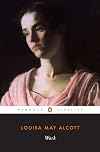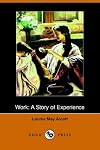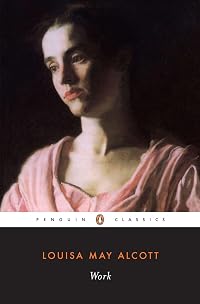
Work: A Story of Experience
by Louisa May Alcott
On This Page
Description
Before she went on to attain literary acclaim with beloved novels like Little Women, author Louisa May Alcott grew up in an environment of abject poverty, from which she had to fight to extract herself through years of back-breaking labor. This semi-autobiographical tale recounts Alcott's initiation into the world of work and what that meant as a woman in nineteenth-century America..
Tags
Recommendations













Member Reviews
A curious paradox of a book -- politically radical in places, irritatingly conventional in others. In one sentence, Alcott advocates movingly for equality between the races; in the next, she portrays the Irish as being lower than animals. In one passage, traditional gender roles are questioned and subverted; in another, we hear all about the strengths and weaknesses supposedly unique to females. Here it ridicules romances for putting silly, impractical ideas in girls' heads; there it resorts to the goopiest of sentimental tropes. Almost like reading two books in one.
Louisa May Alcott came from a family of professional busybodies (in a good way); they were temperance advocates, abolitionists and feminists. In most of Alcott's books for young people, she endeavors to show female characters that are hard-working, educated and striving to better themselves. She had as much contempt for a society that kept well-to-do young women empty-headed, vain and idle as she did compassion for women whose poverty forced them to endless toil.
Work is the story of Christie Devon, a New England orphan brought up by her kind aunt and hard-hearted uncle. Rather than be dependent on (and beholden to) her relatives all her life, she strikes out on her own, determined to work and make an independent life for herself. show more Christie moves through a series of careers, is proposed to by a rich man (who she refuses) and gets herself into trouble standing up for a friend who has been a "fallen woman." This loses Christie her job; she steadily declines into melancholy until she is helped by kind people. She falls in love and marries, only to lose her husband in the Civil War. Her short marriage brings her a child, which inspires her to work once more, so that she cannot not only give her daughter a better life but help other women.
Alcott's prose is hearty and somewhat syrupy. I liked the book for its realistic understanding of the lot of women in the 19th century. Christie Devon isn't a Horatio Alger-type hero; she can't be, because no matter how much of a will most 19th century women brought to work, the decks were stacked against them. They had too little practical training, too few opportunities and the margin for error was far too thin. (Illness or a moral slip brought almost certain disaster.) I found the story pleasant and interesting. Alcott even gets to indulge her taste for melodrama in one chapter in which Christie works for a family with hereditary madness in their genes. show less
Work is the story of Christie Devon, a New England orphan brought up by her kind aunt and hard-hearted uncle. Rather than be dependent on (and beholden to) her relatives all her life, she strikes out on her own, determined to work and make an independent life for herself. show more Christie moves through a series of careers, is proposed to by a rich man (who she refuses) and gets herself into trouble standing up for a friend who has been a "fallen woman." This loses Christie her job; she steadily declines into melancholy until she is helped by kind people. She falls in love and marries, only to lose her husband in the Civil War. Her short marriage brings her a child, which inspires her to work once more, so that she cannot not only give her daughter a better life but help other women.
Alcott's prose is hearty and somewhat syrupy. I liked the book for its realistic understanding of the lot of women in the 19th century. Christie Devon isn't a Horatio Alger-type hero; she can't be, because no matter how much of a will most 19th century women brought to work, the decks were stacked against them. They had too little practical training, too few opportunities and the margin for error was far too thin. (Illness or a moral slip brought almost certain disaster.) I found the story pleasant and interesting. Alcott even gets to indulge her taste for melodrama in one chapter in which Christie works for a family with hereditary madness in their genes. show less
This was an interesting mix, the first half of Christie finding out how to find and keep a job as a young woman with few opportunities had a very strong social message and didn't feel much like a novel. The second half was much more of the Little Women style moral tale with a heavy does of the socially responsible Christian viewpoint and a somewhat overwrought love story. That all being said, I did enjoy reading it. It was not particularly sophisticated and could get heavy handed at times but there was alot of gripping drama that really engaged me. The one chapter that left me cold was the Carrolls and the supposed hereditary madness plot line that just seemed like so much bosh. I know that was common thought at the time but I just show more could not take it seriously as I was clearly meant to. show less
This is the story of Christie, an orphan who decides to make her own way in the world. As she grows from young adult to middle age, she tries her hand at a number of different jobs; in fact, almost all of the jobs available to a woman of her era: servant, actress, governess, companion, and seamstress. (I think there are two notable exceptions: prostitute (for obvious reasons) and factory worker (weirdly, especially for a New Englander).) We see her try her hand at each of these jobs, and I found this pretty fascinating, as Alcott seems to be working to make Christie into a figure who can speak for all working women (except for the lazy Irish, of course), even if some of the chapters go off into odd digressions: the governess chapter show more becomes bogged down in a tedious courtship, while the companion chapter seems like it's from a melodrama and a different book entirely. Most are fun: as a servant, she burns her mistress's dresses (whoops!), while as an actress we get a nineteenth-century perspective on the dangers of acting a part.
After trying her hand at seamstressing, though, Christie has a breakdown and moves in with some incredibly preachy and boring people while she recovers, and though she does eventually work as a nurse, we get to see curiously little of it compared to her previous occupations. I found this part pretty dull, and though Christie's romance in this book is better than any of the ones in Little Women, Alcott still can't write people falling in love to save her life. show less
After trying her hand at seamstressing, though, Christie has a breakdown and moves in with some incredibly preachy and boring people while she recovers, and though she does eventually work as a nurse, we get to see curiously little of it compared to her previous occupations. I found this part pretty dull, and though Christie's romance in this book is better than any of the ones in Little Women, Alcott still can't write people falling in love to save her life. show less
This book had a hard time finding a consistent tone. The main character was hard to like for the first half, being almost too perfect for the life situations she found herself in. By the second half I loved it, and it had come together very well.
A beautiful tribute to working women. It did slow down a bit in the nursing section (I'm sure Alcott had better experiences to share but maybe they were all in her memoir?). But, all in all, a nice work-- equal too and, perhaps, ahead of its time.
A great, sorta rambling story about one woman's life, with asides about slavery, women's rights, the Civil War, religion (with Rev. Power, Alcott's impression of the real-life Theodore Parker) and life in general. Worth reading...makes me want to check out Susan Cheever's new biography of Alcott.
Members
- Recently Added By
Lists

KayStJ's to-read list
1,616 works; 11 members
Author Information

475+ Works 109,584 Members
Louisa May Alcott was born in Germantown, Pennsylvania, in 1832. Two years later, she moved with her family to Boston and in 1840 to Concord, which was to remain her family home for the rest of her life. Her father, Bronson Alcott, was a transcendentalist and friend of Ralph Waldo Emerson and Henry David Thoreau. Alcott early realized that her show more father could not be counted on as sole support of his family, and so she sacrificed much of her own pleasure to earn money by sewing, teaching, and churning out potboilers. Her reputation was established with Hospital Sketches (1863), which was an account of her work as a volunteer nurse in Washington, D.C. Alcott's first works were written for children, including her best-known Little Women (1868--69) and Little Men: Life at Plumfield with Jo's Boys (1871). Moods (1864), a "passionate conflict," was written for adults. Alcott's writing eventually became the family's main source of income. Throughout her life, Alcott continued to produce highly popular and idealistic literature for children. An Old-Fashioned Girl (1870), Eight Cousins (1875), Rose in Bloom (1876), Under the Lilacs (1878), and Jack and Jill (1881) enjoyed wide popularity. At the same time, her adult fiction, such as the autobiographical novel Work: A Story of Experience (1873) and A Modern Mephistopheles (1877), a story based on the Faust legend, shows her deeper concern with such social issues as education, prison reform, and women's suffrage. She realistically depicts the problems of adolescents and working women, the difficulties of relationships between men and women, and the values of the single woman's life. (Bowker Author Biography) show less
Series
Belongs to Publisher Series
Work Relationships
Is abridged in
Common Knowledge
- Canonical title
- Work: A Story of Experience
- Original title
- Work, A Story of Experience
- Original publication date
- 1873
- People/Characters
- Christie Devon; Aunt Betsy; Uncle Enos; Mrs. Flint; Mrs. Stuart; Mr. Stuart (show all 28); Hepsey; Lucy Black; Mrs. Black; Mr. Sharp; Kent [from Work]; Mrs. Saltonstall; Philip Fletcher; Mrs. Carrol; Helen Carrol; Miss Tudor; Harry Carrol; Augustine Carrol; Bella Carrol; Rachel; Mrs. King; Cynthy Wilkins; Elisha Wilkins; Mr. Power; Mrs. Sterling; David Sterling; Kitty; Ruth Sterling
- Important events
- American Civil War
- Dedication
- To my mother, whose life has been a long labor of love, this book is gratefully inscribed by her daughter.
- First words
- "Aunt Betsy, there's going to be a new Declaration of
Independence." - Last words
- (Click to show. Warning: May contain spoilers.)"Me too!" cried little Ruth, and spread her chubby hand above the rest: a hopeful omen, seeming to promise that the coming generation of women will not only receive but deserve their liberty, by learning that the greatest of God's gifts to us is the privilege of sharing His great work.
Classifications
Statistics
- Members
- 488
- Popularity
- 62,428
- Reviews
- 10
- Rating
- (3.53)
- Languages
- English, Spanish, Swedish
- Media
- Paper, Ebook
- ISBNs
- 72
- ASINs
- 9