On This Page
Description
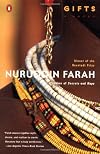
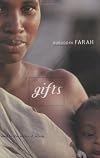
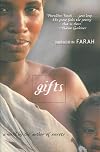
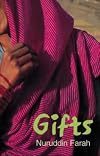
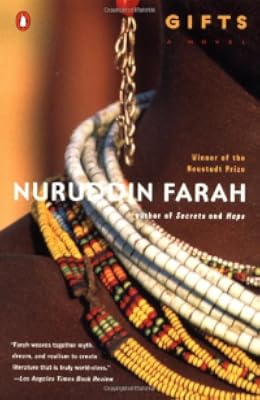
War in Somalia transforms a simple village girl into a self-confident woman who even swims and drives a car. She is Duniya, a widow with three children. By an English-speaking writer, author of Maps.Tags
Recommendations






Member Reviews
Maps, which I wrote about recently, is the first in one of Nuruddin Farah’s several trilogies. Gifts is the second volume. As I wrote earlier, a fundamental theme of Maps is the topic of identity both individual and national. Gifts, though written in a completely different style, continues Farah’s focus on that theme. Where Maps was not at all plot-driven, Gifts is far more conventionally plotted and told. The protagonist, Duniya, is a single mother with teen-age children trying to find her place and her way in a country and a society where she confronts a number of serious challenges. The title is Farah’s second theme: the meaning(s) involved in giving and receiving and Farah casts a wide net, taking in everything from show more individual, tangible gifts between people to intangible gifts to international aid from the “first world” to the “third world.” Indeed, one of Farah’s point is how pervasive the “simple” act of making a gift is in any society. Farah acknowledges his reliance on a scholarly work: in the 1950s, a French academic, Marcel Mauss, wrote an essay that is still enormously influential. The Gift examined what it means to give or accept a gift. To oversimplify greatly, Mauss contended that gifts carry extensive meaning and motives on the part of both the giver and the recipient. Mauss believed that, among other things, gifts had the effect of strengthening bonds (and thus, for example, helping to construct society), not despite but rather because of such motives (such as the implied obligation to reciprocate). So, the question of what is meant by the giver of a gift permeates this book—as does the obverse: what does accepting a gift “mean”? In addition, colonialism, civil war, ethnic conflicts and more are never far from Farah’s attention. On a far more mundane note, the writing here is unaccountably mediocre (Farah always writes in English). For reasons I cannot discern, Farah frequently insists on inserting metaphors that are awkward—or worse: “He searched for words with the clumsiness of a man with very fat fingers trying to undo a subtle knot.” “The one good thing this humiliation was achieving for her was that she was becoming heavy like a club-foot, no fear of flying away from weightlessness.” “Then Hibo’s tongue, thick as a slice of gorgonzola, lay inert in her mouth.” Still, despite the writing, Farah’s insights and his presentation offer a great deal to think about, not the least of which is that the way we handle gifts (whether as giver or recipient) and how that basic act is inextricably tied to our identity, a theme in all of his works. show less
Given its setting—Somalia in the mid-1980s—Gifts is a strikingly upbeat, almost comic novel. Farah is determined to present a portrait of his country and its people which contradicts many Western preconceptions about it. Through the story of Duniya, a nurse and the once-widowed, once-divorced mother of three children, Farah depicts a country which has been hindered, not helped, by foreign aid—a people whose future may lie in refusing, not accepting, gifts. Farah's prose has an admirable deftness of touch, and I'll definitely be seeking out works of his in the future.
Ratings
Members
- Recently Added By
Author Information

23+ Works 1,945 Members
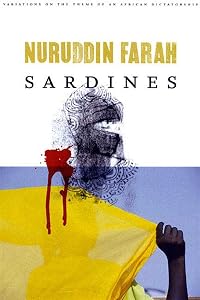
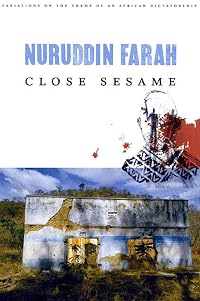
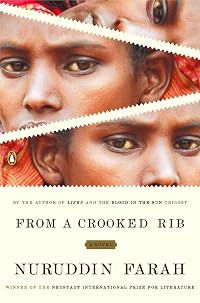
MAPS, Nuruddin Farah, 0-14-029643-3 The 1998 laureate of the Neustadt International Prize for Literature, Nuruddin Farah has been described as "one of the finest contemporary African novelists" (Salman Rushdie). Farah was born in 1945, in what is now Somalia (what was then the Italian Somaliland), in Baidoa, and grew up in Kallafo, under Ethiopian show more rule in Ogaden. The ethnically and linguistically mixed area of his childhood contributred to his early fascination with literature. He spoke Somali at his home but at school learned Amharic, Italian, Arabic, and English. Farah worked for the Ministry of Education in Somalia before leaving for India to study philosophy and literature. His first novel, From a "Crooked Rib", was published in 1970; it has since achieved worldwide cult status, admired for its empathetic portrait of a Somali woman struggling with the restraints of traditional Somali society. It was followed by "A Naked Needle" (1976). Farah's next three novels, "Sweet and Sour Milk" (1979), "Sardines" (1981) and "Close Sesame" (1983), form the trilogy collectively known as "Variations on the Theme of an African Dictatorship". Upon the publication of "Sweet and Sour Milk", which won the English Speaking Union Literary Award, Farah became persona non grata in his native Somalia. In exile, Farah began what has become a lifelong literary project: "to keep my country alive by writing about it." The "Variations" trilogy was followed by the "Blood in the Sun" trilogy, which consists of "Maps" (1986), "Gifts" (1992), and "Secrets" (1998). Farah lives in Cape Town, South Africa, with his wife and two children. show less
Series

Common Knowledge
- Canonical title
- Gifts
- Original publication date
- 1993
- People/Characters
- Duniya; Bosaaso
- Important places
- Mogadiscio, Somalia
- First words
- Duniya had been awake for a while, conscious of the approaching dawn.
- Last words
- (Click to show. Warning: May contain spoilers.)The world was an audience, ready to be given Duniya's story from the beginning.
Classifications
Statistics
- Members
- 155
- Popularity
- 211,273
- Reviews
- 2
- Rating
- (3.33)
- Languages
- 7 — Dutch, English, Finnish, French, German, Italian, Swedish
- Media
- Paper, Ebook
- ISBNs
- 17
- ASINs
- 1