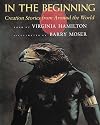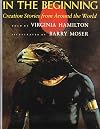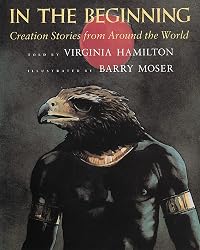
In the Beginning: Creation Stories from Around the World
by Virginia Hamilton
On This Page
Description
An illustrated collection of twenty-five myths from various parts of the world explaining the creation of the world.Tags
Recommendations






Member Reviews
I think this book is excellent. The illustrations are great and the stories are from all over the world. I can see how they relate to modern day stories and modern religion. Really not very accessible to today's students though, especially when so many kids have religious upbringings in the inner city that parent's aren't really all that flexible with.
This is a quite thorough anthology of creation myths from many cultures. We learn of earth being created by an animal, by God, or by Death. In some stories, we first learn about the creation of the creator, and get a vivid description of the creator itself (Quat, Phan Ku). Then, the creator goes to work! Sometimes the world begins in light, other times in dark. Creation is almost always gradual. Some stories provide additional detail about customs of the newly created people. Each story is followed by valuable notes that describe the suspected origin (place and/or time) of the myth, along with other interesting details. I did find myself sometimes going to the note at the end before finishing the myth, because I wanted to guess or be show more told the culture of origin before finishing the story. Perhaps a more patient way of doing this with students would be to read the myth and then see if we could discern an origin based on any clues. I appreciated the inclusion of Genesis creation stories as part of the survey of myths, but I suppose this could be controversial to some. It would be important to discuss the fact that all mythology is perceived as truth to its culture and that it's up to the reader to discern for themselves what they believe. The book's text is straightforward enough to be read by older elementary students, but its richness delivers as much value to middle school and high school students (or adults!). It would be extremely useful not just as a literature project, but also as a way to examine world culture, wildlife, and geography. The illustrations are vivid and powerful, but some of the characters (Imir, Death) could be somewhat frightening to younger children. I would have appreciated a geographical cross reference or map to help organize the myths by culture of origin, but perhaps this could be a student project. Notes at the end summarize more shared themes among the myths and provide extensive sources for further research. show less
Creation stories from around the world side-by-side with colorful illustration. I like how comparisons can be made to modern day religion and how many religions often share similar stories but with different characters in them. I like how this book gives insight to the cultures the stories are borrowed from. This a good book to build upon the idea of critical thinking with older students, 3rd or 4th grade.
A collection of creation myths from a range of cultures. I was excited going into this one because I love this sort of thing, but as it turns out, the book is pretty dry. Disappointing, really. Surely there's a way to retell these stories in a more engaging way? Especially since the intended audience is kids? *shrug*
This collection of creation stories holds tales from around the world and from a variety of cultures. Each story is detailed by Virgnia Hamilton, then includes a note from her at the end of the story for the reader to understand its origin, characters, and purpose. The illustrations add depth and vibrance to each creation story. Overall, a solid collection to ponder the possibilities of the origin of life, death, and the world.
This book contains presents an extensive account of creation myths from around the world. Each creation story is presented in 3 to 8 pages of large type, along with accompanying artistic illustrations from the culture represented. Each creation story is followed by explanatory text that summarizes the origins and history of the myth.
The creation myths that are presented come from indigenous cultures world-wide -- the Americas, Africa, east Asia, Iceland, Australia, the Russian Altaics, Siberia, Tahiti, Melanesia, Micronesia, Egypt, India , Greece, and Babylon. The Hebrew myths of the biblical "Old Testament" myth are represented by two entries -- one from the Priestly ("P") text and the other from the Yahwist ("J"), which as scholars show more have known for more than a century, reflect different authors. One might hope that the Genesis accounts, when placed in the context of myths worldwide, will be viewed as particular myths that have no more of a claim for historical truth than any other.
I found it interesting to see what the creation myths have in common. Each recounts the origins of the particular group of people represented and (often) the land where they lived, often in the context of local geographical and zoological features. Animals commonly figure in the myths, and are endowed with anthropomorphic characteristics. The explanatory comments associated with each account make evident that creation myths is a scholarly field of study. The book offers references for further reading and understanding. show less
The creation myths that are presented come from indigenous cultures world-wide -- the Americas, Africa, east Asia, Iceland, Australia, the Russian Altaics, Siberia, Tahiti, Melanesia, Micronesia, Egypt, India , Greece, and Babylon. The Hebrew myths of the biblical "Old Testament" myth are represented by two entries -- one from the Priestly ("P") text and the other from the Yahwist ("J"), which as scholars show more have known for more than a century, reflect different authors. One might hope that the Genesis accounts, when placed in the context of myths worldwide, will be viewed as particular myths that have no more of a claim for historical truth than any other.
I found it interesting to see what the creation myths have in common. Each recounts the origins of the particular group of people represented and (often) the land where they lived, often in the context of local geographical and zoological features. Animals commonly figure in the myths, and are endowed with anthropomorphic characteristics. The explanatory comments associated with each account make evident that creation myths is a scholarly field of study. The book offers references for further reading and understanding. show less
This is a series of creation stories from various cultures and points in time, and with the accompaniment of specific art pieces, each tale allows the reader to immerse in mythology/ folktales while finding both similarities and differences. This book would be great for upper middle school (7th-8th) or even high school as the reading is dense and full of information, but can be a great resource for studying mythology and folktales across the world.
Members
- Recently Added By
Lists

Newbery Honor Books By year - II - 1981-2035
143 works; 4 members

Books Read in 2024
4,727 works; 128 members
Author Information

49+ Works 16,346 Members
All Editions
Awards and Honors
Distinctions
Common Knowledge
- Original publication date
- 1988
- Dedication
- To Bonnie
To Arnold
—V. H.
To Bonnie, again
—B. M. - First words
- Let us think about when the earth was formed, or when the cosmos had nothing in it. (Introduction)
Classifications
- Genres
- Nonfiction, Children's Books
- DDC/MDS
- 291.2 — Religion Other religions [Formerly: General Religious Topics] [formerly: Doctrines. Relocated to 202]
- LCC
- BL226 .H35 — Philosophy, Psychology and Religion Religions. Mythology. Rationalism Religions. Mythology. Rationalism Natural theology Creation. Theory of the earth
- BISAC
Statistics
- Members
- 987
- Popularity
- 26,715
- Reviews
- 36
- Rating
- (4.07)
- Languages
- English, French
- Media
- Paper
- ISBNs
- 11
- ASINs
- 1