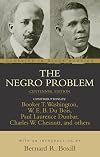
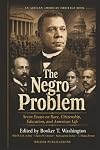
The Negro Problem
by Booker T. Washington
On This Page
Description
Here are six historic essays on the state of race relations during the Reconstruction and early twentieth century, written from the African American point of view. These essays show us how far race relations have progressed, and sadly how far we have yet to go. Included are "Industrial Education for the Negro" by Booker T. Washington, "The Talented Tenth" by W.E. Burghardt DuBois, "The Disfranchisement of the Negro" by Charles W. Chesnutt, "The Negro and the Law" by Wilford H. Smith, "The show more Characteristics of the Negro People" by H.T. Kealing, and "Representative American Negroes" by Paul Laurence Dunbar. show lessTags
Recommendations

























Member Reviews
Collection of seven essays by prominent Black American writers,
such as T. Thomas Fortune, W. E. B. Du Bois and
Paul Laurence Dunbar, edited by Booker T. Washington
”The Negro's Place in American Life at the Present Day” by T. Thomas Fortune
---------------------------------------
such as T. Thomas Fortune, W. E. B. Du Bois and
Paul Laurence Dunbar, edited by Booker T. Washington
”The Negro's Place in American Life at the Present Day” by T. Thomas Fortune
---------------------------------------
Ratings
Members
- Recently Added By
Author Information

84+ Works 6,285 Members
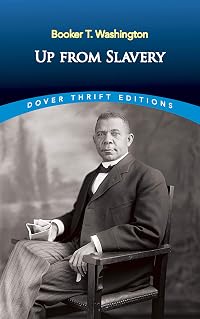
Booker Taliaferro Washington, 1856 - 1915 Booker T. Washington was born a slave in Hales Ford, Virginia, near Roanoke. After the U.S. government freed all slaves in 1865, his family moved to Malden, West Virginia. There, Washington worked in coal mines and salt furnaces. He went on to attend the Hampton, Virginia Normal and Agricultural Institute show more from 1872-1875 before joining the staff in 1879. In 1881 he was selected to head the Tuskegee Normal and Industrial Institute, a new teacher-training school for blacks, which he transformed into a thriving institution, later named Tuskegee University. His controversial conviction that blacks could best gain equality in the U.S. by improving their economic situation through education rather than by demanding equal rights was termed the Atlanta Compromise, because Washington accepted inequality and segregation for blacks in exchange for economic advancement. Washington advised two Presidents, Theodore Roosevelt and William Howard Taft, on racial problems and policies, as well as influencing the appointment of several blacks to federal offices. Washington became a shrewd political leader and advised not only Presidents, but also members of Congress and governors. He urged wealthy people to contribute to various black organizations. He also owned or financially supported many black newspapers. In 1900, Washington founded the National Negro Business League to help black business firms. Washington fought silently for equal rights, but was eventually usurped by those who ideas were more radical and demanded more action. Washington was replaced by W. E. B. Du Bois as the foremost black leader of the time, after having spent long years listening to Du Bois deride him for his placation of the white man and the plight of the negro. He died in 1915. (Bowker Author Biography) show less
Common Knowledge
- Original publication date
- 1903
Classifications
- Genres
- Nonfiction, Anthropology, History, Biography & Memoir
- DDC/MDS
- 305.896 — Society, government, & culture Social sciences, sociology & anthropology Social group - Age, Gender, Ethnicity Ethnic and national groups Other ethnic and national groups Africans and people of African descent; Blacks of African origin
- LCC
- E185.5 .N39 — History of the United States United States Elements in the population Afro-Americans Status and development since emancipation
- BISAC
Statistics
- Members
- 56
- Popularity
- 548,932
- Reviews
- 1
- Rating
- (5.00)
- Languages
- English
- Media
- Paper, Ebook
- ISBNs
- 22
- ASINs
- 5