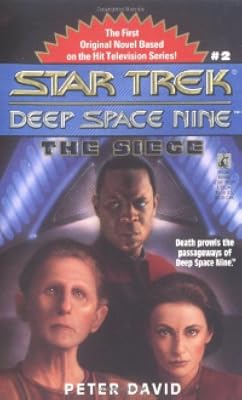
The Siege
by Peter David
Star Trek: Deep Space Nine (2), Star Trek (novels) (1993.05), Star Trek (1993.05)
On This Page
Description
Deep Space NineTM is forced to curtail entry to the wormhole due to increased graviton emissions, and an air of biting tension settles over the station. This anxiety leads to the murder of an Edeman religious leader, Commander Benjamin Sisko and Security Chief Odo realize they face a larger problem. Soon Sisko and Odo have more lifeless bodies on their hands and a killer who strikes without motive. Then, both the Edemans and Cardassians arrive threatening to destroy the station unless the show more murderer is given to them for retribution. In order to save Deep Space Nine and stop the killing, Odo must try to destroy a powerful assassin who is the only link to his mysterious past. show lessTags
Recommendations







Member Reviews
My wife and I are (re)watching Deep Space Nine. Because I get nostalgic about old Star Trek books, every time I finish a season, I read a novel set during that season-- and, of course, review it.
What's impressive about this book is how much Peter David gets right, given how little he knew about what the show was actually like (he discusses in the introduction what he had access to). Mostly this is accomplished by sticking to elements of the show that were clearly defined in the first five episodes. So, Odo is the main character: something my wife and noted in Season One was that Odo is basically always the best regular in every scene, enlivening even the dullest of dialogue. Kira is the other strongly depicted character of S1, but show more there's not much to grab onto in the first five episodes except for "Past Prologue," so she's pretty much sidelined here, along with Dax.
Anyway, my favorite bit about Odo actually comes from O'Brien's perspective, where he reflects that Odo has a similar naïveté about human(oid) nature to Data, but where Data is curious about what he doesn't understand, Odo is just offended. I feel like this is a pretty apt summation of Odo.
Speaking of O'Brien, he's almost right but not quite; his dedication to figuring out magic tricks doesn't really feel like the guy we know. On the other hand, David falls right into the Keiko Trap the writers of the show sometimes did too: treating her as a Generic Motiveless Nagging Wife, and not an actual person with some kind of interior life.
Bashir is a pretty Generic Crusading Starfleet Doctor in some respects, but this works pretty well for Bashir, especially when he's still all idealistic in Season 1. David has a good handle on Sisko, too, except that at the very end of the book Sisko turns into a Generic Peter David Character and begins cracking terrible puns at Odo's expense for some reason. A thing I do not believe Sisko would ever, ever do.
The only character that rang really false for me was Quark; though he is obviously greedy, he was never as stupid as depicted here. The idea that the Ferengi would try to buy DS9 is actually a pretty good one, and has potential to be a real plot line, but here it's an unfunny joke, and Quark pursues it with a business acumen below that of Nog (or even Rom!).
It's interesting that David doesn't really emphasize the decolonization aspects of the series, but that's something the show itself largely avoided in Season 1, until "Duet," the Circle trilogy, and "Cardassians." Instead, The Siege is a pretty standard "weird things come to the station" plot that we saw a lot of in Season 1, and David pulls it off better than the show itself usually did at that point.
Continuity points:
Something that's really interesting to me in rewatching the series is how fascinating the decolonization of Bajor ought to be-- anyone who's read their postcolonial history or literature or theory knows this is a violent, bloody, fraught process, and we get glimpses of that every now and then. But not many, and I often feel like that's where the real meat is and instead we're watching Alexander Siddig ham it up as Ray Oh Van Tika. I'd love to read (or write!) a novel that delved into the upheaval that Bajoran society must be experiencing at this point in time. I find Bajoran politics and religion fascinating.
Even in microcosm, how did Kira go from being a terrorist one week to being an effective administrator the next isn't something we really see on screen. Like, that's a big job adjustment, surely? How did the Bajoran military get organized-- who got to be generals? How did so many smarmy politicians come into being so quickly? I noticed when watching Season Six that Dukat's Bajoran aide from during the Occupation wore a uniform that's clearly the ancestor of the one used by the Bajoran Militia. Even that implies something interesting, in my mind! show less
What's impressive about this book is how much Peter David gets right, given how little he knew about what the show was actually like (he discusses in the introduction what he had access to). Mostly this is accomplished by sticking to elements of the show that were clearly defined in the first five episodes. So, Odo is the main character: something my wife and noted in Season One was that Odo is basically always the best regular in every scene, enlivening even the dullest of dialogue. Kira is the other strongly depicted character of S1, but show more there's not much to grab onto in the first five episodes except for "Past Prologue," so she's pretty much sidelined here, along with Dax.
Anyway, my favorite bit about Odo actually comes from O'Brien's perspective, where he reflects that Odo has a similar naïveté about human(oid) nature to Data, but where Data is curious about what he doesn't understand, Odo is just offended. I feel like this is a pretty apt summation of Odo.
Speaking of O'Brien, he's almost right but not quite; his dedication to figuring out magic tricks doesn't really feel like the guy we know. On the other hand, David falls right into the Keiko Trap the writers of the show sometimes did too: treating her as a Generic Motiveless Nagging Wife, and not an actual person with some kind of interior life.
Bashir is a pretty Generic Crusading Starfleet Doctor in some respects, but this works pretty well for Bashir, especially when he's still all idealistic in Season 1. David has a good handle on Sisko, too, except that at the very end of the book Sisko turns into a Generic Peter David Character and begins cracking terrible puns at Odo's expense for some reason. A thing I do not believe Sisko would ever, ever do.
The only character that rang really false for me was Quark; though he is obviously greedy, he was never as stupid as depicted here. The idea that the Ferengi would try to buy DS9 is actually a pretty good one, and has potential to be a real plot line, but here it's an unfunny joke, and Quark pursues it with a business acumen below that of Nog (or even Rom!).
It's interesting that David doesn't really emphasize the decolonization aspects of the series, but that's something the show itself largely avoided in Season 1, until "Duet," the Circle trilogy, and "Cardassians." Instead, The Siege is a pretty standard "weird things come to the station" plot that we saw a lot of in Season 1, and David pulls it off better than the show itself usually did at that point.
Continuity points:
- It's amazing how well Meta fits with what we later learn about Changelings; there's nothing here that contradicts the idea that he couldn't be one of the Hundred. The only thing that doesn't quite work is that Odo doesn't mention him again, but I can assume that he and Laas talk about Meta off screen in "Chimera" next time I see it.
- At first I thought Meta was a different goo color than Odo because he's described as red, but late in the novel, Odo's goo is described as red as well. (I'd say it was more orange.)
- Sisko says he's never seen Odo shift before this novel, but Odo turned his head gooey to avoid that thief in "Emissary."
- Also Odo is described as maintaining his mass in smaller forms, which is realistic, but contradicted by "Vortex" (though of course that was yet to air at this point).
- Dukat's ship is called the Ravage here, which seems familiar to me, but I can't figure out where else I've seen it used. Dukat never seems particularly attached to his ship on the show, though. (Indeed, it's not particularly obvious if there is a singular "Dukat's ship" on the show.)
Something that's really interesting to me in rewatching the series is how fascinating the decolonization of Bajor ought to be-- anyone who's read their postcolonial history or literature or theory knows this is a violent, bloody, fraught process, and we get glimpses of that every now and then. But not many, and I often feel like that's where the real meat is and instead we're watching Alexander Siddig ham it up as Ray Oh Van Tika. I'd love to read (or write!) a novel that delved into the upheaval that Bajoran society must be experiencing at this point in time. I find Bajoran politics and religion fascinating.
Even in microcosm, how did Kira go from being a terrorist one week to being an effective administrator the next isn't something we really see on screen. Like, that's a big job adjustment, surely? How did the Bajoran military get organized-- who got to be generals? How did so many smarmy politicians come into being so quickly? I noticed when watching Season Six that Dukat's Bajoran aide from during the Occupation wore a uniform that's clearly the ancestor of the one used by the Bajoran Militia. Even that implies something interesting, in my mind! show less
Considering how early in the series run this book was written, I think Peter David nails the characters to a remarkable degree. He also puts forth a very nicely detailed plot, and includes some philosophical questions that can't be wrapped up in a neat and tidy bow. Its an incredibly strong Star Trek novel.
Definitely a gorier plot than I would have expected from Trek. The Ferengi play a central part here but are largely played for laughs, which is about par for the course at this point in DS9 I guess. Julian's subplot, in which he tries to save a crypto-Christian Scientist alien kid whose parents are refusing medical help, is better handled IMO. Sisko does have a couple of classic dad jokes about Odo's pail, but overall it didn't quite fit with my vision of the DS9 characters, perhaps because it's so early in the series.
Okay - this is just plain fun.
There are people who whine that it is too violent. I really got the impression that it was violence with a purpose, though. Peter David says in his forward that he didn't really like the premise of the show - but enjoyed the 5 episodes he had seen. I think he liked the premise even less than he expresses - he spends the book really ripping DS9 a new one, in a way that is respectful to it at the same time.
The series editors wanted the DS9 fiction to start strong - so they offer the first novel to one of their more popular writers. You just know editorial had some uneasiness in their guts putting their seal of approval on the book for publication - but at the same time, only fans are going to buy the fiction show more anyway, right? In a way DS9 was supposed to be more gritty and real... and this book certainly makes a go of getting that done - far moreso than the series itself (at least in the beginning).
I enjoyed it thoroughly. I read it on vacation. The characters felt dead on to me (full disclosure - I myself am only just getting into the series, and I read this book right at the point where PD had seen the series so far - - some correct and deserved critique points out that PD's portrayal of the characters isn't accurate according to episodes that aired after the book was written, but it IS accurate to the series 'bible' - namely the development materials and character synopsis as they existed at the time).
There is fairly ruthless killing, children in peril, Kira and Dax as mindless sex objects for Ferengi pleasure, and Odo out the wazoo. It is great fun, and I recommend it.
The handling of Sisko and O'Brien is worth the price of admission - all stories sharp, relevant, and entertaining. I'm ready for more Peter David Trek, for sure. show less
There are people who whine that it is too violent. I really got the impression that it was violence with a purpose, though. Peter David says in his forward that he didn't really like the premise of the show - but enjoyed the 5 episodes he had seen. I think he liked the premise even less than he expresses - he spends the book really ripping DS9 a new one, in a way that is respectful to it at the same time.
The series editors wanted the DS9 fiction to start strong - so they offer the first novel to one of their more popular writers. You just know editorial had some uneasiness in their guts putting their seal of approval on the book for publication - but at the same time, only fans are going to buy the fiction show more anyway, right? In a way DS9 was supposed to be more gritty and real... and this book certainly makes a go of getting that done - far moreso than the series itself (at least in the beginning).
I enjoyed it thoroughly. I read it on vacation. The characters felt dead on to me (full disclosure - I myself am only just getting into the series, and I read this book right at the point where PD had seen the series so far - - some correct and deserved critique points out that PD's portrayal of the characters isn't accurate according to episodes that aired after the book was written, but it IS accurate to the series 'bible' - namely the development materials and character synopsis as they existed at the time).
There is fairly ruthless killing, children in peril, Kira and Dax as mindless sex objects for Ferengi pleasure, and Odo out the wazoo. It is great fun, and I recommend it.
The handling of Sisko and O'Brien is worth the price of admission - all stories sharp, relevant, and entertaining. I'm ready for more Peter David Trek, for sure. show less
This is the first non-tv episode novelization novel of the DS9 series. It's also a Peter David novel. Unfortunately for Mr David there had only been a few episodes of the TV series before this. So, quite a few of the characterizations are a little off. Sisko seems a bit more combustible than in the series. Odo seems a lot more human in the series and I'm not sure how O'Brien was different, but he did seem different than the TV series.
Still, the writing and plot was amazing as usual. It's mainly Odo's story. He doesn't know much about himself and when a serial killer appears on the station and seems to have the same shape shifting abilities as Odo it gives Odo a chance to go through all sorts of human emotions.
There's also an interesting show more (in a cultury-y philosophical sorta way) subplot with Bashir and an alien family that gets stuck on the station.
It's a full novel with the plots interweaving and separating in the usual dance that Peter David puts on the page. show less
Still, the writing and plot was amazing as usual. It's mainly Odo's story. He doesn't know much about himself and when a serial killer appears on the station and seems to have the same shape shifting abilities as Odo it gives Odo a chance to go through all sorts of human emotions.
There's also an interesting show more (in a cultury-y philosophical sorta way) subplot with Bashir and an alien family that gets stuck on the station.
It's a full novel with the plots interweaving and separating in the usual dance that Peter David puts on the page. show less
This was unquestionably the worst Star Dreck book I ever read during my time as a Star Dreck fan. It's sleazy, tasteless and extremely violent. One more reason to consider Peter David a highly overrated writer.
On top of everything else, David obnoxiously inserts a brief and completely pointless cameo by the Borg: a cube tries to travel through the wormhole from the Gamma Quadrant, but the wormhole destroys it and only its debris makes it through. It serves no purpose but to make readers more interested.
A strong candidate for worst book I ever read of any kind.
On top of everything else, David obnoxiously inserts a brief and completely pointless cameo by the Borg: a cube tries to travel through the wormhole from the Gamma Quadrant, but the wormhole destroys it and only its debris makes it through. It serves no purpose but to make readers more interested.
A strong candidate for worst book I ever read of any kind.
Members
- Recently Added By
Author Information

1,319+ Works 46,706 Members
Series


Work Relationships
Is abridged in
Common Knowledge
- Canonical title
- The Siege
- Original title
- The Siege
- Original publication date
- 1993-05
- People/Characters
- Benjamin Sisko; Odo
- Important places
- Deep Space Nine (space station)
- Important events
- Death of an Endeman religious leader; Curtailing entry to wormhole due to gravitational Anomaly
- Dedication
- To
Pauliina's TV Set ...
Long may it wave - First words
- The vessel with the killer on it moved through space.
- Last words
- (Click to show. Warning: May contain spoilers.)And Fluffy clip-clopped on his way.
- Original language
- English
Classifications
Statistics
- Members
- 581
- Popularity
- 50,584
- Reviews
- 7
- Rating
- (3.62)
- Languages
- Czech, English, French, German
- Media
- Paper, Ebook
- ISBNs
- 9
- ASINs
- 5