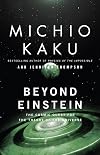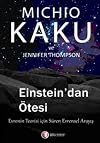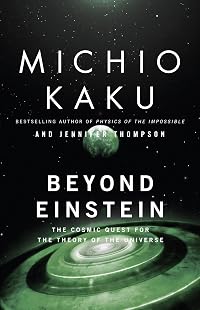
Beyond Einstein: The Cosmic Quest for the Theory of the Universe
by Michio Kaku
On This Page
Description
What is superstring theory and why is it important? Can superstrings offer the fulfilment of Einstein's lifelong dream of a Theory of Everything? This account of the discoveries that have led scientists to the brightest new prospect in theoretical physics today is co-authored by the best-selling author of Hyperspace and one of the leading pioneers in superstrings, Michio Kaku. Revised and updated with groundbreaking research, the book approaches scientific questions with the excitement of a show more detective story, offering a look at the new science that may make the impossible possible. show lessTags
Recommendations









Member Reviews
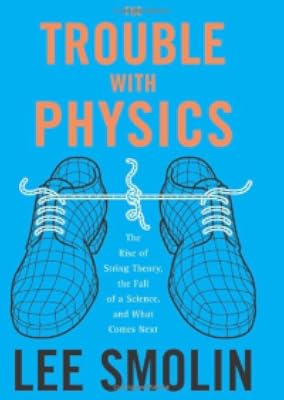
I had been reading The Trouble with Physics: the Rise of String Theory, the Fall of Science, and What Comes Next by Lee Smolin, but on the advice of a fellow LT member, I set it aside for the time being in favor of Beyond Einstein. The latter gives a relatively straightforward foundation for the issues and theories discussed in the former.
Kaku does present the "basic" concepts of quantum physics and relativity well enough for me to almost feel like I've gotten within spitting distance of understanding them. And he lays out the evolution of thinking on these issues, from the composition of the atom to the nature (and history) of the universe and time itself, in a coherent manner, as well.
The book does have some problems of presentation, show more however: there is some very clunky writing in it. For one thing, Kaku, or more likely his co-writer, Jennifer Trainer Thompson, suffers from adverb-itis of the sort normally reserved for bad spy novels. When you tell me something is "incredibly small," for example, my general reaction is, "Well, if it's incredible, then I don't believe it." Because it's not credible, you see. OK, I know you got that. But mostly, when a scientist tells me that anything regarding science and/or scientific theory is "amazingly" or "incredibly" anything, I feel like I'm being talked down to.
Also, there are too many "cause and effect" mashups for me. For example, we read this (be prepared for your eyes to glaze over, but try to hang with me):
"Another example of O(3) symmetry is the atom itself. Because the Schrodinger equation, which is the basis of all quantum mechanics, is invariant under rotations, the solutions to the equation (which are atoms) should also have this symmetry. The fact that atoms have this rotational symmetry is a direct consequence of the O(3) symmetry of the Schrodinger equation."
OK, I don't really understand what that all means, either. With a book like this, I just try to read it through and accept as much as my feeble brain can make out. But as a long-time copy editor, one thing there jumps out at me: The fact that atoms have rotational symmetry is not a consequence of an equation. One might say that our belief or even our knowledge that atoms have rotational symmetry is a consequence of our faith in that equation, but the symmetry is not a consequence of the equation. I found enough such instances that I found them distracting and worth mentioning. But, still, the book did present the issues I wanted to begin learning about, and I am ready to move on (although not immediately) to another volume on the subject. show less
Kaku does present the "basic" concepts of quantum physics and relativity well enough for me to almost feel like I've gotten within spitting distance of understanding them. And he lays out the evolution of thinking on these issues, from the composition of the atom to the nature (and history) of the universe and time itself, in a coherent manner, as well.
The book does have some problems of presentation, show more however: there is some very clunky writing in it. For one thing, Kaku, or more likely his co-writer, Jennifer Trainer Thompson, suffers from adverb-itis of the sort normally reserved for bad spy novels. When you tell me something is "incredibly small," for example, my general reaction is, "Well, if it's incredible, then I don't believe it." Because it's not credible, you see. OK, I know you got that. But mostly, when a scientist tells me that anything regarding science and/or scientific theory is "amazingly" or "incredibly" anything, I feel like I'm being talked down to.
Also, there are too many "cause and effect" mashups for me. For example, we read this (be prepared for your eyes to glaze over, but try to hang with me):
"Another example of O(3) symmetry is the atom itself. Because the Schrodinger equation, which is the basis of all quantum mechanics, is invariant under rotations, the solutions to the equation (which are atoms) should also have this symmetry. The fact that atoms have this rotational symmetry is a direct consequence of the O(3) symmetry of the Schrodinger equation."
OK, I don't really understand what that all means, either. With a book like this, I just try to read it through and accept as much as my feeble brain can make out. But as a long-time copy editor, one thing there jumps out at me: The fact that atoms have rotational symmetry is not a consequence of an equation. One might say that our belief or even our knowledge that atoms have rotational symmetry is a consequence of our faith in that equation, but the symmetry is not a consequence of the equation. I found enough such instances that I found them distracting and worth mentioning. But, still, the book did present the issues I wanted to begin learning about, and I am ready to move on (although not immediately) to another volume on the subject. show less
Considering how many years have passed since this book's publication, it isn't so very bad an introduction to the ideas of particle physics and cosmology, and superstring theory. I won't say it's the most accessible book about heavy science I've read, but it's comprehensive enough and is a good springboard. My edition was purchased in the 80s when the book was newly published, and so is dated, which somewhat amused me. I plan to read another book I picked up with promises to explain the various fields and ideas of physics for dummies like me to grasp before I move on to more books that attempt to bring down these complex thoughts to average joesephines like me. We shall see what sort of success I achieve.
Michio Kaku is very good at writing about highly complex topics in a way that is accessible to the laymen. Beyond Einstein describes the beginning of Superstring Theory and the major players in the field. No mathematics or advanced physics are required to enjoy this book. Just a keen interest to know a bit about superstrings and the potential that this field may have on our understanding of the universe. The book was written about 15 years ago when superstrings were all the rage but the book is still very topical and provides an excellent primer on the science.
This is the book that gave me some idea what string theory was about and totally captured my imagination (maybe more and in different ways than Kaku would appreciate). It's a good book for the lay person to understand a liittle about some of what's going on in science.
Ratings
Members
- Recently Added By
Lists

Physics
29 works; 3 members
Author Information

39+ Works 15,173 Members
Michio Kaku was born January 24, 1947 in San Jose California. Kaku attended Cubberley High School in Palo Alto in the early 1960s and played first board on their chess team. At the National Science Fair in Albuquerque, New Mexico, he attracted the attention of physicist Edward Teller, who took Kaku as a protégé, awarding him the Hertz show more Engineering Scholarship. Kaku graduated summa cum laude from Harvard University with a B.S. degree in 1968 and was first in his physics class. He attended the Berkeley Radiation Laboratory at the University of California, Berkeley and received a Ph.D. in 1972 and held a lectureship at Princeton University in 1973. During the Vietnam War, Kaku completed his U.S. Army basic training at Fort Benning, Georgia and his advanced infantry training at Fort Lewis, Washington. Kaku currently holds the Henry Semat Chair and Professorship in theoretical physics and a joint appointment at City College of New York, and the Graduate Center of the City University of New York, where he has lectured for more than 30 years. He is engaged in defining the "Theory of Everything", which seeks to unify the four fundamental forces of the universe: the strong nuclear force, the weak nuclear force, gravity and electromagnetism. He was a visiting professor at the Institute for Advanced Study in Princeton, and New York University. He is a Fellow of the American Physical Society. He is listed in Who's Who in Science and Engineering, and American Men and Women of Science. He has published research articles on string theory from 1969 to 2000. In 1974, along with Prof. K. Kikkawa, he wrote the first paper on string field theory, now a major branch of string theory, which summarizes each of the five string theories into a single equation. In addition to his work on string field theory, he also authored some of the first papers on multi-loop amplitudes in string theory. Kaku is the author of several doctoral textbooks on string theory and quantum field theory and has published 170 articles in journals covering topics such as superstring theory, supergravity, supersymmetry, and hadronic physics. He is also author of the popular science books: Visions, Hyperspace, Einstein's Cosmos, Parallel Worlds, The Future of the Mind, and The Future of Humanity: Terraforming Mars, Interstellar Travel, Immortality, and Our Destiny Beyond. (Bowker Author Biography) show less
All Editions
Some Editions
Common Knowledge
- Canonical title
- Beyond Einstein: The Cosmic Quest for the Theory of the Universe
- Original title
- Beyond Einstein: The Cosmic Quest for the Theory of the Universe
- Alternate titles
- Beyond Einstein: Superstrings and the Quest for the Final Theory
- Original publication date
- 1987
- First words
- A new theory is rocking the foundations of modern physics, rapidly overturning cherished but obsolete notions about our universe and replacing them with new mathematics of breathtaking beauty and elegance.
- Last words
- (Click to show. Warning: May contain spoilers.)Far from the end, it is only the beginning.
- Original language
- English
Classifications
Statistics
- Members
- 691
- Popularity
- 41,713
- Reviews
- 4
- Rating
- (3.58)
- Languages
- English, German, Turkish
- Media
- Paper, Ebook
- ISBNs
- 8
- ASINs
- 4