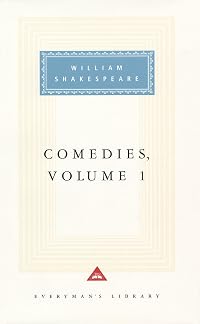
Comedies, Volume 1 (Everyman's Library)
by William Shakespeare
On This Page
Description
Shakespeare forged his tremendous art in the crucible of his comic imagination, which throughout his life enveloped and contained his tragic one. His early comedies--with their baroque poetic exuberance, intense theatricality, explosive bursts of humor, and superbly concrete realizations of the dialects of love--capture as in a chrysalis all that he was to become. They provide a complete inventory of the mind of our greatest writer in the middle of his golden youth. This volume show more contains The Comedy of Errors, The Taming of the Shrew, The Two Gentlemen of Verona, Love's Labor's Lost, A Midsummer Night's Dream, and it's companion piece, Romeo and Juliet, which Tony Tanner describes in his introduction as "a tragedy by less than one minute." The texts, authoritatively edited by Sylvan Barnet, are supplemented with textual notes, bibliographies, a detailed chronology of Shakespeare's life and times, and a substantial introduction in which Tanner discusses each play individually and in the context of Shakespeare's oeuvre. show lessTags
Recommendations



















Member Reviews
What can you say that hasn't been said about the works of one of the most brilliant minds who ever lived? All superlatives elude me. Only the Ancient Greek playwrights are his equals. All others pale in comparison. Unfortunately, so many are turned-off to Shakespeare because of their introduction to him in high school. What a pity. Shakespeare is to be watched! Reading him is a poor substitute. If you can readily understand the English language of his day, he is easy to read, but few are adept at this.
Ratings
Members
- Recently Added By
Author Information

6,059+ Works 441,750 Members
William Shakespeare, 1564 - 1616 Although there are many myths and mysteries surrounding William Shakespeare, a great deal is actually known about his life. He was born in Stratford-Upon-Avon, son of John Shakespeare, a prosperous merchant and local politician and Mary Arden, who had the wealth to send their oldest son to Stratford Grammar School. show more At 18, Shakespeare married Anne Hathaway, the 27-year-old daughter of a local farmer, and they had their first daughter six months later. He probably developed an interest in theatre by watching plays performed by traveling players in Stratford while still in his youth. Some time before 1592, he left his family to take up residence in London, where he began acting and writing plays and poetry. By 1594 Shakespeare had become a member and part owner of an acting company called The Lord Chamberlain's Men, where he soon became the company's principal playwright. His plays enjoyed great popularity and high critical acclaim in the newly built Globe Theatre. It was through his popularity that the troupe gained the attention of the new king, James I, who appointed them the King's Players in 1603. Before retiring to Stratford in 1613, after the Globe burned down, he wrote more than three dozen plays (that we are sure of) and more than 150 sonnets. He was celebrated by Ben Jonson, one of the leading playwrights of the day, as a writer who would be "not for an age, but for all time," a prediction that has proved to be true. Today, Shakespeare towers over all other English writers and has few rivals in any language. His genius and creativity continue to astound scholars, and his plays continue to delight audiences. Many have served as the basis for operas, ballets, musical compositions, and films. While Jonson and other writers labored over their plays, Shakespeare seems to have had the ability to turn out work of exceptionally high caliber at an amazing speed. At the height of his career, he wrote an average of two plays a year as well as dozens of poems, songs, and possibly even verses for tombstones and heraldic shields, all while he continued to act in the plays performed by the Lord Chamberlain's Men. This staggering output is even more impressive when one considers its variety. Except for the English history plays, he never wrote the same kind of play twice. He seems to have had a good deal of fun in trying his hand at every kind of play. Shakespeare wrote 154 sonnets, all published on 1609, most of which were dedicated to his patron Henry Wriothsley, The Earl of Southhampton. He also wrote 13 comedies, 13 histories, 6 tragedies, and 4 tragecomedies. He died at Stratford-upon-Avon April 23, 1616, and was buried two days later on the grounds of Holy Trinity Church in Stratford. His cause of death was unknown, but it is surmised that he knew he was dying. (Bowker Author Biography) show less
Series
Belongs to Publisher Series
Work Relationships
Contains
Common Knowledge
- Canonical title
- Comedies, Volume 1 (Everyman's Library) (Everyman's Library)
- Original publication date
- 1995
- First words
- R and J: Chorus: Two households, both alike in dignity, in fair Verona, where we lay our scene, from ancient grudge break to new mutiny, where civil blood makes civil hands unclean.
Dream: Now, fair Hippolyta, our nuptial ... (show all)hour draws on apace; four happy days bring in another moon...
Shrew: Sly: I'll pheeze you, in faith.
Errors: Aegeon: Proceed, Solinus, to procure my fall, and by the doom of death end woes and all.
Verona: Valentine: Cease to persuade, my loving Proteus: Home-keeping youth have ever homely wits.
Labour's: King: Let fame, that all hunt after in their lives, live register'd upon our brazen tombs, and then grace us in the disgrace of death... - Last words
- (Click to show. Warning: May contain spoilers.)R and J: Escalus: For never was a story of more woe than this of Juliet and her Romeo.
Dream: Give me your hands, if we be friends, and Robin shall restore amends.
Shrew: Lucentio: 'Tis a wonder, by your leave, she will be tamed so.
Errors: Dromio of Ephesus: Nay, then, thus:--We came into the world like brother and brother; and now let's go hand in hand, not one before another.
Verona: Valentine: That done, our day of marriage shall be your; one feast, one house, one mutual happiness.
Labour's: Armado: You that way: we this way.
Classifications
Statistics
- Members
- 171
- Popularity
- 191,073
- Reviews
- 1
- Rating
- (4.00)
- Languages
- English
- Media
- Paper
- ISBNs
- 2
- ASINs
- 1