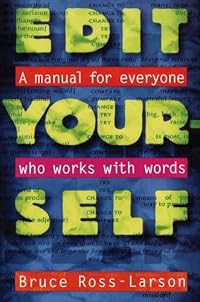
Edit Yourself: A Manual for Everyone Who Works with Words
by Bruce Ross-Larson
On This Page
Description
In the first part of this useful book, the author shows how to solve common problems of writing. The reader will learn how to recognize common problems of writing. The reader will learn how to recognize words and phrases that should be cut; how to shorten cumbersome sentences; how to arrange the elements of pairs, series, and compound subjects and predicates; how to recognize and rectify mismanaged participles; and how to be on the lookout for the better word.The second part of the book show more consists of more than 1500 recommendations for cuts, changes, and comparisons that editors make to produce writing that is concise and effective. show lessTags
Recommendations

















Member Reviews
This is a somewhat disappointing reference subtitled A manual for everyone who works with words. It is organized into two sections. What Editors Look For, contains 11 chapters that deal with topics like cutting out fat, finding better words, using active voice and achieving consistency. Each chapter introduces one or more basic principles and illustrates each with examples. What Editors Cut, Change, and Compare is an alphabetic listing of recommendations.
Section one can be read in a couple of hours by readers who want a quick overview of the author’s views. Section two concerns words rather than grammar or parts of speech. Participles, verbs, and nouns will not be found in section two under those labels. As such, readers may use if show more as a reference when concerned about the use of specific words and phrases. For example, are used to, for the most part, namely, and totally should be cut.
One surprising feature is the instances of poor writing. For example, “All subordinate clauses should be scrutinized to see whether …” converts scrutiny to a verb and uses passive voice. Examine (or Inspect) all subordinate clauses to determine … would illustrate the use of active voice.
Writers who have a question about a particular word or phrase and already have a copy of Edit Yourself on their bookshelf may find this volume useful to consult. I advise those who do not own a copy to find a more useful reference. show less
Section one can be read in a couple of hours by readers who want a quick overview of the author’s views. Section two concerns words rather than grammar or parts of speech. Participles, verbs, and nouns will not be found in section two under those labels. As such, readers may use if show more as a reference when concerned about the use of specific words and phrases. For example, are used to, for the most part, namely, and totally should be cut.
One surprising feature is the instances of poor writing. For example, “All subordinate clauses should be scrutinized to see whether …” converts scrutiny to a verb and uses passive voice. Examine (or Inspect) all subordinate clauses to determine … would illustrate the use of active voice.
Writers who have a question about a particular word or phrase and already have a copy of Edit Yourself on their bookshelf may find this volume useful to consult. I advise those who do not own a copy to find a more useful reference. show less
This book demonizes the passive voice and I feEL VERY ATTACKED!
grammar is painful, but this wasn't so bad, i guess ...
date i finished the book: never ... it never ends!
date i finished the book: never ... it never ends!
Ratings
Members
- Recently Added By
Author Information
8 Works 697 Members
Bruce Ross-Larson, the author of Edit Yourself, is the president of American Writing Corporation, Communications Development Incorporated, and the American Writing Institute. He lives in Washington, D.C.
Common Knowledge
- Original publication date
- 1982
Classifications
Statistics
- Members
- 515
- Popularity
- 57,988
- Reviews
- 3
- Rating
- (3.68)
- Languages
- English
- Media
- Paper, Ebook
- ISBNs
- 6
- ASINs
- 3