On This Page
Description
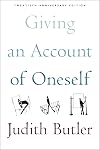
What does it mean to lead a moral life? In her first extended study of moral philosophy, Judith Butler offers a provocative outline for a new ethical practice ́one responsive to the need for critical autonomy and grounded in a new sense of the human subject. Butler takes as her starting point one ́s ability to answer the questions ́What have I done? ́ and ́What ought I to do? ́ She shows that these question can be answered only by asking a prior question, ́Who is this ́I ́ who show more is under an obligation to give an account of itself and to act in certain ways? ́ Because I find that I cannot give an account of myself without accounting for the social conditions under which I emerge, ethical reflection requires a turn to social theory. In three powerfully crafted and lucidly written chapters, Butler demonstrates how difficult it is to give an account of oneself, and how this lack of self-transparency and narratibility is crucial to an ethical understanding of the human. In brilliant dialogue with Adorno, Levinas, Foucault, and other thinkers, she eloquently argues the limits, possibilities, and dangers of contemporary ethical thought. Butler offers a critique of the moral self, arguing that the transparent, rational, and continuous ethical subject is an impossible construct that seeks to deny the specificity of what it is to be human. We can know ourselves only incompletely, and only in relation to a broader social world that has always preceded us and already shaped us in ways we cannot grasp. If inevitably we are partially opaque to ourselves, how can giving an account of ourselves define the ethical act? And doesn ́t an ethical system that holds us impossibly accountable for full self-knowledge and self-consistency inflict a kind of psychic violence, leading to a culture of self-beratement and cruelty? How does the turn to social theory offer us a chance to understand the specifically social character of our own unknowingness about ourselves? In this invaluable book, by recasting ethics as a project in which being ethical means becoming critical of norms under which we are asked to act, but which we can never fully choose, Butler illuminates what it means for us as ́fallible creatures ́ to create and share an ethics of vulnerability, humility, and ethical responsiveness. show lessTags
Recommendations
















































Member Reviews
While difficult to read (I will probably need a few re-reads), I found this book to interrogate many assumptions and ideas I take for granted about selfhood, the "I", and how it is possible (or not) to understand oneself. It has really challenged my research (in a good way) about how democracy asks you to know yourself in order to contribute who you are and what you need to the political process. But how do you know who you are? Where does you come from? What allows you to know who you are, and what are the limits and costs of those practices?
En fecundo diálogo con brillantes pensadores de nuestra época ‹como Adorno, Foucault, Levinas y Laplanche‹, esta obra renueva de manera fundamental la práctica ética, reafirmando con inusitado vigor que la reflexión moral no debe ser considerada fuera del contexto social y político en el cual se formula. Si bien la filosofía moral tiene una tendencia natural a idealizar el sujeto moral, confiriéndole, con demasiada ligereza quizás, una autonomía que supone inherente a él, importa contrarrestar esta tendencia tomando como punto de partida la experiencia intransferible del carácter relacional de cada vida. Ninguna vida podría referirse a sí misma y llegar a construir el relato adecuado de su desenvolvimiento, así como show more tampoco hablar de su emergencia en el mundo. Lo que se sustrae a ella no son solamente las condiciones de su nacimiento y de su desarrollo, sino también las formas sociales que permiten leerla. El reconocimiento de sí mismo por uno mismo es incompleto. Situado en el relato de los otros, está asediado por las formas de justificación que de allí provienen, y acaban por hacer imposible todo procedimiento de reconocimiento. La relación al otro deviene constitutiva de la relación imposible a sí mismo. Es en ese contexto de desposesión que resulta urgente, según la autora, proceder a una indagación sobre las condiciones de posibilidad de una relación moral a sí mismo y a los otros, que no haga violencia a ese contexto sino que, por el contrario, lo tome en consideración. Debemos aceptar que la ética es violenta desde el momento en que ella se arroga el derecho de sobrepasar los contextos singulares en los cuales se encuentran ubicadas las existencias para formular prescripciones universales. show less
Sep 6, 2020Spanish
En fecundo diálogo con brillantes pensadores de nuestra época -como Adorno, Foucault, Levinas y Laplanche-, esta obra renueva de manera fundamental la práctica ética, reafirmando con inusitado vigor que la reflexión moral no debe ser considerada fuera del contexto social y político en el cual se formula.
Sep 19, 2011Spanish
Ratings
Members
- Recently Added By
Author Information

56+ Works 10,833 Members
Judith Butler was born in 1956. She is nationally known for her writings on gender and sexuality. She argues that men and women are not dissimilar and that the notion they are is cultural not biological in books such as Bodies That Matter: On The Discursive Limits Of "Sex" (1993), Excitable Speech: Contemporary Scenes Of Politics (1996), and The show more Psychic Life Of Power: Theories In Subjection (1997). In Gender Trouble (1990), the title a play on John Waters' camp classic Female Trouble (1975), Butler claims that both gender and drag are a kind of imitation for which there is no original. A professor of philosophy at University of California at Berkeley, Butler attended Yale, receiving a B.A. in 1978 and a Ph.D. in philosophy in 1984. (Bowker Author Biography) show less
Series

Classifications
- Genres
- Philosophy, Nonfiction, Literature Studies and Criticism, General Nonfiction, Sexuality and Gender Studies
- DDC/MDS
- 170.42 — Philosophy & psychology Ethics Animals rights, Euthanasia, Pro-life Essays; Special Topics Metaethics
- LCC
- BD450 .B895 — Philosophy, Psychology and Religion Speculative philosophy Speculative philosophy Ontology
- BISAC
Statistics
- Members
- 359
- Popularity
- 87,992
- Reviews
- 3
- Rating
- (3.90)
- Languages
- 6 — English, French, German, Italian, Portuguese (Portugal), Spanish
- Media
- Paper, Ebook
- ISBNs
- 18
- ASINs
- 3