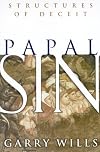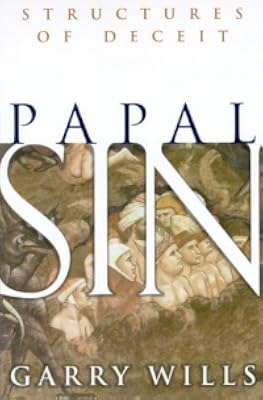
Papal Sin: Structures of Deceit
by Garry Wills
On This Page
Description
Chronicles the history of the Catholic Church and its hierarchy from the nineteenth century to the present, focusing on the Church's devious practices and stubborn resistance to the truth.Tags
Recommendations





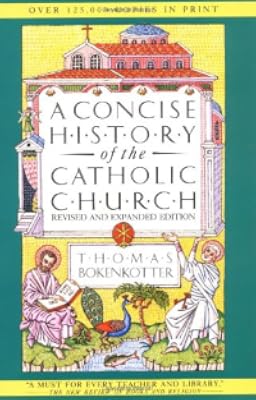
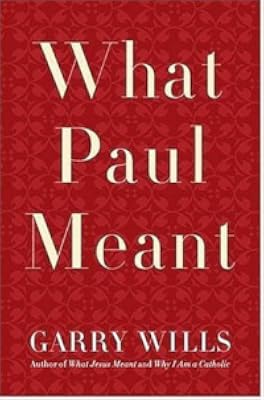
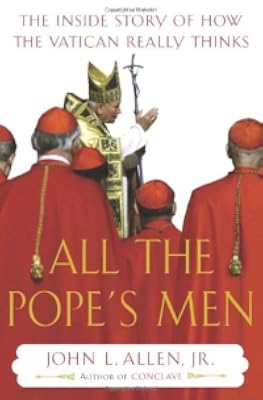
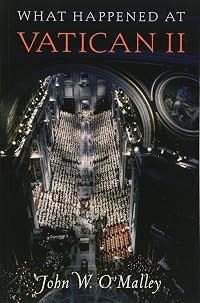





Member Recommendations
Member Reviews
PAPAL SIN should be required reading for all Catholic adults and highly recommended for everyone else.
An unintended result is that whatever religion you do or do not have,
you will become more aware of ALL lies and deceit, thanks to Saint Augustine,
and are likely to become a more moral person.
This book is meticulously researched and documented, chapter by chapter,
demonstrating the most recent (beginning around Pius IX) Vatican and Catholic deceits.
Its scope is worldwide and by now, 17 years after publication,
Garry Wills would be having an enhanced field day with the connections between
rampant world population, world climate change, and the Vatican's ongoing idiocy on contraception,
with professed celibates controlling the intimate show more lives of married and unmarried Catholics.
As well, all of his predictions
regarding an emerging Gay Priesthood have come true, with sad results and jaw-dropping deceits.
His coverage of the cult of the Virgin Mary confirms the bewilderment many of us feel at the endless
mention of SEX in a spiritual setting - why is her hymen glorified or how can you not think about sex
every time it is mentioned?
The Catholic Church, while offering much needed help and solace for the sick and dying,
is a troubling place.
As well, the author confirms that "popes" are never mentioned in the Bible and,
unlike the priests who are modeled after them,
all of the apostles were married.
The alleged divinity and infallibility of the popes receives the condemnation they each deserve.
Unforgettable. show less
An unintended result is that whatever religion you do or do not have,
you will become more aware of ALL lies and deceit, thanks to Saint Augustine,
and are likely to become a more moral person.
This book is meticulously researched and documented, chapter by chapter,
demonstrating the most recent (beginning around Pius IX) Vatican and Catholic deceits.
Its scope is worldwide and by now, 17 years after publication,
Garry Wills would be having an enhanced field day with the connections between
rampant world population, world climate change, and the Vatican's ongoing idiocy on contraception,
with professed celibates controlling the intimate show more lives of married and unmarried Catholics.
As well, all of his predictions
regarding an emerging Gay Priesthood have come true, with sad results and jaw-dropping deceits.
His coverage of the cult of the Virgin Mary confirms the bewilderment many of us feel at the endless
mention of SEX in a spiritual setting - why is her hymen glorified or how can you not think about sex
every time it is mentioned?
The Catholic Church, while offering much needed help and solace for the sick and dying,
is a troubling place.
As well, the author confirms that "popes" are never mentioned in the Bible and,
unlike the priests who are modeled after them,
all of the apostles were married.
The alleged divinity and infallibility of the popes receives the condemnation they each deserve.
Unforgettable. show less
Wills relates issues on which the papacy and its supporters are fallible in both the past and present. The need to support these errors to defend the papacy lead to what he calls the structures of deceit that force the Catholic hierarchy to go against the Church’s best interest. If one thing I gained from this book is an understanding of Christian community from the earliest days and the practices of worship that make the Paulist Center more authentic than any other church I’ve attended.
“In sex, you see, it is all or nothing. Unless the act expresses all values possible to it all the time, it is immoral. It would be hard to find a parallel in the moral world for this principle. Can we say that, unless one’s charity is perfectly show more motivated, you sin by giving alms from lesser motives (e.g. , to bolster self-esteem)? If alms-giving were banned unless its motive was a perfect charity, the church’s donations would fall of sharply.” -p. 100
“The twelve apostles were men, so all priests must be men. But the twelve apostles were married, and the church authorities decided they could change that – in fact, John Paul says that the church cannot go back to the original situation on this point. Saint Peter had a wife, but no modern Pope or priest can. Are we to say that all priests must be converted Jews? The twelve were. Are they all to speak Aramaic? For that matter, if we are to make the gospel situation binding now, we should observe that the apostles were not priests themselves. And there was at least one woman apostle in the New Testament, Junia (Rom 16:7).” p. 104-05
“Serious men might well hestitate before joining this company [the seminary], putting themselves under Rome’s discipline with enthusiastic enforcers as their colleagues. Meanwhile, the number of parishes without priests is growing.
This situation could not have arise in the early centuries of the church. Then a community did not wait for some higher authority to drop a priest down out of the hierarchical heaven, accepting what it was given (if anything). Communities voted for their own priests, who were committed to staying with the community that chose them. There was no candidate list submitted by Rome. Anyone could be chosen, so long as the community wanted that person. That was the proof of a vocation. In fact it was the vocation, the calling by the Christian body of Christ for a leader of its own desire….
A man was obliged to accept this call, out of duty to the Christian community which was Christ’s body.” - p.153
“The better course is to welcome a female analogy for God, but assign it to the third person of the Trinity. The usage even of theologians and Bible translators is misleading when the Spirit is referred to as It – “It breathes where it will.” The personhood of God makes such objectification degrading. The pronoun for the Spirit should be She, which will make clear that many of the functions assigned to Mary (as a symbol of the church, or its protector) truly belong to the Trinity in its female analogue. One should pray to Her as well as to Him.” - p. 218
“Christ likes us to prefer truth to him, because, before being Christ, he is truth. If one turns aside from him to go to the truth, one will not go far before falling into his arms.” – Simone Weil, quoted on p. 275
“Girard’s most radical assertion is that Jesus is not a sacrifice. His Father is not one whose aggressions need to be bought off. Jesus is not an item of barter in the exchange system of set up by sacrifice; God does not accept victims. He sides with the victims against its slayers, reversing the whole logic of placation.” – p. 305 show less
“In sex, you see, it is all or nothing. Unless the act expresses all values possible to it all the time, it is immoral. It would be hard to find a parallel in the moral world for this principle. Can we say that, unless one’s charity is perfectly show more motivated, you sin by giving alms from lesser motives (e.g. , to bolster self-esteem)? If alms-giving were banned unless its motive was a perfect charity, the church’s donations would fall of sharply.” -p. 100
“The twelve apostles were men, so all priests must be men. But the twelve apostles were married, and the church authorities decided they could change that – in fact, John Paul says that the church cannot go back to the original situation on this point. Saint Peter had a wife, but no modern Pope or priest can. Are we to say that all priests must be converted Jews? The twelve were. Are they all to speak Aramaic? For that matter, if we are to make the gospel situation binding now, we should observe that the apostles were not priests themselves. And there was at least one woman apostle in the New Testament, Junia (Rom 16:7).” p. 104-05
“Serious men might well hestitate before joining this company [the seminary], putting themselves under Rome’s discipline with enthusiastic enforcers as their colleagues. Meanwhile, the number of parishes without priests is growing.
This situation could not have arise in the early centuries of the church. Then a community did not wait for some higher authority to drop a priest down out of the hierarchical heaven, accepting what it was given (if anything). Communities voted for their own priests, who were committed to staying with the community that chose them. There was no candidate list submitted by Rome. Anyone could be chosen, so long as the community wanted that person. That was the proof of a vocation. In fact it was the vocation, the calling by the Christian body of Christ for a leader of its own desire….
A man was obliged to accept this call, out of duty to the Christian community which was Christ’s body.” - p.153
“The better course is to welcome a female analogy for God, but assign it to the third person of the Trinity. The usage even of theologians and Bible translators is misleading when the Spirit is referred to as It – “It breathes where it will.” The personhood of God makes such objectification degrading. The pronoun for the Spirit should be She, which will make clear that many of the functions assigned to Mary (as a symbol of the church, or its protector) truly belong to the Trinity in its female analogue. One should pray to Her as well as to Him.” - p. 218
“Christ likes us to prefer truth to him, because, before being Christ, he is truth. If one turns aside from him to go to the truth, one will not go far before falling into his arms.” – Simone Weil, quoted on p. 275
“Girard’s most radical assertion is that Jesus is not a sacrifice. His Father is not one whose aggressions need to be bought off. Jesus is not an item of barter in the exchange system of set up by sacrifice; God does not accept victims. He sides with the victims against its slayers, reversing the whole logic of placation.” – p. 305 show less
Garry Wills is one of the most brilliant, intellectually challenging writers of our time. He is also a devout Catholic who is deeply worried about the direction in which his church is headed. In this well-researched book, he discusses how the hierarchical structure of the Church has led to an arrogant abuse of power, and wilful distortions of church history to promote a conservative agenda.
Papal Sin is about far more than a few instances of bad behavior from a few popes. Anyone who’s done much reading on the Catholic church should be aware of quite a few instances of popes murdering, lying, thieving, etc. But are those actions in the past? Wills’ argument is that the very structure of the office of the pope requires it to lie and cover up, even if it’s not directly involved in wrong-doing in the last century or so.
As Wills lays them out, the book covers historical dishonesties, doctrinal dishonesties, one on the nature of honesty, and a theology of honesty. As a non-Christian and a layman, I found a different categorization of his themes more helpful. He begins with covering harm against others, then moves on to the show more lying to cover those up, followed by what Wills considers to be making shit up doctrinally. He then attributes this to an inability to admit when the church has been wrong, which is ultimately a concern with establishing a precedent that breaks the authority of the church hierarchy. The last chapters deal with some of the history and theology of lying withing the Catholic church.
The book’s premise is that the lying is because the church can’t admit to having been wrong without calling bringing to the fore that it’s been wrong before. In other words, it would open a can of worms that could bring about the end of priestly control of the church. The reasoning that this is the cause of much of the church’s flaws jibes with the evidence that Wills produces, but it’s by no means definitive proof.
Full review: http://reading.kingrat.biz/reviews/papal-sin-garry-wills show less
As Wills lays them out, the book covers historical dishonesties, doctrinal dishonesties, one on the nature of honesty, and a theology of honesty. As a non-Christian and a layman, I found a different categorization of his themes more helpful. He begins with covering harm against others, then moves on to the show more lying to cover those up, followed by what Wills considers to be making shit up doctrinally. He then attributes this to an inability to admit when the church has been wrong, which is ultimately a concern with establishing a precedent that breaks the authority of the church hierarchy. The last chapters deal with some of the history and theology of lying withing the Catholic church.
The book’s premise is that the lying is because the church can’t admit to having been wrong without calling bringing to the fore that it’s been wrong before. In other words, it would open a can of worms that could bring about the end of priestly control of the church. The reasoning that this is the cause of much of the church’s flaws jibes with the evidence that Wills produces, but it’s by no means definitive proof.
Full review: http://reading.kingrat.biz/reviews/papal-sin-garry-wills show less
Gary Wills indicts the papacy for failing to admit that its teachings in the past may have been in error. He is particularly referring to issues such as infallibility, clerical celibacy, contraception, and relationships to the Holocaust. He relies on readings of the Bible and Church fathers, particularly Augustine, to demonstrate that the Curial teaching on these issues is not well supported by tradition, and argues that the main reason for the perpetuation of these teachings is the reluctance of the Papacy to admit to past error. He is enlightening on the politics behind discussions of contraception at Vatican 2, and the promulgation of infallibility at Vatican 1. The discussions were well done, compact chapters of wellsupported show more arguments, but it is hard to know exactly who the book is aimed at; one suspects the clergy will not find it convincing. He is very alarming on the issues of celibacy, and the molestation of young men by priests. He argues convincingly that the priesthood is becoming largely a gay organization. Read mostly on the train to New York for the ANA conference show less
Disclaimer: I am neither a practicing Catholic nor was I raised as a Catholic.
I noticed this book on the bargain table at a local book store, read the jacket and the table of contents and I was intrigued. The book is divided into four sections: Historical Dishonesties; Doctrinal Dishonesties; The Honesty Issue; and The Splendor Of Truth. I recommend using the "search inside this book" option to review the table of contents and the first chapter.
I found this book a challenge. I read a chapter or two and then did not pick up the book for weeks. At times reading Papal Sin was laborious, yet like physical exercise the mental exercise was beneficial. Of particular interest were the chapters on women (Excluded Women), celibacy of priests (The show more Pope's Eunuch's and Priestly Caste), priests as sex offenders (Conspiracy of Silence), homosexuality (A Gay Priesthood) and contraception (The Gift of Life).
To a non-Catholic, Papal Sin is educational and fascinating. To a devote Catholic who believes in the infallibility of the Pope, this book is likely blasphemous. show less
I noticed this book on the bargain table at a local book store, read the jacket and the table of contents and I was intrigued. The book is divided into four sections: Historical Dishonesties; Doctrinal Dishonesties; The Honesty Issue; and The Splendor Of Truth. I recommend using the "search inside this book" option to review the table of contents and the first chapter.
I found this book a challenge. I read a chapter or two and then did not pick up the book for weeks. At times reading Papal Sin was laborious, yet like physical exercise the mental exercise was beneficial. Of particular interest were the chapters on women (Excluded Women), celibacy of priests (The show more Pope's Eunuch's and Priestly Caste), priests as sex offenders (Conspiracy of Silence), homosexuality (A Gay Priesthood) and contraception (The Gift of Life).
To a non-Catholic, Papal Sin is educational and fascinating. To a devote Catholic who believes in the infallibility of the Pope, this book is likely blasphemous. show less
I was fascinated by this book and the bureaucracy surrounding the decision making process in the Roman Catholic church. Reading this book really sheds light on the recent revelations in the church and the reaction that has followed.
Members
- Recently Added By
Published Reviews
ThingScore 100
Wills, an eminent historian and one of the most intellectually distinguished members of the Catholic laity in the United States, has written a devastating, no-holds-barred, indictment.
added by Shortride
Lists

Books in the Bibliography of Freethinkers by Susan Jacoby
155 works; 1 member
Author Information

68+ Works 13,244 Members
Garry Wills, 1934 - Garry Wills was born in Atlanta, Georgia in 1934. Wills received a B.A. from St. Louis University in 1957, an M.A. from Xavier University of Cincinnati in 1958, an M.A. (1959) and a Ph.D. (1961) in classics from Yale. Wills was a junior fellow of the Center for Hellenic Studies from 1961-62, an associate professor of classics show more and adjunct professor of humanities at Johns Hopkins University from 1962-80. Wills was the first Washington Irving Professor of Modern American History and Literature at Union College, and was also a Regents Professor at the University of California in Santa Barbara, Silliman Seminarist at Yale, Christian Gauss Lecturer at Princeton, W.W. Cook Lecturer at the University of Michigan Law School, Hubert Humphrey Seminarist at Macalester College, Welch Professor of American Studies at Notre Dame University and Henry R. Luce Professor of American Culture and Public Policy at Northwestern University (1980-88). Wills is also a member of the American Academy of Arts and Sciences and the American Academy of Arts and Letters, and his articles appear frequently in The New York Review of Books. Wills is the author of "Lincoln at Gettysburg," which won the Pulitzer Prize for General Nonfiction in 1993 and the NEH Presidential Medal, "John Wayne's America," "A Necessary Evil: A History of American Distrust of Government" and "The Kennedy Imprisonment." Other awards received by Wills include the National Book Critics Award, the Merle Curti Award of the organization of American Historians, the Wilbur Cross Medal from Yale Graduate School, the Harold Washington Book Award and the Peabody Award for excellence in broadcasting, which was for writing and narrating the 1988 "Frontline" documentary "The Candidates." (Bowker Author Biography) Garry Wills is a Pulitzer-prize winning historian and cultural critic. A former professor of Greek at Yale University, his many books include Lincoln at Gettysburg, Reagan's America, Witches and Jesuits, and a biography of Saint Augustine. He lives in Evanston, Indiana. (Publisher Provided) Garry Wills is a frequent contributor to The New York Times Magazine and The New York Review of Books. He lives in Evanston, Illinois. (Publisher Provided) show less
Awards and Honors
Distinctions
Common Knowledge
- People/Characters
- Pius IX, Pope (Beatified, Giovanni Maria Mastai Ferretti, 1792&ndash | 1878); Pope Pius XII; Edith Stein; Pope John Paul II; John Henry Newman; John Dalberg-Acton, 1st Baron Acton
- Important events
- World War II (1939 | 1945); Holocaust (1939 | 1945)
Classifications
- Genres
- Religion & Spirituality, Nonfiction, History, General Nonfiction
- DDC/MDS
- 262.13 — Religion Christian organization, social work & worship Ecclesiology Ministry Papacy; Primacy
- LCC
- BX1765.2 .W54 — Philosophy, Psychology and Religion Christian Denominations Christian Denominations Catholic Church Controversial works
- BISAC
Statistics
- Members
- 613
- Popularity
- 47,467
- Reviews
- 9
- Rating
- (3.54)
- Languages
- Dutch, English, Italian, Spanish
- Media
- Paper, Ebook
- ISBNs
- 11
- ASINs
- 5