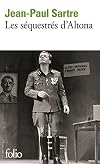
The Condemned of Altona
by Jean-Paul Sartre
On This Page
Description
The Condemned of Altona is an act of judgment on the twentieth century, which might have been an admirable era (the closing lines tell us) if man had not been threatened by 'the cruel enemy who had sworn to destroy him, that hairless, evil, flesh-eating beast--man himself. 'All the characters in the play are defendants, trapped inside the frame of the proscenium as securely as Eichmann within his glass cage in Jerusalem; their judge is the past, and its verdict is without mercy. Two death show more penalties are imposed, and one sentence of solitary confinement for life. The stage, as so often in M. Sartre's hands, becomes a place of moral inquisition, at once a courtroom and a prison. show lessTags
Recommendations






























Member Reviews
Sartre foi um excelente dramaturgo. Os Seqüestrados de Altona mostra a vida de um oficial do exército nazista, Frantz von Gerlach, que não quis mais sair de casa, que se mantem voluntariamente seqüestrado dos seus por ter cometido um crime de guerra. Frantz bombardeia com conchas o retrato de Hitler, e dirige-se a juízes imaginários - os caranguejos - que o aterrorizam, e frente aos quais sua irmã Leni, com a qual mantém relações incestuosas, proclama sua inocência. Leni também tenta convencê-lo da ruína da Alemanha pós-guerra, pois ele não consegue conceber o contrário. A peça inicia após treze anos de clausura, quando o patriarca von Gerlach está perto da morte e deve transmitir a obrigação de cuidar de Frantz ao show more filho Werner, que achava que o irmão estava morto. show less
This was a great play. Sartre uses vivid and entrancing techniques to characterize his personages- especially Franz, to fully execute his will and explore the human condition. I thought it was a very interesting play with a lot to offer and recommend it to those interested in Sartre, theatre, Nobel laureates, French literature, and classics.
4 stars!
4 stars!
Conseil de famille chez les von Gerlach : le père a convoqué sa fille Leni, son fils cadet Werner et johanna, sa bru, pour leur dicter ses dernières volontés. Il n'a plus que six mois à vivre, les médecins l'ont condamné. Après lui, Werner dirigera l'empire industriel des von Gerlach mais doit s'engager à ne jamais quitter Altona. Pourquoi cette condition sinon pour protéger Frantz, le fils aîné, qui se claustre dans sa chambre depuis treize ans et passe pour mort aux yeux du monde ? johanna s'insurge. Son beau-père l'incite subtilement à forcer la porte de Frantz ? par elle il espère obtenir l'entrevue que son fils lui refuse. johanna, fascinée, pénètre dans le monde clos où Frantz, jour après jour, se justifie show more devant un tribunal invisible. Revoir son père équivaut pour lui à rentrer dans le réel et à dresser le bilan de deux conceptions de l'existence mises à l'épreuve dans le creuset de la guerre. Confrontation aux suites tragiques. show less
Conseil de famille chez les von Gerlach : le père a convoqué sa fille Leni, son fils cadet Werner et johanna, sa bru, pour leur dicter ses dernières volontés. Il n'a plus que six mois à vivre, les médecins l'ont condamné. Après lui, Werner dirigera l'empire industriel des von Gerlach mais doit s'engager à ne jamais quitter Altona. Pourquoi cette condition sinon pour protéger Frantz, le fils aîné, qui se claustre dans sa chambre depuis treize ans et passe pour mort aux yeux du monde ? johanna s'insurge. Son beau-père l'incite subtilement à forcer la porte de Frantz ? par elle il espère obtenir l'entrevue que son fils lui refuse. johanna, fascinée, pénètre dans le monde clos où Frantz, jour après jour, se justifie show more devant un tribunal invisible. Revoir son père équivaut pour lui à rentrer dans le réel et à dresser le bilan de deux conceptions de l'existence mises à l'épreuve dans le creuset de la guerre. Confrontation aux suites tragiques. show less
Aug 14, 2010French
In una nota premessa al testo, Simenon decide di rinfrescare la memoria dei lettori sullo scandalo che a meta degli anni Trenta aveva travolto l'immenso impero economico dei fratelli Ferchaux, giunti in Africa alla fine dell'Ottocento come passeggeri clandestini. Per alcune settimane l'affaire aveva occupato le prime pagine dei giornali: con quali mezzi era stata accumulata quell'enorme fortuna? E soprattutto: che fine aveva fatto il vecchio Dieudonne? E qui che comincia il romanzo, ed entra in scena colui che ne sara il vero protagonista: Michel Maudet.
Feb 4, 2020Italian
Ratings
Members
- Recently Added By
Lists

1964 College Preparatory Reading List
202 works; 8 members
Author Information

Sartre is the dominant figure in post-war French intellectual life. A graduate of the prestigious Ecole Normale Superieure with an agregation in philosophy, Sartre has been a major figure on the literary and philosophical scenes since the late 1930s. Widely known as an atheistic proponent of existentialism, he emphasized the priority of existence show more over preconceived essences and the importance of human freedom. In his first and best novel, Nausea (1938), Sartre contrasted the fluidity of human consciousness with the apparent solidity of external reality and satirized the hypocrisies and pretensions of bourgeois idealism. Sartre's theater is also highly ideological, emphasizing the importance of personal freedom and the commitment of the individual to social and political goals. His first play, The Flies (1943), was produced during the German occupation, despite its underlying message of defiance. One of his most popular plays is the one-act No Exit (1944), in which the traditional theological concept of hell is redefined in existentialist terms. In Red Gloves (Les Mains Sales) (1948), Sartre examines the pragmatic implications of the individual involved in political action through the mechanism of the Communist party and a changing historical situation. His highly readable autobiography, The Words (1964), tells of his childhood in an idealistic bourgeois Protestant family and of his subsequent rejection of his upbringing. Sartre has also made significant contributions to literary criticism in his 10-volume Situations (1947--72) and in works on Baudelaire, Genet, and Flaubert. In 1964 he was awarded the Nobel Prize in Literature and refused it, saying that he always declined official honors. (Bowker Author Biography) show less
Some Editions
Series
Belongs to Publisher Series
Work Relationships
Is contained in
Common Knowledge
- Canonical title
- The Condemned of Altona
- Original title
- Les séquestrés d'Altona; Les Sequestrés d'Altona
- Original publication date
- 1959; Argentina: 1961-05-26
Classifications
Statistics
- Members
- 371
- Popularity
- 84,212
- Reviews
- 5
- Rating
- (3.50)
- Languages
- 12 — Dutch, English, Finnish, French, German, Italian, Farsi/Persian, Portuguese, Russian, Spanish, Swedish, Turkish
- Media
- Paper, Ebook
- ISBNs
- 19
- ASINs
- 30