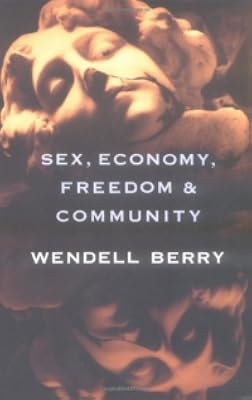
Sex, Economy, Freedom, and Community: Eight Essays
by Wendell Berry
On This Page
Description
"Read [him] with pencil in hand, make notes, and hope that somehow our country and the world will soon come to see the truth that is told here." --The New York Times Book Review In this collection of essays, first published in 1993, Wendell Berry continues his work as one of America's most necessary social commentators. With wisdom and clear, ringing prose, he tackles head-on some of the most difficult problems confronting us near the end of the twentieth century--problems we still face show more today. Berry elucidates connections between sexual brutality and economic brutality, and the role of art and free speech. He forcefully addresses America's unabashed pursuit of self-liberation, which he says is "still the strongest force now operating in our society." As individuals turn away from their community, they conform to a "rootless and placeless monoculture of commercial expectations and products," buying into the very economic system that is destroying the earth, our communities, and all they represent. show lessTags
Recommendations









Member Reviews
Wendell Berry sees the world through a different lens. An accomplished poet, essayist, and novelist, he chose to ignore the lure of literary New York to stay rooted in his Kentucky farm.
Rooted is an important idea for Berry. If more people were rooted in their land, they would want what's best for it. In our global age we have traded in the local concrete for the global abstraction. As Berry reminds us, "abstraction is the enemy wherever it is found" (23).
Berry's rootedness extends beyond his physical location. He has developed strong, firm, and often contrarian opinions which he is not ashamed to publish. For example, take his thoughts on economic growth:
[quote]Unlimited economic growth implies unlimited consumption, which in turn show more implies unlimited pride, covetousness, lust, anger, gluttony, envy, and sloth. (xvii)[/quote]
Try his views on war:
[quote]War is obsolete, in short, because it can no longer produce a net good, even to the winner. (77)[/quote]
Berry on Christian government:
[quote]Jesus would have been horrified by just about every "Christian" government the world has ever seen. He would be horrified by our government and its works, and it would be horrified by him. (115)[/quote]
In the 8 essays (along with the superb preface, "The Joy of Sales Resistance") which make up this volume, Berry speaks the truth as clearly as he sees it. You can either disagree with him and offer counter arguments, or agree and examine your own lifestyle. One thing is impossible: when it comes to Berry, you cannot be neutral! show less
Rooted is an important idea for Berry. If more people were rooted in their land, they would want what's best for it. In our global age we have traded in the local concrete for the global abstraction. As Berry reminds us, "abstraction is the enemy wherever it is found" (23).
Berry's rootedness extends beyond his physical location. He has developed strong, firm, and often contrarian opinions which he is not ashamed to publish. For example, take his thoughts on economic growth:
[quote]Unlimited economic growth implies unlimited consumption, which in turn show more implies unlimited pride, covetousness, lust, anger, gluttony, envy, and sloth. (xvii)[/quote]
Try his views on war:
[quote]War is obsolete, in short, because it can no longer produce a net good, even to the winner. (77)[/quote]
Berry on Christian government:
[quote]Jesus would have been horrified by just about every "Christian" government the world has ever seen. He would be horrified by our government and its works, and it would be horrified by him. (115)[/quote]
In the 8 essays (along with the superb preface, "The Joy of Sales Resistance") which make up this volume, Berry speaks the truth as clearly as he sees it. You can either disagree with him and offer counter arguments, or agree and examine your own lifestyle. One thing is impossible: when it comes to Berry, you cannot be neutral! show less
Wendell Berry has this habit of tweaking sensibilities that you think are untweakable. Here Berry takes on the Individualism that runs rampant in American Culture, especially as it pertains to sexuality.
If you are pretty sure that you dont want anyone bringing new ideas into your head, then stay the hell away from this book.
If you are pretty sure that you dont want anyone bringing new ideas into your head, then stay the hell away from this book.
A provocative little book. The main theme of it is: America would be much better off if we returned to a community focused perspective. This is theme is applied mostly to agriculture, which the author cares a lot about, but also to sex, war and consumerism. One thing that I found very refreshing about Berry is that he's conservative, but conservative in a way that seems true to the word itself, unlike most political conservatives.
The title essay, long and (for Berry) somewhat dense, is well worth the price of admission. Berry begins with the 1990 accusations of sexual harassment made at Supreme Court Justice Clarence Thomas by a former employee, Anita Hill. They were first aired at Thomas's 1990 confirmation hearing. But Berry looks much more deeply than most of us would be able to at the social and cultural context for the incident and how it reflects changes in our culture and society.
For that (now dated) news story you could substitute any number of more contemporary ones -- the essay speaks to our day just as effectively as its own.
For that (now dated) news story you could substitute any number of more contemporary ones -- the essay speaks to our day just as effectively as its own.
I enjoyed reading this and gaining a new perspective into what community truly is. I didn't rate it higher than three stars not because I didn't enjoy all of the essays, but because about half of them dealt with issues that I am simply not that interested in.
Essays identifying the disintegration of community, and the subsequent rootless and placeless monoculture of commercial expectations and products.
However destructive may be the policies of the government and the methods and products of the corporations, the root of the problem is always to be found in private life.
Members
- Recently Added By
Author Information

160+ Works 24,763 Members
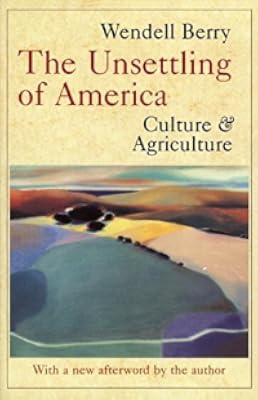
Wendell Berry The prolific poet, novelist, and essayist Wendell Berry is a fifth-generation native of north central Kentucky. Berry taught at Stanford University; traveled to Italy and France on a Guggenheim Fellowship; and taught at New York University and the University of Kentucky, Lexington, before moving to Henry County. Berry owns and show more operates Lanes Landing Farm, a small, hilly piece of property on the Kentucky River. He embraced full-time farming as a career, using horses and organic methods to tend the land. Harmony with nature in general, and the farming tradition in particular, is a central theme of Berry's diverse work. As a poet, Berry gained popularity within the literary community. Collected Poems, 1957-1982, was particularly well-received. Novels and short stories set in Port William, a fictional town paralleling his real-life home town of Port Royal further established his literary reputation. The Memory of Old Jack, Berry's third novel, received Chicago's Friends of American Writers Award for 1975. Berry reached his broadest audience and attained his greatest popular acclaim through his essays. The Unsettling of America: Culture and Agriculture is a springboard for contemporary environmental concerns. In his life as well as his art, Berry has advocated a responsible, contextual relationship with individuals in a local, agrarian economy. (Bowker Author Biography) show less
Common Knowledge
- Canonical title
- Sex, Economy, Freedom, and Community: Eight Essays
- Dedication
- "I dedicate this book to the memory of Harry M. Caudill and
Edward Abbey, great defenders of their homelands, and of Tom
Marsh, who taught that the useful could and should be
beautiful."
Classifications
- Genres
- Nonfiction, General Nonfiction, Philosophy, Religion & Spirituality, Science & Nature
- DDC/MDS
- 330 — Society, government, & culture Economics Jobs & Careers
- LCC
- HN59.2 .B47 — Social sciences Social history and conditions. Social problems. Social reform Social history and conditions. Social problems. By region or country
- BISAC
Statistics
- Members
- 822
- Popularity
- 33,513
- Reviews
- 8
- Rating
- (4.16)
- Languages
- English
- Media
- Paper, Ebook
- ISBNs
- 4
- ASINs
- 2