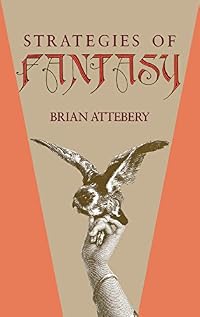
Strategies of Fantasy
by Brian Attebery
On This Page
Description
Brian Attebery's "strategies of fantasy" include not only the writer's strategies for inventing believable impossibilities, but also the reader's strategies for enjoying, challenging, and conspiring with the text. Drawing on a number of current literary theories (but avoiding most of their jargon), Attebery makes a case for fantasy as a significant movement within postmodern literature rather than as a simple exercise of nostalgia. Attebery examines recent and classic fantasies by Ursula K. show more Le Guin, John Crowley, J.R.R. Tolkien, Diana Wynne Jones, and Gene Wolfe, among others. In both its popular and postmodern incarnations, fantastic fiction exhibits a remarkable capacity for reinventing narrative conventions. Attebery shows how plots, characters, settings, storytelling frameworks, gender divisions, and references to cultural texts such as history and science are all called into question the moment the marvelous is admitted into a story. In the early chapters, the author sorts out some of the confusion about the term fantasy, distinguishing the fantastic as a technique from fantasy as a popular formula and a literary genre. Looking back to the early reception of Tolkien's trend-setting epic fantasy, he points out how critical theory at the time was simply unable to account for either the strengths or the weaknesses of The Lord of the Rings. By contrast, critical methods developed for coping with postmodernist metafictions are shown to apply equally well to the genre of fantasy. Having worked primarily with older fantasies in his study of The Fantasy Tradition in American Literature, Attebery focuses here on important recent examples such as Gene Wolfe's Book of the New Sun, Suzette Haden Elgin's Ozark Trilogy, and John Crowley's Little, Big. Analysis of these texts shows not only that fantasy scholarship can learn from contemporary theory, but also that a close look at fantasy can overturn common assumptions about the nature of narrative. Rather than drawing definitive boundaries for the genre, Attebery proposes a description of fantasy as a "fuzzy set": a grouping based on perceived resemblance to one or more central examples rather than on any particular features shared by the whole set. For many readers and writers, the central example has long been Tolkien's The Lord of the Rings, although Attebery points out that newer forms such as women's coming-of-age stories, postmodernist metafiction, science fantasy, and "real world" fantasy may indicate a shift or expansion of the popular conception of the genre. show lessTags
Recommendations











Member Reviews
The title is a bit odd, making it sound like a writer's how-to book, which it is not. It is for the most part an attempt to "legitimize" fantasy as literature, using "Little, Big," LOTR, and other fantasy works of the first rank to make its argument. But the book never really does make that argument in a conclusive way. It seems like a collection of essays gathered together, rather than a thesis building towards a conclusion.
This is a very academic book at times, with lots of references to other academics (people no one outside of academia have ever heard of). This is especially so in the early part, so skimming here is helpful. These ivory tower squabbles are only interesting to the combatants, and bog the book down.
I thought it was show more unfortunate that so much YA material (Dianna Wynne Jones, etc) was included. If you're trying to make an argument that a certain book belongs on the literature shelf, why would you choose children's literature to make your point?
A good source of books TBR, both in the text and in the bibliography. show less
This is a very academic book at times, with lots of references to other academics (people no one outside of academia have ever heard of). This is especially so in the early part, so skimming here is helpful. These ivory tower squabbles are only interesting to the combatants, and bog the book down.
I thought it was show more unfortunate that so much YA material (Dianna Wynne Jones, etc) was included. If you're trying to make an argument that a certain book belongs on the literature shelf, why would you choose children's literature to make your point?
A good source of books TBR, both in the text and in the bibliography. show less
Essential reading for serious students of modern genre fantasy.
Ratings
Members
- Recently Added By
Lists

SFF Writing and Criticism
13 works; 1 member
Author Information

11+ Works 592 Members
Awards and Honors
Awards
Classifications
- Genres
- Literature Studies and Criticism, Nonfiction, Fiction and Literature, Fantasy
- DDC/MDS
- 813.0876609 — Literature & rhetoric American literature in English American fiction in English By type Genre fiction Adventure fiction Speculative fiction Fantasy History of American fantasy
- LCC
- PS374 .F27 .A87 — Language and Literature American literature American literature Prose Prose fiction
- BISAC
Statistics
- Members
- 63
- Popularity
- 491,024
- Reviews
- 2
- Rating
- (4.40)
- Languages
- English
- Media
- Paper
- ISBNs
- 1