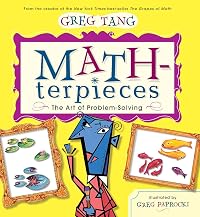
Math-terpieces: The Art of Problem-Solving
by Greg Tang
On This Page
Description
A series of rhymes about artists and their works introduces counting and grouping numbers, as well as such artistic styles as cubism, pointillism, and surrealism.Tags
Recommendations



Member Reviews
This book contains pictures of grouped objects on each page and instructs the reader to find a number of different ways to combine the groups in order to reach a specified number. I like that the book engages the child in problem-solving tasks, but I think that children may find it difficult to remember which group combinations they already used, possibly resulting in unnecessary confusion. I also like that the book contains famous works of art and includes the artists name and the year in which the piece was created.
This book is set up as a puzzle type book that is an entertaining way for kids to be exposed to famous works of art and helping them practice their counting and grouping skills during the process. Tang took several famous paintings, such as VanGough’s Starry Night, and Warhal’s Cambels Soup and uses the painting to create a poem. In the poem, Tang describes the painting and then challenges the reader to look at the next page where there are several groups of objects coming from the painting. After looking at the next page, the reader is to bring different groups of the objects together in order to have one group of a specific predetermined number.
It is a picture book not only full of famous paintings by famous artists, but it is show more also full of very colorful illustrations and pictures that relate and are similar to those specific paintings. The poems are fun to read as well. Tang did a great job at bringing together three different forms of education into one collection teaching across disciplines. The art exposes the students to popular cultural masterpieces. The poems open the children’s minds up to different forms of writing. And the counting exercises that help build math skills and alternative ways to count and group numbers together.
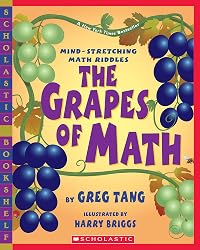
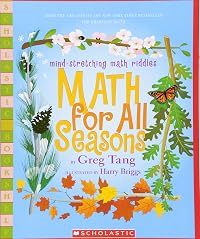
Something very valuable to me was the note about the author in the back of the book. Greg Tang is a very knowledgeable and extremely clever math writer who has written other extremely creative approaches to teach math concepts that don’t include memorization or formulae. He has a B.A. and an M.A. from Harvard in Math, and teachers have praised him across the country. Among his other books include Math Potatoes, The Grapes of Math, The Best of Times, and Math for All Seasons. The book would be very good for early level math lessons, probably anywhere from 2nd to 4th grades, but I could see librarians using it their collection for older students to thumb through just to keep their minds agile or for a review or project including poems or fine art. This could also be a great project for kids where they could find their own works of fine art and write a poem about it and come up with a counting or grouping puzzle to accompany the two and they could present it to the class as a whole. These are the kind of books I loved growing up, and I would only assume that even kids today would pick it up and be intrigued by the creativity of Greg Tang. show less
It is a picture book not only full of famous paintings by famous artists, but it is show more also full of very colorful illustrations and pictures that relate and are similar to those specific paintings. The poems are fun to read as well. Tang did a great job at bringing together three different forms of education into one collection teaching across disciplines. The art exposes the students to popular cultural masterpieces. The poems open the children’s minds up to different forms of writing. And the counting exercises that help build math skills and alternative ways to count and group numbers together.
Something very valuable to me was the note about the author in the back of the book. Greg Tang is a very knowledgeable and extremely clever math writer who has written other extremely creative approaches to teach math concepts that don’t include memorization or formulae. He has a B.A. and an M.A. from Harvard in Math, and teachers have praised him across the country. Among his other books include Math Potatoes, The Grapes of Math, The Best of Times, and Math for All Seasons. The book would be very good for early level math lessons, probably anywhere from 2nd to 4th grades, but I could see librarians using it their collection for older students to thumb through just to keep their minds agile or for a review or project including poems or fine art. This could also be a great project for kids where they could find their own works of fine art and write a poem about it and come up with a counting or grouping puzzle to accompany the two and they could present it to the class as a whole. These are the kind of books I loved growing up, and I would only assume that even kids today would pick it up and be intrigued by the creativity of Greg Tang. show less
Summary: An informative book about how artists use math to create their paintings. It teaches children how to group numbers, look for patterns and keeping an open mind while using pieces of famous art.
Personal Reaction: I really enjoying how this helped teach children math but in a not so traditional way. The illustrations were bright and vivid and helped to keep the reader engaged. I also thought it was pretty ingenious how it also included poetry.
Classroom Extension:
1) Use this book as an introduction to a math unit
2) Use other works of art for the math lesson
Personal Reaction: I really enjoying how this helped teach children math but in a not so traditional way. The illustrations were bright and vivid and helped to keep the reader engaged. I also thought it was pretty ingenious how it also included poetry.
Classroom Extension:
1) Use this book as an introduction to a math unit
2) Use other works of art for the math lesson
Math problems set to fine art and poetry. The art is great, the poems not so, and the math problems are challenging. Z picked this off his shelf last night and asked me to help him read it. He said it was hard fun - and I'm guessing that it will be a constant "flip through" book for a while.
This book uses famous paintings from very famous artists and constructs a math problem from the painting. This book ties together art and math. Each problem is written in a poem. This book could be a fun entry or exit ticket in the classroom to get students' brains thinking but nothing too challenging. This book focuses on grouping, which could be used when learning division.
I love these books! This one was a surprising and pleasant combination of art and math! The children enjoyed seeing Degas and Van Gogh turned into math puzzles.
The author of this book uses poetry to introduce art and with that, certain influential artists and their pieces of work. With each new page comes a new artist and a new set of numbers to find with the images on the page. This book is interesting because it exposes students to older styles of art and makes it a fun challenge to find the sequesce of numbers and pictures on the page.
Members
- Recently Added By
Lists

Five in a Row
174 works; 2 members
Author Information

20 Works 9,081 Members
Awards and Honors
Notable Lists
Classifications
- Genre
- Nonfiction
- DDC/MDS
- 510 — Natural sciences & mathematics Mathematics Mathematics / Graphs
- LCC
- QA248 .T365 — Science Mathematics Mathematics Algebra
- BISAC
Statistics
- Members
- 1,095
- Popularity
- 23,279
- Reviews
- 19
- Rating
- (3.90)
- Languages
- English
- Media
- Paper, Ebook
- ISBNs
- 6
- ASINs
- 4