Ramadan
by Suhaib Hamid Ghazi
On This Page
Description
Describes the celebration of the month of Ramadan by an Islamic family and discusses the meaning and importance of this holiday in the Islamic religion.Tags
Recommendations






Member Reviews
I highly recommend this engaging, gracefully written, concise book to all. I love that it was mostly non-fiction, but did include a character with whom the reader could identify to better help us non-Muslims understand. And there's so much to understand, so much that I never learned in my other readings about Ramadan. I have now, for example, a better understanding of why it still counts as fasting, even though feasting happens before and after the day. I love that it does nor propagandize, but actually respectfully compares w/ other religions a bit. Etc. Glossary included.
Caveat that I did find this note in Ayman Fadel's review:
"Nobody looks for the moon on the 27th night. Every lunar month is 29 or 30 days. After the 29th day, people show more look for the moon. If they see it, the previous month ended the day before and they are now in the first night of the new month. Otherwise, the new month begins after the sunset of the day following that night. You never need to "return the next night." Whoever revises this book should become familiar with the rules of yawm al-shakk.
Fasting begins from dawn, not sunrise. This is the difference between the terms fajr and shuruuq."
Well, both author and reviewer were a bit too free with 'everyone' and 'nobody.' Maybe the author's family looks on the 27th day as a family tradition, perhaps to get used to being up & about after dark. For example.
It's not a perfect book, but I appreciated how much I learned, and how it was so easy and enjoyable to do so. show less
Caveat that I did find this note in Ayman Fadel's review:
"Nobody looks for the moon on the 27th night. Every lunar month is 29 or 30 days. After the 29th day, people show more look for the moon. If they see it, the previous month ended the day before and they are now in the first night of the new month. Otherwise, the new month begins after the sunset of the day following that night. You never need to "return the next night." Whoever revises this book should become familiar with the rules of yawm al-shakk.
Fasting begins from dawn, not sunrise. This is the difference between the terms fajr and shuruuq."
Well, both author and reviewer were a bit too free with 'everyone' and 'nobody.' Maybe the author's family looks on the 27th day as a family tradition, perhaps to get used to being up & about after dark. For example.
It's not a perfect book, but I appreciated how much I learned, and how it was so easy and enjoyable to do so. show less
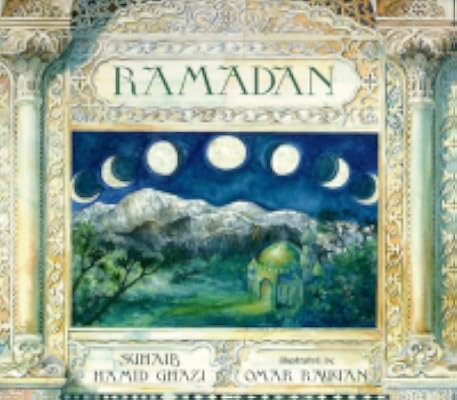
This is a beautifully-illustrated book which relates the history of Ramadan and the Muslim faith through a young boy's eyes. Importantly, it is careful to demonstrate how inclusive the Muslim faith can be and the importance of family and community ties as part of its practice. It does a solid job of telling the story of the holiday’s origins and history without being preachy, and near its end, demonstrates the diversity found in those who practice Islam all around the world. An essential glossary listing all the concepts/terminology introduced in the text closes the book.
An excellent introduction to a significant Muslim tradition!
An excellent introduction to a significant Muslim tradition!
SUMMARY
Muslims celebrate Ramadan, the ninth month of the lunar year. Fourteen centuries ago, this was when Allah first began sharing the Quran with Muhammed. Hakeem and his family do not eat or drink during the day. Instead share a meal called Suhur before dawn. They break fast by eating a meal called Iftar. Ramadan is also a time to give charity, pray, and reflect.
REVIEW
This book is one of the more informational books that I have read. It provided me with a lot of crucial information about Ramadan. I liked that instead of simply giving information about the holiday, the author presented as though I was following Hakeem and his family through the traditions and celebrations of Ramadan. For example, the story talks about how Hakeem's show more family gathers around the dinner table and eats beef, chicken, fish, and more food. The passage was more engaging than it would have been had the author had just told me what people traditionally ate at the meals. I also like that each page includes borders and decorations that I feel reflect some of those seem in the Muslim community. show less
Muslims celebrate Ramadan, the ninth month of the lunar year. Fourteen centuries ago, this was when Allah first began sharing the Quran with Muhammed. Hakeem and his family do not eat or drink during the day. Instead share a meal called Suhur before dawn. They break fast by eating a meal called Iftar. Ramadan is also a time to give charity, pray, and reflect.
REVIEW
This book is one of the more informational books that I have read. It provided me with a lot of crucial information about Ramadan. I liked that instead of simply giving information about the holiday, the author presented as though I was following Hakeem and his family through the traditions and celebrations of Ramadan. For example, the story talks about how Hakeem's show more family gathers around the dinner table and eats beef, chicken, fish, and more food. The passage was more engaging than it would have been had the author had just told me what people traditionally ate at the meals. I also like that each page includes borders and decorations that I feel reflect some of those seem in the Muslim community. show less
I liked this book because it had a narrative that was informational in a way that a child might appreciate. For example, the book explains the Muslim religion in a short and sweet fashion when it says “ Assalamu alaikum! That means ‘May peace be with you” and “Hakeem is Muslim, which means he believes in the religion of Islam”. The writing flowed well in my opinion. The story follows a boy as he learns about Ramadan, as he is a young boy, and how he participates and learns the tradition. I think that the main idea of this text is to be informative to its audience and to tell a story that allows the audience to be indulged in the tale, but also learn. This is evident to me when the book says ‘To prepare for fasting, Muslims show more wake up before dawn…and eat an early meal called ‘Suhur’”. The book then goes on to say “Hakeem’s family eats a variety of food during Suhur”. This allows the reader to further see and identify this new word. The book is clearly contemporary realistic fiction as it is believable and is representative of how a young child might become accustom to experiencing and participating in a new practice such as when Hakeem, the main character gets overly excited when seeing the tasty food at Suhur. show less
Personal Response - This book isn't new, but it is good for the detail and vocabulary of Islam. I would continue to look for more engaging stories that feature Muslim characters in more natural settings,, but would use this as an introduction to another culture and as an accurate depiction of the Muslim faith and holidays. The author is an insider to Islam, and is authentically familiar with the culture.
Library Program - As mentioned above, it does provide the facts on Islam and Ramadan, and the pictures would be useful in a display of middle eastern style art. I would try to add some other multicultural books featuring Muslim characters to the story time program where this book provides the facts.
Library Program - As mentioned above, it does provide the facts on Islam and Ramadan, and the pictures would be useful in a display of middle eastern style art. I would try to add some other multicultural books featuring Muslim characters to the story time program where this book provides the facts.
This book is a fantastic resource for children to learn about the Muslim holiday Ramadan. The author of this story not only made a beautiful story about the customs and culture of this holiday but turned it into a story about this little boy, Hakeem, and everything his family and relatives do for this special holiday. For people who do not know the customs of Ramadan, this book takes you through every detail that goes into celebrating this important holiday for the Muslim people. This is an informational text that is filled with beautiful pictures. This book would be wonderful for any collection but it does speak about the religion a lot so it may be a conflict for using it for teaching instruction.
Ramadan follows a young boy as he and his family observe Ramadan. The book, told from the boy's perspective, explains the practices Muslims observe during Ramadan. I really enjoyed this book because I thought it did a great job explaining Ramadan. Coming from a non-Muslim background, I did not know much about Ramadan before reading this book, but I felt like I learned a good deal from this book. While the book is very informative, it was written so young people can understand it and holds the reader's interest.
Members
- Recently Added By
Lists

The Story of the World: History for the Classical Child: Activity Book Two
415 works; 2 members
Author Information
6 Works 313 Members
Some Editions
Awards and Honors
Awards
Common Knowledge
- Original publication date
- 1996
- People/Characters
- Hakeem
- Important events
- Ramadan
- First words
- Assalamu alaikum!
- Last words
- (Click to show. Warning: May contain spoilers.)Assalamu alaikum!
- Original language
- English
Classifications
Statistics
- Members
- 251
- Popularity
- 129,815
- Reviews
- 18
- Rating
- (4.50)
- Languages
- English
- Media
- Paper
- ISBNs
- 2