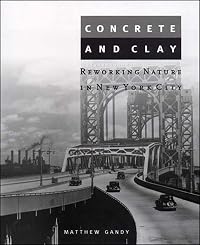
Concrete and Clay: Reworking Nature in New York City
by Matthew Gandy
On This Page
Description
An interdisciplinary account of the environmental history and changing landscape of New York City.In this innovative account of the urbanization of nature in New York City, Matthew Gandy explores how the raw materials of nature have been reworked to produce a "metropolitan nature" distinct from the forms of nature experienced by early settlers. The book traces five broad developments: the expansion and redefinition of public space, the construction of landscaped highways, the creation of a show more modern water supply system, the radical environmental politics of the barrio in the late 1960s and early 1970s, and the contemporary politics of the environmental justice movement. Drawing on political economy, environmental studies, social theory, cultural theory, and architecture, Gandy shows how New York's environmental history is bound up not only with the upstate landscapes that stretch beyond the city's political boundaries but also with more distant places that reflect the nation's colonial and imperial legacies. Using the shifting meaning of nature under urbanization as a framework, he looks at how modern nature has been produced through interrelated transformations ranging from new water technologies to changing fashions in landscape design. Throughout, he considers the economic and ideological forces that underlie phenomena as diverse as the location of parks and the social stigma of dirty neighborhoods. show lessTags
Recommendations



Member Reviews
Geographer Matthew Gandy presents a century and a half of humans interacting with and overcoming nature in New York City in five chapters. He starts with the city's amazing water supply system, which draws fresh water from watersheds and reservoirs north of the city. Then he moves on to the conception and realization of Central Park in the late 19th century. Next is the parkway system laid down by Robert Moses in the middle of the 20th century. The last two chapters are the most contemporary: one on the Young Lords and their environmental justice movement in Puerto Rican neighborhoods; and the second on the "rustbelt ecology" of the Greenpoint-Williamsburg waterfront in Brooklyn as it shifted from industrial uses to something else. In show more the Bloomberg years that followed Gandy's book, that something else ended up as large commercial and residential developments at the Brooklyn Navy Yard and miles of waterfront north of it. If Gandy updated his book, surely the waterfront parks and success story that is the High Line would serve as a continuation of the last chapter. As is, Gandy's unconventional history of modern-day New York is a scholarly yet readable series of case studies that illuminates how the city has viewed nature and harnessed its resources to its advantage. Gandy hopes for more equality than reality affords; he sees Central Park as an extension of bourgeois private realms into the public rather than as bucolic nature in the midst of the city, as it's often presented. Therefore, even though the fourth and fifth chapters don't carry the same impact in terms of scale and scope as the first three chapters, they fit into the book remarkably well, carrying his argument of equality to the (near) present. show less
Ratings
Members
- Recently Added By
Lists

University Presses
155 works; 1 member
Author Information

10+ Works 142 Members
Matthew Gandy teaches geography at University College London. He has been a visiting scholar in the Graduate School of Architecture, Planning, and Preservation at Columbia University and has published widely on cultural, urban, and environmental themes
Awards and Honors
Awards
Series
Belongs to Publisher Series
Common Knowledge
- Canonical title
- Concrete and Clay: Reworking Nature in New York City
- Original publication date
- 2003-10
- Important places
- New York, New York, USA
- First words
- In October 2001 I had an opportunity to present material from this book as part of a festival of New York history organized by the recently founded Gotham Center in midtown Manhattan.
- Last words
- (Click to show. Warning: May contain spoilers.)The clouds of steam rising from the street remind us that the possibilities for urban life are sustained by an unseen web of structures, connections, and relationships.
- Blurbers
- Rydin, Yvonne; Menkin, William
Classifications
- Genres
- Science & Nature, Nonfiction, Sociology, Art & Design, History
- DDC/MDS
- 304.2 — Society, government, & culture Social sciences, sociology & anthropology Factors affecting social behavior Human ecology
- LCC
- HT243 .U62 .N74 — Social sciences Communities. Classes. Races Communities. Classes. Races Urban groups. The city. Urban sociology
- BISAC
Statistics
- Members
- 59
- Popularity
- 523,610
- Reviews
- 1
- Rating
- (3.50)
- Languages
- English
- Media
- Paper, Ebook
- ISBNs
- 5
- ASINs
- 1