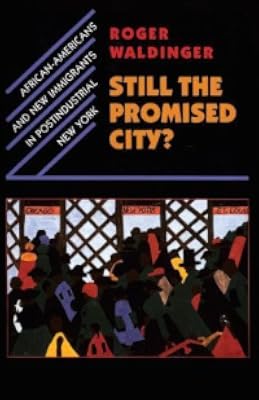
Still the Promised City?: African-Americans and New Immigrants in Postindustrial New York
by Roger Waldinger
On This Page
Description
Still the Promised City? addresses the question of why African-Americans have fared so poorly in securing unskilled jobs in the postwar era and why new immigrants have done so well. Does the increase in immigration bear some responsibility for the failure of more blacks to rise, for their disappearance from many occupations, and for their failure to establish a presence in business? The two most popular explanations for the condition of blacks invoke the decline of manufacturing in New York show more and other major American cities: one claims that this decline has closed off job opportunities for blacks that were available for earlier immigrants who lacked skills and education; the other emphasizes "globalization"--the movement of manufacturing jobs offshore to areas with lower labor costs. But Roger Waldinger shows that these explanations do not fit the facts. Instead, he points out that a previously overlooked factor--population change--and the rapid exodus of white New Yorkers created vacancies for minority workers up and down the job ladder. Ethnic succession generated openings both in declining industries, where the outward seepage of whites outpaced the rate of job erosion, and in growth industries, where whites poured out of bottom-level positions even as demand for low-level workers increased. But this process yielded few dividends for blacks, who saw their share of the many low-skilled jobs steadily decline. Instead, advantage went to the immigrants, who exploited these opportunities by expanding their economic base. Waldinger explains these disturbing facts by viewing employment as a queuing process, with the good jobs at the top of the job ladder and the poor ones at the bottom. As economic growth pulls the topmost ethnic group up the ladder, lower-ranking groups seize the chance to fill the niches left vacant. Immigrants, remembering conditions in the societies they just left, are eager to take up the lower-level jobs that natives will no longer do. By contrast, African-Americans, who came to the city a generation ago, have job aspirations similar to those of whites. But the niches they have carved out, primarily in the public sector, require skills that the least educated members of their community do not have. Black networks no longer provide connections to the lower-level jobs, and relative to the newcomers, employers find unskilled blacks to be much less satisfactory recruits. The result is that a certain number of well-educated blacks have good middle-class jobs, but many of the less educated have fallen back into an underclass. Grim as this analysis is, it points to a deeper understanding of America's most serious social problem and offers fresh approaches to attacking it. show lessTags
Recommendations






















Member Reviews
Members
- Recently Added By
Lists

Good Nonfiction about New York City
62 works; 10 members
Author Information
10+ Works 137 Members
Awards and Honors
Awards
Common Knowledge
- Important places
- New York, New York, USA
Classifications
- Genres
- Economics, Nonfiction, General Nonfiction, History
- DDC/MDS
- 330.97471 — Society, government, & culture Economics Jobs & Careers Economic geography and history North America Northeastern U.S. New York
- LCC
- F128.9 .N3 .W32 — Local History of the United States, Canada and Latin America United States local history New York
- BISAC
Statistics
- Members
- 22
- Popularity
- 1,109,311
- Rating
- (4.00)
- Languages
- English
- Media
- Paper
- ISBNs
- 2