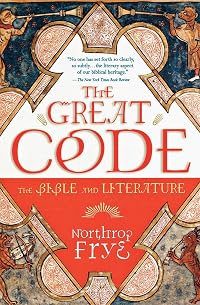
The Great Code: The Bible and Literature
by Northrop Frye
On This Page
Description
An examination of the influence of the Bible on Western art and literature and on the Western creative imagination in general. Frye persuasively presents the Bible as a unique text distinct from all other epics and sacred writings. "No one has set forth so clearly, so subtly, or with such cogent energy as Frye the literary aspect of our biblical heritage" (New York Times Book Review).Tags
Recommendations










Member Reviews
The Great Code (a term borrowed from William Blake, who wrote that the Old and New Testaments are the great code of art) is one of the most interesting and challenging books about the Bible that I’ve come across. It doesn’t deal with matters of faith or doctrine but with “the impact of the Bible on the creative imagination.” Frye’s experience as a teacher convinced him that “a student of English literature who does not know the Bible does not understand a good deal of what is going on in what he reads.” Yet he distinguishes his work from the plethora of “Bible as literature” courses and books that had become fashionable by the time that he wrote. He does not treat the Bible as an anthology of Ancient Near Eastern show more texts. Yet, as the book’s subtitle, The Bible and Literature suggests, his approach is not far removed. Frye states his aim at the outset: to “study the Bible from the point of view of a literary critic.”
This requires, first, treating the collection of writings contained in the Bible not as an anthology but as a unit. He does this not only because the Bible has traditionally been read in this way, but more importantly, because it does have something very much like a plot, with a beginning and a conclusion, and because it contains “a body of concrete images,” which “recur so often that they clearly indicate some kind of unifying principle.”
Frye’s analysis is organized according to language, myth, metaphor, and typology. They are treated in that order in the four chapters of Part One, then in reverse order in Part Two, in which these topics are applied more directly to the Bible. Frye calls this structure a “double-mirror.” I thought the structure apt, since so many of the thought units of the Bible have a chiastic structure.
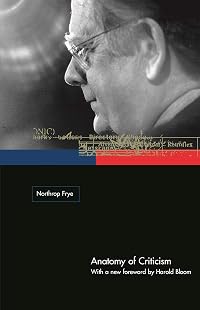
Having read Frye’s earlier book, Anatomy of Criticism, some of his terminology was familiar to me, as well as his adoption of Vico’s ages (mythical, heroic, vulgar), which Frye calls the hieroglyphic, the hieratic, and the demotic, each with its typical kind of language (metaphorical, allegorical or metonymic, and descriptive). Some other key terms are centripetal/centrifugal, categories of metaphor (importantly, the “royal metaphor,” which unites the individual and the group), and the ladder of polysemous sense.
The book is sprinkled with observations that go beyond the topic of the Bible and literature, such as: “A good deal of human activity is wasted on perverted energy, making war, feeding a parasitic class, building monuments to paranoid conquerors, and the like.” Plus ça change!
Implicit in the course of the book is a running controversy with “literalists.” I was one when this book appeared in 1982. I wonder what I would have made of it if I had read it then.
In this book, as in Anatomy, Frye faults those who rush to make judgments of quality. Yet he clearly has his standards of excellence — Homer, Dante, Shakespeare, Milton, and Blake. His distaste for evaluation as a subordinate activity would probably mean he would take a dim view of an entire website with star ratings. Nevertheless, I’ll give this a full five stars. Usually, that means I feel any reader could profit by reading. That may not be the case with this book, but I hadn’t gotten far in reading a copy borrowed from the library before deciding it’s one I know I’ll want on my shelf and refer to often. show less
This requires, first, treating the collection of writings contained in the Bible not as an anthology but as a unit. He does this not only because the Bible has traditionally been read in this way, but more importantly, because it does have something very much like a plot, with a beginning and a conclusion, and because it contains “a body of concrete images,” which “recur so often that they clearly indicate some kind of unifying principle.”
Frye’s analysis is organized according to language, myth, metaphor, and typology. They are treated in that order in the four chapters of Part One, then in reverse order in Part Two, in which these topics are applied more directly to the Bible. Frye calls this structure a “double-mirror.” I thought the structure apt, since so many of the thought units of the Bible have a chiastic structure.
Having read Frye’s earlier book, Anatomy of Criticism, some of his terminology was familiar to me, as well as his adoption of Vico’s ages (mythical, heroic, vulgar), which Frye calls the hieroglyphic, the hieratic, and the demotic, each with its typical kind of language (metaphorical, allegorical or metonymic, and descriptive). Some other key terms are centripetal/centrifugal, categories of metaphor (importantly, the “royal metaphor,” which unites the individual and the group), and the ladder of polysemous sense.
The book is sprinkled with observations that go beyond the topic of the Bible and literature, such as: “A good deal of human activity is wasted on perverted energy, making war, feeding a parasitic class, building monuments to paranoid conquerors, and the like.” Plus ça change!
Implicit in the course of the book is a running controversy with “literalists.” I was one when this book appeared in 1982. I wonder what I would have made of it if I had read it then.
In this book, as in Anatomy, Frye faults those who rush to make judgments of quality. Yet he clearly has his standards of excellence — Homer, Dante, Shakespeare, Milton, and Blake. His distaste for evaluation as a subordinate activity would probably mean he would take a dim view of an entire website with star ratings. Nevertheless, I’ll give this a full five stars. Usually, that means I feel any reader could profit by reading. That may not be the case with this book, but I hadn’t gotten far in reading a copy borrowed from the library before deciding it’s one I know I’ll want on my shelf and refer to often. show less
While carefully distinguishing the Bible from the various categories of secular literature, Northrop Frye applies the techniques and perspectives of his work in literary criticism to it in The Great Code. (The title phrase, like most of Frye's, is a quote from Blake.) The book works in an exploratory fashion that proceeds from the atomic level of language, through myth and metaphor, to the continuities involved in biblical typology. Then he traces the same arc in reverse, to integrate what he had previously analyzed.
Frye makes no pleas on behalf of supernatural agency or religious institutions. He discusses the Bible as a textual curiosity, and works to demonstrate the worth it can have for thoughtful readers, as well as the show more contributions that it has made to the mental infrastructure of our civilization. In the denouement of this volume, the first of several he would eventually write about the Bible, Frye cites Nietzsche and Feuerbach, and muses about magic and sexuality. As always, he is a lively and elegant writer.
I would strongly recommend this book to anyone who enjoys serious literature, and yet is tempted to dismiss the Bible as an anthology of ancient superstitions. It may also be a useful tonic for those who view the Bible as their own sectarian playground--although it is less likely to endear itself to them. For me, it mostly served as a convenient review and lucid exposition of ideas I had previously considered; but there were definitely fresh nuggets to be discovered throughout. show less
Frye makes no pleas on behalf of supernatural agency or religious institutions. He discusses the Bible as a textual curiosity, and works to demonstrate the worth it can have for thoughtful readers, as well as the show more contributions that it has made to the mental infrastructure of our civilization. In the denouement of this volume, the first of several he would eventually write about the Bible, Frye cites Nietzsche and Feuerbach, and muses about magic and sexuality. As always, he is a lively and elegant writer.
I would strongly recommend this book to anyone who enjoys serious literature, and yet is tempted to dismiss the Bible as an anthology of ancient superstitions. It may also be a useful tonic for those who view the Bible as their own sectarian playground--although it is less likely to endear itself to them. For me, it mostly served as a convenient review and lucid exposition of ideas I had previously considered; but there were definitely fresh nuggets to be discovered throughout. show less
"The Great Code" really re-configured the way that I conceive of the Bible as a literary document. After two centuries of historical criticism (or narrative criticism as it's called when applied to the Bible), it is refreshing to see a whole new interpretive methodology which looks inward at the Bible, instead of trying to test its significance by how well it correlates to something outside of itself. And that is the central thesis to Frye's argument - that the Bible is a unified mythology, replete with its own literary devices, that hardly needs confirmation from history or archaeology to successfully tell the story (mythos) that it tells. Because of this, the book has been the target of a number of appropriate historicist critiques, show more all claiming that one can't cut wholly separate the work of literature from its social and cultural context. Although these criticisms aren't all fair themselves, as Frye even considers the structure of certain metaphors (like the ubiquitous flood myth) modulate themselves repeatedly via literary transmission into new texts.
The first part of the book consists of a highly condensed theory of language which Frye employs in the second half. I found this part just as useful, yet often elided in critical reviews. According to Frye, his own ideas are highly influenced by Vico's "Scienza Nuova" which posits the idea of a cyclical theory of language wherein each human epoch uses language in a unique, irreducible way. In his tripartite interpretation, there is the hieroglyphic stage in which words have the pure energy of potential magic, the hieratic stage in which words begin to reflect an objective reality of a transcendent order, and the demotic stage, where prose continues its subordination to "the inductive and fact-gathering process," and seems to be the stage we remain in today. If this evolution has taken us full circle from feel the pure immediacy of metaphor, how are we supposed to read the Bible (whose language is, of course, one of pure metaphorical immediacy)? Nietzsche said that God had lost his function, but Vico (and Frye in turn) might have replied that the Bible is simply entombed in a lost part of the cycle, inaccessible and unable to be interpreted by the demotic. His neo-Viconian theory of language goes some way in offering a theory for the vulgarism that so often takes the name of Biblical interpretation: "With the general acceptance of demotic and descriptive criteria in language, such literalism becomes a feature of anti-intellectual Christian populism" (45).
The second part begins the literary criticism as one would more formally recognize it. According to Frye, the Bible can operate independently precisely because it functions and maintains its own body of rhetorical devices, including metaphor, and type, antitype, and archetype. "We clearly have to consider the possibility that metaphor is not an incidental ornament, but one of its controlling modes of thought" (54). Metaphor and trope become the sole measure of the Bible's inner verbal consistency. The "type" and "antitype" are essentially import; he construes the entire Bible as a series of musical call-and-response gestures between the Old and New Testaments: the Resurrection is the response to the Old Testament Promised Land, the baptism in the River Jordan is the New Testament's answer to the Old Testament's Red Sea. He also integrates a number of other complex typologies, including the Creation-Incarnation-Death-Descent to Hell-Harrowing of Hell-Resurrection-Ascension-Heaven motif and a nomenclature of types, including the "demonic," "analogical," and "apocalyptic." This universe - multiverse, even - of complex metaphor, meaning, and type are the ones that we continue to recognize, read, and struggle with today, which accounts for the fact that myth goes a long way in exploring who we are and what we do as a community. Notice how Frye deftly bypasses any theological or strictly philosophical concerns. As Frank Kermode would comment almost a decade after the book was published, "Just as he exiled questions of value from the Anatomy [of Criticism], he exiles from his Biblical criticism questions of belief."
I was considering giving this book four stars, because of my occasional disagreements with it (including the arguments from historicism mentioned above). But I can't in good conscience do that. Just for the interpretive vistas that it opens up, I feel that anything less than five would convey an impression that I was less than impressed, which certainly is not the case. show less
The first part of the book consists of a highly condensed theory of language which Frye employs in the second half. I found this part just as useful, yet often elided in critical reviews. According to Frye, his own ideas are highly influenced by Vico's "Scienza Nuova" which posits the idea of a cyclical theory of language wherein each human epoch uses language in a unique, irreducible way. In his tripartite interpretation, there is the hieroglyphic stage in which words have the pure energy of potential magic, the hieratic stage in which words begin to reflect an objective reality of a transcendent order, and the demotic stage, where prose continues its subordination to "the inductive and fact-gathering process," and seems to be the stage we remain in today. If this evolution has taken us full circle from feel the pure immediacy of metaphor, how are we supposed to read the Bible (whose language is, of course, one of pure metaphorical immediacy)? Nietzsche said that God had lost his function, but Vico (and Frye in turn) might have replied that the Bible is simply entombed in a lost part of the cycle, inaccessible and unable to be interpreted by the demotic. His neo-Viconian theory of language goes some way in offering a theory for the vulgarism that so often takes the name of Biblical interpretation: "With the general acceptance of demotic and descriptive criteria in language, such literalism becomes a feature of anti-intellectual Christian populism" (45).
The second part begins the literary criticism as one would more formally recognize it. According to Frye, the Bible can operate independently precisely because it functions and maintains its own body of rhetorical devices, including metaphor, and type, antitype, and archetype. "We clearly have to consider the possibility that metaphor is not an incidental ornament, but one of its controlling modes of thought" (54). Metaphor and trope become the sole measure of the Bible's inner verbal consistency. The "type" and "antitype" are essentially import; he construes the entire Bible as a series of musical call-and-response gestures between the Old and New Testaments: the Resurrection is the response to the Old Testament Promised Land, the baptism in the River Jordan is the New Testament's answer to the Old Testament's Red Sea. He also integrates a number of other complex typologies, including the Creation-Incarnation-Death-Descent to Hell-Harrowing of Hell-Resurrection-Ascension-Heaven motif and a nomenclature of types, including the "demonic," "analogical," and "apocalyptic." This universe - multiverse, even - of complex metaphor, meaning, and type are the ones that we continue to recognize, read, and struggle with today, which accounts for the fact that myth goes a long way in exploring who we are and what we do as a community. Notice how Frye deftly bypasses any theological or strictly philosophical concerns. As Frank Kermode would comment almost a decade after the book was published, "Just as he exiled questions of value from the Anatomy [of Criticism], he exiles from his Biblical criticism questions of belief."
I was considering giving this book four stars, because of my occasional disagreements with it (including the arguments from historicism mentioned above). But I can't in good conscience do that. Just for the interpretive vistas that it opens up, I feel that anything less than five would convey an impression that I was less than impressed, which certainly is not the case. show less
This book is Frye's take on the Bible and its meaning. As a literary critic, he's clearly out of his element tackling the Bible: he makes egregious mistakes, is dependent upon biblical scholars for essential ideas, and presents his own without a context. And this lack of context shows. His views on typology are arbitrary and uncontrolled by any hermeneutical principle that I could detect. And since linguistic meaning is created by juxtaposition, his association of type and anti-type produced ludicrous results. On the other hand, his discussion of metaphor in general and in the Bible specifically was generally helpful and at times insightful. Frye is caught between how the Bible is and has been understood by people and cultures down show more through the ages and how the Bible was intended to be understood by the original authors to the original recipients. He should have stuck with the "reader response" side of how the Bible has been used in Western civilization, for that is his expertise. His attempts to confuse that approach with actually interpreting the message and meaning of the Bible are unconvincing at best. show less
Man, is this guy ever smart.
I had to agree with every single thing he said. After I was done reading it, I thought, no wonder I am always so confused whenever I hear a preacher start talking about the Bible or about God; it's because he--the preacher--has probably never read Northrop Frye and doesn't realize that reading Genesis or the Revelation of St. John the Divine like science textbooks is bound to lead to fatal flaws in arguments. After this, I could never read the Bible in the same way again. Thank you Northrop Frye.
(On a side note, it was after reading Frye that I really started reading a lot of the poetry of William Blake; I am still not sure if I really understand Blake that well; must try again.)
I had to agree with every single thing he said. After I was done reading it, I thought, no wonder I am always so confused whenever I hear a preacher start talking about the Bible or about God; it's because he--the preacher--has probably never read Northrop Frye and doesn't realize that reading Genesis or the Revelation of St. John the Divine like science textbooks is bound to lead to fatal flaws in arguments. After this, I could never read the Bible in the same way again. Thank you Northrop Frye.
(On a side note, it was after reading Frye that I really started reading a lot of the poetry of William Blake; I am still not sure if I really understand Blake that well; must try again.)
Thoughts as I read this book (2/13/2010):
This is a book about the literary nature of the Bible from the perspective of a literary critic. It is a challenging read, but well worth the struggle.
One objective the author had for this book was, "What follows attempts to extract the introductory and prefatory part of what I have to say about the Bible's relationship to Western literature" (p. xxi). I am half way through the book, and currently feel that this has not been achieved very thoroughly. In general, the author has given more of an explanation of how to read the Bible, as opposed to its relationship to Western literature--but again, I'm only at the mid-point.
I have a great appreciate for the author's presentation of how to read the show more Bible; i.e., that we should understand the phases of language development and where various parts of the Bible fit into that scheme. However, there are times that I feel I am reading a "history of religions" presentation rather than a literary critical view. Granted, the broadest sense of literary criticism does encompass various aspects of historical criticism.
This volume is not intended to be a reading informed by faith, yet it is extremely helpful to a person of faith who desires to read the Bible from a perspective that does not require one to suspend reason, as if reason and faith were mutually exclusive.
Frye created a good environment for the discussion of mythology and apocalypticism, particularly with his presentation of the idea of the myths of deliverance. This material is a good primer for a fresh read of the book of Revelation.
I'm still ruminating over Frye's statement, "For Christianity the Old Testament was primarily a book of prophecy, foretelling the future event of the Incarnation and thereby pointing to the transcendence of the law" (p. 84). This statement strikes me as somewhat simplistic. Many of the NT writers used the OT narratives to explain the Christian life and eschatology rather than as a source of predictions regarding the Incarnation. Even such books as Hebrews, which is highly Christological, utilizes OT references and Christological inferences to encourage faithful Christian living. show less
This is a book about the literary nature of the Bible from the perspective of a literary critic. It is a challenging read, but well worth the struggle.
One objective the author had for this book was, "What follows attempts to extract the introductory and prefatory part of what I have to say about the Bible's relationship to Western literature" (p. xxi). I am half way through the book, and currently feel that this has not been achieved very thoroughly. In general, the author has given more of an explanation of how to read the Bible, as opposed to its relationship to Western literature--but again, I'm only at the mid-point.
I have a great appreciate for the author's presentation of how to read the show more Bible; i.e., that we should understand the phases of language development and where various parts of the Bible fit into that scheme. However, there are times that I feel I am reading a "history of religions" presentation rather than a literary critical view. Granted, the broadest sense of literary criticism does encompass various aspects of historical criticism.
This volume is not intended to be a reading informed by faith, yet it is extremely helpful to a person of faith who desires to read the Bible from a perspective that does not require one to suspend reason, as if reason and faith were mutually exclusive.
Frye created a good environment for the discussion of mythology and apocalypticism, particularly with his presentation of the idea of the myths of deliverance. This material is a good primer for a fresh read of the book of Revelation.
I'm still ruminating over Frye's statement, "For Christianity the Old Testament was primarily a book of prophecy, foretelling the future event of the Incarnation and thereby pointing to the transcendence of the law" (p. 84). This statement strikes me as somewhat simplistic. Many of the NT writers used the OT narratives to explain the Christian life and eschatology rather than as a source of predictions regarding the Incarnation. Even such books as Hebrews, which is highly Christological, utilizes OT references and Christological inferences to encourage faithful Christian living. show less
When was the last time I read a challenging theology book? Heck, when was the last time that I read a book that took me more than two days to finish? ("Spelling Power" doesn't count) "The Great Code" is the book that was central to my wife's master's thesis. She brought it along with her to China in case anybody wanted to examine her credentials and read her thesis. So far, nobody has said word one about it. But it did give me one more book to read. Actually, I erred when I referred to it as a theology book. In "The Great Code", Profesor Frye examines the Bible as a work of literature. He's interested in what story it tells and how that tale is told. He doesn't wrestle with the question of whether the story is true or not, or how one show more should apply it to one's life. It was a different way to look at Scripture and I found it interesting to take a gander from that perspective. A lot of the thechnical terms went over my head, but overall I enjoyed the read. I'm glad I checked it out.
--J. show less
--J. show less
Members
- Recently Added By
Lists

Jordan B. Peterson's Recommended Books
104 works; 5 members

Works cited in Palimpsest: A History of the Written Word by Matthew Battles
79 works; 2 members
Author Information

101+ Works 7,090 Members
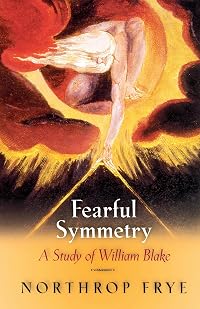
Herman Northrop Frye was born in 1912 in Quebec, Canada. His mother educated him at home until the fourth grade. After graduating from the University of Toronto, he studied theology at Emmanuel College for several years and actually worked as a pastor before deciding he preferred the academic life. He eventually obtained his master's degree from show more Oxford, and taught English at the University of Toronto for more than four decades. Frye's first two books, Fearful Symmetry (1947) and Anatomy of Criticism (1957) set forth the influential literary principles upon which he continued to elaborate in his numerous later works. These include Fables of Identity: Studies in Poetic Mythology, The Well-Tempered Critic, and The Great Code: The Bible and Literature. Frye died in 1991. (Bowker Author Biography) show less
Awards and Honors
Series
Belongs to Publisher Series
Paperbacks [Einaudi] (170)
Common Knowledge
- Original publication date
- 1982
- First words
- A sacred book is normally written with at least the concentration of poetry, so that, like poetry, it is closely involved with the conditions of its language.
- Quotations
- To put it another way, the Bible taken as a poem is so spectacularly bad a poem that to accept it all as poetry would raise more questions than it solves.
- Original language
- Inglese
Classifications
- Genres
- Literature Studies and Criticism, Nonfiction, Religion & Spirituality
- DDC/MDS
- 809.93522 — Literature & rhetoric Literature, rhetoric & criticism History, description, critical appraisal of more than two literatures Literature displaying specific features, miscellaneous writings Literature displaying other aspects Literature emphasizing subjects Bible As Literature
- LCC
- PN56 .B5 .F7 — Language and Literature Literature (General) Literature (General) Theory. Philosophy. Esthetics
- BISAC
Statistics
- Members
- 1,132
- Popularity
- 22,329
- Reviews
- 10
- Rating
- (3.97)
- Languages
- 9 — Danish, Dutch, English, French, Hungarian, Italian, Spanish, Turkish, Portuguese (Portugal)
- Media
- Paper, Ebook
- ISBNs
- 25
- ASINs
- 5