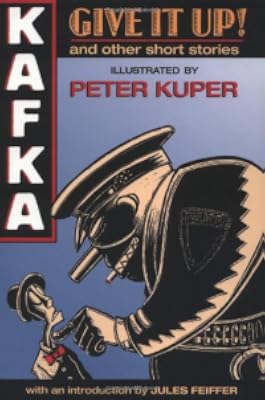
Give It Up! And Other Short Stories
by Franz Kafka  , Peter Kuper (Illustrator)
On This Page
Description
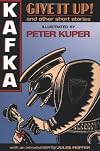
Nine short works by the early 20th Century German novelist presented in comic-book format. The black-and-white illustrations match the bleak subject of the stories which include The Helmsman, A Fratricide and The Trees.Tags
Recommendations


















Member Recommendations
Member Reviews
Feiffer argues against the "Classics Illustrated concept" in his Introduction, and then claims: "Kuper, in this volume, doesn't do what I hate, he does what I love. Jazz. This book is a series of riffs, visual improvisations on short takes by the old master." I'm not persuaded, though I grant without Feiffer's suggestion of a "merger" between Euro-alienation and American rock-and-roll alienation I would have missed the film noir grittiness of Kuper's settings. Still, for the most part the visual interpretations are literal. The exception is the best in the collection, in which Kuper envisions a squalid cityscape for Kafka's "The Trees", streetdwellers and cops standing in for tree trunks, and the ending even coming as an ironic surprise.
Graphic novels have never been high in my reading priorities, but I decided this year I would try some different things. This little gem came up in my search.
I selected it because it is short stories, it is Kafka, it has an introduction by Jules Feiffer. I didn't know Kuper.
I had read all of these stories before (more than once) but Kuper's bold black and white illustrations add a whole now dimension. He nails it.
I selected it because it is short stories, it is Kafka, it has an introduction by Jules Feiffer. I didn't know Kuper.
I had read all of these stories before (more than once) but Kuper's bold black and white illustrations add a whole now dimension. He nails it.
This graphic novel is an adaptation of several of Franz Kafka’s short stories. Not having read any of the stories portrayed in this book, I am not able to say whether or not they are faithfully adapted. With a few of the stories, I was left with a “huh?” feeling, as though I were missing something. I’m not sure if this was because of the shortened graphic novel version, or if I would have felt the same way reading the original version. I enjoyed the story, “Hunger Artist,” the most out of the lot. Kuper’s dark, stylized graphics work well with Kafka’s dark, enigmatic stories.
I wanted to know if they were literal translations. Translated to English, of course, but also to find out if they were abridged. At the library, I checked out "Franz Kafka - Collected Stories." The shortest are word for word and the longest (?) are very close.Word for WordA Little FableGive It UpThe BridgeThe TreesThe TopThe VultureSlightly AbridgedThe HelmsmanAbridgedA Hunger ArtistA FratricideI continue reading the Collected Stories . . .
I wanted to know if they were literal translations. Translated to English, of course, but also to find out if they were abridged. At the library, I checked out "Franz Kafka - Collected Stories." The shortest are word for word and the longest (?) are very close.Word for WordA Little FableGive It UpThe BridgeThe TreesThe TopThe VultureSlightly AbridgedThe HelmsmanAbridgedA Hunger ArtistA FratricideI continue reading the Collected Stories . . .
Ratings
Members
- Recently Added By
Author Information

1,502+ Works 103,672 Members
Franz Kafka -- July 3, 1883 - June 3, 1924 Franz Kafka was born to middle-class Jewish parents in Prague, Czechoslovakia on July 3, 1883. He received a law degree at the University of Prague. After performing an obligatory year of unpaid service as law clerk for the civil and criminal courts, he obtained a position in the workman's compensation show more division of the Austrian government. Always neurotic, insecure, and filled with a sense of inadequacy, his writing is a search for personal fulfillment and understanding. He wrote very slowly and deliberately, publishing very little in his lifetime. At his death he asked a close friend to burn his remaining manuscripts, but the friend refused the request. Instead the friend arranged for publication Kafka's longer stories, which have since brought him worldwide fame and have influenced many contemporary writers. His works include The Metamorphosis, The Castle, The Trial, and Amerika. Kafka was diagnosed with tuberculosis (TB) in August 1917. As his disease progressed, his throat became affected by the TB and he could not eat regularly because it was painful. He died from starvation in a sanatorium in Kierling, near Vienna, after admitting himself for treatment there on April 10, 1924. He died on June 3 at the age of 40. (Bowker Author Biography) show less
Franz Kafka has a Legacy Library. Legacy libraries are the personal libraries of famous readers, entered by LibraryThing members from the Legacy Libraries group.

Some Editions
Awards and Honors
Notable Lists
Work Relationships
Is an adaptation of
Is expanded in
Common Knowledge
- Original language
- German
- Disambiguation notice
- Graphical adaptation of 9 short stories by Franz Kafka
Classifications
- Genres
- Fiction and Literature, Graphic Novels & Comics
- DDC/MDS
- 833.912 — Literature & rhetoric German & related literatures German fiction 1900- 1900-1990 1900-1945
- LCC
- PT2621 .A26 .G5 — Language and Literature German, Dutch and Scandinavian literatures German literature Individual authors or works 1860/70-1960
- BISAC
Statistics
- Members
- 134
- Popularity
- 244,147
- Reviews
- 5
- Rating
- (3.61)
- Languages
- English, German, Italian, Swedish
- Media
- Paper
- ISBNs
- 6